
Ask an employee to describe their last bonus and watch what happens. Most can't tell you the number without checking a pay stub. What they remember instead is how it felt: forgettable, tacked onto a paycheck, gone from memory before the next quarter started.
That gap between a bonus that changes behavior and one that's just payroll math with better timing is where most companies quietly lose the return on money they're already spending.
An employee bonus is extra compensation paid on top of base salary to reward performance, milestones, or company success. It falls into two legal categories, discretionary or guaranteed by a stated formula, and both get taxed as supplemental wages rather than regular pay.
Handled well, a bonus becomes a lever, shaping behavior, keeping your best people off job boards, telling the rest of the company what actually gets rewarded. Handled badly, it becomes exactly what that employee described a moment ago: a line item that shows up in December and vanishes from memory by February.
Something else has shifted the ground under all of this. Remote hiring means your best performer is weighing offers from three companies instead of the two down the street. Skill shortages in specific roles flipped who holds the leverage, and people who know their market value are asking for it outright. A bonus program designed in 2015 was not built for this version of the labor market.
What follows covers what a bonus actually is, the types worth knowing, what the law requires of you, what counts as good at a given level, and what the data says about bonuses that do more than sit in a bank account for a week before disappearing into rent.
Key Takeaways
- What is an Employee Bonus?
- Why Do Companies Offer Bonuses?
- Types of Employee Bonuses (With Examples)
- Discretionary vs. Non-Discretionary Bonuses
- Legal Implications and Tax Treatment
- How Much Is a Good Bonus? Benchmarks by Level and Industry
- How Are Bonuses Calculated?
- The Strategic Value of Bonuses in Talent Management
- Modern Trends: Personalized, ESG-Linked, and Non-Monetary Bonuses
What Is an Employee Bonus?

Employee bonus: extra money a company pays a worker on top of their regular salary, usually as a reward for good performance, hitting a goal, or the company doing well. It's never guaranteed the way a regular paycheck is.
That's the mechanic underneath every version of this, whether it shows up as a year-end check, a spot award, or a slice of company profits.
Motivating people to do better work, and making the effort visible while they do it, is the actual job a bonus is hired to do. It functions as proof rather than promise that the work mattered.
A performance bonus pays for individual achievement. Profit-sharing hands everyone a slice when the company does well. A retention bonus exists for one narrow reason: keeping a person who is actively deciding whether to leave.
Nearly half your workforce would tell you compensation is why they'd stay, if you actually asked them. Eddy's 2026 compensation research, drawing on Lever's 2022 retention data, puts the figure at 46%. Not a soft number, and not one HR can afford to file under background noise.
46% of employees say compensation, including bonuses, is the reason they'd stay at a company. — Eddy, 2026

Infographic showing bonus lifecycle
Bonus traditions shift by geography, which is worth knowing if your team spans borders. Diwali bonuses are timed to the festival calendar in India. American companies frequently route bonus dollars through 401(k) profit-sharing structures. British firms still treat the Christmas bonus as a cultural expectation rather than a perk that can quietly disappear.
Why Do Companies Offer Bonuses?

Nobody hands out bonus checks purely out of generosity. There is a return being calculated somewhere, even on the occasions nobody says so out loud.
Motivation is the most obvious one. Tell people strong work leads to extra pay and effort climbs, which is just reward psychology wearing a payroll costume.
Retention gets expensive fast, and this is where the argument stops being theoretical. A 2019 Gallup analysis puts the cost of replacing an employee at half to two times their annual salary, calling that estimate conservative even at the time. Adjust for wage growth since, and a 20% retention bonus starts looking like a rounding error next to what a bad resignation actually costs.
There's a specific reason this math matters more this year than last. US voluntary turnover sits at a historically low 10.0% as of 2025, per Aon's 2026 salary planning research, a number that reads as reassuring right up until you notice what's shifting underneath it. Compensation jumped from the fifth most-cited reason employees stay to the first, according to McKinsey's 2026 HR Monitor, a 24-point swing in a single year that knocked job security out of the top spot for the first time. Over half of employees now name pay as the reason they'd stay. Meanwhile 57% say they haven't seen a raise in the past twelve months. Low turnover right now says nothing about whether that gap closes quietly or all at once.
I'd push back a little on framing retention purely as cost avoidance, because it undersells what's actually happening on the ground. The savings from a canceled replacement search matter less than what the retained employee now knows: that someone noticed before they had one foot out the door. Harder to put a number on, and arguably the more important half of the equation.
Anticipation does more work than the bonus itself, oddly enough. Knowing a bonus is possible changes how people show up months before any money moves. Our AIRe report data backs this from an adjacent angle: 62% of companies already lean on monetary value to drive recognition effectiveness, evidence that pay and recognition function as one connected system rather than two separate budget lines.
62% of companies already lean on monetary value to drive recognition effectiveness. — Vantage Circle AIRe Report
Reciprocity complicates the picture further. Surprise someone with a bonus they didn't expect and they'll often work to retroactively earn it. The effect reverses just as easily, though.
Once a bonus becomes routine, it quietly stops registering as recognition and starts registering as expected pay. Skip a cycle after that point and motivation can drop below where it started, not just flatten out.
Types of Employee Bonuses (With Examples)

Eight variations show up across most organizations, each aimed at a different problem rather than a smaller version of the same one.
| Type | What It Is | Typical Example |
|---|---|---|
| Performance | Pays for hitting specific, pre-set targets | Sales quota, on-time project delivery |
| Spot | Unscheduled, immediate recognition for standout work | A manager awards $200 the week it happened |
| Sign-on | One-time payment to close a hire in a competitive market | $50,000 spread over 24 months, clawback if you leave early |
| Referral | Rewards employees for bringing in good hires | $2,000–$4,000 per successful referral |
| Retention | Keeps a specific person from leaving | Paid out after an acquisition or counteroffer |
| Profit-sharing | A slice of company performance, split across everyone | Annual payout tied to yearly profit |
| Holiday | Traditional year-end payout | Expected in Wall Street compensation structures |
| Non-cash | A reward instead of money | Gift cards, electronics, travel vouchers |
Performance bonuses pay for hitting specific targets, quota for sales teams, on-time and under-budget delivery for project leads. Tie these directly to an OKR system and the connection stays obvious: hit the objective, get paid, miss it, wait for the next cycle. Spot bonuses run on a completely different clock. Unscheduled, immediate, meant for work that deserves acknowledgment now rather than at some December ceremony. Their power comes entirely from timing. Recognition and reward landing together, instead of six months apart, is what makes them memorable instead of routine, and waiting until the annual review to mention something that happened in March is how good work quietly stops getting noticed at all.
Sign-on money pulls talent into competitive hiring markets, tech especially, and it rarely arrives as one lump sum anymore. Companies increasingly spread a five-figure offer across 12 to 24 months instead, clawback clause attached if the employee exits early, which is really a retention mechanism wearing a recruiting costume. Referral bonuses flip the incentive toward your own people instead, typically $2,000 to $4,000 per successful hire. They work for an unglamorous reason: employees already know who's good and who isn't, usually better than a recruiter does.
Then there's the one built purely around the fear of losing someone. Retention bonuses target a single narrow risk, an acquisition, a competing offer already on the table, a project nobody else can finish. When a counteroffer lands on someone's desk, this is frequently what tips the decision back toward staying.
Profit-sharing spreads a slice of company performance across everyone, usually annually, blunt as a morale tool but effective mostly because everyone genuinely does win when the company does. Holiday bonuses remain the traditional year-end payout, and in industries like finance it reads as expected rather than optional, most Wall Street firms treat it as embedded in the compensation structure rather than a surprise anyone budgets around. Non-cash bonuses skip money altogether in favor of gift cards, electronics, travel, or experiences, a luxury trip earning bragging rights a direct deposit simply can't buy.
Cash is no longer the whole conversation, either. Skill-development stipends, extra PTO, mental health app subscriptions, and flexible-schedule weeks are becoming standard alternatives, landing well specifically because they feel personal rather than transactional.
Discretionary vs. Non-Discretionary Bonuses

Get this distinction wrong and the legal exposure follows fast, so it's worth sitting with before you write a single check.
Discretionary bonus: stays entirely at the company's discretion. No advance promise, no formula, no guarantee, management decides who gets what and how much without owing a repeat performance next cycle.
Non-discretionary bonus: promised in advance, tied to a stated metric or written into an employment agreement. Once someone clears the target, the bonus is functionally earned rather than gifted.
This isn't a semantic argument. It decides how overtime gets calculated, how the bonus gets taxed, and, as the next section covers, whether an employer can walk it back after the fact.
| Discretionary Bonuses | Non-Discretionary Bonuses | |
|---|---|---|
| Decision basis | Company's full discretion | Predetermined criteria |
| Employee expectation | No employee expectation | Contractual obligation |
| Common examples | Holiday/appreciation bonuses, spot recognition awards | Commission-based bonuses, profit-sharing agreements |
| Example | "Management may award year-end bonuses based on company performance" | "Employees receive 5% of annual salary if company meets revenue targets" |
Legal Implications and Tax Treatment
Bonus law splits along that same discretionary line, and the split looks different depending which country you're operating in.
| United States (FLSA) | India (Payment of Bonus Act, 1965) | |
|---|---|---|
| Is it mandatory? | No — bonuses are a business decision | Yes, for eligible employees |
| Statutory range | No fixed range | 8.33% – 20% of wages |
| Overtime impact | Non-discretionary bonuses must be folded into the regular pay rate before calculating overtime | Not applicable — bonus sits outside overtime math |
| Can it be skipped? | Yes, if genuinely discretionary | No, once an employee is eligible |
In the US, the Fair Labor Standards Act requires folding non-discretionary bonuses into an employee's regular rate of pay before calculating overtime. Discretionary bonuses sit outside that calculation entirely. The Department of Labor reaffirmed the rule in a January 2026 opinion letter, functioning less as new law than a pointed nudge: bonuses tied to attendance, safety, or production still count as non-discretionary, and the overtime math has to reflect the workweek the bonus was actually earned in, not the week the check arrived.
A second opinion letter, issued mid-2026 and aimed specifically at quarterly bonus structures, clarified something narrower: a bonus that raises total earnings, straight-time and overtime combined, by an identical fixed percentage doesn't trigger a separate recalculation. Useful carve-out, but it only holds if the formula genuinely treats both pay types proportionally, which fewer plans do than employers assume.
India runs a different system altogether. The Payment of Bonus Act, 1965 makes an annual bonus legally mandatory for eligible employees, floor set at 8.33% of wages, ceiling at 20%. Skipping a cycle the way a US employer might with a discretionary program simply isn't an option there.
Whether an employer can refuse to pay comes down to that same discretionary line. Genuinely discretionary, no stated formula, no advance promise, and it can be withheld with limited legal exposure. Once the stated conditions on a non-discretionary bonus are met, most courts treat it as earned wages rather than a gift, a principle California courts have been especially explicit about, though protections shift meaningfully by state. What actually decides the category is the wording in the offer letter or bonus plan document, never what either side calls it after the check doesn't show up.
Handbooks should spell all of this out in plain language. Ambiguity here does more than create legal risk. It erodes trust in a way that no future bonus check fully repairs.
How Much Is a Good Bonus? Benchmarks by Level and Industry
"Good" isn't a fixed number, it's relative to role, level, and industry, and treating it like one universal percentage is exactly how HR teams end up over par in one department and embarrassingly behind in another.
Across all employees, the market average lands around 9% to 9.6% of base salary, based on 2026 compensation research from Oyster and ShareWillow. Treat that as the calibration point, not the target.
By level:
| Level | Typical Bonus (% of Base Salary) |
|---|---|
| Entry-level / early career | 1% – 5% |
| Mid-level / experienced professional | 5% – 10% |
| Senior manager / department lead | 10% – 20% |
| Executive leadership | 10% – 30%+ |
By industry:
| Industry | Typical Bonus (% of Base Salary) |
|---|---|
| Technology | 10% – 20% |
| Finance & Banking | 20% – 50% |
| Healthcare | 5% – 15% |
| Retail & Consumer (corporate roles) | 10% – 20% |
| Retail & Consumer (frontline roles) | 2% – 5% |
| Hospitality & Leisure | 1% – 3% |
A 5% annual bonus sits at the strong end of entry-level and squarely mid-pack nowhere else. For a mid-level employee at a tech or finance company specifically, it trails the market, and probably deserves a conversation rather than quiet acceptance.
Seven percent clears entry-level comfortably and lands close to the middle of the mid-level band, ahead of what most retail and hospitality workers see but still behind tech and finance, where mid-career bonuses commonly run 10% to 20%.
Benchmark against level and industry first. Decide afterward whether the goal is matching the market or beating it to win a specific hire.
How Are Bonuses Calculated?
None of the math here is complicated. What varies is the formula, and the formula itself is a tell for what the company actually cares about.
The standard performance bonus formula: Base Salary × Bonus Percentage × Performance Score = Bonus Amount.
Worked Example
$60,000 salary × 15% target bonus × 120% performance score = $10,800 bonus
| Method | How It Works | Best For |
|---|---|---|
| Formula-based | Salary × bonus % × performance score | Tying pay directly to individual output |
| Flat-rate | Same fixed amount for everyone at a level | Simplicity, company-wide milestones |
| Percentage-of-salary | 5–10% junior, 25–50%+ senior, no performance multiplier | Consistent, predictable payouts |
Some companies split the calculation three ways instead: half weighted to individual performance, three-tenths to team results, the rest to company-wide success. That split is itself a statement, telling employees exactly how much their individual effort is worth relative to everyone else's.
Example: A Blended Bonus Formula
How much of the final bonus each performance layer contributes, in this example weighting.
Industry Variations
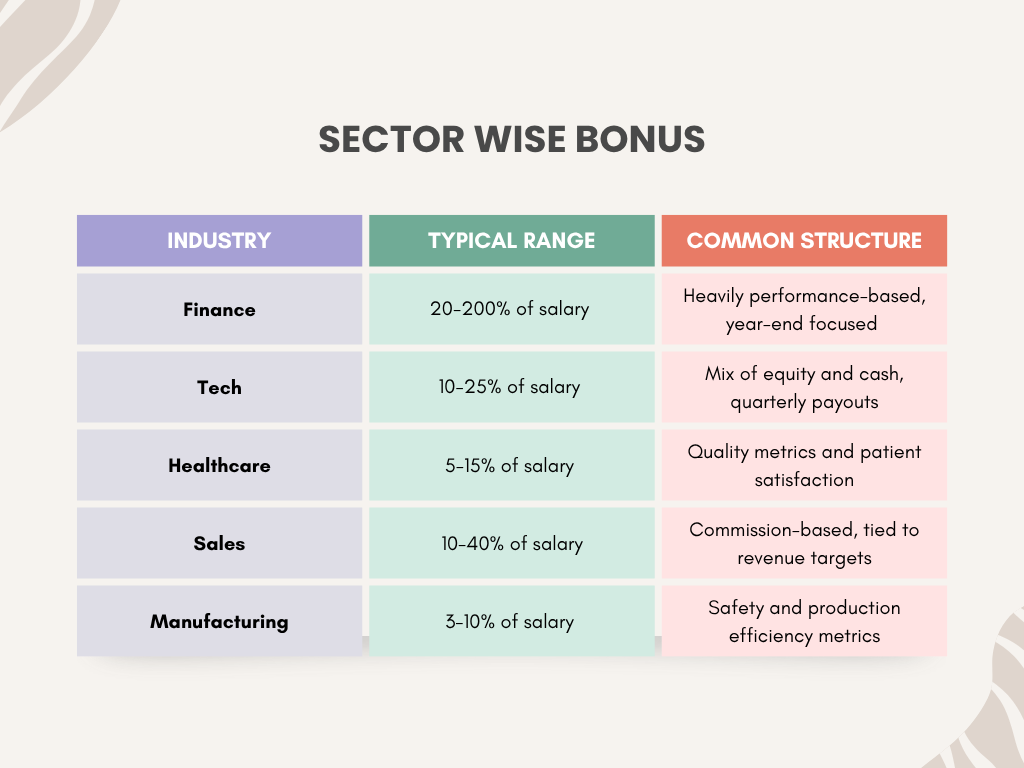
Sectors don't play by the same bonus rules, and assuming otherwise is a fast way to misjudge your own program against the wrong benchmark.
(Source)
Finance bonuses run enormous and unpredictable, tightly coupled to firm performance year over year. Tech bonuses stay steadier but frequently blend in equity, so the cash figure alone understates total compensation. Healthcare weights bonuses toward patient outcomes as much as, sometimes more than, straight financial results, per ShareWillow's sector breakdown.
The Strategic Value of Bonuses in Talent Management

Bonuses in Talent Management, At a Glance
Performance Boost That Lasts
A well-designed bonus creates a cycle that feeds itself. Effort climbs once people see it actually pays off, and that higher baseline settles in as the new normal rather than a temporary spike that fades by spring.
The real trick is connecting the bonus to behavior worth repeating. Reward collaboration and collaboration increases. Reward the wrong behavior and you'll get more of exactly that, a mistake companies make more often than they'd like to admit out loud.
Most companies believe they've solved this. Most haven't. Josh Bersin's 2023 research found 80% of companies claiming to practice pay-for-performance, with 91% of them getting the execution wrong, usually because the raise gap between an average performer and a top one is too thin to register as a real signal. Companies that actually get it right aren't marginally ahead.
Companies that get pay-for-performance right are 2.7x more likely to effectively engage and retain their workforce. — Josh Bersin, 2023
Morale Investment with ROI
A bonus program's morale effect rarely stays contained to whoever received the check, which is the part most companies overlook entirely.
Watching a colleague get recognized for genuinely strong work sends a signal that travels well past that one inbox: the company notices excellence, and says so, in public.
Retention Strategy That Works
Losing a good employee costs more than most people estimate until they're the one running the actual math. A well-timed retention bonus can head off losing someone who would otherwise cost up to 150% of their salary to replace.

A bonus hits harder when the person receiving it can see exactly what it's tied to, rather than a lump sum arriving in December with no explanation attached. Recognition Analytics earns its place in this conversation here: it shows whether bonus payouts paired with visible, specific recognition move retention further than a bonus delivered in silence.
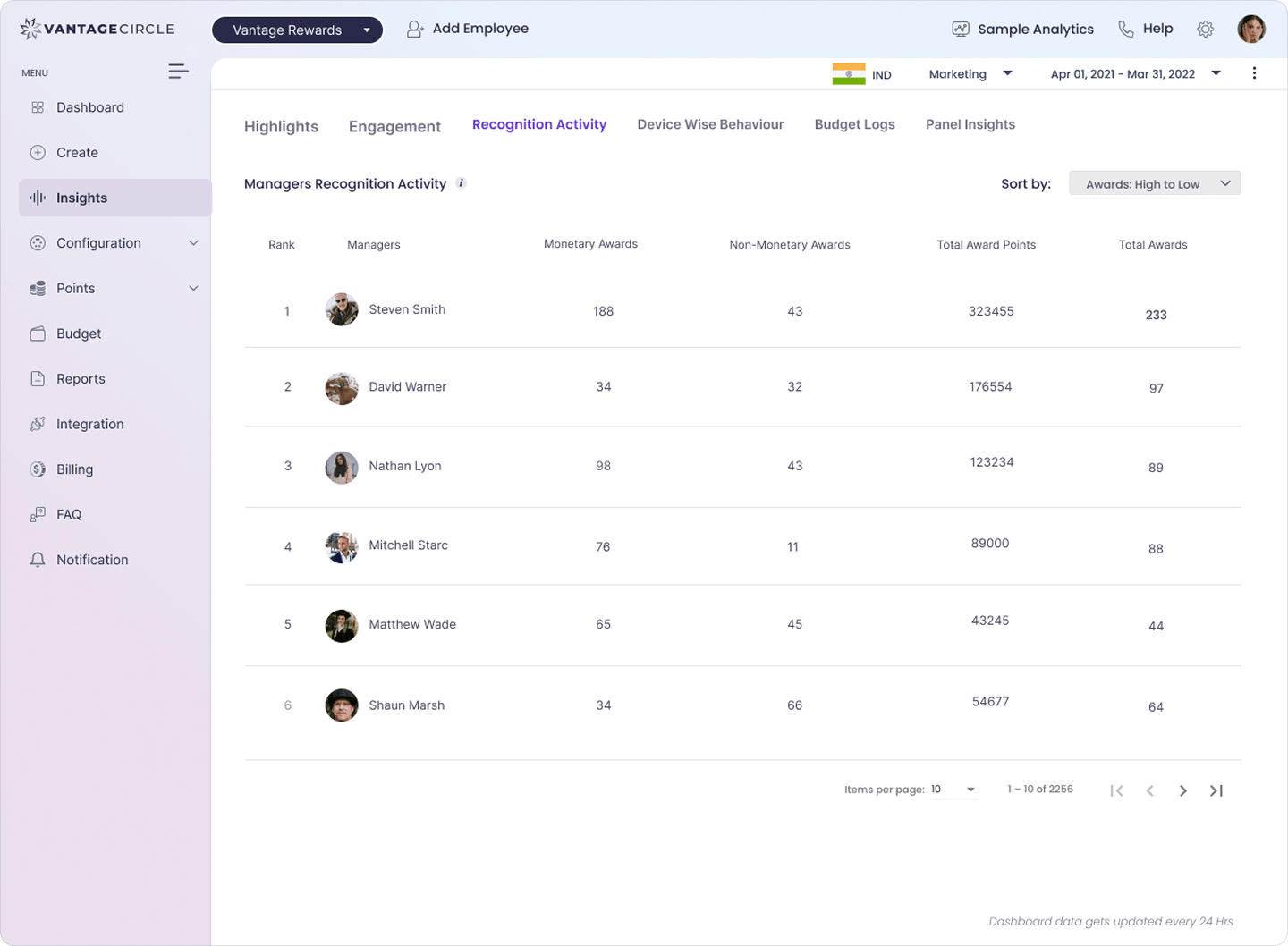
Vantage Circle's own recognition data adds a sharper second data point. Teams pairing monetary bonuses with visible recognition post materially stronger retention outcomes than teams relying on the bonus alone, echoing the same pattern behind the 62% AIRe figure cited earlier. Bonus and recognition were never competing line items. Same lever, pulled twice.
Employer Branding Impact
Your bonus reputation moves faster than most people expect. Glassdoor reviews mention compensation constantly, and the gap between "great bonus structure" and "bonuses barely exist here" shapes how a candidate sees you before a recruiter ever dials the phone. Companies running strong, clearly communicated bonus programs consistently outscore peers on employer rating platforms, translating directly into stronger applicant pools and noticeably less recruiting friction.
Netflix skips bonuses entirely.
No annual bonus, no performance bonus, nothing on the table beyond base pay. This isn't an oversight. It's a deliberate stance the company has been consistent about in how it talks about compensation publicly. The logic runs like this: pay top of market from day one, and a bonus stacked on top becomes a strange thing to still be dangling. Framed out loud, it sounds close to insulting, something like telling someone they're worth $100k but here's another $5k to actually try.
Rather than holding a bonus over someone's head until year-end, Netflix pays high upfront and stays flexible about structure, no complicated formula, no waiting game built in.
"If base pay alone isn't enough to keep someone motivated, base pay is the actual problem, not the missing bonus check."
Copying this wholesale isn't realistic for most companies, few carry Netflix's margins or market position. But the challenge underneath it is worth sitting with regardless: is your bonus program doing real work, or quietly patching a base salary that's already fallen behind market?
(Source)
Modern Trends: Personalized, ESG-Linked, and Non-Monetary Bonuses

Personalized Bonus Experiences
One-size-fits-all bonus structures are fading out for good reason. Cash appeals to some employees, time off to others, a development budget to a third group entirely. Building a bonus menu, letting people choose their reward format once they've hit the target, beats assuming everyone wants the identical thing.
A simple bonus menu at $1,000: take it as cash, convert it to 3 extra PTO days, or apply it toward a course or certification. Same budget, three ways to redeem it.
Peer-to-Peer Recognition
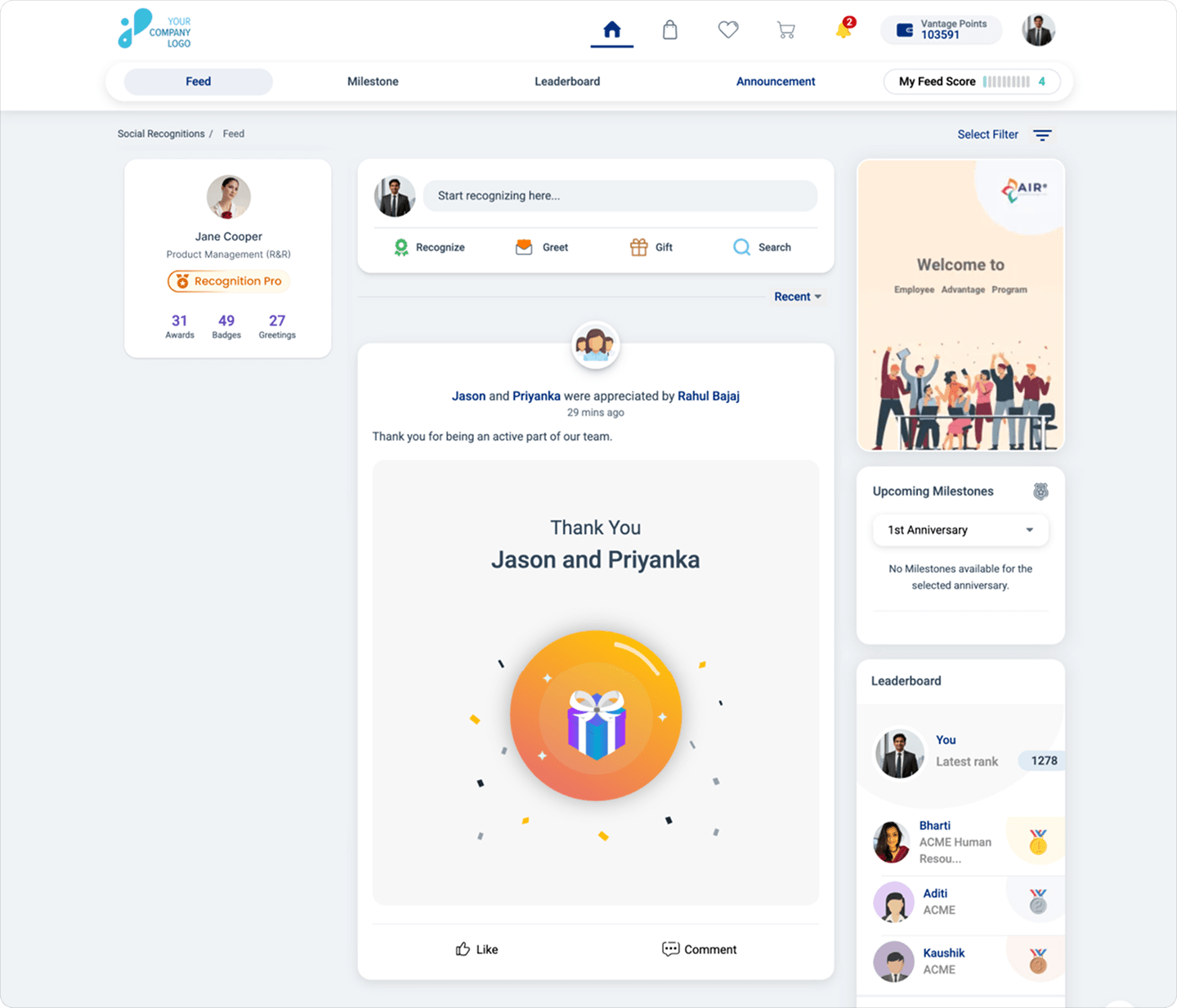
Managers miss things constantly, simply because coworkers see far more of the day-to-day than someone three meetings deep in their own calendar ever will. Peer-to-peer bonus programs let employees nominate each other for spot rewards directly, no manager bottleneck required.
A spot bonus lands harder with a visible, specific reason attached to it, rather than arriving silently through payroll where only the recipient and accounting ever know it happened. Peer-to-Peer Recognition turns that reason into a public moment instead of a quiet transaction buried in a pay stub, and that distinction matters given the entire point of a spot bonus is reinforcing behavior other people can actually see.
Gamified Bonus Systems
Points, levels, and unlockable milestones have moved well past game design and into bonus structure itself. Some sales organizations now tie badges and leaderboard position directly to bonus eligibility. Hit a milestone, unlock the opportunity, and performance tracking turns into something people check voluntarily instead of avoiding until review season.
A system like that needs real scaffolding behind it though, a defined window, explicit rules, visible progress, or it collapses into a leaderboard nobody trusts within a quarter. Campaign Management exists to run exactly that kind of time-boxed initiative, giving the program enough structural backbone to survive a full cycle instead of fizzling out by week two.
Recommended Resource: Gamification in Employee Recognition: How it helps?
Wellness-Focused Rewards
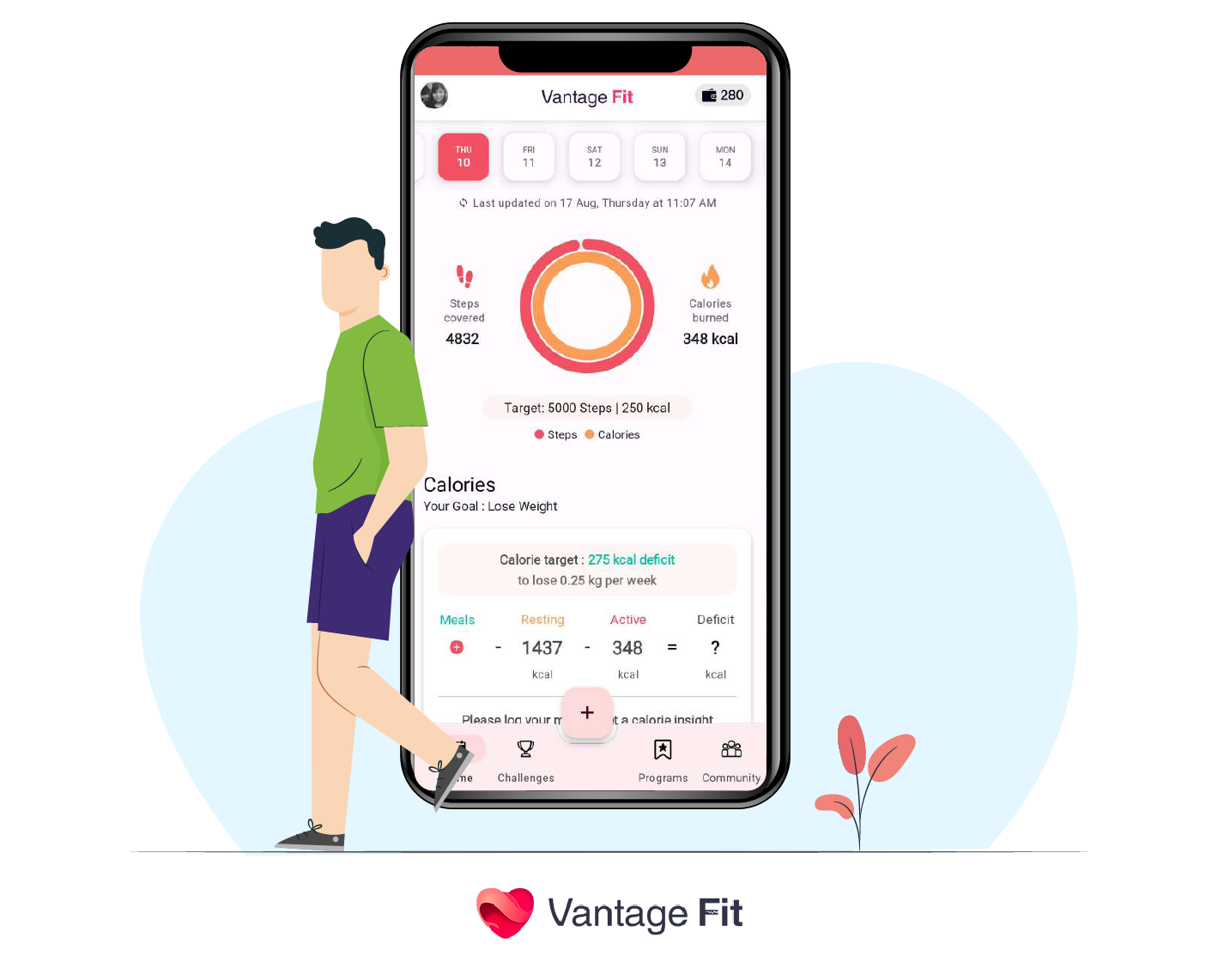
Mental health and work-life balance now carry real weight in bonus design, more than they used to even five years back. Meditation app subscriptions, fitness memberships, and dedicated mental health days are becoming standard alternatives, signaling the company cares about the whole person rather than just the output they produce.
(Source: Vantage Fit)
ESG-Linked Bonus Programs
Environmental, Social, and Governance metrics have worked their way into bonus calculations, and it stopped being purely a profit conversation a while back. Patagonia ties executive bonuses directly to environmental impact metrics.
Some companies now make 20% of a manager's bonus contingent on diversity hiring and mentorship outcomes specifically.
An ESG-linked bonus only works if employees can trace the connection to something the company has actually named as a value, not a vague nod toward sustainability buried in a slide nobody remembers past the meeting. Core Values Alignment keeps that connection visible and explicit rather than implied, and the distinction matters because an ESG bonus without a visible link to a stated value reads as marketing dressed up as strategy.
Retention bonuses deserve the identical scrutiny. Handed out once with no pattern behind it, an ad hoc retention bonus can feel arbitrary, as though tenure only earned notice because someone nearly walked. Long Service Awards puts that recognition on a predictable, fair cadence instead, so acknowledgment isn't only triggered by a resignation letter someone almost sent.
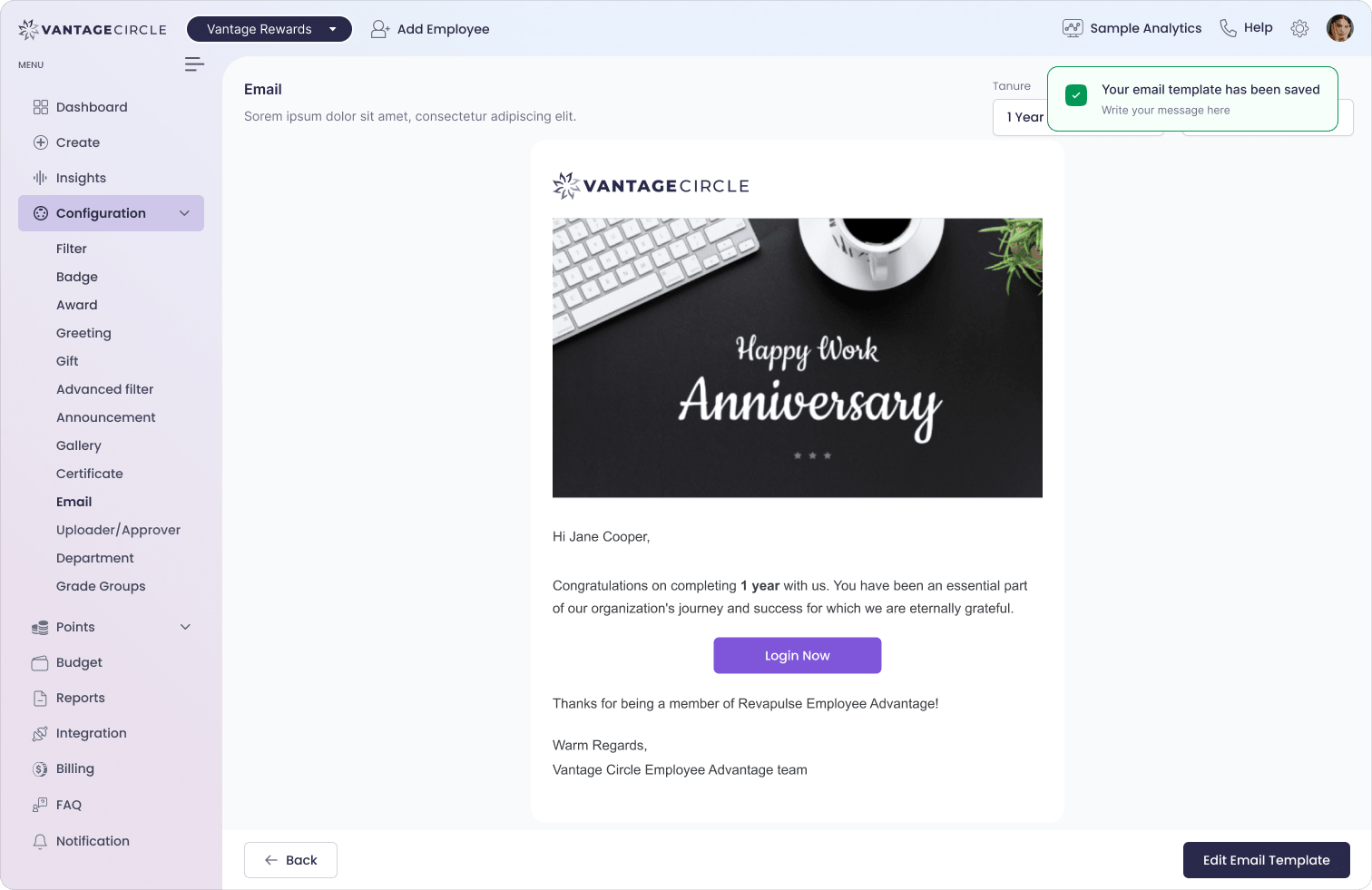
Over 75% of companies report service/tenure-based awards as the most prevalent element of their recognition program. — Vantage Circle, Annual Rewards & Recognition Report, USA 2023-24
The throughline across all of this holds steady. Bonuses are becoming tools for reinforcing values-based behavior, not just financial output, which loops back to the reward-and-recognition thread running underneath this entire guide.
Conclusion
An employee bonus stopped being a nice-to-have a while back. It's a strategic lever shaping behavior, protecting retention, and telling the company out loud what actually earns reward here.
The companies getting this right aren't simply spending more. They're building systems that connect to something visible, a named value, a public moment of recognition, a formula employees can calculate themselves, rather than a mystery figure that lands once a year in December.
Start with whatever's within reach. A single well-run spot bonus program can move the needle before a full program overhaul ever gets off the ground. Starting matters more than starting perfectly, and paying attention to what the data actually says once you're underway matters most of all.
FAQs About Employee Bonuses

He has worked in the human resources environment and has elevated recognition and rewards through his insightful and detailed writing. He aims to enhance the practice of Recognition in the workplace with new ideas and innovation that will help shape the work culture. For any related queries, contact editor@vantagecircle.com