




How Do You Create a High-Impact Employee Engagement Committee? (With Ideas and Names)

A Global Employee Recognition and Wellness Platform
If your goal is to promote your organization's growth, investing in your employees is important. You must provide opportunities for your employees to engage, participate and offer feedback. Employees who do that are more likely to do quality work and foster a healthy work atmosphere. One effective way to achieve this is to form an employee engagement committee.
What Is An Employee Engagement Committee?
An Employee Engagement Committee is a team of employees committed to building an overall positive work environment. They do it by organizing activities, recognition programs, and initiatives that enhance morale, connections, and overall job satisfaction.
The core purpose of an employee engagement committee is to:
-
plan and implement activities designed to engage and motivate employees.
-
create a positive and productive workplace culture.
-
work on strengthening the employer's relationship with its employees.
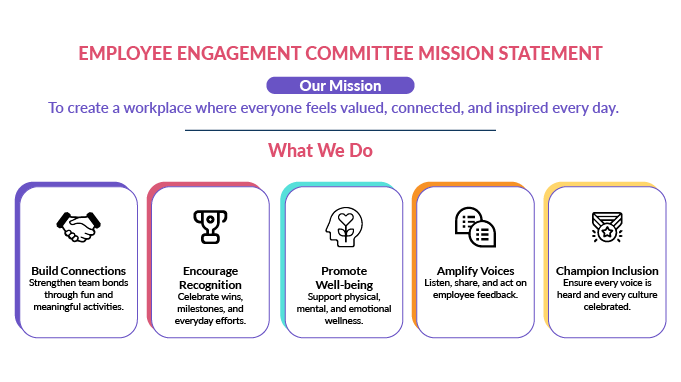
Its primary mission is to act as a voice for employees to drive cultural improvements. In line with this mission, its prime responsibilities include:
- amplifying employees' voices to leadership,
- celebrating employee accomplishments,
- fostering work-life balance, and
- planning team-building events, among other things.
Read our blog on: 38 Quick and Easy Team Building Activities Your Employees Will Love (+How to Play)
Employee Engagement Mission Statement Example
Pros of an Employee Engagement Committee
1. It keeps communication real.
Employees get a genuine platform to speak up and share ideas. Leaders stay in touch with what truly matters to their teams.
2. It lifts everyone’s mood.
From small shoutouts to fun activities, the committee brings positivity to everyday work life. Happy teams simply work better.
3. It builds a sense of belonging.
People connect beyond job titles and departments. It turns the workplace into a community, not just a company.
4. It helps people stay longer.
When employees feel heard and appreciated, they’re less likely to leave. Engagement naturally boosts loyalty.
5. It sparks new ideas.
Committees encourage people to think creatively and bring fresh perspectives. Sometimes, the best ideas come from casual conversations.
6. It makes employees feel empowered.
Being part of decisions gives people ownership and pride. They see their impact- and that’s incredibly motivating.
7. Encourages timely recognition and appreciation

It encourages managers to recognize and appreciate employees' good work and achievements. This could be through simple gestures such as a thank-you note or social recognition in a meeting. Nonetheless, they make sure that it’s timely and consistent.
And you can do it with the assistance of Vantage Circle's AI-powered recognition platform. With the platform, you can set the desired budget for your employees and assign specific roles within the team. Once everything is set, you can start appreciating your coworkers while incentivizing the awards with points.
Cons/Hurdles of an Employee Engagement Committee
1. It needs time, money, and planning.
Committee work adds to people’s regular work load, activities often need a budget, and without proper planning you risk burnout and unmet expectations.
2. It can miss real representation.
If the committee isn’t diverse, initiatives can exclude groups- you must actively seek underrepresented voices, or people will feel ignored.
3. Ideas can stall or meet resistance.
Without clear goals and leadership backing, sustaining the committee becomes difficult. In addition, monitoring and transparency also comes to a halt. Because of which good plans can lose direction due to managers resisting the idea or becoming skeptical over time.
Launching An Employee Engagement Committee
1. Notify your team and invite volunteers

Explain what an employee engagement committee is and why you're forming one. Assist your team in understanding what topics they can discuss with committee members. Using your company's HR platforms, you can notify your organization about your plans.
Here's an example of how you could introduce the establishment of such a committee to your organization:

2. Secure leadership buy-in
With leaders influencing nearly 70% of employee engagement, securing leadership support is key for your engagement committee to succeed.
The active support of top leaders - or, even better, when they are participating in the committee - sends a strong message. It makes the committee work a business priority, not just something that happens on the side.
An advisor or ambassador from the senior leadership team acts to narrow the communication breach between employees and management.
Moreover, leadership visibility in your committee will help instill confidence in your employees. Employees are more likely to feel connected, motivated, and involved if they see that their leaders truly care about their opinions and take meaningful action based on what they say.
Leadership buy-in, in other words, is what turns an engagement committee from a nice-to-have into a strategic force for culture change.
3. Seek a diverse, cross-functional team
Identify team members who may be interested in participating in the committee. Filter down candidates with various backgrounds, ages, corporate roles, races, and genders. It would be best if the committee welcomes varied perspectives and opinions. It would be best if the committee welcomes varied perspectives and opinions:
- Consider their interest
Find the appropriate candidate based on their passion for participating and committee service. Ensure they do not regard their membership as "just another thing to do." They should be active and available, attend committee meetings and provide suggestions on time.
- Consider their expertise and skills
Seek members with relevant skills and knowledge that match the committee's goals and objectives.
Say, if you want to improve workplace communication, look for members who are excellent communicators.
Balance committee members' workload and availability: Make sure to balance committee members' workload and availability. Avoid overburdening a small group of employees with too many duties.
- Evaluate and finalize the selection
Once you've found suitable members, go over their qualifications and make your decision. Ensure to communicate the purpose and responsibilities of the committee to the selected members.
4. Define your committee structure, roles, and guidelines
Begin by structuring the committee appropriately. Consider the number and mix of members (it may represent various departments or levels) and who will assume leadership roles (Chairperson, Secretary). You should set the specific duties of each role. For example, if someone is responsible for employee feedback and communication, they could manage pulse surveys, feedback forms, or monthly engagement updates.
Then, create operational procedures for consistency and accountability. It may also define things such as:
- How frequently the committee will meet,
- How decisions should be made,
- How to manage budgets, and
- Track and report progress.
Individuals ensuring those rules are established early counteract confusion further down the road establishing a smooth and transparent operating committee. Determine if the committee will be reporting to HR, top management, or directly to the CEO.
5. Make a budget
Establishing a budget will give you a clear understanding of the things that the committee can cover in the long run. So, make a budget for special events, programs, and meetings. Even a small budget can allow the committee to bring in coffee and dessert to boost morale.
6. Create a strong brand for your employee engagement committee
Branding your employee engagement committee is an excellent idea. Branding helps increase awareness of the committee's activities. Here are some tips for branding your employee engagement committee:
- Choose a name
Pick the right employee engagement committee name. The name should be easy to remember, catchy, and express the purpose and goals of the committee.
- Make a logo
Create a visually appealing logo for your committee. The logo should be able to convey your goals and objectives. It must meet the branding standards of the organization as well.
- Create a tagline
Create a tagline that clearly expresses the committee's purpose and goals. "Empowering Workers to Build a Better Workplace," for example.
- Make use of social media
Promote the committee and its operations through social media. Establish a committee Facebook page, Twitter account, or LinkedIn group. You must use these media to share updates, news, and events.
- Create marketing materials
Create marketing materials to promote the committee and its activities. For example, posters, flyers, and pamphlets. Make it consistent and identifiable by using the committee's logo and tagline.
- Organize events
Organize promotional events for your activities. You can launch a party or a town hall meeting. These events are sure to increase excitement while communicating your mission and aims.
Considering these factors, you can choose the best members for your employee engagement committee. It would ensure that the committee is capable of impacting employee engagement significantly.
7. Communicate with the larger organization
Inform the organization of the committee's activities and progress regularly. It will serve to raise awareness and support for the committee's efforts. Also, ensure that everyone understands the committee's goals and objectives.
What Actionable Ideas and Initiatives Can Your Committee Implement?
1. Strategies for Community and Culture
a. Hold monthly theme days (e.g. ethnic wear day, show off your hobby).
b. Plan a volunteer drive or CSR activity.
c. Start a buddy program for new hires.
d. Celebrate cultural and festival events inclusively.
e. Create interest groups (books, music, working out, etc.).
f. Start an informal breakfast or coffee meet-up and maybe name it "Coffee with Leaders".
g. Create an employee newsletter that highlights employee stories and achievements.
2. Strategies for Improving Wellness and Work-Life Balance
a. Try and run simple wellness challenges like steps, hydration, or sleep challenges.
b. Help people unwind through guided meditation or daily yoga sessions.
c. Experiment with "No-Meeting Fridays" or focus hours so your teams can reset themselves.
A single "no-meeting" day can boost productivity by 35%. Businesses that implement two of these days have reported productivity increase of 71%.
d. Celebrate special occasions like Mental Health Days or Recharge Days to promote rest.
e. Conduct wellness, nutrition, and fitness workshops and bring practical takeaways to the table.
f. Introduce flexible working options (remote or hybrid) or adjusted hours to support work-life balance.
g. Make it fun by holding family-inclusive special events such as a picnic or fun fest
3. Ideas for Recognition and Growth
a. Launch a peer-to-peer recognition program.
b. Celebrate employee milestones and achievements monthly.
c. Start a “Wall of Fame” (digital or physical).
d. Offer learning stipends or skill-building workshops.
e. Create mentorship programs pairing junior and senior employees.
F. Introduce spot awards for quick appreciation.
Naming Your Committee: Keep it Fun, Catchy, and Creative
Picking a name for your employee engagement committee matters more than you think. It needs to be catchy, easy to recall, and aligned with your goals. Steer away from generic or boring names; go for something that represents the impact you want to create.
Here are 10 unique committee-name ideas for your reference:
-
Rise Up
-
Catalyst Squad
-
Ignite Crew
-
Thrive Club
-
Empower Force
-
The Sparkle Squad
-
The Dream Team
-
The Fun Force
-
Team Harmony
-
Smile Squad
If you’d like more ideas, you can check out the full list here .
How Do You Measure a Committee's Success and Ensure Long-Term Impact?
To know if your committee is truly making a difference, keep an eye on these simple indicators:
-
Engagement Survey Scores: Helps to see if the overall engagement levels are rising over time.
-
Participation Rates: Check how many employees are joining and indulging in your activities.
-
Employee Retention: Check whether or not more people are choosing to stay with the company after you have formed the committee.
-
Productivity Levels: Look for a boost in performance and teamwork after your initiatives.
-
Employee Feedback: Listen to what people are saying in pulse surveys. Or can also have casual chats to understand the general feelings.
5 Best Practices For Sustaining Your Committee’s Momentum
-
Keep your goals clear and measurable. Revisiting your objectives from time to time would be helpful because they keep you focused.
-
Celebrate small wins. It is also utmost important to acknowledge progress and appreciate the team’s effort along the way.
-
Rotate the committee members regularly to ensure different people bring fresh perspectives. Assign new roles or mini projects to keep energy high.
-
Communicate consistently. You can post updates, wins, and plans to keep everyone motivated and engaged. Take help of your company’s intranet, Slack or Teams channels, internal newsletters, or digital noticeboards for the same.
-
Obtain employee feedback on a regular basis. Listen to the employees and adapt the company programs accordingly.
FAQs- Employee Engagement Committee

1. How frequently does the employee engagement committee hold a meeting?
Employee engagement committee meetings may vary in frequency. However, they are usually held monthly or quarterly.
2. What metrics do employee engagement committees use to assess performance?
They use employee engagement surveys, feedback, and engagement metrics such as employee turnover rates.
Read our blog on: 5 Easy And Cost-Effective Ways to Reduce Employee Turnover
3. How can employees offer suggestions or feedback to the employee engagement committee?
For feedback and suggestions, employees can use questionnaires or suggestion boxes. Or they can directly speak to a committee member.
4. How does the committee ensure the inclusiveness and diversity of its initiatives?
Having members from various backgrounds can ensure that it is inclusive and diverse. But, it is equally important to include their action plans and opinions in committee decisions.
5. Why join an employee engagement committee?
Joining an employee engagement committee is a great way to have a say in creating the best workplace culture. It's a chance to connect with colleagues from all levels of the organization. It is a great way to collaborate and learn from others. It can also boost your portfolio and showcase your leadership and teamwork skills. Overall, it's an excellent opportunity to make a difference in your workplace.

Susmita Sarma is a seasoned Digital Marketer at Vantage Circle, specializing in content strategy, employer branding, and HR thought leadership. Passionate about creating recognition-driven and people-first workplace cultures, she blends data, storytelling, and empathy to drive meaningful engagement. Connect with Susmita on Linkedin or reach out at editor@vantagecircle.com for inquiries.