Corporate Social Responsibility doesn't roll off the tongue at a dinner party. Nevertheless, it's critical to your business success.
Companies today are held to a higher standard than ever before.
- Customers want to buy from brands they trust.
- Employees want to work for organizations with a purpose.
- Investors are scrutinizing environmental, social, and governance metrics alongside balance sheets.
In this landscape, Corporate Social Responsibility (CSR) has shifted from a “nice to have” to a strategic imperative.
And you know what, done right, CSR doesn’t cost a business, it builds one. Here’s how.
So, now let's cut through the buzzwords and talk about why CSR is actually a game-changer for your business. But first of all, let's understand its meaning.
What is Corporate Social Responsibility?
At its core, Corporate Social Responsibility (CSR) is a company's commitment to operate in a way that benefits not just its bottom line, but the world around it. It's the idea that businesses don't exist in a vacuum. They're part of communities, ecosystems, and societies, and they have a responsibility to those systems.
The simplest way to think about it: CSR is what a company does when it asks, "How do we succeed without leaving a mess behind?"
In recent times, this question has never been more pressing.
- Regulatory scrutiny is tightening globally.
- Consumer awareness is at an all-time high.
- With ESG (Environmental, Social, and Governance) reporting becoming mainstream, CSR has moved from the PR department to the boardroom.
But CSR isn't a single thing you do. It's a range of commitments across different areas of your business. To understand it properly, let me break it down for you.
| CSR Dimension | What It Means | Example |
|---|---|---|
| Environmental | Reducing your ecological footprint | Switching to renewable energy, cutting carbon emissions |
| Ethical | Operating with fairness and integrity | Fair wages, ethical sourcing, transparent supply chains |
| Philanthropic | Giving back to communities | Donations, employee volunteering, social impact programs |
| Social | Improving people's quality of life | Education initiatives, diversity & inclusion programs |
Together, these four pillars form the foundation of a meaningful CSR strategy. One that goes well beyond writing a check to a charity once a year.
Free Ebook
Decoding and Driving Employee Engagement
CSR is one of the most underrated drivers of engagement. This free guide shows you how to build a workplace where employees feel connected, valued, and motivated to contribute.
Download for FreeDo Give a Read: 15 Amazing CSR Activities To Boost Employee Engagement
The 4 Types of Corporate Social Responsibility
CSR isn't one-size-fits-all.
Depending on your industry, size, and values, the way you show up as a responsible business will look different. But most CSR efforts fall into one of four categories.
Here's what each looks like in the real world.
1. Environmental Responsibility
This is arguably the most visible form of CSR today, and for good reason. From climate change to plastic pollution, environmental issues are impossible to ignore. Companies practicing environmental responsibility actively work to minimize their impact on the planet.
That might mean reducing greenhouse gas emissions, investing in renewable energy, cutting water usage in manufacturing, or redesigning packaging to eliminate waste.
2. Ethical Responsibility
Ethical responsibility is about how a company treats people, employees, suppliers, contractors, and partners. It means holding yourself to standards that go beyond legal compliance.
Think fair wages, safe working conditions, no child labor in your supply chain, and honest marketing. It also means standing up when something is wrong, even when it's uncomfortable.
3. Philanthropic Responsibility
This is what most people picture when they hear "CSR."
Charitable giving, community programs, and social impact initiatives. But the best philanthropic CSR isn't random, it's strategic and aligned with the company's values.
Salesforce, for example, operates on a 1-1-1 model:
1% of equity, 1% of product, and 1% of employee time donated to community causes. Google.org for instance, funds nonprofits through grants and deploys Googlers as volunteers for high-impact projects.
Done well, philanthropy builds goodwill, strengthens communities, and gives employees something to be proud of.
4. Social Responsibility
Social responsibility zooms out to look at a company's impact on society as a whole. This includes:
- How it addresses inequality
- Supports diversity and inclusion
- Promotes employee well-being
- Contributes to education or public health
Microsoft's AI for Health initiative uses data science to accelerate global health research.
Unilever has programs focused on improving hygiene and sanitation in developing markets. These aren't just side projects. They're part of how these companies define success.
The Benefits of Corporate Social Responsibility For Businesses
"Organizations are no longer assessed based only on traditional metrics such as financial performance, or even the quality of their products or services. They are increasingly judged for their impact on society at large, transforming them from business enterprises into social enterprises."
— Deloitte
Corporate Social Responsibility initiatives benefit both the company as well as the environment (ecological and social) in which they live in.
Improves Brand Value
Being socially responsible brings recognition to the company. It shows that your company is more than just profits. More people start knowing about your company and the good work that it is doing. Customers start trusting your business, and it builds an overall positive image of the brand.
Builds Customer Loyalty
Your customers want to feel that they are a part of something. Even if not directly, they feel good to be part of a company with a vision and the willingness to do good.
Engages Gen Z
Gen Z doesn't see sustainability as a core part of who they are.
Over 70% of younger consumers are willing to pay a premium for eco-friendly products, and a similar majority actively evaluate a company's environmental and social impact before making purchases or accepting job offers.
For this generation, a company's CSR stance isn't just relevant, it's a deciding factor.
Helps Attract and Retain Talent
When employees feel they are part of an organization that is more than just about profits, they’ll want to stick around. To help them achieve this, a lot of companies are now providing their employees with the benefit of taking time off to volunteer in their organizations of choice.
Increases Employee Engagement
CSR requires employee assistance. Right from designing and developing the CSR program to volunteering for a cause. So, when you include your employees in such important events, they feel valued and appreciated. It helps improve your relationship with them, helps build the team’s dynamics, and increases the overall employee engagement level of the workforce.
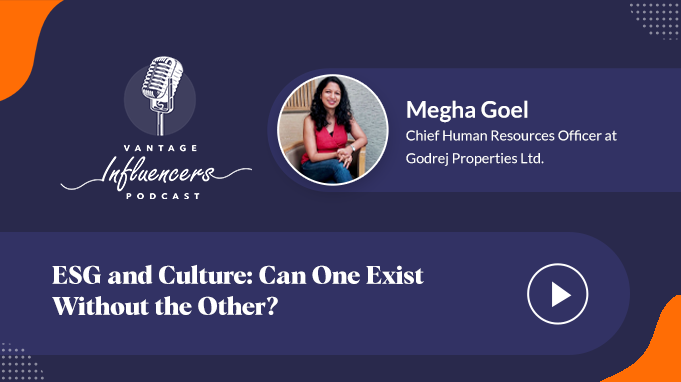
Vantage Influencers Podcast
"The real impact of ESG isn't just in policies or disclosures, but in how leaders make decisions and how employees experience the organization every day."
— Megha Goel, CHRO, Godrej Properties Limited
Listen to the EpisodeReal-World CSR Examples That Actually Worked
It's one thing to talk about CSR in theory. It's another to see what it looks like when a company gets it right. Here are a few examples worth paying attention to, not because they're perfect, but because they show how CSR, done thoughtfully, becomes part of a company's identity.
1. TATA Group
Tata has practiced CSR for over a century, long before it became a regulatory requirement. Through Tata Trusts, the group directs over 65% of its promoter equity toward education, healthcare, and rural development.
Unlike campaign-driven models, CSR is treated as a performance metric across Tata companies. The Tata Sustainability Group oversees group-wide goals including net-zero targets and water stewardship.
2. Microsoft
Microsoft committed in 2020 to being carbon negative by 2030 and to removing all historical carbon emissions by 2050.
Microsoft Philanthropies provides technology and cloud access to nonprofits globally, while AI for Good funds research across health, humanitarian, and accessibility domains. Their annual sustainability reports are among the most detailed in the industry.
3. IKEA
IKEA aims to become fully circular by 2030, meaning all products will be designed to be reused, repaired, or recycled. As of recent reporting, IKEA produces more renewable energy than it consumes across its operations.
IKEA has invested over 4 billion euros in renewable energy since 2009 and now owns more than 900,000 solar panels and 600 wind turbines globally, making it one of the largest corporate renewable energy owners in the world.
Their humanitarian programs include Let's Play for Change (safe spaces for children in conflict zones) and long-running partnerships with UNHCR for refugee energy access.
4. Infosys
Infosys achieved carbon neutrality in 2020, ahead of schedule. Infosys Foundation funds rural library digitization, healthcare infrastructure in underserved areas, and education programs.
Their approach is notable for deploying what the company actually knows how to do, using technology to scale impact rather than writing checks to unrelated causes. ESG disclosures are independently audited.
5. Levis Strauss
Since the inception of their Water Less program in 2011, Levis have saved more than 1 billion liters of water. They have reduced the usage of water for manufacturing for some of their styles by 96%.
They have also worked to support people with HIV/AIDS and decrease their contribution to climate change.
CSR Strategy: How to Build and Measure One That Actually Works
Having good intentions is a start. But a CSR strategy that drives real business impact requires structure — clear priorities, genuine employee involvement, and a way to measure whether it's actually working.
Here's how to build one from the ground up.
Step 1: Define Your CSR Priorities
The most effective CSR programs aren't designed in a boardroom in isolation. They're shaped by what the business stands for and what its people care about. Start by asking two questions:
- What issues align with your company's mission and industry?
- What causes do your employees actually care about?
A tech company might focus on digital equity and STEM education. A manufacturing firm might prioritize environmental sustainability and worker safety. When CSR priorities reflect both business values and employee values, participation goes up and the impact goes deeper.
Step 2: Implement with Transparency and Employee Involvement
The quickest way to kill a CSR program is to announce it from the top and hand it down. Employees can tell the difference between a PR exercise and a genuine commitment.
Build involvement in from day one:
- Let employees nominate causes and vote on initiatives
- Create volunteer programs with paid time off to participate
- Share progress openly, what was committed, what was spent, what changed
Transparency isn't just good ethics. It's what turns a CSR initiative into something employees feel ownership over.
Step 3: Measure What Matters
CSR without measurement is just spending. To know whether your initiatives are working and to make the case internally, you need to track the right signals:
- Participation rates : how many employees are actively involved in CSR programs
- Engagement survey scores : anlayzes whether employees feel the company lives its values?
- eNPS lift : are employees more likely to recommend the company as a place to work?
- Retention data : are CSR-engaged employees staying longer?
- Community impact metrics : volunteer hours, donations, beneficiaries reached
Do Give a Read: Employee Surveys: A Complete Guide to Building a Listening Culture
How to Measure CSR Success with Employee Listening
One of the most underused tools in CSR measurement is the employee survey. Not a generic annual engagement survey, but targeted questions that specifically assess how employees perceive and experience the company's social responsibility efforts.
Ask things like:
- Do you feel our CSR initiatives reflect your values?
- Do you feel meaningfully involved?
- Are you proud to tell others about what this company does in the community?
Tracking these scores over time, before and after major initiatives gives you a clear picture of whether your CSR is landing or just existing on paper.
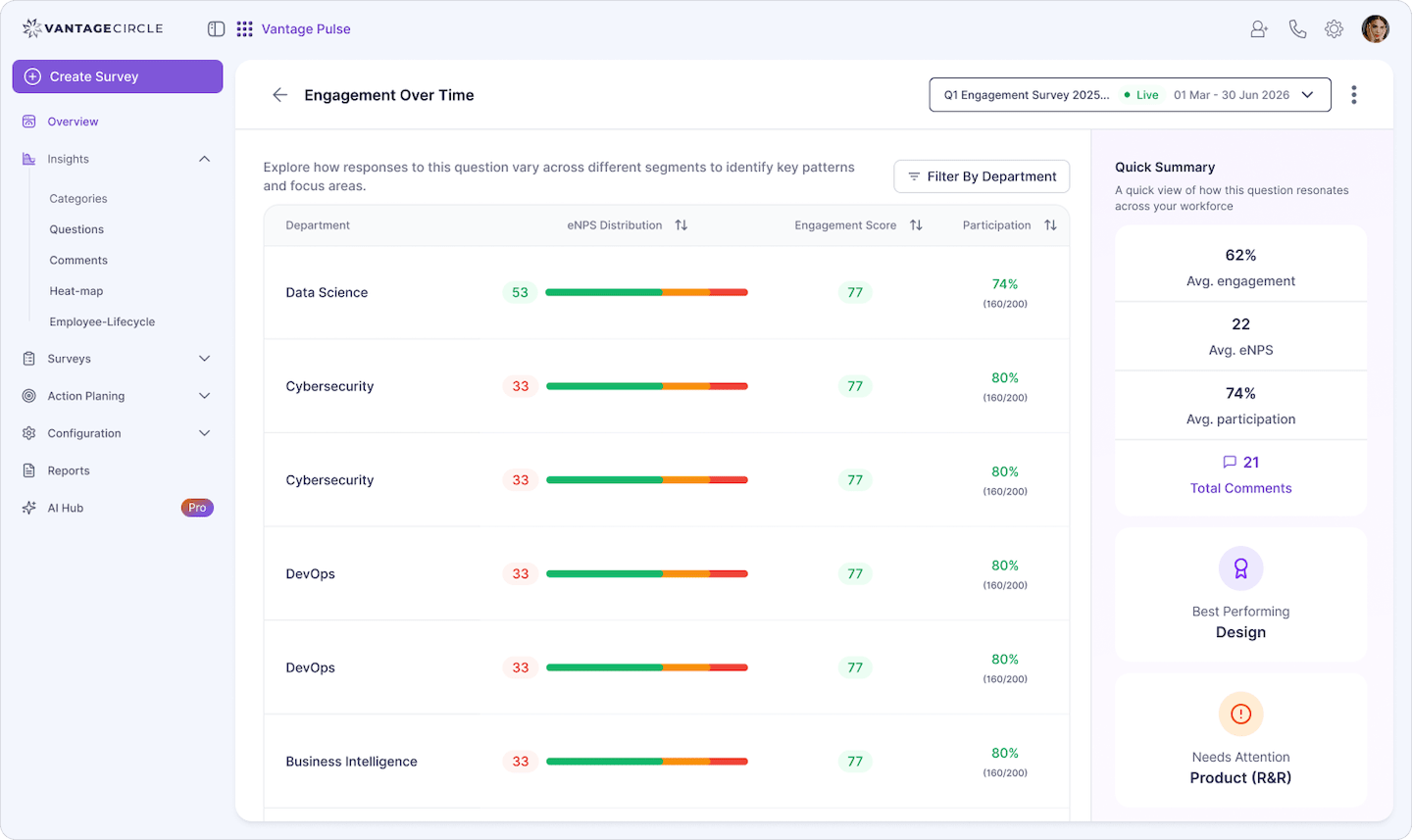
The logistics of running these surveys consistently can be a hurdle, especially for larger organizations. Platforms like Vantage Pulse make it easier to gather this kind of focused employee feedback on a regular cadence.
So the data actually informs decisions rather than sitting in a spreadsheet.
FAQs
1. What is the difference between CSR and philanthropy?
Philanthropy is a donation. CSR is a practice. A company can write a check to a charity and call it philanthropy. CSR goes deeper, shaping how the business operates day to day, from supply chain ethics to environmental policy to employee wellbeing. One is occasional; the other is structural.
2. How do companies measure CSR impact?
Common methods include tracking environmental metrics (carbon emissions, water usage), social indicators (volunteer hours, community investment), employee survey scores, and third-party ESG ratings. The most credible measurement combines internal data with external audits and ties results to specific, time-bound goals.
3. What are the main CSR challenges?
The biggest challenges are greenwashing risk, lack of consistent measurement standards, low employee awareness of programs, and difficulty linking CSR efforts to business outcomes. Many companies also struggle to move CSR from a PR function to a core operational one.
4. Is CSR legally required?
In most countries, CSR is voluntary. India is a notable exception, where the Companies Act 2013 mandates that qualifying businesses spend at least 2% of net profits on CSR activities. Elsewhere, regulatory pressure is growing through ESG disclosure requirements rather than direct spending mandates.
5. What is the ROI of CSR?
Research consistently links strong CSR programs to lower employee turnover, better brand reputation, and increased customer loyalty. While exact ROI is hard to isolate, companies with high ESG scores tend to outperform peers on long-term financial metrics. The returns are real but often indirect and cumulative.
6. Can small businesses practice CSR?
Yes, and many do it well. CSR does not require a dedicated budget or a sustainability team. For small businesses, it often looks like fair pay, local sourcing, reduced waste, or community involvement. Scale does not determine sincerity.
Conclusion
CSR isn't about being perfect. It's about being intentional.
The companies that do it well aren't necessarily the ones with the biggest budgets or the splashiest campaigns. They're the ones that ask honest questions about their impact, involve their people in finding answers, and show up consistently.

Sanjeevani Saikia is a Senior Content Strategist at Vantage Circle, where she leads end-to-end content strategy across SEO, thought leadership, brand storytelling, podcasts, and video. She is also the host of the Vantage Influencers Podcast, where she brings conversations with HR and business leaders from top global organisations, including Fortune 500 companies.
Connect with Sanjeevani on LinkedIn.