



From Instant Gratification to Purpose-Driven Recognition: Lessons for Modern Leaders

A Global Employee Recognition and Wellness Platform
So, I see this, with my children, every single day too. They have to be instantly recognized... even if they have made their bed. So, forget about the grades. That is the level of instant gratification itself. - Manu N. Wadhwa, CHRO, Sony Pictures Network
During the SHRM Fireside Chat “Celebrating Recognition” 2025, this revelation was not just a throwaway line of a personal story - it served as a significant recall of how the whole expectation of recognition has changed from the very basis.
Employee recognition has long been known to influence workplaces. Psychologists in the 1970s proved that effectively recognizing employees drives action.
Recognition is still very much part of the equation in today's workplaces.
92% of workers are more likely to repeat a specific action after receiving recognition, and 78% work harder and with more enthusiasm when their efforts are acknowledged.
But today, it has to be immediate; it has to be a personal feeling, and if leaders delay it by even a minute, they are likely to miss the opportunity to deliver a powerful level of motivation, engagement, and inspiration to their followers.
Recognition is neither a ceremonial gesture anymore, nor a mere checkmark on an HR form. It is a key lever, one that influences engagement, productivity, retention, and even innovation, to be used strategically.
The problem? Each generation feels and understands recognition in its own way.
Why Is Multi-Generational Recognition a Leadership Imperative?

The workforce has never been so diverse as today. Gen Z and Alpha are still coming in large numbers; millennials are in the process of taking over, and Gen X and Boomers are at the top of the ladder, at least for now. Different expectations and different triggers characterize each group.
Gen Z & Alpha
Research shows that 94% of Gen Z and Alpha workers desire frequent feedback and recognition, compared to 68% of Boomers, highlighting how immediate acknowledgment has become a crucial engagement driver for younger employees. A quick text, recognition in a meeting, or a digital badge is what keeps them motivated.
Also Worth Reading: 12 Key Expectations of Gen Z Employees That Must be Addressed
Millennials
Recognition is important only if it helps one grow in his/her career and gives a sense of purpose. Feedback that helps enhance the skill set and see the impact of one's work is very energizing for them.
Dive Deeper: Understanding Millennials in the Workforce
Gen X & Boomers
For Gen X and Baby Boomers, recognition is most meaningful when it acknowledges their depth of experience and the real impact of their work. They value appreciation that highlights specific contributions, strategic wins, and the expertise they’ve built over the years. Generic compliments don’t resonate with them. Being singled out for a significant accomplishment carries far more weight than broad, routine praise.
If these differences are ignored, it becomes very risky. Meaning? A "one size fits all" method may result in loss of engagement, attrition, and, consequently, the missing outcomes.
Here comes the role of “strategic recognition,” which is about getting everyone on the same page, boosting employees’ discretionary effort, and strengthening the company’s culture.
According to the AIRe survey report “Quantitatively Assessing Recognition Programs For The New World of Work”, 64% of employees expressed a desire for more meaningful recognition, while 45% felt their current programs were stale or disconnected from what truly mattered to them - underscoring that recognition must be thoughtful, timely, and relevant to drive real engagement.
Recognition as a Strategic Leadership Tool
Recognition is not only about "feel-good moments". Leaders who are proficient in recognition get business results. How? Let’s see below:
Employees who feel that they are valuable become better contributors, collaborators, and initiators.
People who feel recognized are committed and thus the recruitment and training costs are significantly lowered.
Recognition is a kind of signal that shows what behaviors and values are the most significant ones.
And if recognition is related to the set objectives, it stops being just a plan; it becomes something people practice every day.
The main point here is quite straightforward: recognition is the tool that shapes behavior, culture, and business results. Leaders who choose to ignore it are not making the best decision.
Recognition Across Generations: Practical Approaches

Here is the way leaders can modify the way they recognize the efforts of others without unnecessarily complicating things:
1. Instant Gratification for Gen Z & Alpha
-
Immediately recognize the small achievements - a short message, video recognition, or a badge can do wonders.
-
Invite and encourage peer-to-peer recognition to enlarge the effect.
-
Use tech for extending recognition but keep the personal human touch.
2. Growth-Oriented Recognition for Millennials
-
Make acknowledgment dependent on learning, skill development, and career progression.
-
Let them see how their work is connected to the organization's purpose.
-
Emphasize the contributions that make future employability better.
3. Respect-Driven Recognition for Gen X & Boomers
-
Concentrate on the contributions over a long period, the expertise, and the strategic impact.
-
Give recognition personally or privately.
-
Offer legacy-oriented recognition: mentoring, leadership influence, and tenure.
Technology as a Cross-Generational Enabler
While each generation prefers recognition differently, leaders still need a single, seamless way to deliver all these experiences at scale. That’s where the right technology becomes essential.
Platforms like Vantage Circle make recognition universally accessible, whether it’s a quick appreciation moment for Gen Z, developmental feedback for Millennials, or personalized, experience-honoring messages for Gen X and Boomers.
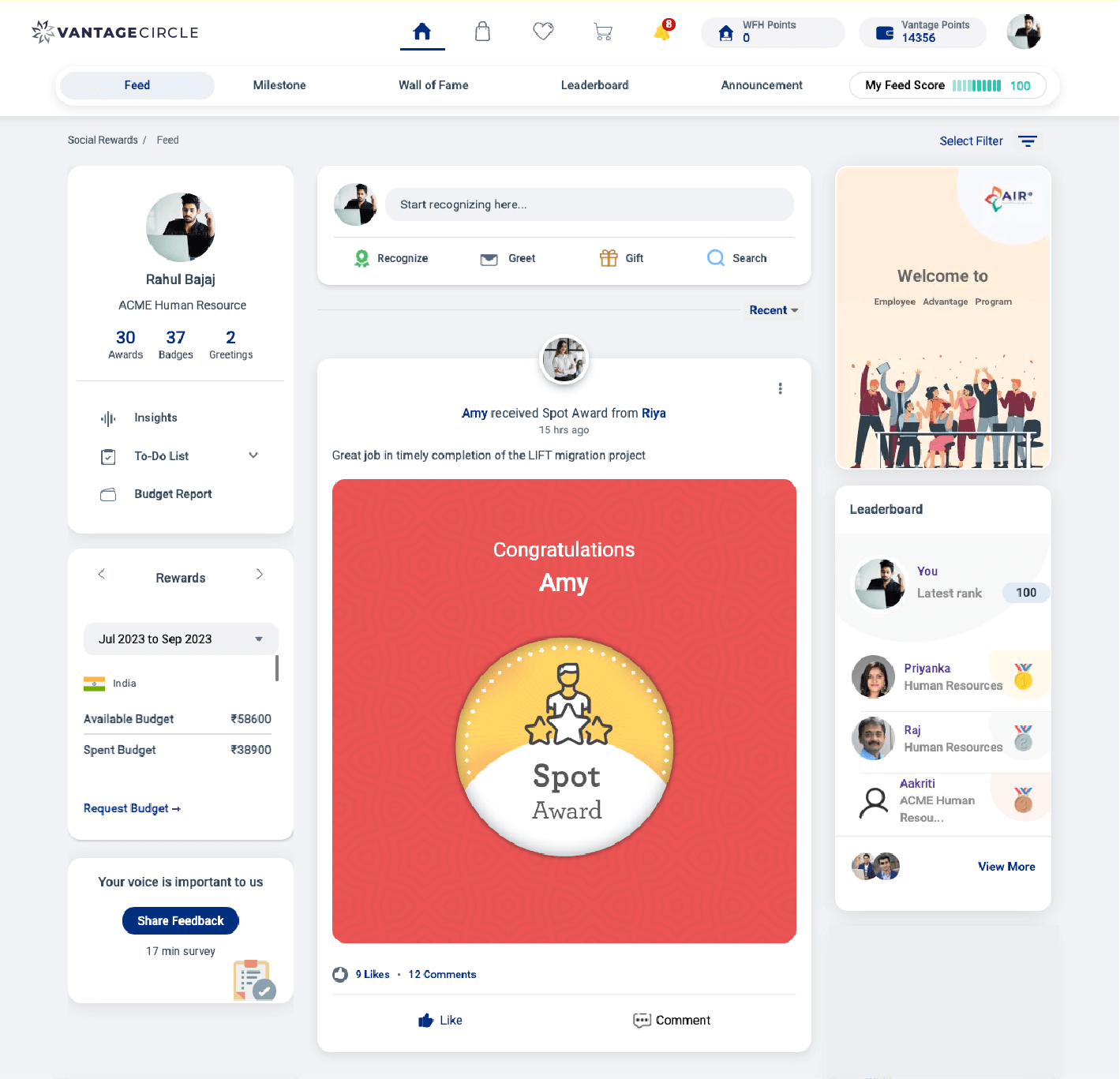
Source: Vantage Recognition
-
Instant recognition becomes easier through mobile notifications, badges, or quick appreciation posts.
-
Purpose-linked recognition can be tied to skills, competencies, or values.
-
Private, respectful acknowledgment can be sent directly and personally.
-
Analytics ensure fairness across generations by highlighting recognition patterns and gaps.
But even with a strong platform, human touch remains irreplaceable. A thoughtful note, a short video message, or a personalized appreciation delivered through the platform often creates more emotional impact than automation alone.
Good news: A of 1,000+ organizations survey show recognition has shifted to a continuous experience, with 68% already using technology to enhance, not replace the human touch.
Principles for Leaders to Make Recognition Effective

Recognition works best when it is intentional and thoughtfully delivered. Leaders should keep the following principles in mind:
Layered Recognition
Leaders should value contributions at every level, from everyday wins to peer appreciation and major milestones, so recognition feels continuous, balanced, and meaningful.
Purpose Binding
Recognition must connect daily work to larger organizational goals, so employees clearly understand the purpose behind their efforts and feel aligned with the mission.
Personalized Acknowledgment
Appreciation should reflect individual preferences and generational expectations, so each recognition moment feels authentic, respectful, and truly motivating.
Evaluation and Adjustment
Recognition practices need ongoing review through feedback and analytics, so the system stays fair, relevant, and continuously improves changing workforce needs.
Leading by Example
Recognition becomes a cultural norm when modeled consistently from the top, setting a standard that encourages teams to appreciate openly and frequently.
Recognition is a driver of a business when the above principles are being put into practice by the leaders, not just an HR routine.
Leadership Takeaways
-
Delayed recognition is one of the top causes of disengagement, as an appreciation that comes late loses its value.
-
Personalized recognition creates loyalty as people tend to stay where they feel recognized and valued.
-
Recognition through a link with the purpose makes the employees more committed as they understand the reason for their work.
-
When recognition is personalized for a multi-generational workforce, leaders get a truly competitive advantage. Employees become more cohesive, more motivated, and more willing to work beyond the set limits.
-
Technology can take this experience to another level by making recognition timely, inclusive, and giving an easy delivery option, while still retaining the human aspect.
-
Recognition has become an essential and strategic lever that turns human potential and leads to measurable business results, no longer just a feel-good extra in a hybrid, fast-moving workplace.

Susmita Sarma is a seasoned Digital Marketer at Vantage Circle, specializing in content strategy, employer branding, and HR thought leadership. Passionate about creating recognition-driven and people-first workplace cultures, she blends data, storytelling, and empathy to drive meaningful engagement. Connect with Susmita on Linkedin or reach out at editor@vantagecircle.com for inquiries.