Let's put to rest the common misconception predominating the discussions on employee engagement. It is not about making people happy. It's about commitment, effort, and ownership. Engaged employees demonstrate willingness to invest in their energy, take initiative, and drive outcomes.
Engagement has often been dismissed as intangible, something you "just know" but can't quantify. It has been reduced to "soft skills" alongside culture and morale, making it harder to justify in budget conversations.
But here's where ROI flips the entire understanding of employee engagement. Measuring the return on investment of employee engagement reframes it as a business investment bearing measurable returns.
This presents engagement in a new light, which highlights it as a strategic lever that drives retention, productivity, and profitability. It no longer reduces engagement as a feel-good HR initiative.
As a business leader, if you have questions about whether it’s worth it, how to prove it to your stakeholders, let me show you, through this blog, how precisely to answer with data, clarity, and confidence.
Why Should You Measure the ROI of Employee Engagement?
How does Measuring ROI Turn Engagement into a Business Advantage?
The shift in perceiving engagement as a business advantage begins when you swap your discussions around “employee satisfaction scores” with “productivity gains per dollar invested.”
HR as a Value Driver
Measuring engagement’s ROI repositions HR from being an administrative support to a strategic partner, making it a value driver.
Engagement discussions lessen around programs and are directed towards retention savings, productivity lift, and risk reduction, highlighting the actual numbers at play.
Alignment with Financial Goals
Engagement will start aligning directly with financial goals. HR can link engagement investments to metrics leaders genuinely care about, such as revenue per employee, attrition costs, customer retention, and operating margins.
Your engagement strategy becomes less of an abstract program and more of a performance lever to navigate your outcomes.
What Are the Measurable Benefits of Employee Engagement?

Here are the measurable benefits of employee engagement:
1. Productivity
According to a Gallup study, highly engaged employees achieve 14% higher productivity and 23% higher profitability.
The statistic shows that engaged employees do not simply show up; they perform.
For example, a 500-person company with $50M in revenue achieves a productivity boost that translates to roughly $9-11.5M in additional output. That's not abstract. That's a measurable value.
2. Retention
A Gallup study reveals that enterprises with higher engagement levels have 18% lower turnover compared to companies that have lower engagement and more than 40% turnover every year.
Also, the SHRM study states that the cost of replacing an employee can range from 50% to 200% of their annual salary, depending on their level.
It’s clear that engagement significantly impacts retention. Even small retention gains unlock big savings. You eliminate recruiting costs, onboarding time, and the productivity lost while new hires get up to speed.
3. Absenteeism & Presenteeism
Disengagement not only results in absenteeism, but it also creates a group of employees who are physically present but mentally checked out.
Leaders often overlook these people. But both categories have measurable cost implications.
However, engaged workforces reduce both categories by improving operational continuity and team performance.
4. Customer Outcomes
Gallup shows that engagement results in 10% higher customer loyalty.
Engaged employees are knowledgeable and attentive. They take personal ownership of making customers happy and are willing to go the extra mile. They believe in what they are selling.
In short, they create remarkable customer experiences by influencing customer satisfaction, loyalty, and repeat business.
How Strong is the Link Between Engagement and Business Results?
Correlation vs Causation
Engagement and performance are correlated, but claiming pure causation is complex. Multiple factors influence business outcomes.
But when engagement improvements consistently precede performance gains across multiple metrics, the business case is clear. You don’t need perfect causation but just reasonable confidence.
Why Baselines and Deltas Matter More Than Benchmarks
Do not stress yourself over whether your engagement score is "above industry average." What genuinely matters more than comparisons is your trajectory.
Did turnover decrease after engagement scores rose? Did productivity improve in teams with higher engagement gains?
If your engagement increased by 12 points and your productivity rose 8% in the same period, that's your business case. Track your own before-and-after metrics. Your delta is your proof.
What Is the Employee Engagement Equation and ROI Formula?
What Is the Core Employee Engagement ROI Formula?
The standard formula is straightforward:
ROI (%) = (Net Benefits − Total Engagement Costs) ÷ Total Costs × 100
Here,
- Net Benefits are the financial gains from improved retention, productivity, reduced absenteeism, and customer outcomes.
- Total Engagement Costs cover platform fees, program costs, training, time investment, and recognition budgets.
What Counts as Engagement Costs and Financial Gains?
Engagement costs can be direct and indirect:
Direct vs Indirect Costs
Direct costs cover software subscriptions, recognition platform fees, training facilitation, and external consultants.
Indirect costs cover HR team time, manager training hours, and employee participation time.
Be careful when counting costs but stay realistic. Exaggerating costs will make a good investment look mediocre.
Financial gains fall into two categories:
Revenue Lift vs Cost Avoidance
The revenue lift includes increased sales and higher productivity, which is exciting and forward-looking.
Cost avoidance that includes retention savings and reduced absenteeism is defensive but is of greater magnitude.
Both matter, but cost avoidance is often easier to prove early. Revenue lifts usually follow over time.
How Do You Measure the ROI of Employee Engagement Step by Step?
Here’s how a structured approach helps keep your calculations grounded.
How Do You Establish the Right Metrics and Baselines?
Start with a set of business metrics that engagement influences and that you can reliably track:
- Voluntary turnover rate
- Absenteeism rate
- Revenue or output per employee
- Customer satisfaction (CSAT/NPS)
- Profitability or contribution margin
Historical Data (6–12 Months)
Before launching initiatives, make sure to use 6-12 months of baseline data. You need a credible "before" data to prove your "after" results.
How Do You Track Engagement and Performance Changes?
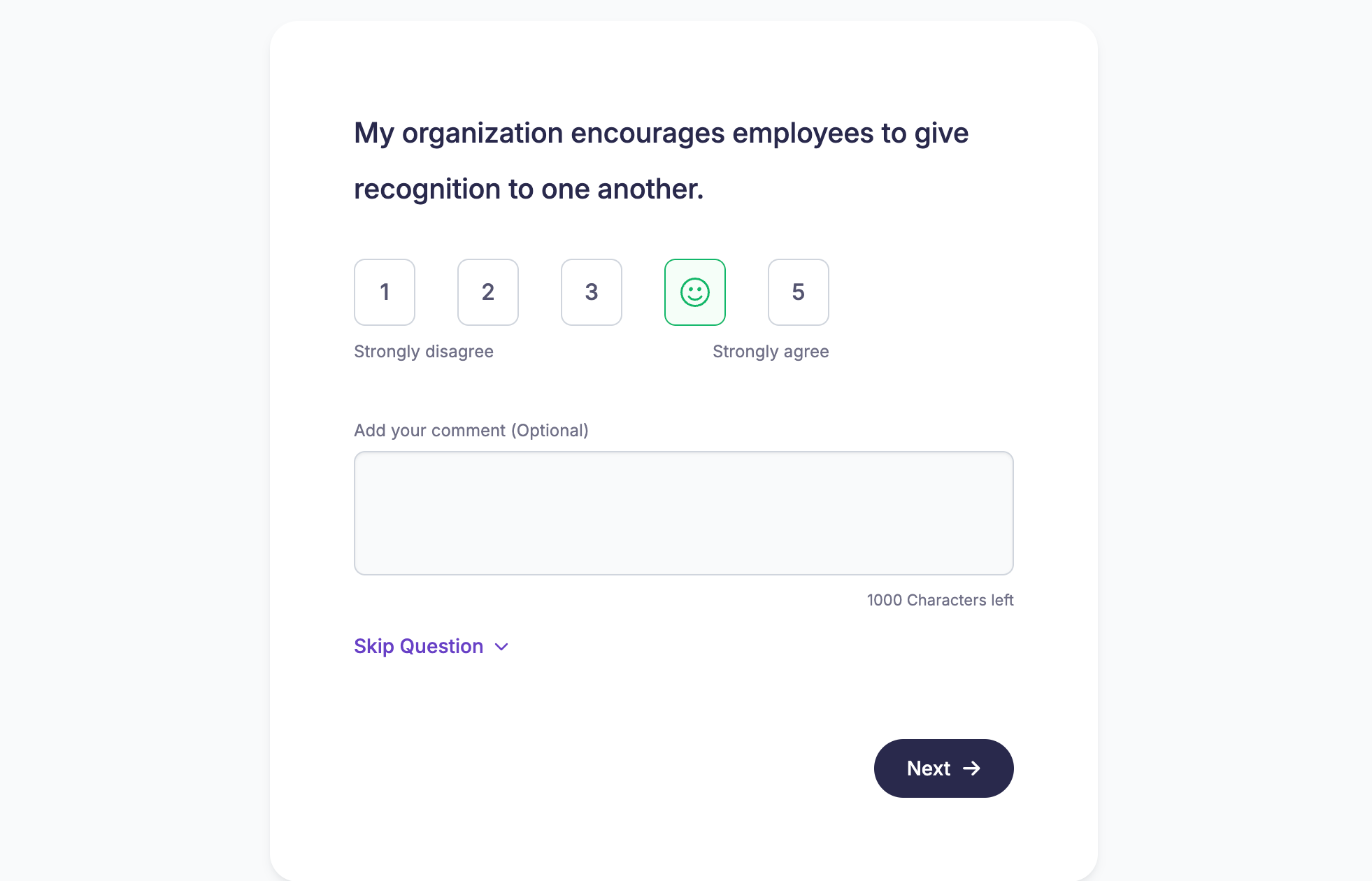
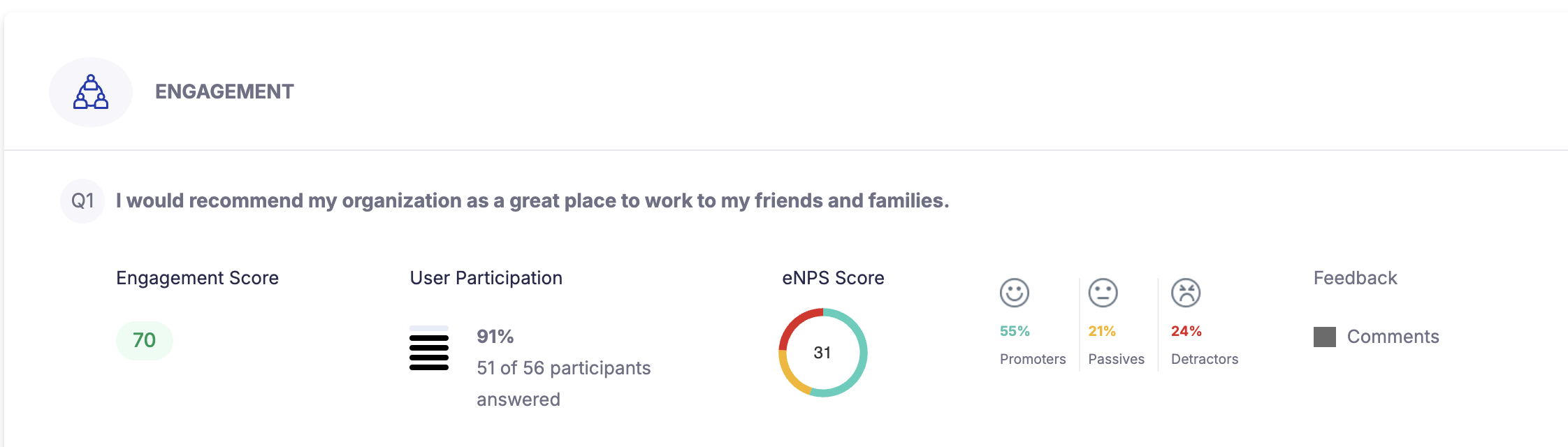
Engagement Surveys
Source: Vantage Pulse
You can run quarterly or bi-annual pulse surveys with consistent questions. This will help you track overall engagement scores across key drivers, including leadership trust, recognition frequency, growth opportunities, and workload balance.
Don't limit to measuring sentiment; instead, measure the behaviors and conditions that drive outcomes.
Performance and Customer Metrics
Monitor your business metrics monthly. Watch for movement 60-90 days after the launch of engagement initiatives.
Also, look for patterns. When engagement scores rise in Q2, do productivity or retention metrics improve in Q3?
How Do You Convert Engagement Improvements into Financial Value?
Dollarizing Improvements
This is where ROI becomes more practical.
Let's say engagement initiatives reduced turnover from 18% to 14% (4 percentage points) for your 500-person workforce:
- Employees retained: 500 × 0.04 = 20 employees
- Average replacement cost: $75,000
- Total retention savings: $1,500,000
If productivity increased 5% and your revenue per employee is $150,000:
500 employees × $150,000 × 0.05 = $3,750,000 in additional output
Now applying the ROI Formula
Total benefits: $1.5M (retention) + $3.75M (productivity) = $5.25M Total costs: $250,000 (platform, programs, time)
ROI = ($5.25M − $250K) ÷ $250K × 100 = 2,000%
Interpreting Results Realistically
Got 2,000% ROI? Be conservative with attribution. Even claiming just 30-50% of gains from engagement yields a 300-600% ROI, which is more than enough to justify investment.
How Can You Build an Employee Engagement ROI Calculator?
An ROI calculator need not be a complex one to be useful. It simply needs to be transparent.
How Do You Calculate Retention Savings?
Retention savings can be calculated using the following formula:
Employees Retained × Average Cost of Replacement
Replacement cost typically covers hiring expenses, onboarding, training, and lost productivity during ramp-up.
- Calculate baseline turnover: (Departures ÷ Average Headcount) × 100
- Calculate the new turnover rate after engagement improvements
- Multiply the reduction in departures by your cost-per-replacement
How Do You Calculate Productivity Gains?
Productivity gains can be calculated as:
Revenue per Employee × Productivity Increase %
- Calculate baseline revenue per employee: Total Revenue ÷ Headcount
- Estimate productivity increase from engagement (typically 3-8% for engaged teams)
- Multiply workforce size by revenue per employee by percentage gain
How Do You Estimate Customer Impact?
CSAT/NPS → Retention → Revenue
This chain is powerful but requires some industry-specific assumptions:
- Track how engagement improves customer satisfaction scores
- Research or estimate how CSAT/NPS correlates with customer retention in your industry
- Calculate revenue protected by improved retention
What Common Mistakes Should You Avoid in ROI Calculations?
Be wary of these mistakes, which repeatedly show up:
Double Counting
If improved engagement reduces turnover and that, in turn, improves productivity, don't count the productivity gain twice. Attribute it once.
Over-Attribution
If you launch multiple initiatives at once, do not give all the credit to engagement alone. Be honest about the other contributing factors. This builds trust.
Ignoring Presenteeism
Most calculators focus on absenteeism and miss out on presenteeism, that is, employees present but disengaged.
Presenteeism bears more severe consequences than absenteeism because it’s invisible. Employees appear productive, but they operate at reduced capacity for far more days, resulting in quality errors, issues, and reduced output that goes unmeasured and unaddressed.
Therefore, consider productivity losses from disengagement, and not just empty desks.
How Can You Prove and Demonstrate Employee Engagement ROI to Stakeholders?
Proof is not limited to numbers but also includes narrative. Learn how to prove the ROI of employee engagement in the discussion below.
How Do You Address Executive Skepticism About Engagement?
Leading vs Lagging Indicators
Engagement is a leading indicator that predicts future performance. Financial results are lagging indicators that confirm past decisions.
When executives want proof, show them the pattern: engagement goes up first, then retention, performance, and revenue improvements follow within 2-6 months.
Short-Term vs Long-Term Outcomes
Some benefits, such as reduced absenteeism and improved morale, materialize quickly, while others, such as retention savings and cultural transformation, take time.
Set expectations: Aim to prove sentiment and attendance in 90 days, followed by financial impact, which will show in 3-6 months.
How Long Does It Take to See ROI From Engagement?
Early Signals (0–90 Days)
Within three months, watch out for:
- Better attendance
- Increased participation in recognition programs
- Improved engagement survey scores
- Manager feedback on team energy
Financial Impact (3–6 Months)
- By six months, you should see:
- Declining turnover rates
- Productivity metrics improving
- Rising customer satisfaction scores
Sustained ROI (6–12+ Months)
- Long-term returns compound:
- Significant retention savings
- Cultural momentum building
- Employer brand strengthening (lower recruiting costs)
- Innovation and collaboration gains
Setting realistic timelines builds confidence.
How Should Engagement ROI Be Reported to Leaders?
As different leaders care about distinct outcomes, tailor the reports accordingly:
CFO: Financial Impact
Lead with numbers and use their language to communicate: "Our $200K investment generated $1.8M in retention savings and $800K in productivity gains, delivering 1,200% ROI." Include cash flow timing and risk reduction.
CHRO: Workforce Health
Focus on metrics that predict business stability: retention, internal mobility, engagement trajectory, and bench strength. Show how engagement builds organizational resilience and reduces talent risk.
CEO: Strategic Outcomes
Link engagement to strategy: "Our initiatives cut new hire ramp time by 23% and boost innovation by 31%." Show how people’s investments drive competitive advantage
What Strategies Help Maximize the ROI of Employee Engagement?
Let’s explore how the following strategies can maximize the ROI of employee engagement.
How Do Culture and Autonomy Improve ROI?

When employees possess a clear idea of how their work serves the company’s purpose and goals, and have autonomy over how they achieve results, productivity and retention soar automatically.
A Gartner survey found that employees who are allowed to decide when they work are 2.3 times more likely to achieve higher performance than employees without autonomy.
The moment you cut micromanagement, you become subjected to immediate performance gains.
Trust scales better than control. The ROI comes from reduced management overhead and increased employee ownership.
Why Does Continuous Recognition Drive Higher Returns?

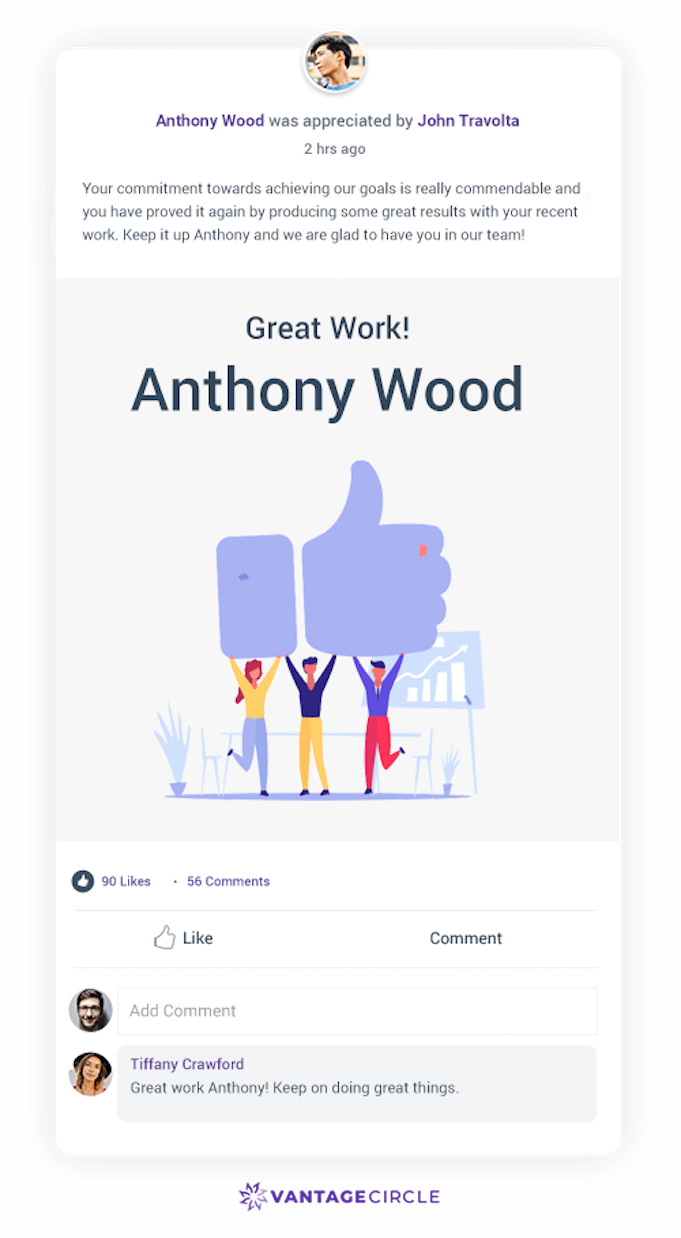
Annual performance reviews no longer fuel motivation. Instead, continuous, specific recognition is a motivation booster that creates a real-time feedback loop, reinforcing desired behaviors.
The statistics below reflect the powerful impact of continuous recognition:
- According to a study, well-recognized employees are 7 times more likely to be fully engaged compared to those who are not recognized.
- A study reveals that the top 20% of companies with a “recognition-rich culture,” have a 31% lower voluntary turnover rate.
- According to research, Employee recognition increases productivity by 17% when workers feel valued.
Source: Vantage Recognition
The ROI of recognition isn't the platform cost; it's the behavioral change. When managers recognize great work within 24 hours, that behavior gets repeated.
Compound that across hundreds of employees and thousands of moments, and you've built a performance culture.
How Does Development and Mobility Reduce Long-Term Costs?

Your best people leave when they see no scope for growth.
In fact, Internal mobility also helps employees find their next role within the company. It costs 30-50% less than external hiring and retains institutional knowledge.
Investing in upskilling and creating development pathways helps demonstrate ROI in the following ways:
- Lower turnover among high performers
- Faster time-to-productivity (internal moves on board quicker)
- Stronger succession pipelines
- Better employee lifetime value
Conclusion
As you have realized by now, measuring and proving the ROI of employee engagement is crucial for securing budgets, building credibility, and driving strategic decisions.
When you show returns of 300%, 500%, or even 1,000% through retention, productivity, and customer impact, the conversation shifts from "Can we afford this?" to "Can we afford not to?"
Therefore, start with clear baselines, track consistently, and calculate conservatively. You need proof to show engagement works, and the data will help back it up.
FAQs
How long does it take to see ROI from employee engagement?
You may see early signals in morale and participation within 3–6 months.
Hard outcomes like productivity, retention, and cost savings typically follow in 6–12 months.
Can employee engagement ROI be negative?
Yes, if initiatives are poorly designed, misaligned with business goals, or lack leadership support.
Low adoption, unclear metrics, or one-off programs can lead to wasted spend and no measurable impact.
What tools help track engagement ROI effectively?
Pulse surveys, lifecycle feedback tools, attrition analytics, and performance dashboards are essential.
Platforms that link engagement data with turnover, productivity, and recognition usage deliver clearer ROI.
How often should engagement ROI be measured?
Track leading indicators monthly or quarterly for timely course correction.
Assess business impact annually to validate long-term value and justify continued investment.

This article is written by Riha Jaishi. Riha Jaishi is a Content Marketing Specialist at Vantage Circle and host of the HR Vantage Influencers podcast, sharing insights that help organizations build recognition-rich, people-first cultures!!
Connect with Riha on LinkedIn.