




Total Rewards Strategy: A Complete Guide to Increase Employee Retention

A Global Employee Recognition and Wellness Platform
You are fighting a losing battle if you think your next 5% salary increase will stop your best engineer from leaving. In the current American talent market, salary has become a commodity. It surely gets people in the door, but it creates almost zero loyalty.
The "mercenary" employee will always leave for a higher bidder. Therefore, if you want to build a "missionary" workforce, a workforce that stays because they are deeply integrated into your ecosystem, you need to change the math of leaving.
This isn't just about employee satisfaction or employee engagement. It's about architecting a Total Rewards strategy that makes leaving your company financially, emotionally, and professionally illogical.
Therefore, in this blog, we are going understand how you can effectively execute that strategy.
Key Insights
- What Is a Total Rewards Strategy?
- Why Total Rewards Strategies Are Critical for Retention in 2026
- The Five Pillars:How Each Drives Retention
- How to Build a Total Rewards Strategy Step-by-Step
- Total Rewards Strategy Examples That Work
- Measuring the Impact of Your Total Rewards Strategy
What Is a Total Rewards Strategy?
A total rewards strategy is a comprehensive approach that includes all the investments an employer makes in their workforce. This strategy aims to attract top talent and foster long-term employee retention strategies . The concept, heavily standardized by organizations like WorldatWork, moves beyond basic payroll to combine all emotional, physical, and developmental investments into a singular employee value proposition .
Total Rewards vs. Total Compensation: Key Differences
It is a common mistake for HR leaders to use these terms interchangeably. In reality, they reflect two very different strategies when it comes to investing in human capital.
| Feature | Total Compensation | Total Rewards |
|---|---|---|
| Definition | The direct and indirect financial value provided to an employee. | The complete package of financial, physical, emotional, and developmental value provided. |
| Components | Base salary, bonuses, stock options, 401(k) matching. | Compensation, health benefits, wellness programs, career growth, peer recognition, and flexibility. |
| Primary Goal | Talent acquisition and baseline market competitiveness. | Holistic employee loyalty, high performance, and long-term retention. |
| Psychological Impact | Transactional. The organization pays for time and output. | Relational. The organization invests in the employee's life and career trajectory. |
The Five Pillars of Total Rewards
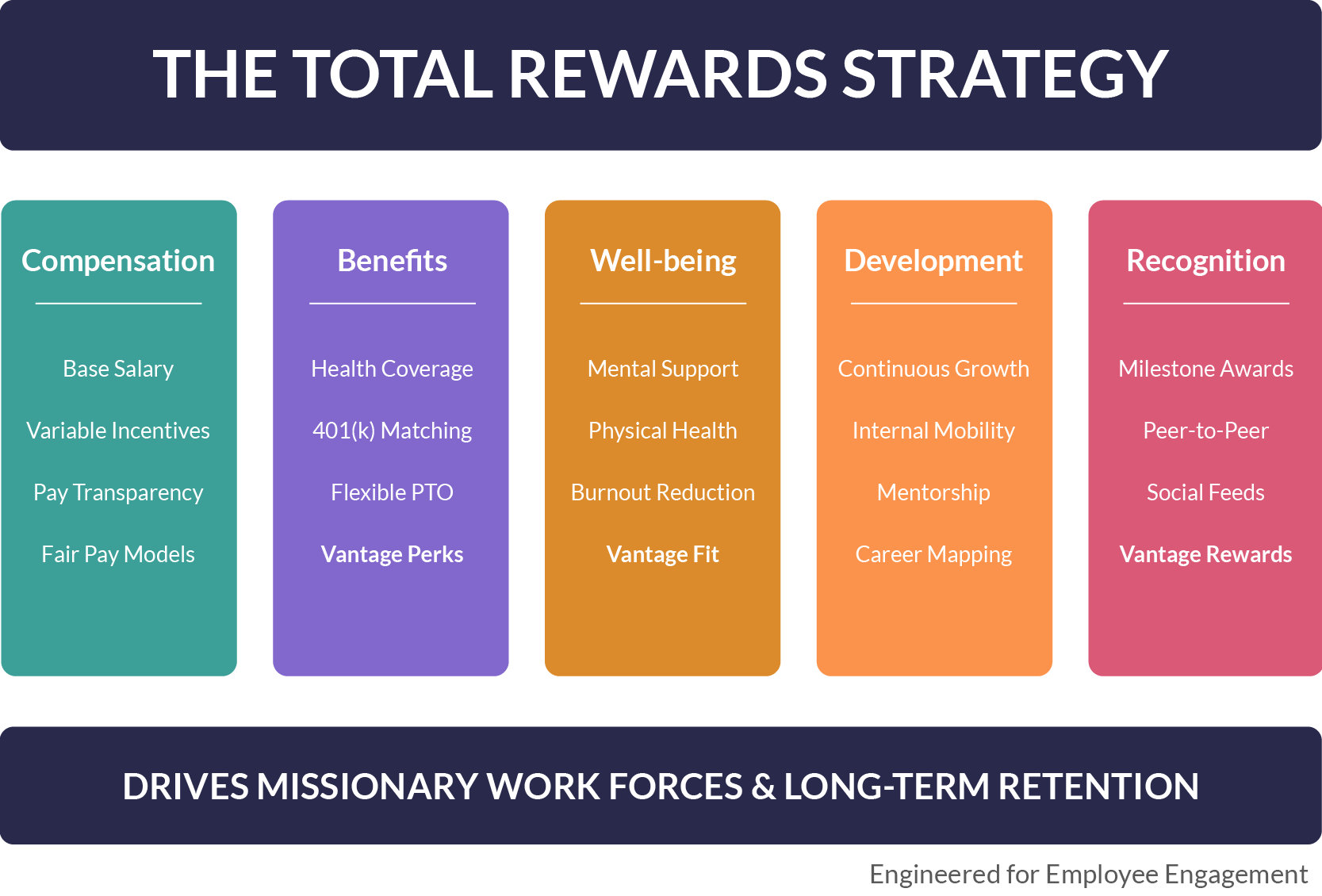
To create a strategy that genuinely reduces turnover, human resources leaders must balance five distinct pillars.
-
Compensation: The foundational financial pay, including base salary and variable incentives.
-
Benefits: The protective safety nets, such as health insurance, retirement plans, and paid time off.
-
Well-being: Initiatives supporting physical, mental, and financial health.
-
Development: Opportunities for upskilling, mentorship, and career advancement.
-
Recognition: Formal and informal acknowledgment of employee contributions and milestones.
Why Total Rewards Strategies Are Critical for Retention in 2026
The Cost of Turnover-What the Data Says
Retention plays a crucial role in driving business profitability. To truly grasp the impact of employee turnover , we need to consider the significant financial losses it can lead to. Gallup reports that the cost of replacing an individual employee can range from one-half to two times the employee's annual salary.
When you take into account the costs of recruiting new employees and the unavoidable dip in productivity, the financial impact of employee attrition can be quite overwhelming. Conversely, the 2025-26 State of Employee Retention reveals that 65% of organizations now identify total rewards-related issues as their primary internal driver of turnover.
Why Traditional Compensation Alone No Longer Works
Historically, organizations relied on golden handcuffs to keep top performers. While massive sign-on bonuses delay an exit, they do not actually prevent disengagement. And once an employee decides the work environment lacks growth or support, they will not make their best effort.
These days, employees are looking for a psychological contract that truly respects their whole being.
What Employees Actually Value: Generational Insights (Gen Z, Millennials, Gen X)
A monolithic rewards package will fail in a diverse workplace. Organizations must understand the distinct preferences of different generations.
| Generation | Primary Total Rewards Drivers | Retention Anchors |
|---|---|---|
| Gen Z | Mental health support, extreme flexibility, rapid upskilling. | Paid mental health days, transparent career mapping. |
| Millennials | Childcare support, student loan assistance, hybrid work. | Generous parental leave, home office stipends. |
| Gen X | Robust healthcare, 401(k) matching, leadership development. | Caregiver support for aging parents, advanced health screenings. |
| Boomers | Medicare transition assistance, phased retirement, legacy projects. | Catch-up retirement contributions, mentorship roles. |
The Five Pillars: How Each Drives Retention
Pillar 1. Compensation: Beyond Base Pay
Compensation is the foundation of any job. To do it right, companies need to establish fair pay structures, be open about salary ranges, and create pay models that reward employees for their future contributions, not just their past achievements.
Global consulting firm Mercer notes that pay transparency is quickly becoming a standard expectation for building trust, making clear communication about compensation essential.
Pillar 2. Benefits: From Table Stakes to Strategic Differentiators
A benefit is only highly effective if removing it disrupts the employee's personal cash flow or daily routine. This is why comprehensive employee benefits must extend past basic dental and vision coverage. Whether you are designing employee benefits for small business or managing a global enterprise, look for low-cost employee benefits that have a disproportionate impact on daily life.
Corporate discount programs are a clever way to enhance employee compensation without actually raising payroll costs. Many organizations turn to integrated solutions like Vantage Perks , to make it easy to provide exclusive corporate deals and cashback options.
By offering perks, like subsidized internet, gym memberships, and grocery discounts, companies create a personal economy that's tough for competitors to match.

Pillar 3. Well-being: Supporting the Whole Employee
Wellness programs often miss the mark because they tend to pile on more tasks. They expect already drained employees to log into yet another portal during their downtime. True employee engagement and well-being must be subtractive by removing the stressors that cause burnout. According to Deloitte's Global Human Capital Trends report , well-being has evolved from a nice perk to becoming a crucial business necessity.
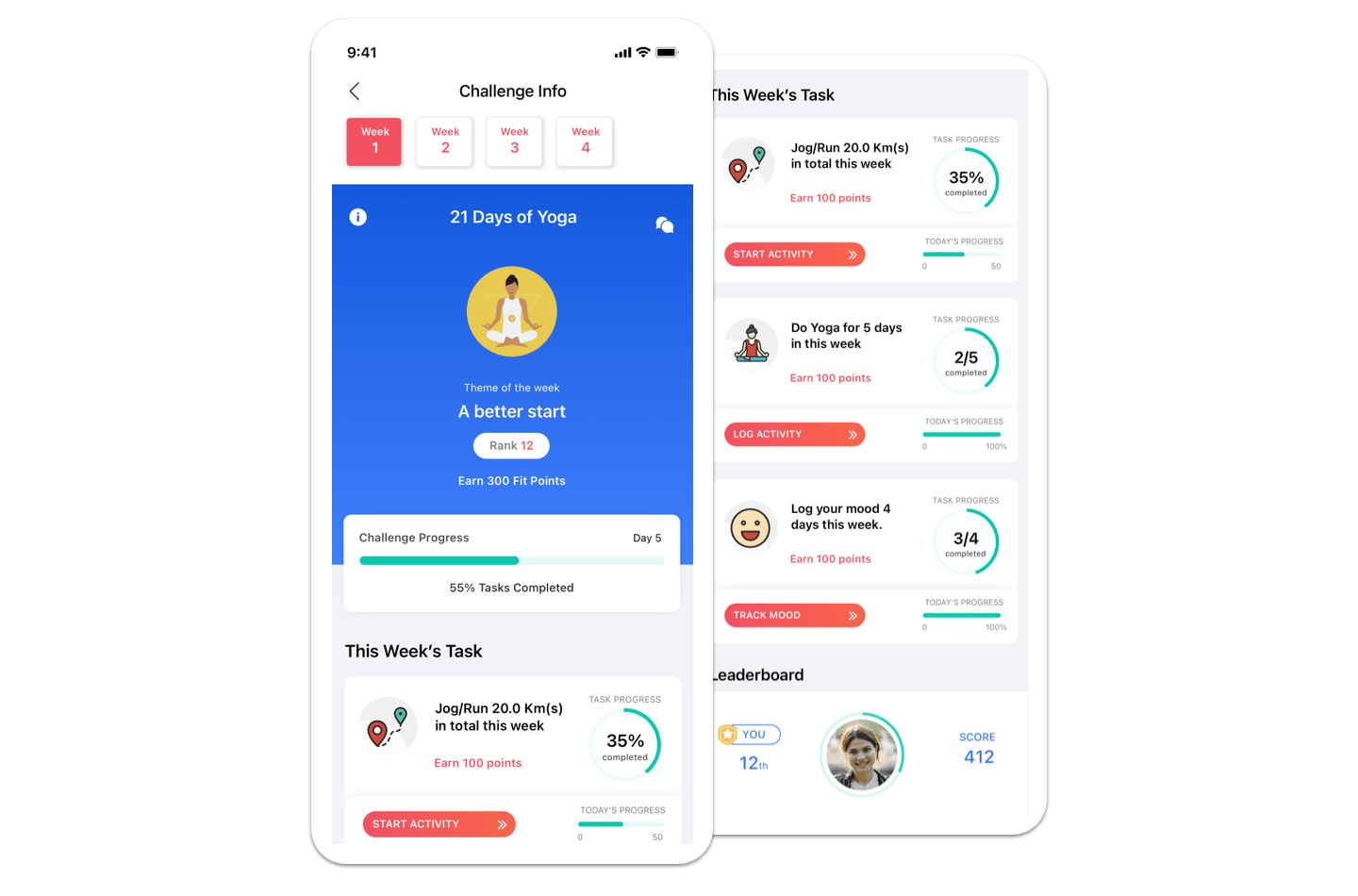
To operationalize this, modern HR teams are moving away from passive gym reimbursements toward gamified wellness platforms.
Integrating a system such as Vantage Fit turns the well-being pillar into daily engagement through step challenges, mindfulness tracking, and wellness rewards. It operationalizes health, proving to employees that the company is actively invested in their physical and mental well-being.
Pillar 4. Career Development: Growth as a Retention Tool
Disengagement is usually a response to stalled momentum. Providing a clear employee development plan is essential. Organizations should embrace internal mobility, allowing talent to move fluidly across projects to gain new skills.
Visual competency mapping tools empower employees to visualize their growth journey. By transforming career advancement from a vague promise into a clear, measurable part of their overall rewards, the likelihood of employees being tempted by outside recruiters decreases.
Pillar 5: Recognition: The Emotional Anchor
Standard plaques can often come off as a bit too formal and uninspired. To truly foster loyalty, organizations need to implement engaging employee recognition programs that highlight the daily efforts that keep everything running smoothly.
To execute this at scale, a solid infrastructure is essential. By leveraging comprehensive platforms like Vantage Rewards, companies can effortlessly facilitate peer-to-peer, manager, and milestone recognition across their global teams.
Also, leaders need to combine both monetary and non-monetary incentives to cater to various psychological needs. By nurturing intrinsic rewards, you can create a sense of internal satisfaction, while providing experiential rewards gives employees unforgettable experiences that strengthen their emotional connection to the company.
Furthermore, milestone-based recognition, such as years of service award at the 5, 10, and 20-year marks, anchors the emotional dimension of total rewards. When appreciation is visibly tied to core values on a company-wide social recognition feed, it becomes a reinforcement mechanism for the exact behaviors the employee reward program is designed to scale.
How to Build a Total Rewards Strategy Step-by-Step
Step 1.Audit Your Current Rewards Landscape
Before you start introducing new elements, take a moment to assess your current situation. Look into how well your benefits are being utilized, compare your compensation against industry standards, and review your existing recognition tools to spot any gaps.
Step 2. Segment by Employee Persona and Generation
Review your HRIS data to understand your workforce's demographics. Design your strategy to be flexible and tailored to different personas, ensuring that every demographic group sees immediate benefits from their package.
Step 3. Design a Balanced Rewards Mix Using Data
Do not rely on guesswork to allocate your budget. Vantage Circle's AIRe Framework provides a research-backed model for designing recognition programs that align perfectly with the recognition pillar of total rewards. Additionally, leverage technology to sustain the program. AI-powered features like intelligent recognition and manager recommendations ensure that the recognition pillar does not depend solely on managerial memory. The system proactively identifies under-recognized employees and nudges managers to act.
Step 4. Communicate Your Total Rewards (Total Rewards Statements)
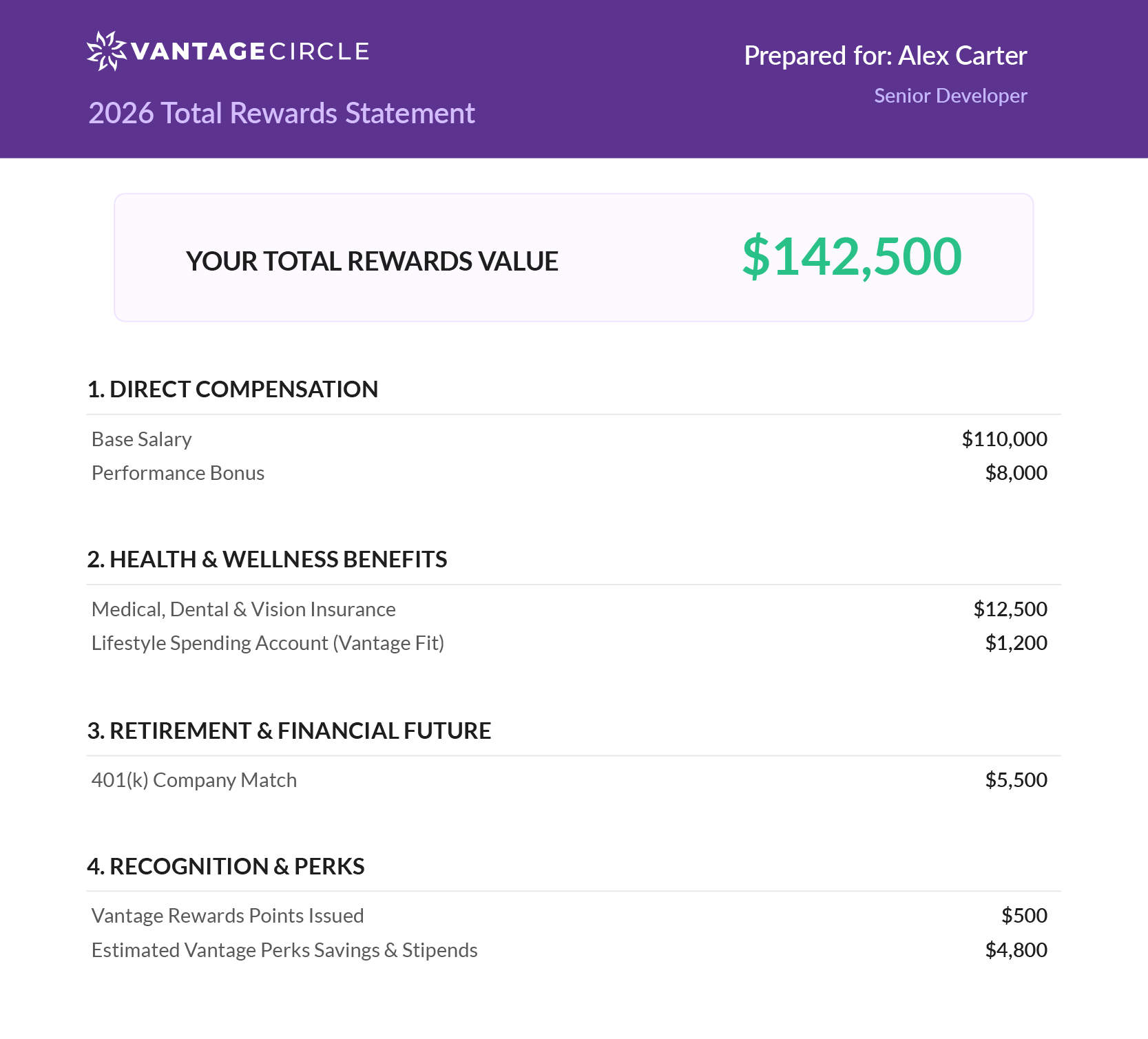
According to MetLife's Employee Benefit Trends Study , employees who fully understand their benefits are significantly more likely to feel valued and remain with their employer. You must generate personalized Total Rewards Statements that clearly outline the exact monetary value of an employee's salary, healthcare, 401(k) match, and stipends.
Taking it a step further, implementing multi-purpose employee wallets that combine wellness rewards, recognition points, and work-from-home allowances into a single balance provides employees with a clear, real-time snapshot of their total rewards.
Step 5. Measure, Iterate, Personalize
A total rewards strategy is a living system. Launch an annual employee engagement survey explicitly focused on rewards perception. Track metrics meticulously and adjust your offerings based on actual utilization data.
Total Rewards Strategy Examples That Work
Example 1: Retention-Focused Rewards for Hybrid Workforces
A tech company struggling with high turnover among its remote developers decided to change things up. They took the money they had set aside for catering at their downtown office and turned it into a flexible lifestyle spending account. This way, remote employees could use the funds for things like ergonomic furniture for their home offices or local co-working spaces. By directly addressing the everyday challenges of remote work with this benefit, they stabilized their retention rate within just six months.
Example 2: Multi-Generational Total Rewards Design
A healthcare provider with a massive age variance implemented a choice-based rewards architecture. They started with a basic package of standard health benefits and then added a secondary allowance of points. Younger employees often used their points to help pay off student loans, while the more senior staff preferred to use theirs for advanced caregiver support programs.
Example 3: Global Total Rewards with Regional Personalization (SOLI)
Managing rewards across borders requires extreme nuance. By using the SOLI framework , we can ensure that rewards are fair and equitable across various regions. It means that a recognition award given in Mumbai holds the same value and purchasing power as one given in Manhattan. Plus, by offering a global rewards catalog with localized options, we ensure our strategy truly resonates with employees, no matter where they are located.
Measuring the Impact of Your Total Rewards Strategy
Key Metrics: Retention Rate, eNPS, Engagement Score, Cost-per-Hire
To prove the ROI of your Total Rewards strategy to the C-suite, you must move beyond vague assumptions and track hard data. Do not look at turnover as a flat percentage. Instead, monitor these four specific metrics to understand exactly how your rewards package is influencing employee behavior:
- Retention Rate & Regrettable Attrition
The Metric: The percentage of employees who remain over a set period, specifically isolating high-performers who leave for better offers (regrettable attrition).
In Practice: If your overall retention is 85%, but 10% of that turnover consists of your top-tier developers leaving for better 401(k) matches, your rewards package has a critical structural gap.
- eNPS (Employee Net Promoter Score)
The Metric: A quantitative -100 to 100 scale measuring the likelihood of an employee recommending your company as a workplace.
In Practice: If you roll out a new lifestyle spending account, launching a targeted survey through Vantage Pulse immediately after can track a score jump from +15 to +40, proving the direct impact of that specific benefit.
- Engagement Score
The Metric: A numerical measure of an employee's emotional commitment and willingness to give discretionary effort.
In Practice: Correlating engagement data with recognition frequency often reveals a technical trend: teams that utilize peer-to-peer recognition platforms weekly consistently show a 20% higher engagement score than siloed teams.
- Cost-per-Hire (CPH)
The Metric: Total internal and external recruiting costs divided by the number of new hires.
In Practice: If replacing a senior manager costs $45,000 in agency fees and lost productivity, investing $5,000 annually into upgrading their total rewards package is a technically sound, high-yield financial defense.
Using Pulse Surveys to Track Rewards Perception
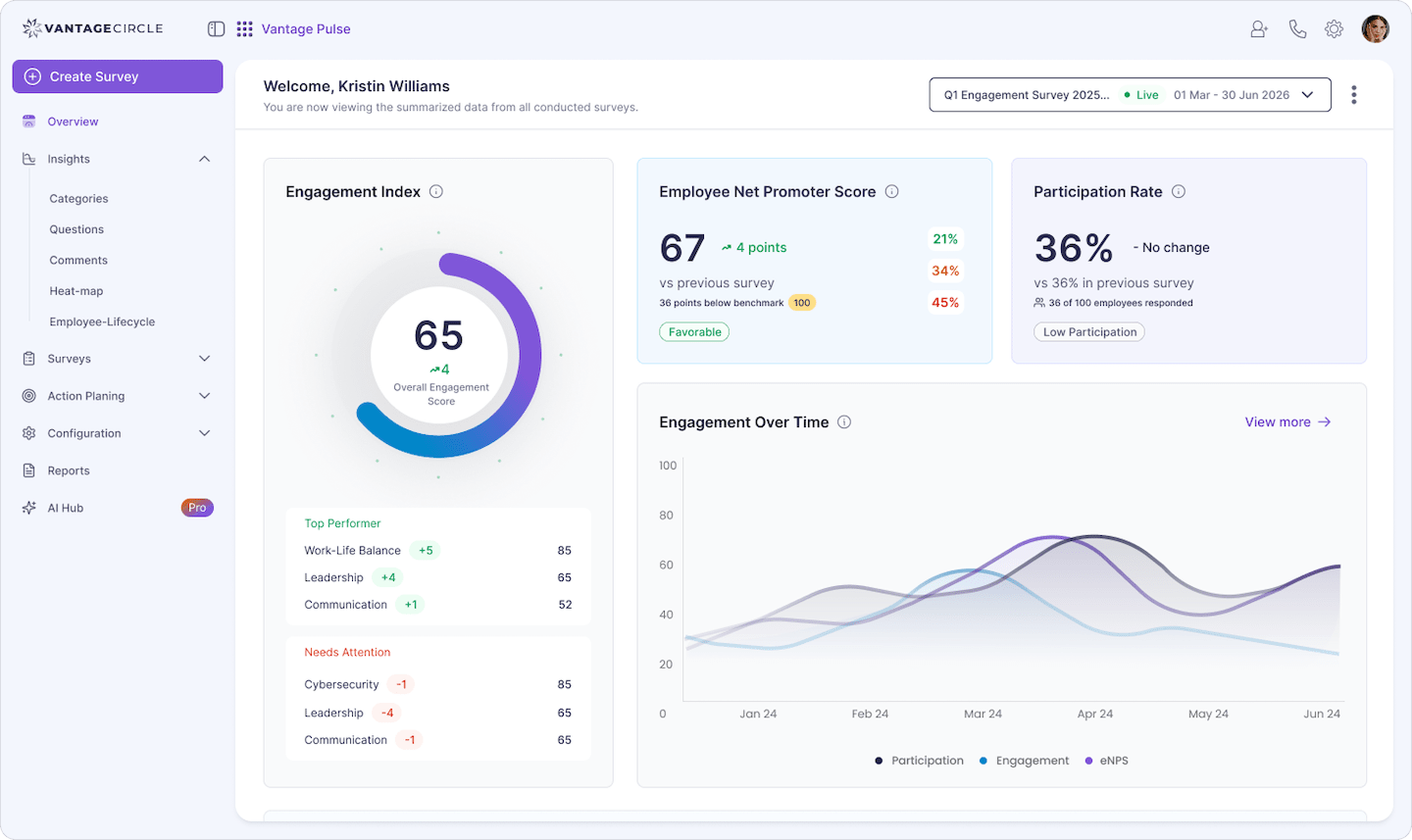
A strategy is only successful if employees actually appreciate it. You must regularly deploy employee pulse survey questions to gauge sentiment. Tools specifically designed for employee listening, like Vantage Pulse , allow HR teams to measure how staff perceive their total rewards through eNPS scores and anonymous feedback, ensuring the strategy can be iterated using real data.
Closing the Communication Gap: Why Employees Don't Know Their Rewards
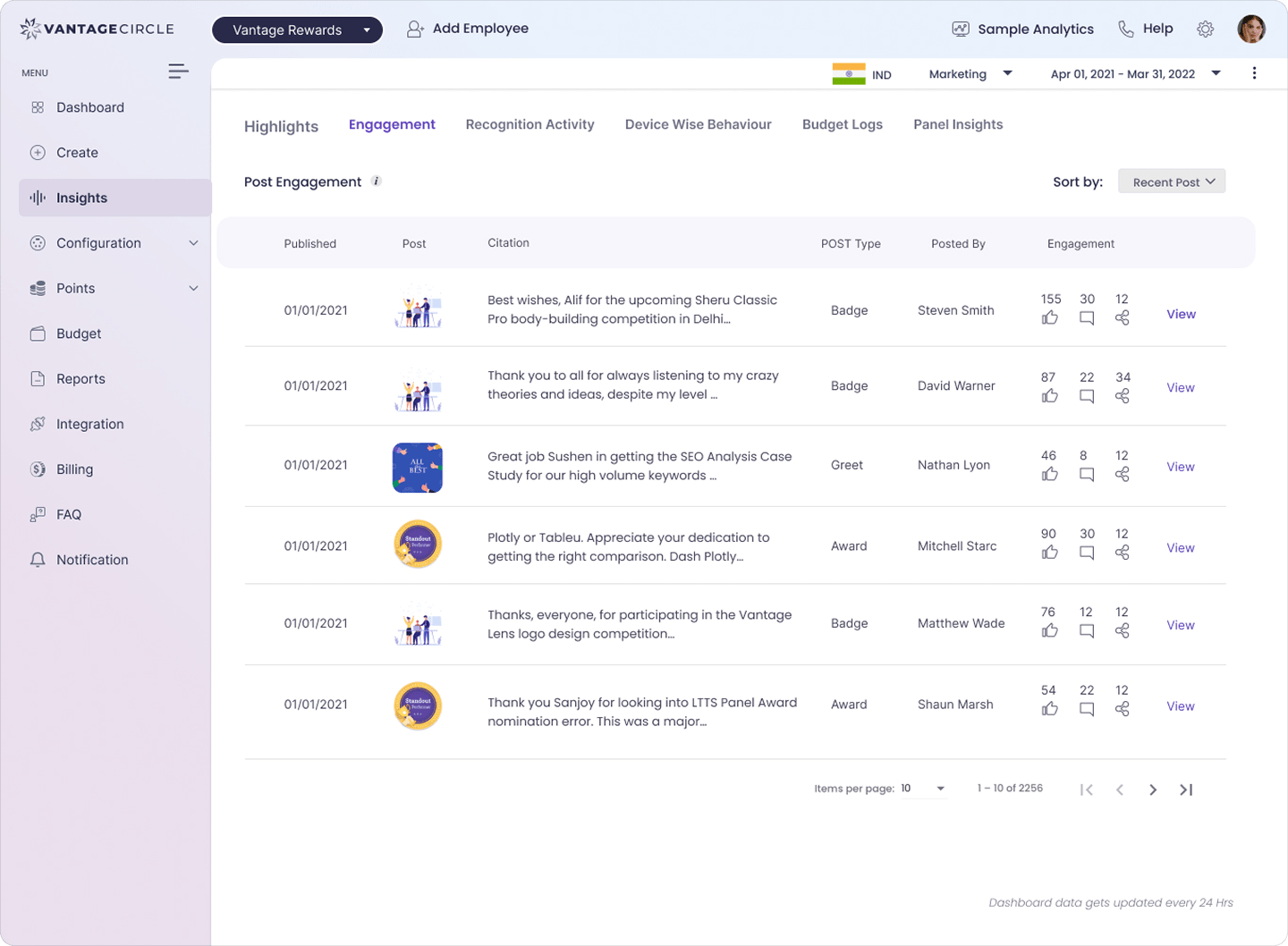
Navigating the benefits system can often feel like a maze, due to complicated portals and scattered login processes. To tackle this issue, organizations need to implement unified tracking systems that help leaders monitor adoption rates, campaign engagement, and the frequency of employee recognition.
A detailed, real-time dashboard provides clear insights into how the strategy is performing, enabling HR teams to step in and make adjustments well before utilization rates dip.
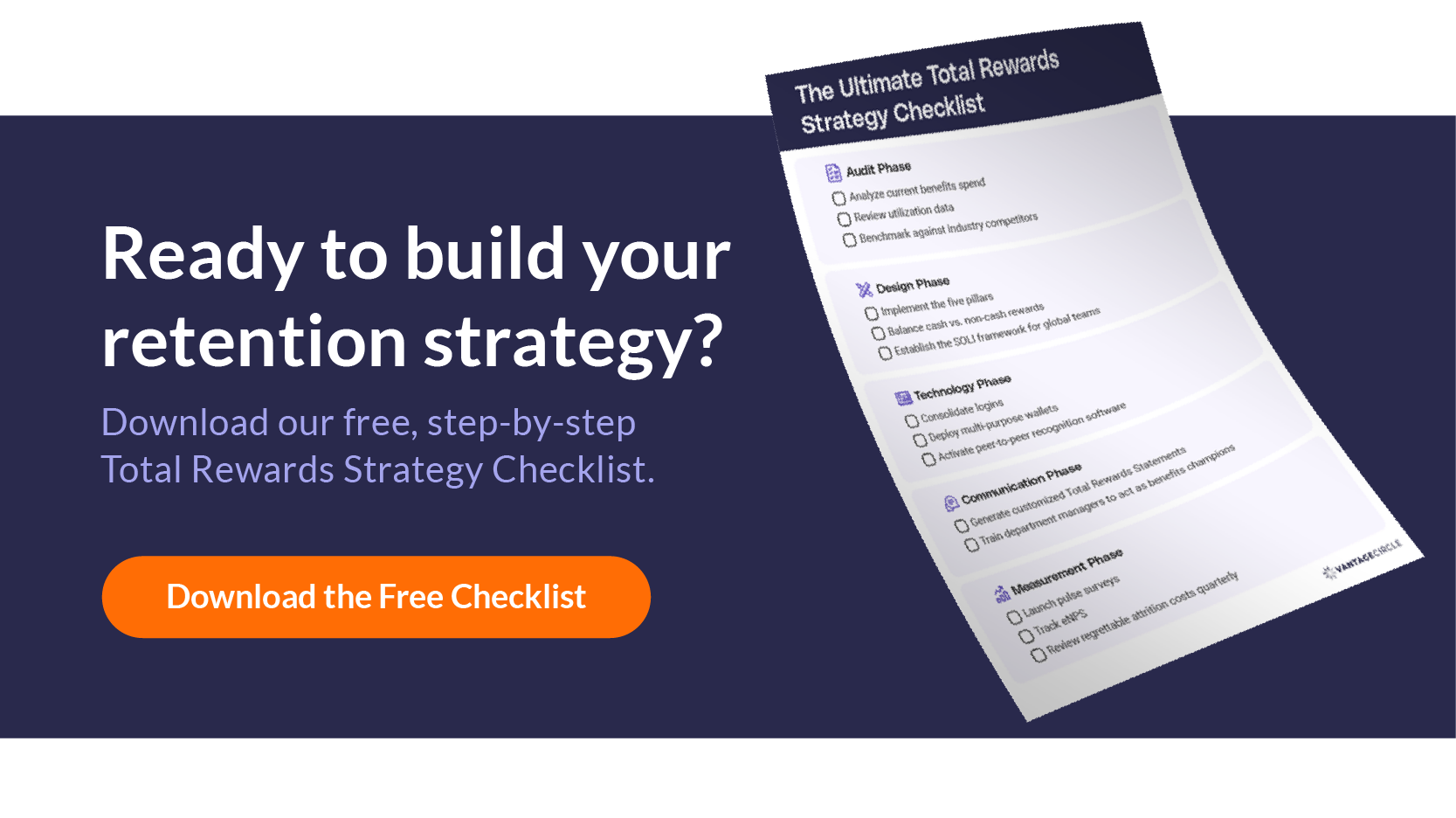
Total Rewards Strategy Checklist
Conclusion
Employee retention is no longer about paying more or fancy recognition programs. It's about designing a system people are reluctant to leave.
When your Total Rewards strategy rewards future commitment, replaces real-life expenses, protects personal boundaries, supports critical life moments, and creates visible growth inside the organization, you change the equation entirely. Leaving no longer feels like a step forward. It feels like a step backward.
The winners of the next decade won't be those who simply outbid the market, but those who build an ecosystem where the cost of starting over elsewhere is higher than the benefit of a new title.
FAQs: Total Rewards & Employee Retention
- What is a total rewards strategy?
A total rewards strategy is a comprehensive HR framework that includes all the investments an employer makes in its employees. It brings together base pay, health benefits, programs for physical and mental well-being, opportunities for career growth, and ways to recognize achievements, all aimed at attracting talent and ensuring long-term retention.
- What are the 5 components of total rewards?
The five components of the total rewards model are compensation, benefits, well-being, career development, and recognition. Together, these pillars create a comprehensive ecosystem that addresses an employee's financial, emotional, physical, and professional needs.
- How does total rewards improve retention?
Total rewards improve retention by embedding employees into an ecosystem that is difficult to replicate. By subsidizing lifestyle costs, protecting mental boundaries, and actively supporting career development, companies make it less tempting for employees to leave, even if another job offers a better salary.
- What is a total rewards statement?
A total rewards statement is a personalized document that gives employees a clear picture of the full financial value of their job. It highlights base pay alongside the hidden monetary value of health insurance premiums, 401(k) matching, wellness stipends, and company-provided perks.
- How do you personalize total rewards for different generations?
Personalizing total rewards involves using a flexible, choice-based system. HR leaders allocate a core benefits package, then provide a stipend or points allowance that Gen Z can use for mental health apps, while Gen X can direct toward eldercare or retirement catch-up plans.
- What is the difference between total rewards and total compensation?
Total compensation refers strictly to direct and indirect financial pay, such as base salaries, bonuses, and stock options. Total rewards is a broader concept that includes compensation, as well as non-financial elements such as peer recognition, flexible scheduling, and clear career advancement pathways.

Shaoni Gupta is a content marketing specialist at Vantage Circle, with expertise in scriptwriting and copywriting in the field of employee rewards and recognition. As a writer, she specializes in creating insightful stories and blogs focused on elevating the employee experience and driving meaningful workplace conversations.
Connect with Shaoni on LinkedIn and X, or reach out to editor@vantagecircle.com for inquiries.