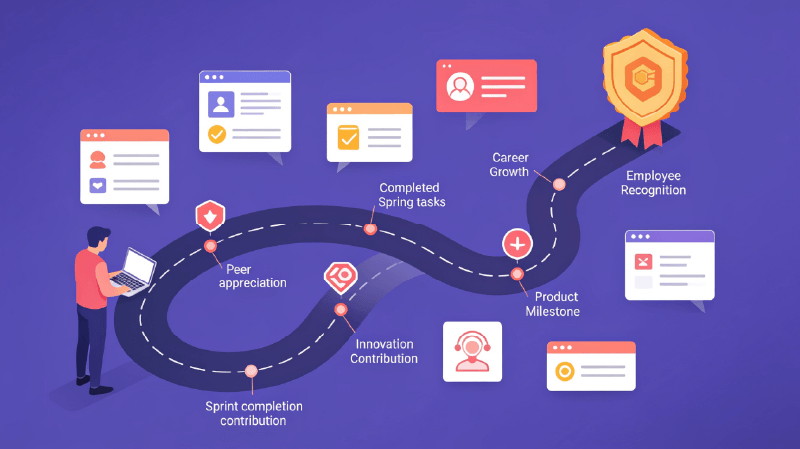


An employee engagement survey only matters if something changes after it. An employee engagement action plan is how you make that change happen: a structured roadmap that turns survey results into specific, measurable actions, each with an owner, a deadline, and a metric. The best plans stay focused on two or three priority drivers, pair every focus area with a concrete initiative, and re-measure with pulse surveys to confirm progress. This guide walks you through a 5-step framework, a 90-day rollout timeline, and a filled-in example you can adapt for your team.
What Is an Employee Engagement Action Plan?
A strong plan has four components:
- Focus areas: The highest-impact survey drivers (typically two or three)
- Initiatives: Specific actions tied to each focus area
- Owners and timelines: Named individuals accountable for each initiative, with deadlines
- Metrics: A measurable target, usually a pulse-survey score, to confirm whether the initiative worked
The plan is not a one-time document. It is a cycle: collect feedback, prioritize the right issues, take visible action, re-measure, and adjust. That loop is where employee trust is built or broken.
Where Most Organizations Get Stuck
Most organizations are better at running surveys than acting on them. They collect feedback, analyze scores, and hold leadership meetings. Then the momentum fades. Insights never become action, and employees notice.
An employee who spent 15 minutes answering honestly about feeling undervalued and ideas that never get heard checks back three months later to find nothing has changed. No follow-up, no visible action. Running a survey without a structured follow-up plan is one of the fastest ways to damage employee trust.
According to Gallup, only 1 in 4 employees globally strongly agree that their opinions count at work. That gap exists because feedback rarely translates into visible change. When employees see their survey responses ignored, they stop participating and stop believing leadership is genuinely listening.
An action plan is what closes that gap. It shows employees that speaking up leads somewhere real. For a broader view of how action plans fit into your overall employee engagement strategies, that guide covers the full landscape.
The 5 Steps of an Employee Engagement Action Plan
Step 1: Analyze the Drivers Behind the Score
Do not lead with the overall number. A drop from 72 to 68 tells you something changed. It does not tell you what to fix.
The real story lives beneath the score. Low engagement in a team almost always links to a specific driver: manager effectiveness, career development, workload, or recognition. The overall score is a symptom. The driver is the cause, and that is where the plan needs to target.
How to read the data: Slice the results across three cuts: team or department, tenure band, and job level. When the same theme surfaces across multiple cuts, that is your focus area. If career development scores are low among employees with two to four years of tenure across multiple departments, that is a systemic issue. If manager communication scores are low only in one region, that is a localized one with a different fix.
Gallup's research shows that highly engaged teams experience 23% better profitability compared to disengaged teams. That improvement comes from acting on the right drivers, not chasing the top-line score.
The score is a starting point, not an answer.
Step 2: Prioritize 2 to 3 Focus Areas Using an Impact vs. Effort Matrix
After analyzing the data, most teams surface 10 to 20 issues worth addressing. Trying to fix all of them at once is how action plans die. Teams spread thin, nothing gets finished, and the momentum that follows a survey collapses fast.
The impact vs. effort matrix keeps the plan to a manageable scope. Plot each initiative on a 2x2 grid:
| Low Effort | High Effort | |
|---|---|---|
| High Impact | Quick wins: start here. Build momentum and make progress visible fast. | Strategic bets: plan carefully and schedule for the next cycle. |
| Low Impact | Fill if bandwidth allows. Not a priority. | Avoid. Drains resources without moving engagement. |
Start with the high-impact, low-effort quadrant. Quick wins build confidence and show employees that change is actually happening. Then move to the high-impact, high-effort initiatives in a later cycle.
Worked example: A team wants to improve recognition to increase morale. Ideas range from a formal peer-bonus system (high effort, requiring budget approval and platform setup) to managers giving more specific, timely praise (low effort, zero cost). Both matter. The matrix makes it obvious which one to start with.
Limit the plan to 2 or 3 focus areas. Word cloud analysis of open-text survey responses helps surface the themes employees mention most, cutting through the noise before you start the matrix exercise.
Step 3: Define SMART Initiatives, Owners, and Timelines
Vague commitments do not move scores. "We will improve recognition" is a wish, not a plan. Every initiative in the action plan needs three things: a SMART goal (Specific, Measurable, Achievable, Relevant, and Time-bound), a named owner, and a deadline.
Vague vs. SMART:
- Vague: "We will focus on career development."
- SMART: "Every employee in the engineering team receives a documented career development plan and a one-on-one career conversation by end of Q2 2026. Owner: Engineering managers. Metric: Career growth score from 48% to 65% on the Q3 pulse survey."
Gallup's research on goal-setting shows that employees involved in setting clear goals are up to 3.6 times more likely to be engaged. The real reason is simpler than the number suggests: when employees see a specific commitment with an actual date, they start believing their feedback mattered.
On ownership: every action needs a person's name, not a team or department. "HR should look into it" means nobody owns it. "Sarah from HR owns the peer recognition program launch by March 15th" means someone is accountable. Diffuse ownership is how plans stall. A name and a date make accountability real.
Some initiatives belong with HR (company-wide programs, policy changes, system rollouts). Most engagement actions belong to line managers, because that is where the employee experience actually lives day to day.
| Responsibility | HR | Manager |
|---|---|---|
| Designing and running the engagement survey | ✓ | |
| Analyzing company-wide results | ✓ | |
| Sharing team-level results breakdown | ✓ | |
| Building the action plan framework and template | ✓ | |
| Defining team-level initiatives | ✓ | |
| Assigning initiative owners and deadlines | ✓ | |
| Tracking progress across teams | ✓ | |
| Running team action-planning sessions | ✓ | |
| Communicating results to leadership | ✓ | |
| Day-to-day initiative execution | ✓ | |
| Running pulse surveys | ✓ | |
| Reporting outcomes and iterating the plan | ✓ | ✓ |
Step 4: Communicate Survey Results and Secure Buy-In
The survey results belong to the employees who gave them. Sharing what you found, and what you plan to do about it, is what separates organizations that build trust from ones that quietly erode it.
Communicate at two levels.
Company level: Leadership shares a summary of the top findings and the 2 or 3 priority focus areas the organization is committing to. Keep it honest. Employees can tell the difference between a genuine response and a filtered summary that avoids the difficult findings. Commit publicly to the priority focus areas, not every issue surfaced, just the ones the organization is actually going to act on.
Team level: Managers share the results relevant to their team and invite the team into the action-planning conversation. Before any open discussion, give everyone five to ten minutes to write down what they think would actually help. Then share ideas and discuss them together. Writing before speaking gives quieter employees the same voice as the most confident person in the room. The solutions that come out of that kind of session are almost always better.
Manager buy-in is the most important variable in whether a plan succeeds. An HR-built plan that managers do not believe in will stall at the team level, which is the level that matters most. Give managers the framework, then let them own the execution for their teams.
Step 5: Re-Measure with Pulse Surveys and Iterate
Three months after launching the action plan, run a short pulse survey targeted at the specific areas you addressed. Not the full annual survey. Five to ten focused questions: "Have you noticed improvements in how recognition is given on your team?" Yes, sometimes, rarely.
The pulse check does two things. It tells you whether the initiatives are working. And it signals to employees that leadership is still paying attention, not just during survey season.
An employee who flagged career development concerns in the annual survey, then received an individual development plan and quarterly career conversations, now gets a pulse question asking whether it actually helped. That follow-up is the difference between feeling heard and feeling managed.
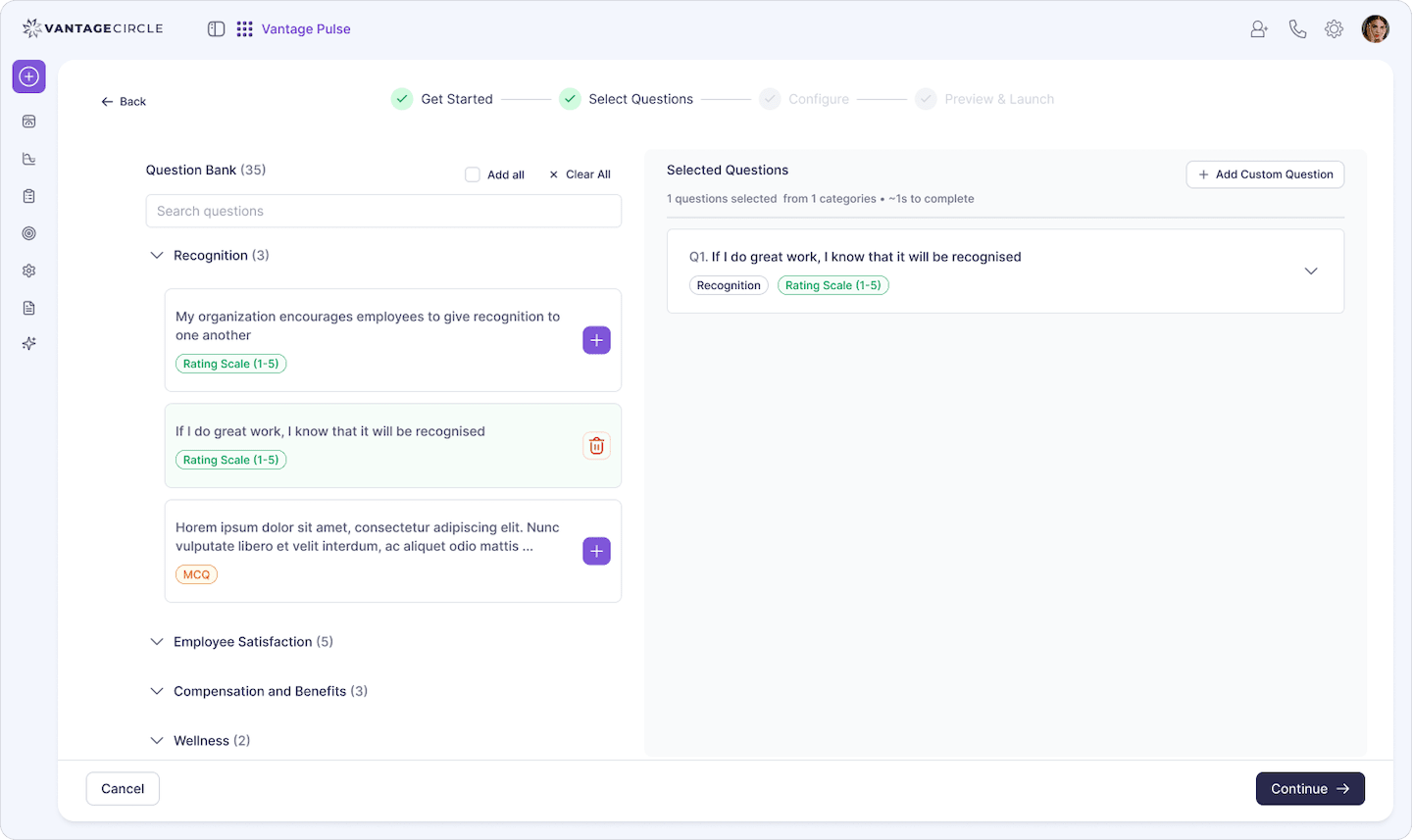
If the pulse shows progress, name it publicly. Employees who raised an issue and can see it being addressed are the most powerful signal you can send to the rest of the organization. If scores are still low, adjust the initiative rather than the metric. Run the cycle again. Each round of feedback, action, and measurement gets the plan closer to what actually works for the specific team running it.
Employee Engagement Action Plan Rollout Timeline
Most action plans stall not because the ideas are wrong, but because nobody agrees on when things happen. This 90-day timeline maps the 5 steps to a calendar so every stakeholder knows what is expected and when.
| Phase | Timeframe | Who | Actions |
|---|---|---|---|
| Analyze | Days 1–7 | HR team | Review full survey results; slice by team, tenure, and level; identify top 2–3 drivers |
| Communicate | Days 8–14 | Leadership + HR | Share company-level findings with all employees; distribute team-level results to managers |
| Plan | Days 15–28 | Managers + HR | Run team action-planning sessions; apply impact vs. effort matrix; assign owners and deadlines for each initiative |
| Launch | Days 29–60 | Initiative owners | Go live on all initiatives; first owner check-in at the 30-day mark |
| Pulse Check | Days 61–90 | HR + Managers | Run a 5–10 question pulse survey on the specific focus areas; review scores against baseline targets |
| Iterate | Day 90+ | HR + Leadership | Name what improved publicly; adjust initiatives that did not move the score; begin the next cycle |
What typically goes wrong at each phase:
- Analyze: Teams skip the driver breakdown and react to the headline score
- Communicate: Results are shared once and never revisited
- Plan: Initiatives get assigned to teams instead of named individuals
- Launch: No 30-day check-in, so stalled initiatives go unnoticed for weeks
- Pulse Check: The full annual survey is re-run instead of a targeted pulse: too slow, too broad
Employee Engagement Action Plan Example (Filled-In Sample)
The scenario: a mid-size technology company ran its annual engagement survey and found manager communication scores at 52%, recognition satisfaction at 58%, and career development scores at 48%. All three fell below the 65% baseline target. Here is what their 90-day action plan looked like.
| Focus Area | Root Cause | Initiative | Owner | Timeline | Metric | Status |
|---|---|---|---|---|---|---|
| Manager Communication | Managers not sharing project updates, decisions, or team goals consistently | Weekly 15-minute structured team stand-ups; two-session manager communication workshop | Head of HR + all line managers | By September 30, 2026 | Manager communication score from 52% to 70% on Q4 pulse survey | In Progress |
| Recognition and Feedback | No structured peer or manager recognition practice; generic "great job" feedback common | Peer-to-peer recognition channel in MS Teams; manager training on behavior-specific praise | HR Manager | By August 15, 2026 | Recognition satisfaction from 58% to 72% on Q4 pulse survey | Not Started |
| Career Development | No documented career pathways; employees with two to four years of tenure rate growth opportunities as poor | Individual development plans for all employees; quarterly career conversations with managers | L&D Lead + Line Managers | By December 31, 2026 | Career growth score from 48% to 65% on Q1 2027 pulse survey | Not Started |
After 90 days: the manager communication initiative moved the score from 52% to 64%. That fell short of the 70% target but showed clear progress. The company kept the target at 70% and extended manager training to include a third session focused on running structured team retrospectives.
Action Plan Ideas by Focus Area
The framework matters. So do the actual initiatives inside it. These are proven ideas that move engagement scores and make a visible difference in how employees experience work.
1. Recognition and Appreciation Initiatives
Employees do not work only for pay. They work to feel that what they do holds value. When employee recognition is absent, engagement drops quietly, and then suddenly.
Peer-to-peer shoutouts: Integrate your recognition platform with MS Teams or Slack. Real-time appreciation does not wait for performance reviews, and when it comes from a colleague, it lands as genuine.
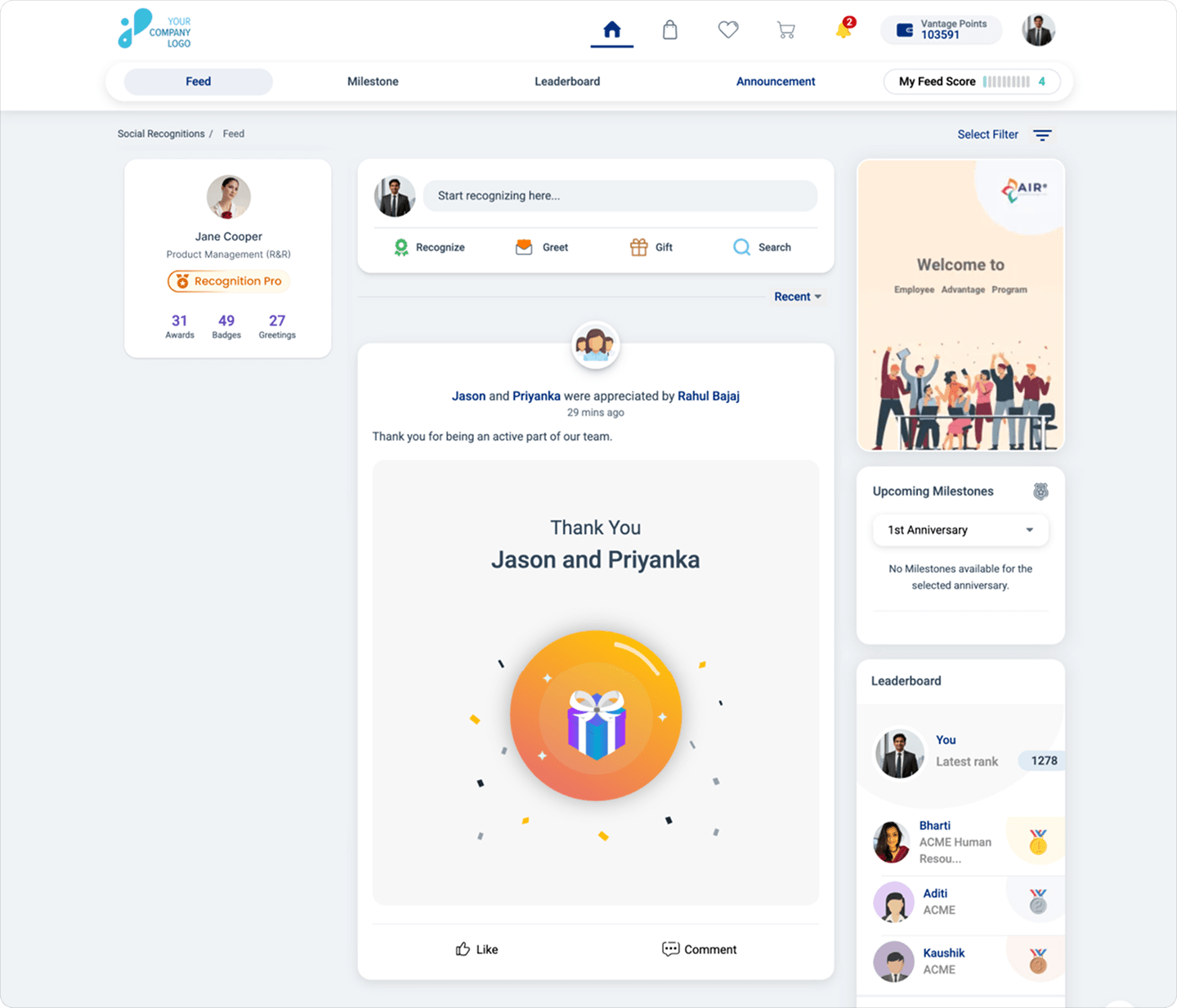
Manager recognition training: Teach managers that "great job" holds no weight. Specific, timely recognition does. "Your presentation clarified our pricing strategy for the entire sales team" is the kind of acknowledgment that reinforces the behavior and makes it more likely to repeat.
Milestone celebrations: Note work anniversaries, project completions, and personal wins. Digital yearbooks where colleagues share messages for a peer's work anniversary are a low-cost, high-impact way to make people feel seen.
Related read: Marking The Moment: 9 Special Ways To Celebrate Employee Milestones
Monthly recognition roundups: Share wins in team meetings or newsletters. This normalizes appreciation and makes invisible contributions visible across the team.
Gallup's research on recognition shows that regular, authentic recognition significantly strengthens employees' sense of belonging and connection to organizational culture. The cost of a peer shoutout is near zero. The cost of employees who feel invisible shows up in attrition data.
Related read: Empower the Workforce With a Culture of Peer-to-Peer Recognition
2. Professional Development Initiatives
Employees who do not see a path forward eventually stop trying to build one inside your organization.
Mentorship circles: Pair employees across departments for quarterly mentorship sessions. Cross-functional knowledge sharing is low cost and has a high impact on retention.
Gig projects: Allow employees to spend 10 to 15 percent of their time on projects outside their core role. It builds skills without formal training programs and breaks the routine that contributes to disengagement.
Skill-sharing sessions: Monthly lunch-and-learn sessions where employees teach what they already know. This turns existing talent into a development resource without a training budget.
Documented career pathways: Remove the mystery from advancement. When employees can see what it takes to move from junior to senior, they see a future inside the organization rather than just a current job.
Gallup's State of the Global Workplace report found that only 30% of employees strongly agree that someone at work encourages their development, and that number has been falling. Organizations that address this gap systematically, through documented pathways and regular career conversations, consistently outperform those that leave development to chance. Most of what moves development scores costs less than a training budget line item. It takes someone deciding it matters and following through on it.
3. Wellness and Work-Life Initiatives
Burnout does not announce itself. By the time it is obvious, the employee is already preparing to leave.
No-meeting time blocks: One morning per week where calendars stay clear. Deep-focus work that gets interrupted in back-to-back meeting days finally gets done, and the relief is noticeable within weeks.
Flexible work hours: Not every employee works best from 9 to 5. Some think clearest early in the morning; others do their best work in the evening. Trusting people to know when they do their best work costs nothing and signals respect.
Mental health days: Designated days for employees to rest and reset, separate from sick leave. The signal that the organization sees mental health as a legitimate priority matters as much as the days themselves.
Walking meetings: Get people out of conference rooms. Ideas often surface differently when people are moving, and conversations feel less formal and more candid.
4. Communication Initiatives
Trust erodes when employees feel left in the dark, hearing about changes through rumor before they hear from leadership.
"Ask Me Anything" sessions: Once a month, executives answer real questions from employees directly. No scripts. When someone asks about the layoff rumors circulating in the hallway, addressing it directly (explaining the context, saying what is known and what is not) matters more than a polished answer. Employees do not expect leadership to have everything figured out. They expect to be treated like adults.
Transparent updates: Share company performance, challenges, and decisions with employees on a regular cadence. Employees handle reality far better than silence.
Open-door policies that work in practice: Managers make specific, recurring time available. "My door is always open" means nothing without calendar availability to back it up.
When communication flows freely, trust builds. When it does not, assumptions fill the void, and assumptions are rarely kind.
How to Make Sure Your Action Plan Succeeds Long-Term
Why Manual Action Plans Fail
The pattern is familiar. HR builds a well-structured spreadsheet with columns for actions, owners, deadlines, and status. It goes out to fifteen managers with a subject line: "Q1 Engagement Action Plan: Please Update Weekly."
Week one, three managers update their rows. Week two, one does. By week four, the spreadsheet is buried in everyone's inbox and nobody has touched it in weeks.
This is spreadsheet fatigue. Managers are not indifferent to the plan. They are drowning between meetings, projects, and daily operational demands. Updating a tracker feels like homework added to a full workload. HR spends Tuesday mornings sending the same chaser: "Hi team, just checking on the action plan status..." Managers feel guilty for not responding. Nobody is happy, and nobody is making progress.
Static PDFs are worse. Someone downloads it once, glances at the first page, and then it disappears into a downloads folder.
The core problem is structural: there is no accountability built into a static document. No automatic reminders. No way for HR to see what is happening without manually asking everyone. So the plan dies quietly, and employees who gave honest survey feedback conclude that nothing ever changes.
How a Platform Closes the Loop
When the action plan lives in a platform, the system handles the logistics. A manager gets a notification: "Your career development initiative check-in is due this week." They click, add a quick update, done in two minutes. HR logs in and sees the full picture: what is on track, what needs support, what has stalled. No chaser emails sent.
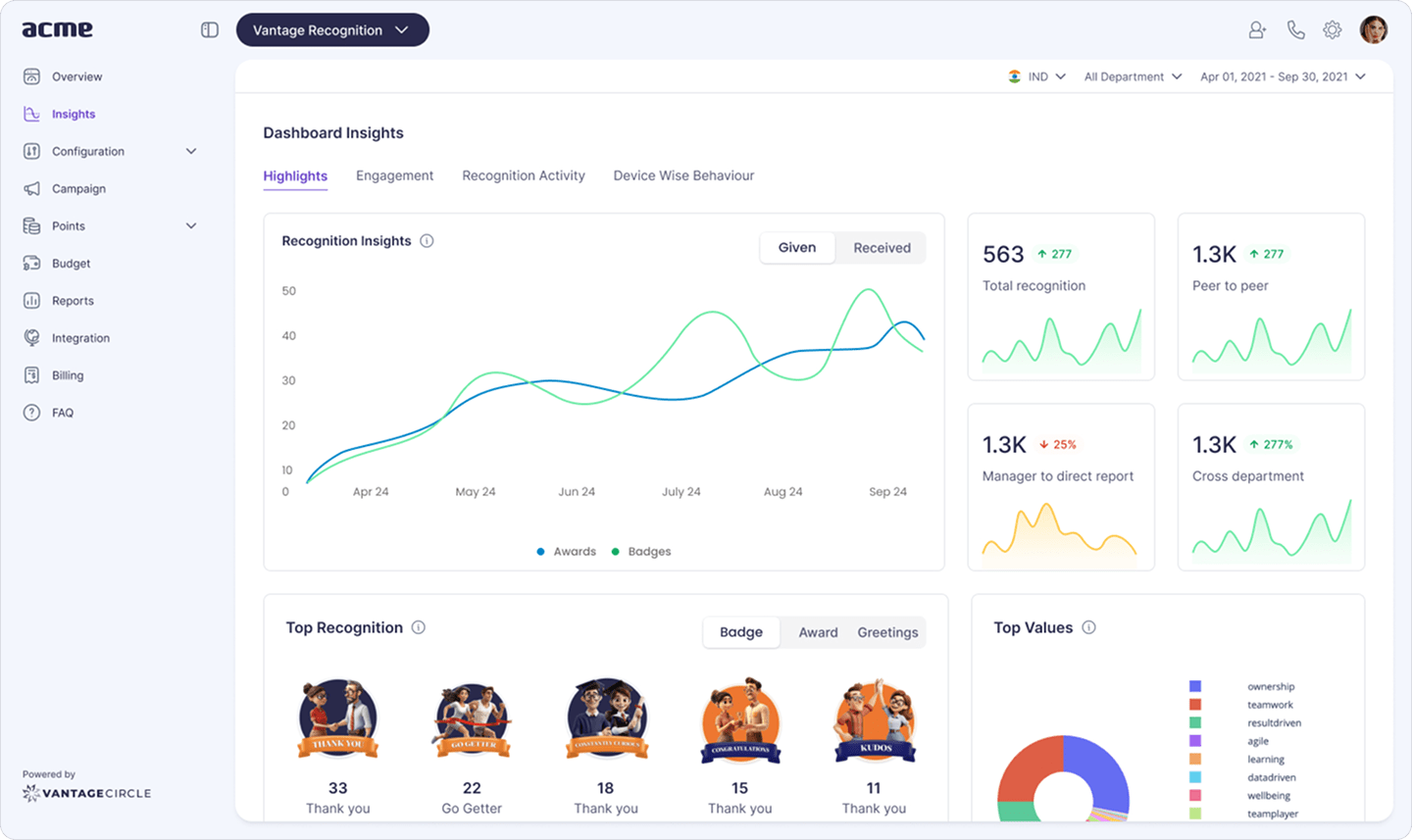
Vantage Circle connects the full loop. Vantage Pulse collects the survey data and surfaces the drivers. Vantage Recognition and Perks operationalize the recognition and wellness focus areas. Pulse analytics then confirm whether each initiative actually moved the driver it was designed to target.
The tracking happens in the background. People focus on the actual work of improving things rather than maintaining a spreadsheet about improving things.
See it in action: Book a Vantage Pulse demo
Frequently Asked Questions
1. What are the 5 C's of employee engagement?
The 5 C's of employee engagement are Connection, Communication, Congratulate, Collaboration, and Care. Connection is the sense of belonging employees feel within their teams and the broader organization. Communication covers how openly leadership shares information and listens to feedback. Congratulate reflects the role of recognition in making employees feel valued. Collaboration is about how well teams work together toward shared goals. Care addresses whether managers and the organization genuinely support employee wellbeing. See Unlocking the 5 C's of Employee Engagement for the full breakdown.
2. What are the 5 steps of an action plan?
The 5 steps of an employee engagement action plan are: (1) Analyze the drivers behind the engagement score, not just the overall number. (2) Prioritize 2 to 3 focus areas using an impact vs. effort matrix. (3) Define SMART initiatives with named owners and deadlines for each focus area. (4) Communicate survey results to employees and secure manager buy-in. (5) Re-measure with a targeted pulse survey after 60 to 90 days and iterate based on what the data shows.
3. What is a good action plan example?
A good action plan example starts with a specific finding from the survey. For instance: manager communication scores dropped to 52% in Q2. The action plan identifies the root cause (managers not sharing updates or team goals consistently), sets a SMART initiative (weekly 15-minute team stand-ups and a two-session communication workshop), names an owner (Head of HR and all line managers), sets a deadline (by September 30), and defines a metric (communication score from 52% to 70% on the Q4 pulse survey). The filled-in sample table in this guide shows a complete three-focus-area example using this structure.
4. Who should own the employee engagement action plan?
Ownership is split between HR and managers. HR owns the process: designing the survey, analyzing results, building the action plan framework, tracking cross-team progress, and running pulse surveys. Managers own the execution: sharing team-level results, running action-planning sessions with their teams, defining initiatives, assigning owners, and following through on day-to-day delivery. An action plan that sits entirely with HR will stall at the team level. One that sits entirely with managers loses consistency and accountability. The HR vs manager responsibility table in Step 3 of this guide is the most practical starting point.
5. How long does an employee engagement action plan take?
The active planning phase takes two to four weeks from the time survey results are shared. The first round of initiatives typically runs over 60 to 90 days, followed by a targeted pulse survey to measure progress. A complete cycle (survey, plan, execute, measure, iterate) runs approximately four to six months. Organizations that run this cycle twice a year see the most consistent improvement in engagement scores over time.
6. How do you measure the success of an employee engagement action plan?
Success is measured by whether the specific drivers you targeted actually improved. Run a pulse survey three months after launching the action plan, using 5 to 10 questions focused on the exact focus areas, not a full re-run of the annual survey. Compare scores to the baseline from the original survey. A successful plan shows a measurable score increase on the targeted drivers. Secondary signals include higher participation rates in the next survey cycle, lower voluntary attrition in the teams where initiatives ran, and qualitative feedback from managers that the team conversation has shifted.
Conclusion
Employee engagement surveys reveal what is not working. An action plan is how you fix it.
The 5 steps are clear: analyze the real drivers, prioritize focus areas, define SMART goals with named owners, communicate openly, and re-measure with a pulse survey. The rollout timeline tells you when. The filled-in example shows you what it looks like in practice.
Start with one cycle. Build the habit of closing the loop. Over time, the survey stops being a once-a-year ritual and becomes the beginning of an ongoing conversation between employees and the organization. That shift is where engagement actually moves.
Written by