Table Of Content
- What Is Gamification in Employee Recognition?
- How Gamification Improves Recognition Programs?
- Solves the Frequency Problem
- Makes Contribution Visible
- Drives Platform Adoption
- Reinforces Values, Not Just Performance
- 15 Gamification Ideas for Employee Recognition
- Recognition Mechanics
- Campaign & Challenge Mechanics
- Milestone & Achievement Mechanics
- The Psychology Behind Gamification (And When It Fails)
- Inclusive Gamification Design
- 5-Metric Measurement Framework
- 1. Peer-to-Peer Recognition Ratio
- 2. Recognition Frequency
- 3. Platform Adoption Rate
- 4. eNPS Before and After
- 5. Voluntary Turnover Rate
- Conclusion
- FAQ
- What is Gamification in Employee Recognition?
- What are the real benefits of Gamifying Recognition?
- What are the best Gamification Ideas for Employee Recognition?
- Can Gamification feel Fake or Forced?
Most employee recognition programs fail. Not because the idea is wrong, but because the execution is boring, forgettable, and utterly uninspiring.
Think about your current recognition program, if you even have one. How many times this month have you seen meaningful recognition happening? How many employees can name the last time they felt genuinely appreciated at work? How often do managers actually use that recognition platform you invested in?
This is the problem gamification was designed to solve, but it doesn't turn work into a video game. Instead, it uses the parts of games that people find engaging, like being able to see your progress, knowing your effort adds up over time, and getting recognized right away for what you do.
In this blog, we'll break it all down for you. From why gamification works to when to use it, we'll also give you a set of gamified employee recognition ideas you can start using right away.
What Is Gamification in Employee Recognition?
Gamification in employee recognition involves incorporating game-like elements such as points, badges, and leaderboards to make appreciation more visible, engaging, and rewarding.
Implementing gamification in recognition brings fun and playfulness into the daily grind. It effortlessly brings the elements of scoring, competition, and achievements found in games into the workplace.
This approach taps into basic human psychology that is rooted in our natural desire for recognition, competition, and accomplishment. This triggers a dopamine response in the brain reinforcing positive behavior.
But here is the critical distinction most guides miss — gamification is a delivery mechanism, not a replacement for recognition culture.
A gamified system built on top of a weak recognition culture will not fix the culture. It will just create a more visible version of the same problem. The mechanics work when the underlying intent is already there.
To Know More. Read: How to Use Gamification in the Workplace Effectively
How Gamification Improves Recognition Programs?
Solves the Frequency Problem
The single biggest reason recognition programs fail is that recognition happens too rarely. Annual reviews, quarterly shout-outs, and "Employee of the Month" once cannot build a recognition culture. Gamification fixes this by making recognition easier to give and more rewarding to receive, turning a periodic gesture into a daily habit.
Makes Contribution Visible
In most organizations, great work disappears into inboxes and Slack threads. Gamified recognition surfaces it publicly. When a badge appears on someone's profile, when a peer's name rises on a leaderboard, when a recognition post gets reactions from colleagues across departments, it becomes visible at scale.
Drives Platform Adoption
Recognition platforms fail when employees do not use them. Gamification changes the adoption equation by giving employees a reason to log in beyond obligation. When the platform itself is engaging, adoption follows.
Reinforces Values, Not Just Performance
The most sophisticated use of gamification is not rewarding output. It is reinforcing the behaviors that reflect company values. Badges tied to specific values make culture visible and repeatable.
According to Vantage Circle's State of Recognition 2025 report, 60% of high-effectiveness program leaders use escalating, value-tied badge structures, compared to just 13% of lower-effectiveness programs. The difference between decorative badges and behavioral ones is the difference between a feature and a culture tool.
15 Gamification Ideas for Employee Recognition
Recognition Mechanics
1Social Leaderboard
A real-time leaderboard that tracks recognition activity showing who is giving recognition, who is receiving it, and which teams are most engaged. Make it visible on your intranet or recognition platform.
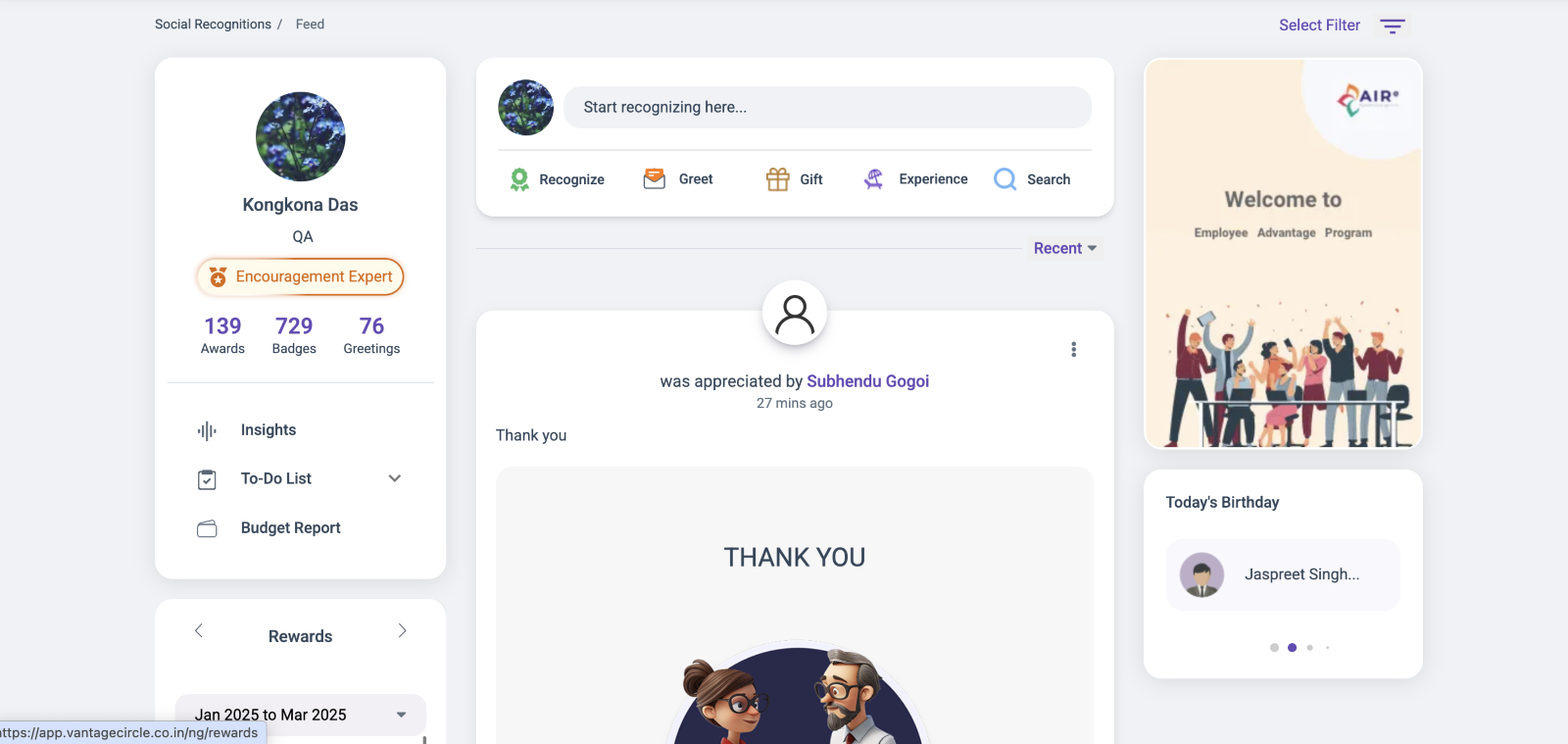
2Core Value Badges
Create a set of badges, each tied to a specific company value, and award them when someone demonstrates that value through observable behavior. Not generic "great job" badges but specific ones like "Customer First," "Innovator," and "Culture Builder."
Source: Vantage Recognition
3Activity-Based Platform Badges
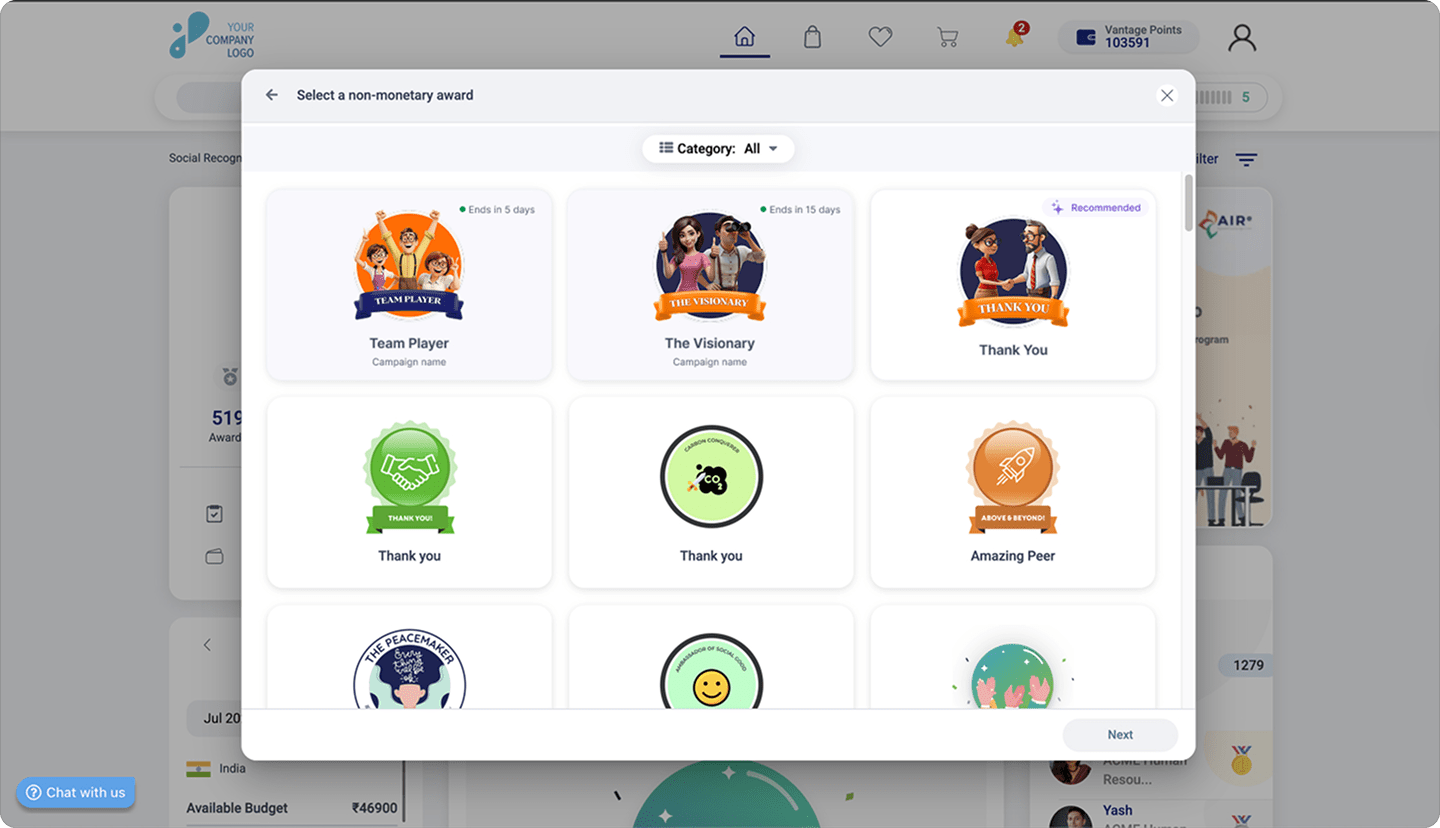
Most badge systems reward receiving recognition. Flip it. Award badges for giving recognition or completing a first peer nomination. You can also reward employees for recognizing someone in a different department for the first time. This gamifies the act of appreciating others and builds a habit of recognition-giving across the organization.
4Peer Kudos Points
Let employees earn points every time they send genuine peer recognition. Points accumulate and can be redeemed for rewards or simply serve as a visible signal of who consistently lifts others up. When giving recognition comes with a small reward for the giver, participation accelerates.
5Recognition Relay
One person recognizes a colleague, then nominates that person to recognize someone else within 24-48 hours. The relay continues as long as people keep passing it forward. Everyone in the chain earns a special "Relay" badge.
This creates cross-functional visibility. When the relay jumps from Tech to Sales to Customer Success, it breaks silos and makes collaboration visible in a way that standard recognition feeds rarely do.
Campaign & Challenge Mechanics
6Onboarding Quests
Turn the first 90 days into a gamified journey with milestone badges at 30, 60, and 90 days. Let new hires earn badges for completing onboarding tasks, meeting team members across departments, and hitting their first performance milestone.
This reduces the anxiety of starting something new by giving structure and visible progress. It also ensures new employees are recognized early — when the impact of recognition on retention is highest.
7Wellness Challenges

Source: Vantage Fit
Integrate wellness activities such as step targets, hydration tracking, and meditation minutes into the recognition ecosystem. Employees earn points for completing challenges, and team-based competitions build community around health.
8Innovation Points
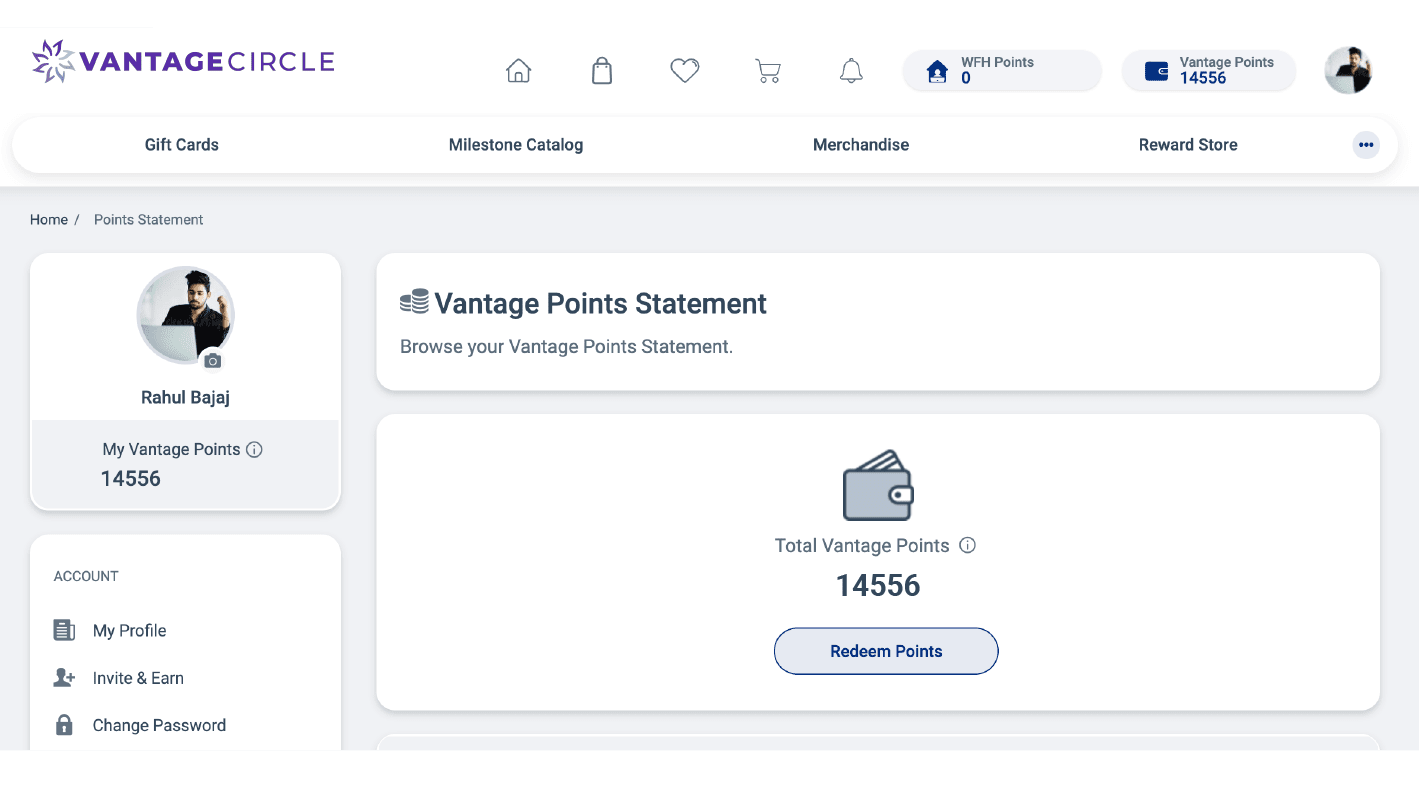
Award points for submitting ideas, not just for ideas that get implemented. If employees only earn recognition when their idea is selected, most people will never submit at all.
Reward the behavior of contributing, not just the outcome. Create a simple tiered structure. For instance, you can provide points for any submission, additional points for participating in feedback rounds, and bonus points if the idea is shortlisted.
9Campaign Badges
Time-limited recognition campaigns such as Women's Day, Friendship Day, Founder's Day, and Sustainability Month drive engagement spikes that keep recognition fresh throughout the year. They also give employees a prompt and a reason to recognize colleagues they might not interact with daily.
Tata Motors saw a 105% surge in peer recognition during a Women's Day campaign. IBS Software recorded 6 times the monthly average in recognitions during their Friendship Day campaign.
10Monthly Sender Leaderboard
A leaderboard that ranks recognition givers, not receivers. Who gave the most recognition this month? Who recognized the most people across different departments?
Reset it every month. The reset is as important as the leaderboard itself. It gives every employee a fresh chance at the top, prevents permanent winners from dominating, and keeps the competition feeling fair.
Milestone & Achievement Mechanics
11Tiered Award Names
Move beyond flat "good job" recognition. Create escalating award tiers that carry increasing weight — like Spark Award, Rising Star, Excellence Award, CEO's Choice. Each tier requires more specificity and carries more visibility.
Vantage Circle's State of Recognition 2025 data shows 60% of high-effectiveness program leaders use tiered award structures, compared to 13% in lower-effectiveness programs. Tiers create aspiration. They give employees something to work toward.
12Personalized Achievement Journeys
Each employee builds a longitudinal recognition profile over time: a visual record of the badges earned, values demonstrated, milestones reached, and peer recognitions received. Not a snapshot. A story.
This is particularly powerful during performance reviews, promotion conversations, and career development discussions. The profile becomes evidence of contribution, not just a list of past awards.
13Long Service Award Gamification
Service milestones should not be a generic email with a gift card link. Gamify them with personalized yearbooks built from recognition moments over the employee's tenure and social posts that invite colleagues to comment and celebrate.
14Manager "Golden Kudos"
When something is limited, it carries more weight. Give each manager one high-visibility recognition token per month that carries extra points, a distinctive badge, and company-wide visibility. The scarcity is intentional. It signals that this is not routine recognition. It is a manager's highest endorsement.
15Spotlight Spin-the-Wheel
A randomized draw for recognition givers. Employees who gave recognition during the week or month are entered into a pool. A winner is drawn and rewarded with bonus points, a premium badge, or a small perk.
The randomness creates excitement around giving recognition because anyone could win. Variable reward schedules are one of the most powerful behavioral levers in psychology.
The Psychology Behind Gamification (And When It Fails)
Understanding why gamification works also explains when it will not.
Overcomplicate Rules: The more complex your gamification system, the less people will use it. Multi-tier badge hierarchies and convoluted redemption systems cause adoption to plummet. People don't participate in things they don't understand.
Social Comparison Theory: People naturally compare themselves to others. Leaderboards tap into this instinct. The key is ensuring the comparison is aspirational, not demoralizing. Leaderboards where the top five are always the same people do not inspire. They discourage.
The Overjustification Effect: When external rewards replace intrinsic motivation, people can become less motivated to do the thing they originally enjoyed. This is where poorly designed gamification destroys recognition culture. If employees only recognize each other to earn points, and the points disappear, so does the recognition.
Favoritism: Nothing kills motivation faster than a recognition system that feels rigged. When the same five people dominate every leaderboard, win every badge, and receive every spotlight, the other 95% of your workforce mentally checks out. They look at the system and think: "Why bother?"
Inclusive Gamification Design
Leaderboards have an inclusion problem. They tend to favor employees who are naturally extroverted, highly visible, or digitally connected. Introverts, mid-ranking contributors, and frontline workers without regular platform access are systematically disadvantaged.
Part of that gap is structural. Recognition programs are often designed for desk workers and extend poorly to factory floors, retail locations, and field teams.
To address this, here are five principles for designing inclusive, gamified recognition:
- Make leaderboards opt-in, not default. Employees who prefer not to compete publicly should not be forced to.
- Use team-based competition alongside individual rankings. Teams naturally include more people in the win.
- Rank recognition givers, not just receivers. The Monthly Sender Leaderboard rewards behavior anyone can exhibit, not just those whose roles generate high visibility.
- Award activity badges for platform participation, not just performance achievements. This gives every employee a path to recognition.
- Ensure mobile and kiosk access for employees without desktop devices. Use a phygital approach — combining digital platforms with physical recognition cards — to ensure frontline employees are included in every campaign.
5-Metric Measurement Framework
1. Peer-to-Peer Recognition Ratio
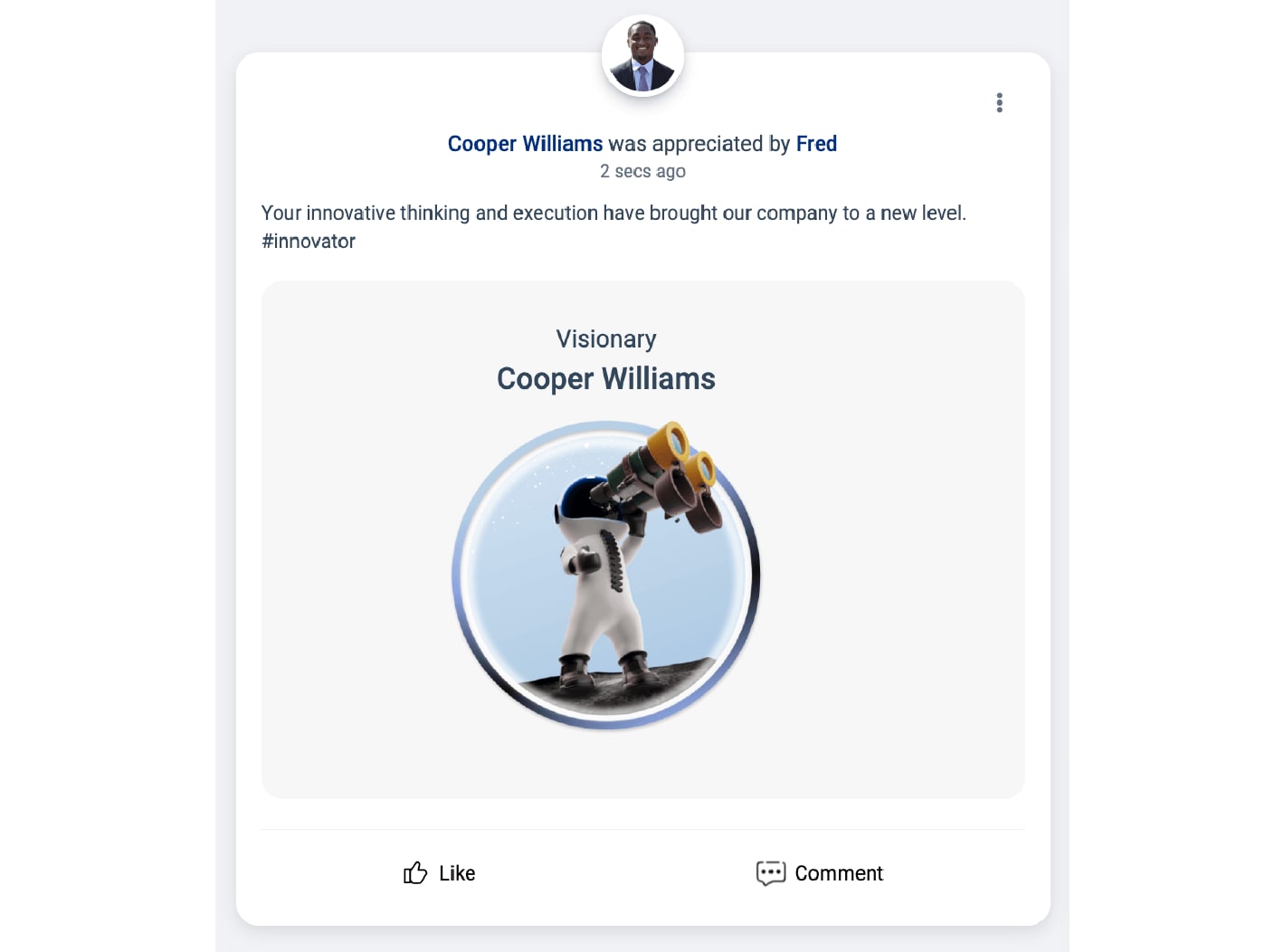
What percentage of total recognition is peer-driven versus manager-driven? A healthy program has strong peer-to-peer participation because it means employees are internalizing the behavior of recognition, not just waiting for managers to initiate it.
Tata Motors saw a 2x increase in non-monetary versus monetary recognition. IBS Software saw a 198% increase in peer-to-peer recognition. Tata Communications saw a 185% surge in peer non-monetary recognition over five years.
2. Recognition Frequency
How often is recognition happening? Measure recognitions per employee per month, then calculate the average interval between recognition events across the organization. If your frequency is 1 recognition per employee per quarter, you do not have a recognition program. You have a recognition event.
3. Platform Adoption Rate
What percentage of employees are actively using the recognition platform each month? Track registered users and active users separately. Low adoption means the system is not reaching the people it is designed for. Investigate whether the barrier is access, awareness, or design.
4. eNPS Before and After
Run employee eNPS (Net Promoter Score surveys) at baseline, then at 90 days, 6 months, and 12 months post-launch. eNPS is a proxy for overall engagement and trust in the organization. Recognition programs, when they work, move this number.
However, do not expect dramatic shifts in 30 days. Look for consistent directional movement over 6-12 months.
5. Voluntary Turnover Rate
Recognition is a retention lever. Measure voluntary attrition in the 12 months before and after launching a gamified recognition program. Recognition-driven cultures show 92% retention rates compared to 76% in low-recognition cultures, according to Vantage Circle's AIRe Report.
Conclusion
We've looked at the different elements that bring gamification to life. But the real power isn't in the system you build; it's in the genuine appreciation you foster. The organizations that get this right do not treat gamification as a feature to switch on. They treat it as a design discipline: one that requires inclusive mechanics, specific value alignment, measurement discipline, and the understanding that no leaderboard will fix a culture that does not already care about recognizing people.
FAQ
What is Gamification in Employee Recognition?
Gamification in employee recognition applies game-like elements such as challenges, points, badges, and leaderboards to make contributions more visible. It is a delivery mechanism for appreciation, not a substitute for it.
What are the real benefits of Gamifying Recognition?
The primary benefits are higher recognition frequency, broader participation across the workforce, increased platform adoption, and stronger alignment between recognition and company values.
What are the best Gamification Ideas for Employee Recognition?
The highest-impact ideas are those that reward giving recognition (not just receiving it), tying badges to specific company values, using time-limited campaigns to drive engagement spikes, and gamifying service milestones.
Can Gamification feel Fake or Forced?
Gamification can feel fake when the mechanics are disconnected from genuine appreciation or when the same people win every time.

This article is written by Shikha Gogoi. Shikha Gogoi is a Content Marketing Specialist focused on SEO-driven content around employee engagement, recognition, and workplace culture, helping build people-first workplaces.
Connect with Shikha on LinkedIn.