










Understanding Survey Fatigue and How to Avoid It

A Global Employee Recognition and Wellness Platform
I was finishing up a report on a Tuesday afternoon when another survey request landed in my inbox. “Quick pulse check on workplace satisfaction.” I glanced at it, minimized the tab, and kept going. I had three meetings left and a deadline in two hours.
Two days later, I archived it without opening it. The same thing had happened with the last two surveys. A few months ago, I would have filled them out during lunch. After the third manager effectiveness survey and the fifth benefits feedback form, I stopped making time for it because feedback rarely led to anything employees could see.
That pattern has become common at work. Microsoft’s Work Trend Index research found that 48% of employees and 52% of leaders say work feels chaotic and fragmented. In that environment, surveys that feel repetitive or disconnected from action get ignored fast.
This blog defines survey fatigue, breaks down its root causes, shows the warning signs, and shares eight practical ways to prevent it so your feedback stays credible and usable.
Key Takeaways
- What is Survey Fatigue?
- 4 Reasons your Surveys are Dying
- Signs your Organiation has Survey Fatigue
- 8 Practical tips to Avoid Survey Fatigue
- Conclusion
What Is Employee Survey Fatigue?

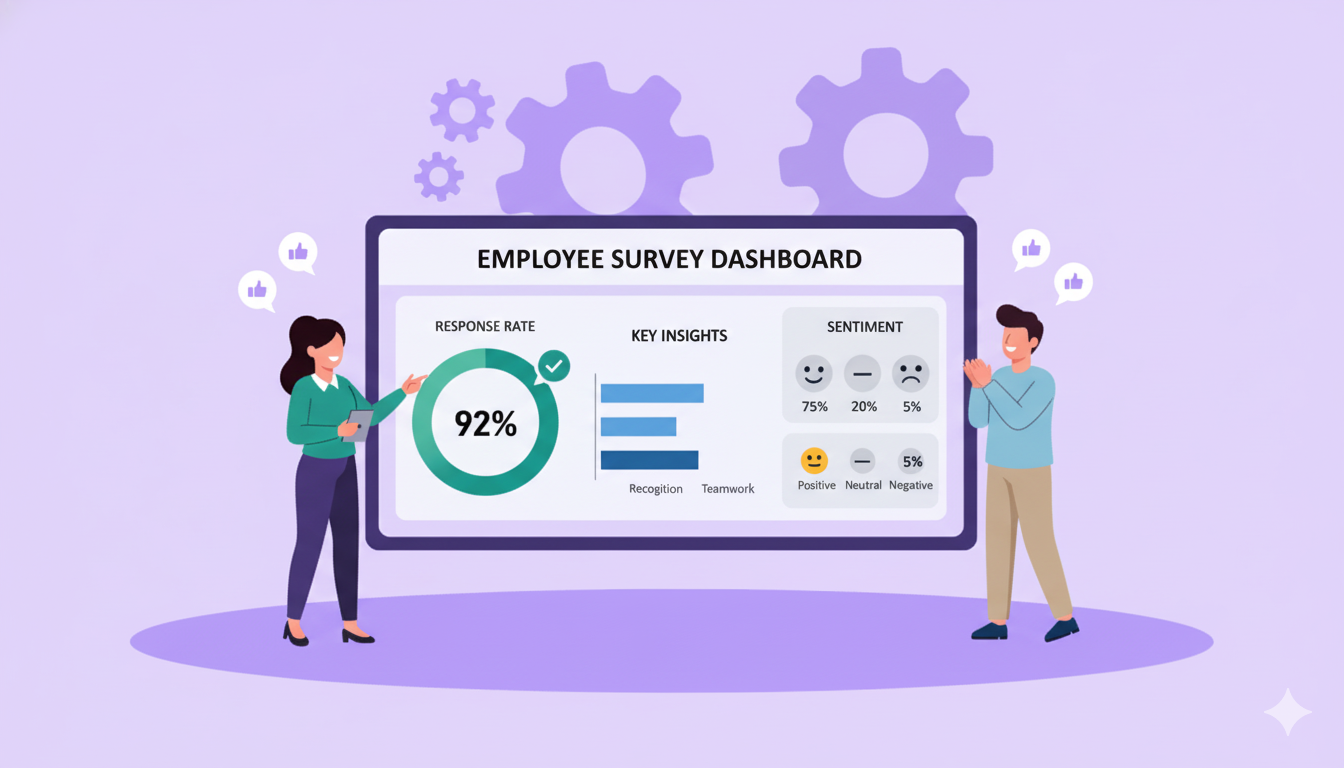
Survey fatigue is the psychological disengagement that happens when employees receive too many surveys, encounter poorly designed questions, or see no action taken on their feedback. It shows up as declining response rates, abandoned surveys, and low-quality responses.
Recommended Read: Employee Engagement Surveys Done Right: A Complete Guide to Design, Deliver and Action
The fatigue is not just about frequency. An employee might complete ten well-designed, purposeful surveys in a year without issue. But two poorly timed, redundant surveys can trigger complete disengagement. The fatigue comes from the perceived waste of time and effort.
When survey fatigue sets in, employees skip surveys entirely. Some start but abandon them halfway through. Others rush through and select neutral responses repeatedly just to finish. Each behavior corrupts your data differently, but the result is the same: you cannot trust what you are measuring.
The Four Real Reasons Your Surveys Are Dying

Most people think survey fatigue is about sending too many surveys. Send fewer, problem solved, right?
Wrong.
A Survey research has established that respondents engage in "satisficing"—choosing "good enough" answers rather than optimal ones—when surveys become cognitively demanding.
As surveys get longer, people are more likely to select response options close to the starting point of the scale and exhibit straightlining behavior regardless of actual attitudes. But here's the thing: I've seen ten-question surveys get abandoned immediately while 40-question onboarding surveys get 90% completion rates.
The difference? These four things working together to either build trust or destroy it:
1. Cognitive Fatigue (When Your Questions Make People's Brains Hurt)
Cognitive fatigue is driven by the mental effort required to complete a survey. When surveys are long, poorly worded, or complex, employees start to mentally check out.
Bad question design is exhausting. Ever seen a question like "My manager provides clear direction and recognizes my contributions"? That's two completely different things shoved into one question. If your manager gives you crystal-clear direction but never says "good job," how are you supposed to answer?
Or questions like "Rate your satisfaction with organizational alignment." What does that even mean? Employees have to decode what you're asking before they can answer, and every confusing question is a chance for them to just close the tab.
Complex rating scales make it worse. Seven-point scales with unclear labels, matrix grids where you're matching rows and columns—you're making people work harder than necessary. Three confusing questions in a row and you'll lose 15-20% of your respondents.
The weird thing? A 15-question survey with clear, simple questions will outperform a 10-question survey full of convoluted garbage. People will put in effort when the path is obvious. They'll bail when every question feels like a riddle.
2. Emotional Fatigue (When People Are Already Maxed Out)
Emotional fatigue builds when survey requests arrive in an already overloaded week. Gartner also found that 54% of HR leaders reported their employees were experiencing change fatigue. Under those conditions, even a short survey can feel like one more demand competing with deadlines and constant context-switching.
Over time, that pressure changes how employees respond. They postpone surveys, skim questions, and give minimal answers because they want the task off their plate. The data you collect becomes thinner, and the employee experience around listening starts to feel draining instead of supportive.
3. Purpose Fatigue (The "Why Should I Care?" Problem)
Purpose fatigue sets in when employees cannot link a survey to a concrete decision. If the invite does not clarify what leaders plan to decide, who owns the next step, and when outcomes will be shared, employees assume the survey will end as a report, not a change.
That assumption builds fast because many employees already feel their voice has limited weight. Gallup found only one in four employees strongly agree their opinions count at work. Research also shows that survey follow-up is often neglected in practice, which reinforces the belief that surveys exist without accountability.
4. Action Fatigue (The Real Killer)
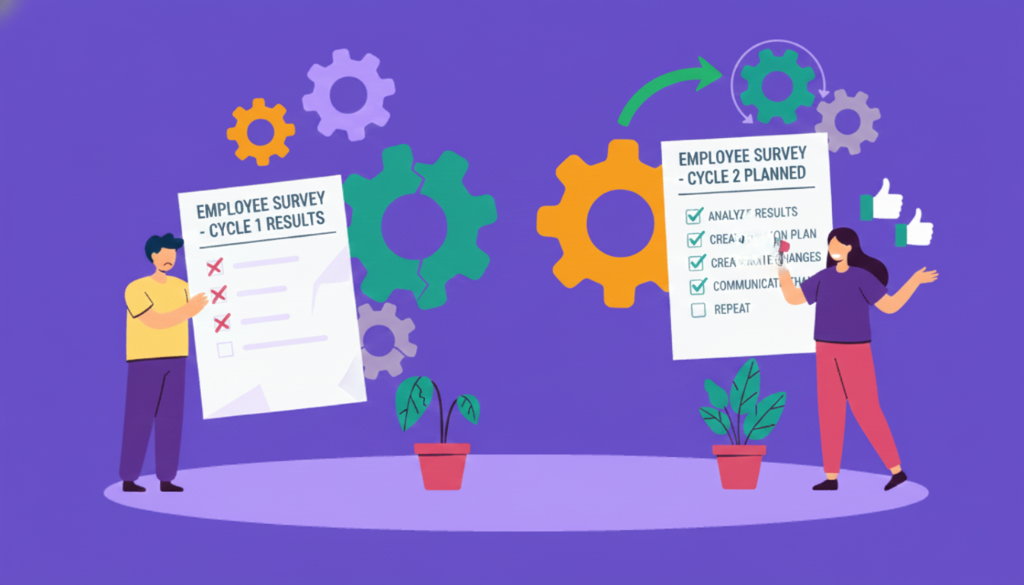
Action fatigue builds when employees share feedback repeatedly, and the organization cannot show a clear response. After a few cycles, surveys start to feel like a routine request that benefits the system more than the employee. People conserve effort. They skip the invite, complete it quickly, or keep answers vague because they expect the same outcome: a report and no visible change.
The real issue is credibility. If employees cannot trace feedback to a specific decision, a named owner, and a timeline, participation becomes optional and candor becomes risky. Over time, the program collects more data and learns less, because the most useful input requires trust and attention that employees no longer want to invest.
Recommended Read: Why Employee Surveys Die After One Cycle (And How to Actually Fix It)
Signs Your Organization Has Survey Fatigue
Survey fatigue is easy to miss early because the survey still “runs.” The warning signs show up in participation patterns and in the shape of the data.
1. Response rates trend down across cycles
A single dip can be timing but a steady decline signals fatigue or low trust.
2. Drop-offs spike after page one
Employees start the survey, then exit when effort rises or questions feel repetitive.
3. More partial completions
People intend to respond, then abandon midway because the survey feels too long or too demanding.
4. Neutral answers increase across themes
“Neither agree nor disagree” becomes the default. It often signals low effort, low safety, or low belief in outcomes.
5. Open-text comments shrink or disappear
You see fewer specifics, fewer examples, and more generic statements because employees do not want to invest time.
6. Participation becomes uneven by team or level
Certain groups stop responding more than others, which creates blind spots and makes the data less representative.
8 Practical Ways to Prevent Survey Fatigue

Preventing survey fatigue means changing how you design, deploy, and follow up on surveys. Each strategy addresses a specific cause of disengagement. Use them together for best results.
1. Set a Clear Survey Rhythm
Random surveys create instant resistance. People do not know how often they are expected to respond, so every new request feels like “another one.”
-
Set a predictable rhythm employees can get used to:
-
A monthly pulse for one theme at a time.
-
A deeper engagement check quarterly or twice a year.
Short lifecycle check-ins at moments that naturally shape experience, such as 30–60 days after joining, after an internal move, or during an exit process.
Keep the calendar steady. The moment cadence changes based on leadership anxiety, employees sense it. A stable rhythm feels intentional. A reactive rhythm feels noisy.
2. Keep Surveys Short and Focused
Short surveys like a help, but only when they are sharp. A short survey that tries to cover everything still feels heavy because the questions bounce across topics with no clear point.
Before you send a survey, write down the decision it will support. One decision. If the survey cannot support a decision, it becomes noise.
A useful rule is to run a pulse survey around one theme and keep a single optional comment box that asks for a concrete example. When surveys feel focused, people respond faster and with more care.
3. Explain the Purpose Upfront
Employees do not need a long preface. They need clarity that respects their time.
Make the opening message specific:
-
What you are trying to learn.
-
Why you are asking now.
-
What happens after the survey closes, including when you will share outcomes.
Most survey invites talk about the topic. Very few talk about the next step. That is where purpose fatigue starts.
4. Improve Question Quality
Question quality controls effort and trust. Employees lose patience with questions that are vague, overly formal, or packed with multiple ideas.
Keep questions clean:
-
One idea per question.
-
Plain language.
-
Neutral phrasing.
-
Direct link to what employees actually experience.
Avoid long grids and complicated scales unless you truly need them. Confusing questions reduce response quality even when the survey is short.
5. Reduce Repetition
Repetition creates irritation and trains employees to answer without thinking. You still need trends, but you do not need to repeat everything.
Use a simple model:
-
Keep 2–3 “core” questions for trend tracking.
-
Rotate the rest based on what you are ready to address in the next cycle.
If you have asked the same question for multiple cycles without action, stop asking it until you can do something with the answer.
6. Close the Loop Every Time
This is the most effective way to reduce fatigue. Employees continue participating when they can see outcomes, not just reports.
Closing the loop means sharing:
-
What you heard.
-
What you will do.
-
Who owns it.
-
When employees will see progress.
Use a consistent “You said, we did” update format and deliver it in the channels employees use daily. Consistency builds credibility.
7. Personalize Survey Timing with Data
Timing can make a good survey fail. Avoid launching surveys during peak workload periods, major deadlines, or heavy change weeks.
Use internal participation patterns to pick better windows:
-
Look at completion and drop-off rates by team.
-
Avoid weeks that historically have low participation.
-
Align surveys to moments when feedback is naturally relevant, such as onboarding milestones or post-role changes.
This reduces drop-offs and improves the quality of responses.
8. Use Visuals and Simple UX
A clunky survey experience increases abandonment. Clean design reduces friction.
Keep the experience simple:
-
Mobile-friendly layouts.
-
Clear progress indicators.
-
Short, readable screens.
-
Easy formats like rating scales and sliders.
Use emojis only when they clarify sentiment and keep them consistent. Limit open-text questions and keep them optional. When you ask for text, ask for a concrete example so the input is usable.
The Truth Most People Won't Tell You
Here's the thing nobody wants to admit: survey fatigue usually isn't caused by too many surveys. It's caused by sending surveys when you're not actually ready to do anything with the answers.
Before you send your next survey, ask yourself: do we actually have the authority, budget, and commitment to act on what we might learn?
If the answer is no, don't send it. You're not gathering data, you're burning credibility. Every survey is a withdrawal from your trust account with employees. If you're not prepared to make a deposit by actually doing something, you're just accelerating the path to bankruptcy.
If the answer is yes, close the loop visibly and specifically. Employees will keep showing up for a system that delivers. They'll ghost a system that just extracts.
Your survey response rate isn't measuring engagement or satisfaction. It's measuring whether employees believe you'll actually do something with what they tell you.
Start acting like it.



This article was co-authored by Sahil, Supriya and Vaishali, who work as digital marketers at Vantage Circle. For any queries reach out to editor@vantagecircle.com.