




Awards vs Rewards: The Key Differences You Need to Know

A Global Employee Recognition and Wellness Platform
The deepest principle in human nature is the craving to be appreciated.”
- William James
In employee recognition conversations, awards and rewards are often used interchangeably. But while they may look similar on the surface, they play very different roles in shaping employee motivation, behavior, and culture.
This lack of clarity creates real challenges for HR teams. When awards and rewards are combined, recognition programs tend to focus more on payouts than on meaning. Research from The Recognition Effect Report shows that only 55% of employees feel truly recognized at work, highlighting how easily recognition efforts can miss the mark.
Understanding the difference matters. According to the State of Recognition & Rewards Report 2025, organizations with intentionally designed recognition programs are 2× more likely to embed recognition into everyday work, focusing on meaningful appreciation alongside incentives, resulting in higher engagement, stronger emotional connection, and better retention outcomes.
In this blog, we’ll break down the difference between awards and rewards using a simple framework that covers intent, timing, impact, and examples, so you can design recognition programs that deliver both cultural and business value.
Awards Vs Rewards: The Definitions That Set Them Apart

An award is a formal form of employee recognition that honors individual or team achievement. Awards are usually presented publicly, often in front of peers. They may include a trophy, plaque, certificate, or symbolic token to highlight an employee’s exceptional contribution and impact on the organization.
A reward is a form of compensation or incentive given to employees for completing a task, meeting a target, or demonstrating desired performance. In the workplace, rewards are typically delivered privately and often have monetary or tangible value, such as bonuses, gift cards, or incentive points.
The Difference in Action
Micro-story 1: The Award
At the annual town hall, one employee is announced as Employee of the Month. Their name is displayed, their story is shared, and peers applaud. The recognition isn’t just about what they did , it’s about what they represent. The award elevates their standing and reinforces what excellence looks like in the organization.
Micro-story 2: The Reward
Later that quarter, another employee received a spot bonus for closing a critical deal under tight timelines. The payout is immediate, appreciated, and motivating. It reinforces the behavior the organization wants to see more often, but it doesn’t carry public judgment or symbolic weight.
Together, these examples show the fundamental difference: awards create meaning and identity; rewards drive action and performance. Both matter, but they serve very different purposes in an effective recognition strategy.
Key Differences Between Awards and Rewards

While both awards and rewards are essential components of employee recognition, they serve very different functions. The table below breaks down the differences across the dimensions that matter most when designing HR programs.
| Dimension | Awards | Rewards |
|---|---|---|
| Purpose | To recognize excellence, achievement, or distinction. | To incentivize effort, performance, or desired behaviors. |
| Formality | High: structured, criteria-driven, and often ceremonial. | Low to medium: flexible, informal, and often spontaneous. |
| Tangibility | Often symbolic (trophies, titles, certificates), sometimes paired with material value. | Primarily tangible (cash, gift cards, perks, points, or experiences). |
| Timing | Retrospective: given after evaluation over a defined period of time. | Immediate or near-immediate: closely tied to a specific action or outcome. |
| Public / Private Nature | Typically public and visible to peers. | Can be public or private; often delivered discreetly. |
| Competitive Aspect | Yes: limited recipients and comparative by design. | No: accessible to many and generally non-competitive. |
| Common Examples | Employee of the Year, Excellence Awards, Leadership Awards. | Spot bonuses, gift cards, incentive points, experience-based rewards. |
Dimension: Purpose
Awards: To recognize excellence, achievement, or distinction.
Rewards: To incentivize effort, performance, or desired behaviors.
Dimension: Formality
Awards: High — structured, criteria-driven, and often ceremonial.
Rewards: Low to medium — flexible, informal, and often spontaneous.
Dimension: Tangibility
Awards: Often symbolic (trophies, titles, certificates), sometimes paired with material value.
Rewards: Primarily tangible (cash, gift cards, perks, points, or experiences).
Dimension: Timing
Awards: Retrospective — given after evaluation over a defined period.
Rewards: Immediate or near-immediate — closely tied to a specific action.
Dimension: Public / Private Nature
Awards: Typically public and visible to peers.
Rewards: Can be public or private; often delivered discreetly.
Dimension: Competitive Aspect
Awards: Yes — limited recipients and comparative by design.
Rewards: No — accessible to many and generally non-competitive.
Dimension: Common Examples
Awards: Employee of the Year, Excellence Awards, Leadership Awards.
Rewards: Spot bonuses, gift cards, incentive points, experience-based rewards.
In short: Awards celebrate excellence. Rewards encourage effort.
Examples of Awards vs Rewards in the Workplace
The difference between awards and rewards becomes most visible in how they are used across roles and moments. Awards are typically selective and prestige-driven, while rewards are frequent and performance-linked. The scenarios below illustrate how each shows up in real workplace settings.
Type: Award
Example Name: Leadership Impact Award
Purpose / Trigger: Recognizes leaders who demonstrate sustained people impact and model organizational values
Delivery Format: Announced at the annual town hall or leadership meeting; citation shared company-wide
Type: Reward
Example Name: Spot Performance Bonus
Purpose / Trigger: Reinforces immediate, high-impact outcomes such as closing a key deal or solving a critical issue
Delivery Format: Manager-initiated or system-triggered; delivered via payroll or rewards platform
Type: Award
Example Name: Sales Excellence Award
Purpose / Trigger: Honors top-performing sales professionals based on overall performance and consistency
Delivery Format: Presented at quarterly or annual sales meets; public recognition
Type: Reward
Example Name: Sales Target Incentive
Purpose / Trigger: Encourages achievement of monthly or quarterly sales goals
Delivery Format: Automated payout or points allocation upon target completion
Type: Award
Example Name: Learning Champion Award
Purpose / Trigger: Recognizes employees who actively promote learning, mentoring, or capability building
Delivery Format: Announced during the L&D forums, the digital badge and leadership acknowledgment
Type: Reward
Example Name: Course Completion Voucher
Purpose / Trigger: Motivates employees to complete priority courses or certifications
Delivery Format: Auto-issued through LMS via email or rewards system
These examples highlight the practical distinction: awards signal what excellence looks like, while rewards reinforce behaviors the organization wants repeated. When used together with intent, they create a balanced and effective recognition ecosystem.
Psychological Impact: Why Awards and Rewards Motivate Differently

Although reward and award sound the same, they have pretty different meanings. Understanding this distinction helps HR leaders choose the right lever depending on the level of motivation and support employees need.
Did you know: A good 66% of employees would leave their jobs if they felt unappreciated.
Awards: Esteem, Identity, and Meaning
Awards primarily satisfy higher-order psychological needs. In Maslow’s hierarchy, , they map closely to esteem (recognition, respect, status) and self-actualization (achievement, purpose, contribution). Because awards are selective and public, they shape how employees see themselves and how others see them.
This is why awards work best when organizations want to reinforce values, celebrate role models, and build long-term emotional attachment. Through the AIRᵉ lens, awards strongly activate Appreciation, Incentivization, Reinforcement, and Emotional Connect, making people feel seen, respected, and proud to belong.
Rewards: Reinforcement, Momentum, and Action
Rewards operate differently. They engage in extrinsic motivation, drawing on behavioral psychology, most notably Skinner’s Operant Conditioning , in which behavior is strengthened through immediate reinforcement.
Because rewards are timely and tangible, they are highly effective at driving specific actions and sustaining effort. Within the AIRᵉ framework, rewards align most closely with Incentivization and short-cycle Reinforcement, helping employees connect their effort to outcomes.
Awards vs Rewards Through the AIRᵉ Framework
| AIRe Pillar | Award Works Best When… | Reward Works Best When… |
|---|---|---|
| Appreciation | Public recognition is needed to elevate excellence and highlight role models. | Immediate praise or acknowledgment is required to encourage effort. |
| Incentivization | Long-term goals or sustained impact need to be recognized. | Short-term KPIs or milestones are achieved. |
| Reinforcement | Cultural behaviors and values need to be honored and remembered. | Specific actions need to be repeated consistently. |
| Emotional Connect | Peer-nominated or value-based awards create shared pride and belonging. | Personalized tokens or timely rewards help build trust and goodwill. |
AIRe Pillar: Appreciation
Award Works Best When: Public recognition is needed to elevate excellence and highlight role models.
Reward Works Best When: Immediate praise or acknowledgment is required to encourage effort.
AIRe Pillar: Incentivization
Award Works Best When: Long-term goals or sustained impact need to be recognized.
Reward Works Best When: Short-term KPIs or milestones are achieved.
AIRe Pillar: Reinforcement
Award Works Best When: Cultural behaviors and values need to be honored and remembered.
Reward Works Best When: Specific actions need to be repeated consistently.
AIRe Pillar: Emotional Connect
Award Works Best When: Peer-nominated or value-based awards create shared pride and belonging.
Reward Works Best When: Personalized tokens or timely rewards help build trust and goodwill.
The Insight That Matters for HR
Awards and rewards are not interchangeable motivators; in fact, they are complementary psychological tools. Awards deepen identity and meaning; rewards accelerate action and momentum. High-impact recognition strategies use both, thus matching the level of support to the necessary level of motivation.
When to Use Awards vs Rewards in the Workplace

Understanding when to use awards versus rewards helps HR leaders, managers, and people teams design recognition programs that are strategic, equitable, and impactful. Neither works in isolation: rewards reinforce specific behaviors and short-term performance, while awards elevate identity, culture, and long-term contribution.
Use-Case Recommendations
When to Use Awards
-
To acknowledge exceptional contributions that set a benchmark for others
-
For achievements that reflect organizational values or long-term impact
-
When you need public recognition to reinforce culture and identity

Source: Vantage Recognition
-
For nominations that build emotional connection and peer pride (e.g., peer-nominated awards)
-
To validate behaviors tied to strategic goals or leadership qualities
Award Examples that Fit Best
- Leadership Excellence Award for transformational leadership
- Innovation Impact Award for game-changing contributions
- Values Champion Award nominated by peers
When to Use Rewards
- To motivate performance in the near term (e.g., quarterly targets.)
- When you want behavioral reinforcement through tangible incentives
- To celebrate frequent, repeatable wins across roles and levels
- For clearly measurable outcomes such as sales targets, productivity improvements, or project delivery
- As part of structured performance programs tied to KPIs
Reward Examples that Fit Best
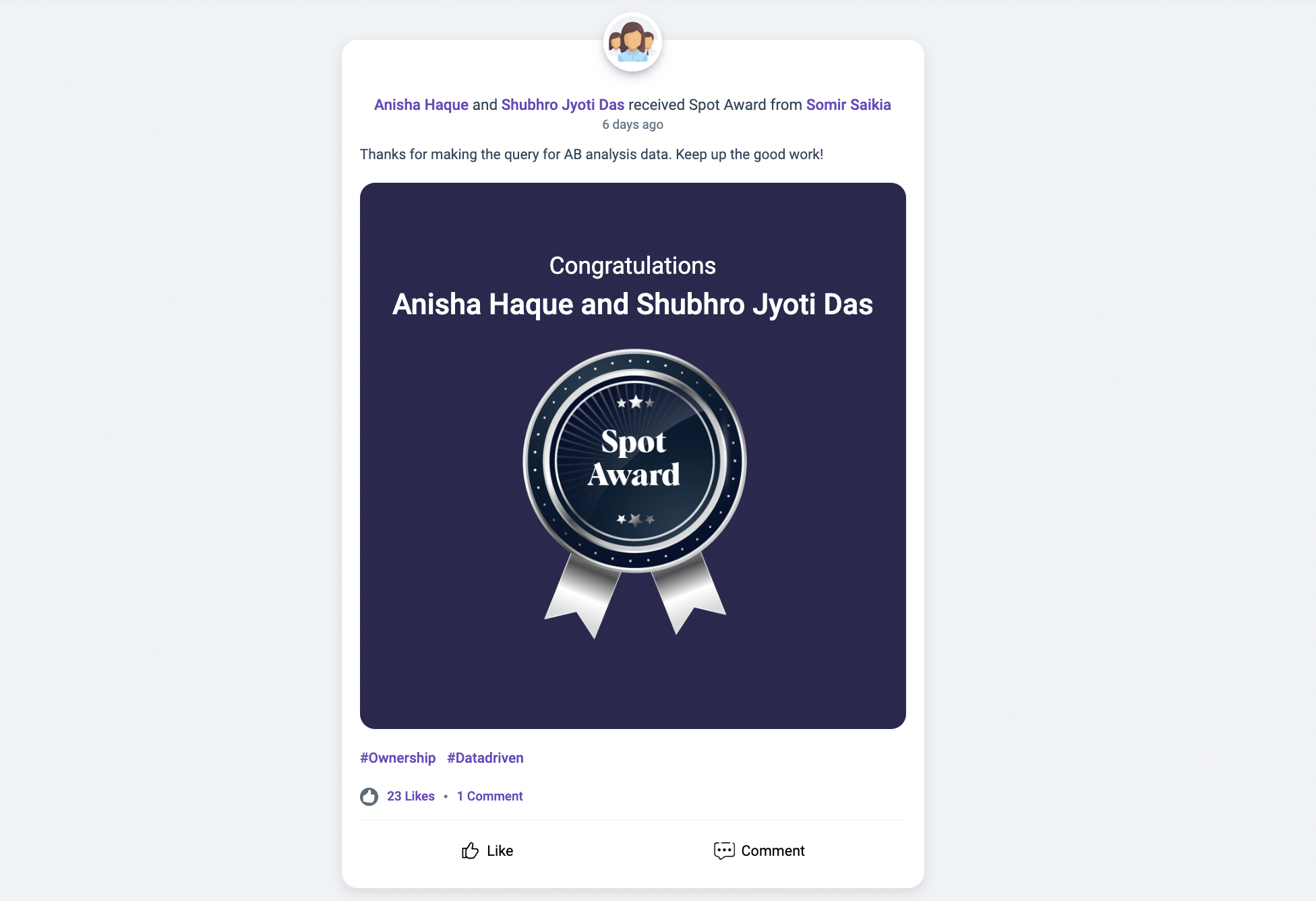
- Spot performance bonuses
Source: Vantage Recognition
-
Target-based incentives
-
Points that can be redeemed for perks
-
Time-off or wellness rewards
Rewards excel when goals are specific and repeatable and when employees can see the immediate connection between effort and outcome.
Recommended Resource: 20 Employee Rewards Ideas and Examples for Remote Workers
Decision Checklist: Should This Be an Award or a Reward?

Use this simple logic flow when designing or reviewing your recognition program:
Is the contribution rare and distinctive among peers?
→ Yes: Consider an Award
→ No: Proceed to 2
Is the action tied to a specific performance metric or KPI?
→ Yes: Consider a Reward
→ No: Proceed to 3
Is the purpose to reinforce culture or values publicly?
→ Yes: Consider an Award
→ No: Proceed to 4
Is the aim to motivate frequent effort, habits, or repeatable behaviors?
→ Yes: Consider a Reward
→ No: Reassess with stakeholders
This checklist helps ensure you match recognition type to strategic intent, not just tradition or budget availability.
What HR Leaders Say
Recognition matters for retention; according to a SHRM survey, a large majority of HR professionals agree that employee recognition positively impacts retention and even recruitment when done consistently and meaningfully.
Rewards support performance, but recognition builds culture. Research from HR thought leaders notes that while tangible rewards can drive action, recognition that fulfills psychological needs (esteem, belonging) has more profound and more lasting engagement effects.
Consistency is key. HR practitioners are increasingly focused on recognition that is timely and predictable, rather than annual awards delivered months apart, because frequent acknowledgement helps sustain motivation and trust.
Bottom Line for HR Program Design
-
Use awards to elevate, inspire, and set examples.
-
Use rewards to motivate, reinforce, and drive specific outcomes.
When thoughtfully combined and aligned to organizational goals, awards and rewards help build both high performance and a culture where employees feel genuinely valued.
How to Design an Effective Awards & Rewards Program

An effective awards and rewards program isn’t about choosing one over the other, it’s about designing both with intent. The most successful organizations are deliberate about what they recognize, how often, and why.
Practical Design Tips for HRs and Team Leaders
1. Define the role each plays
Use awards to spotlight excellence, values, and role models.
Use rewards to reinforce effort, progress, and performance.
Clarity here prevents over-incentivization and recognition fatigue.
2. Get the timing right (this is often overlooked)
Awards: Quarterly or annual cadence works best. This allows time for evaluation, peer input, and storytelling, which are essential for prestige and meaning.
Rewards: Monthly, real-time, or event-based. The closer the reward is to the action, the stronger the reinforcement.
3. Separate evaluation from execution
Awards should involve clear criteria, nominations, and a process for judgment.
Rewards should be simple, fast, and manager-enabled.
53% of employees prefer to receive recognition from their immediate manager.
4. Balance consistency with flexibility
Keep awards limited to preserve their significance.
Allow rewards to be frequent and adaptable across roles and teams.
5. Design for visibility
Awards benefit from public moments that reinforce culture.
Rewards don’t always need an audience; personal, timely delivery often works better.
6. Anchor everything to behavior, not just outcomes
Whether it’s an award or a reward, recognition should clearly answer:
“What behavior are we reinforcing?”
Conclusion
Awards and rewards may sit under the same recognition umbrella, but they serve very different purposes. Awards build identity, pride, and long-term cultural alignment while rewards drive momentum, reinforce effort, and keep performance moving.
When organizations confuse the two, recognition becomes ineffective. When they understand the distinction, recognition becomes a key differentiator; one that shapes behavior, strengthens morale, and delivers measurable results.
Hence, recognizing people the right way, at the right moment, and for the right reason doesn’t just make employees feel valued; it effectively builds a workplace where excellence is visible, effort is sustained, and culture is intentionally designed.

Supriya Gupta leads the Content team at Vantage Circle where she drives strategy and thought leadership across digital channels.With over a decade of experience in corporate and marketing communications, she specializes in storytelling that connects brand purpose with audience engagement. Her bylined work at Vantage Circle has been featured in platforms like Comp and Benefits Today, while her ghostwritten contributions—crafted in her role as a communications expert—have supported global brands across tech, media, and FMCG sectors, including Intel, ESPN, Pepsi, and the World Bank. Connect with Supriya on LinkedIn and X, or reach out to editor@vantagecircle.com for inquiries.