
Business, as I have seen it, places one great demand on you: it needs you to self-impose a framework of ethics, values, fairness, and objectivity on yourself at all times.
That was Late Ratan N. Tata, Chairman Emeritus of Tata Sons, India's oldest and largest conglomerate—on why company core values matter.
So what comes to mind when you think of a company?
Probably a group of like-minded people working toward a shared goal: turning products or services into profit. And you'd be right.
But you know what, it's easy to miss,
- What actually holds that group together?
- What drives them to hit deadlines, stay productive, and uphold strong ethics all at once?
The answer is company core values.
These are the principles a company is built on. The ones that help it grow and thrive over time. They keep everyone aligned, from the top floor to the ground floor, all moving in the same direction.
What Are Company Core Values?
Company core values are the fundamental beliefs and guiding principles that shape how an organization operates, makes decisions, and treats its people.
You can think of them as a company's DNA. They're the non-negotiable standards that define what a company stands for and how it behaves, no matter the circumstances.
To be honest, core values are not just words on a careers page.They quietly influence everything, including:
- Who gets hired (and who doesn't)
- How teams work together day to day
- Which clients a company chooses to take on
- The tough calls leaders make when no one's watching
But it's interesting to know, what separates values that actually work from the ones that don't?
The answer is simple.
The good ones are lived, not laminated. A company can print "integrity" on the wall all it wants, but its real core values show up in how it acts, especially when doing the right thing isn't the easy thing.
Why Core Values Matter: The 4 Real Drivers

Company core values matter for four concrete reasons:
they shape how decisions get made, they build the culture your team actually works in, they attract and keep the right people, and they determine how your brand is perceived by customers and competitors alike.
That's the short answer. Here is the fuller picture.
1. Decision-Making and Behavior
Every organization, big or small, faces hundreds of tiny decisions every day.
Without strong values, those calls come down to individual judgment. Sometimes that works out. Often it doesn't, especially at scale.
That's where core values earn their keep. They act as a shared decision-making framework. When "customer-first" is actually practiced, a tricky customer call gets a lot clearer. When "transparency" is the norm, hard conversations get easier, because everyone already knows the rules of the game.
Values don't remove judgment calls. They just give people a reliable reference point for making them well, every time.
2. Culture and Team Spirit
Core values, when they're actually practiced and not just posted on a wall, are the fastest way to shape your culture on purpose. They give people a shared language, taking the friction out of cross-functional work. And they create a sense of belonging that cuts across departments and job titles.
This is where recognition becomes a real multiplier.
Tying recognition to your company values instead of vague "nice work" moments, reinforces a specific behavior you want to see more of. Core values alignment through structured recognition is one of the most direct levers HR leaders have to close the gap between values on paper and values in action.
According to The Recognition Effect (2025), a joint study by Great Place To Work® India and Vantage Circle, when employees experience all four emotional signals of recognition (Appreciated, Accepted, Validated, Accomplished), workplace sentiment hits 98%, motivation 96%, and retention intent 97%. When only two signals are present, those numbers drop to 60%, 49%, and 54% respectively. Values-linked recognition is what closes the gap.
3. Hiring and Retention
Ask any recruiter what separates a fast-growing company from one that constantly refills the same seats. The answer is almost always culture fit, which is another way of saying values alignment.
Candidates who understand and connect with a company's values are more likely to stay past the first year, contribute meaningfully, and grow within the organization.
On the retention side, the logic holds just as strongly. Employees who feel that the organization lives its values are more engaged, more forgiving of operational friction, and more likely to advocate for the company as an employer. Employees who see a gap between stated values and actual behavior are the ones who go quiet before they resign. For a deeper look at what drives people to stay, see employee retention in the modern workplace.
The numbers back this up.
According to Gallup, well-recognized employees are 45% less likely to have left their job two years later.
Recognition tied to values does not just feel good. It keeps people.
4. Brand and Business Results
Organizations that build a genuine values-driven culture tend to earn trust faster, win clients who share their standards, and bounce back quicker from reputational hits, because their track record speaks for itself.
Compare that to companies where values are purely decorative, just plaques on the lobby wall with no behavior to back them up. These organizations are far more exposed to culture failures, PR crises, and talent walkouts, usually right when they can least afford it.
And employees notice the gap.
In fact, only 32% of employees feel strongly connected to their organization's mission or purpose, a clear sign that most companies are still stuck at the plaque-on-the-wall stage.
So the truth is, the business case for core values isn't idealistic. It's operational. Values reduce decision friction, build cohesion, improve talent outcomes, and protect brand equity. That's not soft ROI. That's the work.
Do Give a Read: The Business Case for Employee Recognition
How to Implement Core Values in the Workplace
The single most important thing you can do to implement core values is to make them behavioral, not just documented. Values that live only in a PDF or on a lobby wall do not change how people work. Values that show up in how you hire, how you recognize, and how you lead, do.
Here is what that looks like in practice across five key steps.
| Implementation Step | What It Looks Like in Practice |
|---|---|
| Define values collaboratively | Involve employees and managers in shaping values, not just the leadership team. Values that people helped create are values they actually believe in. |
| Embed values into hiring and onboarding | Use value-based interview questions. During onboarding, show new hires specific examples of values in action, not just a slide deck of statements. |
| Tie recognition to specific values | Every time someone is recognized, link it to a named company value. "Great work on the client call" becomes "This is exactly what our Customer First value looks like." |
| Train managers to model values | Managers are the biggest variable in whether values stick or get ignored. Train them to reference values in feedback, decision-making, and team conversations. |
| Measure and review values adoption | Run regular pulse surveys to track whether employees feel the values are being lived. Review the data and act on gaps publicly — it signals that values are taken seriously. |
Of these five steps, recognition gives you the fastest, most visible payoff. When employees see a colleague get recognized for living a specific value, that behavior sticks, and everyone else finally sees what the value looks like in real life, not just on a slide.
So think of values-linked recognition as the bridge between what you say and what people actually do.
If you're feeling stuck on where to begin, keep it simple. Pick one value, build a 30-day recognition campaign around it, and pay attention to what changes. In how your team talks, how they act, and how much easier certain conversations get. Then take it from there.
Importance of Company Core Values
The moment you call something a "value," you're telling everyone it's worth protecting, even when it's inconvenient. That message doesn't just shape your team. It reaches the people deciding whether to join you at all.
Top talent has options, and they tend to bet on companies that clearly know what they stand for.
And in the early days? Values are your cheat sheet. When everything feels urgent and you can't do it all, they help you decide what comes first.
As an example, here are 5 company core values of TATA Group that shaped their business ethics.
1. Integrity: We will be fair, honest, transparent, and ethical in our conduct; everything we do must stand the test of public scrutiny.
2. Responsibility: We will integrate environmental and social principles in our businesses, ensuring that what comes from the people goes back to the people many times over.
3. Excellence: We will be passionate about achieving the highest quality standards, always promoting meritocracy.
4. Pioneering: We will be bold and agile, courageously taking on challenges, using deep customer insight to develop innovative solutions.
5. Unity: We will invest in our people and partners, enable continuous learning, and build caring and collaborative relationships based on trust and mutual respect.
We have one other example for you. It's GOOGLE
Here are 5 principles from Google's founding philosophy that function as its core values:
1. Focus on the user: We put the user first in everything we build. Get that right, and everything else, including the business, tends to follow.
2. Do one thing really well: We stay focused on solving one hard problem exceptionally, rather than doing many things at a mediocre level.
3. Fast is better than slow: We respect people's time. Speed is a feature, and we obsess over shaving milliseconds so users never have to wait.
4. You can make money without doing evil: We believe doing good business and doing the right thing aren't in conflict. We never let short-term gain compromise user trust.
5. Great just isn't good enough: We treat being great at something as a starting line, not a finish line. We set goals we can't quite reach yet, because stretching gets us further than we planned.
If you're building your own from scratch, this list of company core values examples from 12 real organizations is a practical place to start.
7 Positive Impact of Company Core Values
1. Employee Engagement
Every employer desires to have a performance-driven company culture. However, cultivating the same within the organization is impossible until and unless proper emphasis is put on engaging the employees.
Employee Engagement has now become the buzzword for the same across the corporate industry. The reason here is that with changing times, the motion of providing your employees with the best is shifting from a handsome paycheck to a wide range of other benefits. And with the competitive nature of the work environment taking over workplaces worldwide, adopting policies that benefit your employees gives an employer a competitive edge over the other.
2. Employee Retention
Adopting strong core values in your work culture also helps you to retain your top talents.
If you’re wondering how?
Then let me ask you if you would rather stay in an organization that hasn’t got a vision or move to another that thrives on a set of core values.
You’ll choose the latter. Adopting specific values right from inception adds stability to the functions in the organization. And with stability comes satisfaction which motivates everyone to work together towards a better future. Thus, keeping the workforce together on track and fuelling their zeal to achieve more.
3. Talent Acquisition
Since you have read about retention, you might have got this point very well then.
Talent acquisition is where every organisation needs to ensure they get the best people for their workforce. However, the catch here is money may not be everything to attract them to work for you.
Challenging the status quo, the top talents now first lay their eyes on the organization's future. They desire to be a part of an organization with a predefined vision and learn and grow there.
As such, organizations must emphasize creating a culture based on solid workplace values supporting long-term goals.
4. Company Branding
This is where company core values play the trump card.
First, let’s not confuse company branding with the logos and tagline that are used on its products or services. The deal here is not to sell products but to project your organization as the perfect destination for business and recruitment.
Every successful company has some core values associated with it. These values act as the pillars that help the organization earn goodwill. Thus, creating a much needed positive image for the organization that affects it both internally and externally.
Internally, the employees feel good and stay motivated as the positive image adds more value to their work and themselves.
Externally, attracting the top talents and businesses to work for and with you becomes much easier. Peer-to-peer recognition plays a particularly strong role here — when employees publicly celebrate each other's contributions, it signals a healthy culture to candidates and clients alike.
5. Customer Satisfaction
To grow in your field of business, you must always keep a check on your customer satisfaction levels. The happier you keep your customer, the better your business is going to be.
Many of the successful companies around the globe ensure top customer service to their clients as a part of their company values.
Why?
As I said earlier, company core values allow organizations to implement their goals efficiently and continuously improve them. On the bottom line, ensuring the best customer service depends mainly on the employees of the company. As such, core values help employers instill the same principle in the minds of every employee.
6. Fair Business Practices
”You can make money without doing evil”
It's one of the guiding principles of Google.
Corporations often go rogue with regards to their business practices in the lust for more revenue.
Situations like this put everyone associated with the company in jeopardy, causing a loss of trust and integrity within the organization.
However, this can be kept in check and avoided from happening by firmly abiding by the set of core company values. When applied by an organization in its day-to-day activities, these values would prevent malpractices from nurturing.
7. Growth and Stability
Your company core values do a lot of quiet heavy lifting when it comes to growth and stability. Give everyone a clear end goal to rally around, and the whole workflow just runs smoother.
The proof is in how people vote with their feet.
According to Deloitte's 2025 survey, 44% of Gen Zers and 45% of millennials have left a role because they felt a lack of purpose. That's nearly half of your future workforce walking out the door when their work doesn't connect to something bigger.
Flip that around, though, and it's a real advantage. When people can see the purpose behind what they do, they show up more engaged
Here were some of the benefits of abiding by company core values that I could think of now.
How Vantage Circle Helps Make Core Values Real
The mechanism is recognition. Specifically, recognition that is tied to a named company value every time it is given, so that over time, the behaviors you want to see become the behaviors people actually repeat.
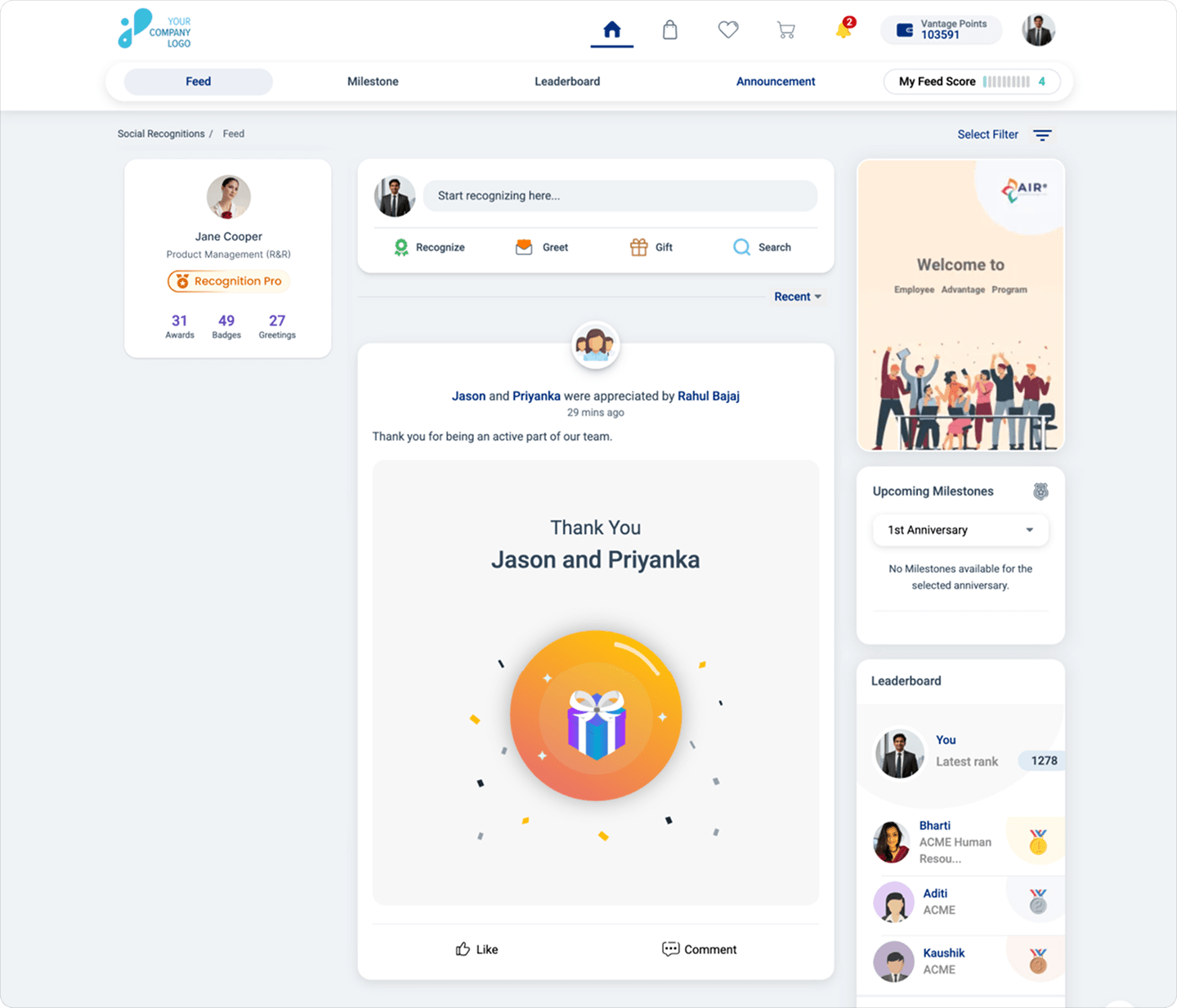
Most recognition programs treat values as an optional tag. Vantage Recognition is built around the opposite assumption: that values should be the primary reason recognition is given, not an afterthought. Here is what that looks like across the platform's core features.
| Vantage Circle Feature | How It Reinforces a Value |
|---|---|
| Values-linked recognition | Every award, peer shoutout, or manager recognition is tagged to a specific company value. The behavior gets named, the value gets reinforced, and the team sees both in real time. |
| Social recognition feed | Recognition moments are visible across the organization. When a value is tied to a shoutout, everyone sees what that value looks like in practice, not just on a slide. |
| Behavior-linked badges | Employees earn badges tied to specific values or behaviors. Over time, their profile becomes a visible record of which values they consistently demonstrate. |
| Recognition campaigns | HR can run themed campaigns around a specific value (such as a Values Week or Innovation Challenge), making the spotlight intentional and organization-wide. |
| Recognition analytics | Dashboards show which values are being recognized most, which teams are underrecognized, and where the gaps are — so HR can act on data, not guesswork. |
None of this replaces the work of defining good values or getting leadership to model them. But once your values are in place, recognition is the fastest way to turn them from a statement into a habit. Every time someone is recognized for living a value, that value gets a real-world example attached to it.
That is how company culture and employee engagement get built in practice. Not through annual workshops, but through the small, consistent moments where the right behavior gets noticed and named.
Frequently Asked Questions (FAQs)
1. What are the 7 core values of a company?
There is no universal list, but the most commonly adopted company core values are integrity, accountability, innovation, respect, customer focus, teamwork, and excellence. The specific values that matter most depend on the industry, culture, and goals of each organization. What is more important than the list is whether those values are practiced consistently.
2. Why are company core values important?
Company core values matter because they give everyone in the organization a shared framework for making decisions, working together, and treating people well. Without them, behavior defaults to individual judgment, which becomes inconsistent at scale. Values that are genuinely practiced improve employee engagement, retention, hiring quality, and brand trust.
3. How many core values should a company have?
Most practitioners recommend between three and seven. Too few and they feel vague; too many and they become impossible to remember or apply. The goal is a short list that employees can actually use as a reference point in day-to-day decisions, not a comprehensive document that lives on a shelf.
4. What is the difference between core values and culture?
Core values are the stated principles a company chooses to stand for. Culture is what actually happens when people work together over time. Ideally, the two align. In practice, many companies have a gap between their stated values and their lived culture. Closing that gap is the real work, and it happens through hiring decisions, manager behavior, and recognition practices.
5. How do you know if your company core values are working?
The clearest signals are behavioral: employees reference values when making decisions, managers use values language in feedback, and recognition is tied to specific values rather than generic praise. You can also measure it through engagement surveys, retention data, and how consistently different teams behave under pressure. If values only show up on the careers page and nowhere else, they are not working.
Conclusion
Company core values are only as good as the behaviors they produce. The ones that stick are not the ones that are written best. They are the ones that show up in how people are hired, how decisions get made, and how recognition is given.
If your values feel abstract right now, that is a solvable problem. Pick one. Name it out loud. Recognize someone for living it this week. Then watch what happens next.

Sanjeevani Saikia is a Senior Content Strategist at Vantage Circle, where she leads end-to-end content strategy across SEO, thought leadership, brand storytelling, podcasts, and video. She is also the host of the Vantage Influencers Podcast, where she brings conversations with HR and business leaders from top global organisations, including Fortune 500 companies.
Connect with Sanjeevani on LinkedIn.