
Most companies can list their engagement drivers from memory. Far fewer can say which one actually moved their last engagement score, because the eight rarely get separated out long enough to tell.
Employee engagement is driven by eight measurable factors: communication, leadership, recognition, wellness, development, clear roles, feedback, and work environment. None of these work in isolation. A company can recognize employees generously and still lose them if managers do not communicate, or offer strong development opportunities and still see disengagement if feedback only happens once a year.
The stakes are real and getting harder to ignore. Only 31 percent of employees in the US and Canada are engaged, and global engagement has now fallen for two straight years in a row (Gallup, State of the Global Workplace 2026). Organizations with above-average engagement see better productivity, lower turnover, and stronger customer satisfaction, the exact factors that show up on a P&L, not just a human resources (HR) dashboard.
This guide breaks down each of the 8 drivers, what building it looks like day to day, and how to tell whether it is moving the needle for your team.
What Drives Employee Engagement?
At the core, employee engagement is driven by a sense of purpose, supportive leadership, and continuous opportunities to grow, the same three threads that show up across nearly every major study on the topic, from Gallup to Workday to Slack. Purpose means employees can connect their daily work to something that matters, whether that is a customer outcome, a team goal, or the company's mission. Supportive leadership means managers communicate clearly, remove obstacles, and notice good work instead of only catching mistakes, and it also shows up as psychological safety, the sense that people can raise a mistake or a concern without being punished for it. Growth means employees can see a path forward, through new skills, new responsibilities, or a next role, instead of standing still.
The 8 drivers below are how those three threads translate into things you can build, measure, and improve, not just talk about in a values statement.
8 Key Drivers of Employee Engagement
Effective employee engagement rests on eight interconnected drivers, and building all eight consistently is what separates a company with a real culture of trust and strong work ethics from one that just talks about engagement once a year. The table below is a quick reference; each driver gets a full breakdown next, with one concrete way to build it.
| Driver | What It Looks Like | How to Build It |
|---|---|---|
| Communication | Employees raise ideas and concerns without hesitation | Open-door policy, balanced listening, peer-to-peer channels |
| Leadership | Managers communicate often and take real accountability | Model accountability, equip managers, invest in leadership development |
| Recognition | Good work gets noticed and acknowledged, not just top performers | Culture-specific program, peer-to-peer recognition, year-round cadence |
| Wellness | Physical and mental health are treated as an organizational responsibility | Choice-based benefits, community fitness challenges, incentives |
| Development | Employees see a clear path to grow their skills and career | Training programs, passion projects, defined roles that show what is next |
| Clear Roles | Everyone understands their responsibilities and how they fit in | Detailed job descriptions, structured onboarding, individual goals |
| Feedback | Employees get regular, specific, two-way feedback, not just annual reviews | Proactive and personalized feedback, recurring pulse surveys |
| Work Environment | Physical and cultural spaces support focus and comfort | Personalized workstations, informal meetings, natural light |
1. Strengthen Communication
Communication is the driver that makes every other driver possible. Employees who cannot interact freely with peers and leaders never build the sense of community that turns a job into something they are invested in. Robust communication gives employees a sense of belonging, and it only works in both directions: an open-door policy means nothing if a manager only ever talks and never listens, and peer-to-peer channels matter as much as top-down ones, since cross-functional work resolves the kind of miscommunication a memo never catches. Strengthened work relationships and better internal communication both follow from the same habit underneath all of it.
How to build it: The next time someone's feedback actually changes a decision, say so out loud to the team. Silence after feedback is what teaches people to stop giving it.
2. Be a Leader
Leadership determines whether the other seven drivers ever get built. Gallup's analysis of engagement scores across hundreds of companies found managers account for at least 70 percent of the variance in team engagement scores (Gallup, 2015), which means a leadership problem cannot be fixed anywhere else in the organization. A good leader communicates clearly and often, takes real accountability instead of assigning blame when something breaks, and keeps people motivated well past the first few months through backing their ideas and protecting work-life balance. A 2018 OfficeTeam survey of 2,800 employees found 37 percent see their boss as a mentor and 34 percent consider their boss a friend, evidence that the relationship with a direct manager shapes how people feel about work overall, not just how they perform at it. See our full breakdown of leadership qualities that transform a company from good to great for more.
How to build it: When something on your team goes wrong, ask what let it happen before you ask who caused it. Teams mirror whichever question their manager asks first.
3. Appreciate Employees
Recognition is the driver employees notice fastest, and its absence is just as fast to notice. When you recognize employees for their effort, they work harder and stay longer, because recognition is the acknowledgment that their work connects to something the organization actually values. That means building a culture-specific recognition program instead of a generic one, recognizing individuals separately from their team since a single person's contribution can get lost inside a team win, and encouraging peer-to-peer recognition so coworkers who do not work directly together still learn about each other's wins.
Vantage Recognition turns this from a policy into a daily habit. Guided prompts help any employee write a specific, meaningful thank-you in seconds, tag it to the company values it reflects, and publish it publicly, turning "recognize employees more" from a vague goal into something anyone on the team can start today.
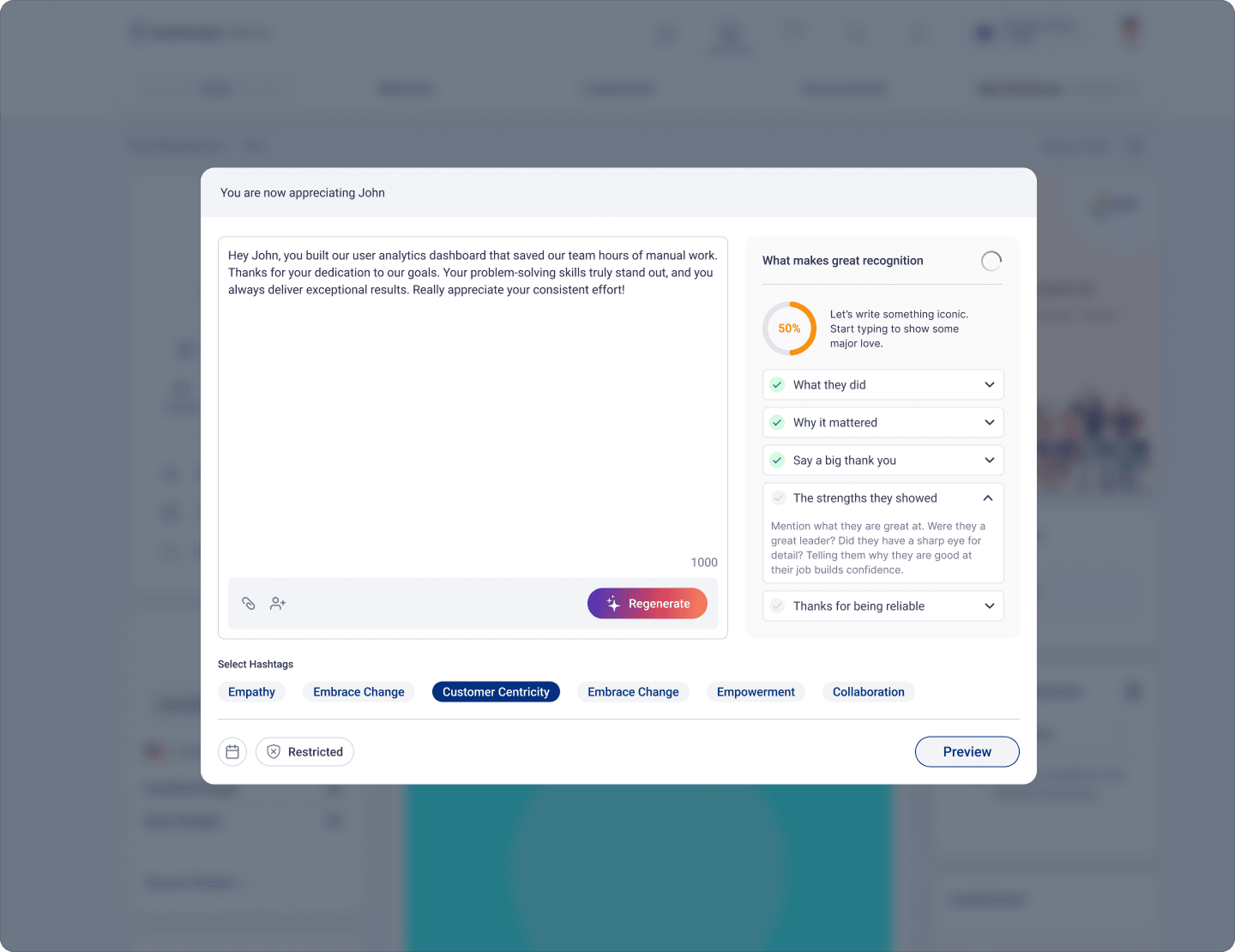
How to build it: Say what someone did and why it mattered before this week ends, not a blanket "great job." Vague praise is forgettable; specific praise gets repeated.
4. Provide Workplace Wellness
Wellness is the driver most likely to get treated as optional, even though employees spend most of their day at work and their health is directly affected by workplace stress and fatigue. Physical and mental strain, from stress and anxiety to backaches and burnout, are common, which makes an employee's complete well-being an organizational responsibility, not a perk. The fix is rarely a single company-wide program; it is benefits employees can choose from, since a gym membership does not fit everyone the way mental health resources or fitness tracking might, paired with a community-driven approach like team activities and group fitness challenges that help people adopt healthy habits faster than they would alone. For more, see our complete guide to corporate wellness programs.
Vantage Perks gives employees a marketplace of corporate benefits and discounts they can browse and redeem directly, instead of a one-size-fits-all wellness stipend nobody ends up using.
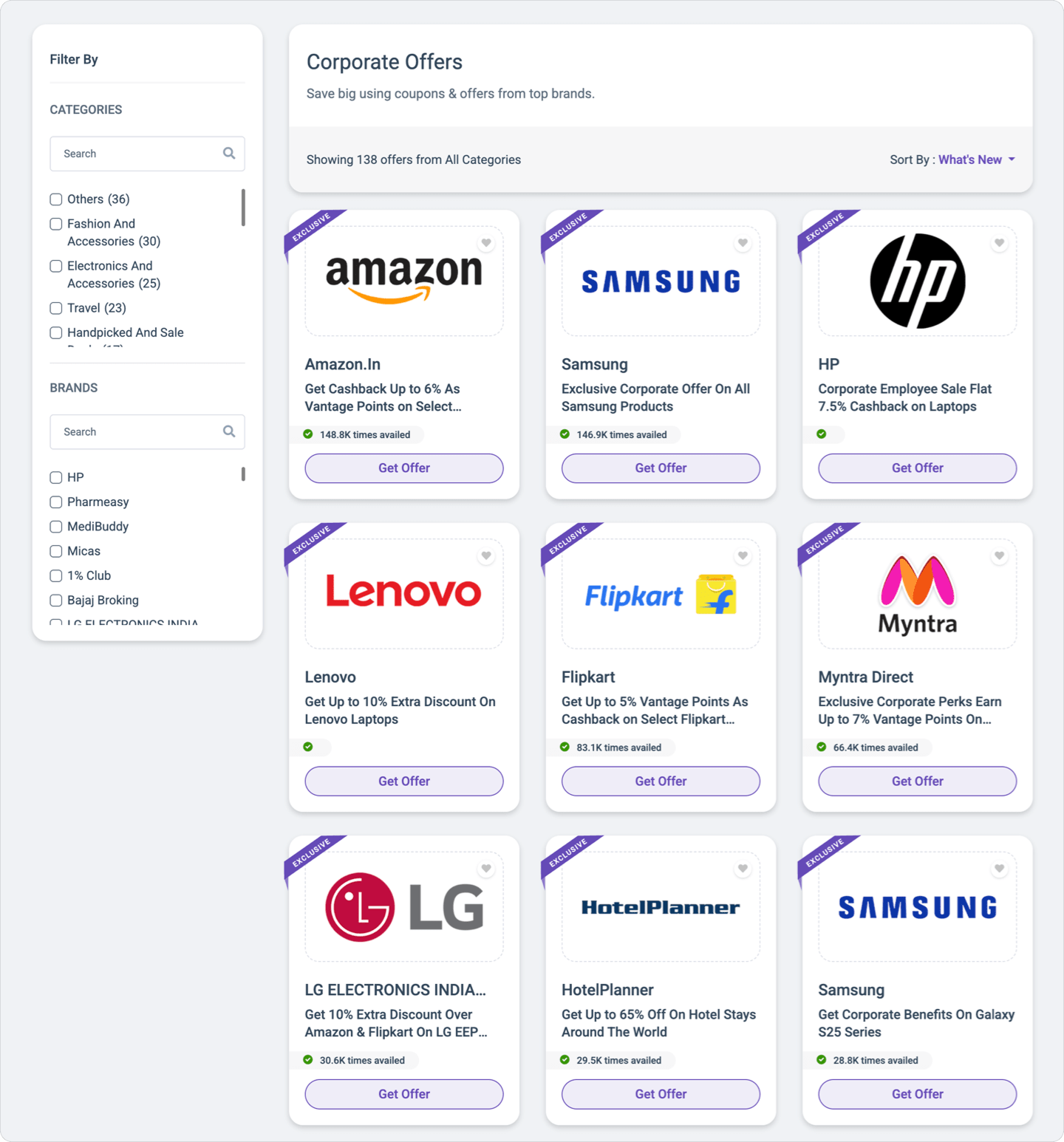
How to build it: Attach an incentive to one wellness challenge this quarter instead of just announcing that the benefit exists. Participation follows reward, not availability.
5. Personal and Professional Development
Development is the driver that determines whether ambitious employees stay or start looking elsewhere. A Randstad survey found 57 percent of employees feel they have to leave their current employer to advance their careers, evidence that internal growth paths matter as much as the work itself. When employees feel the expectations that brought them into a role are not being met, they leave, and new-age employees are especially unwilling to trade their personal life for career progress that never arrives. Clear roles make the difference here too: employees who understand exactly what performing well looks like can see a real path forward, training that builds tomorrow's skills instead of only today's keeps ambitious people from looking elsewhere for that growth, and passion projects, whether that is a mentoring circle or a side initiative, give people room to pursue what they care about without having to leave the building to find it.
How to build it: Ask each direct report what skill they want to build next, then hand them one piece of real work that uses it. A training budget nobody applies to a real task teaches nothing.
6. Define Roles and Responsibilities
Clear roles are what a strong onboarding and orientation program is actually built to deliver. When responsibilities are defined clearly from day one, there is no room for the misunderstandings that erode trust later, and employees who understand their daily duties can see exactly how they contribute to the company's larger goals. That starts with job descriptions that cover the skills and qualifications a role actually needs, continues through a real onboarding program that assigns new hires to a team and pairs them with a mentor, and holds up only if roles get revisited as the team grows. A role written for a five-person team rarely still fits once that team doubles, and an outdated job description is a quiet source of the exact confusion this driver is supposed to prevent.
How to build it: Set a first goal with every direct report in their first week, not their first month. Ambiguity compounds fastest in the gap before that goal exists.
7. Practice Feedback and Evaluation
Feedback is one of the most measurable drivers on this list. Across seven Gallup studies covering more than 44,000 employees, about 7 in 10 were highly engaged when they strongly agreed they had received meaningful feedback in the past week, compared with only 1 in 4 among those who did not (Gallup, 2022 to 2024 surveys). Feedback and evaluation improve performance and, in turn, productivity, but only when it goes beyond praise into specifics about where someone can actually improve, delivered proactively rather than saved for a bi-annual or year-end review. Not everyone processes feedback the same way either: a Gallup analysis of 65,672 employees found that those who received strengths-based feedback had turnover rates 14.9 percent lower than employees who received none at all (Gallup, 2011), evidence that framing feedback around strengths keeps people longer, not just happier in the moment. Structured 360-degree feedback closes a different gap: a single manager's view of someone's performance misses how they actually show up with peers and cross-functional partners, so pairing manager feedback with structured peer input gives a fuller picture without waiting for a formal review cycle. Employee surveys do the same at scale, catching problems before they surface in an exit interview.
Vantage Pulse turns feedback from an annual event into a continuous one. Recurring eNPS (employee Net Promoter Score) surveys give HR a real-time read on sentiment, with AI-generated summaries that surface what is actually driving a dip in scores, so a problem gets caught in weeks instead of a year later in an exit interview.
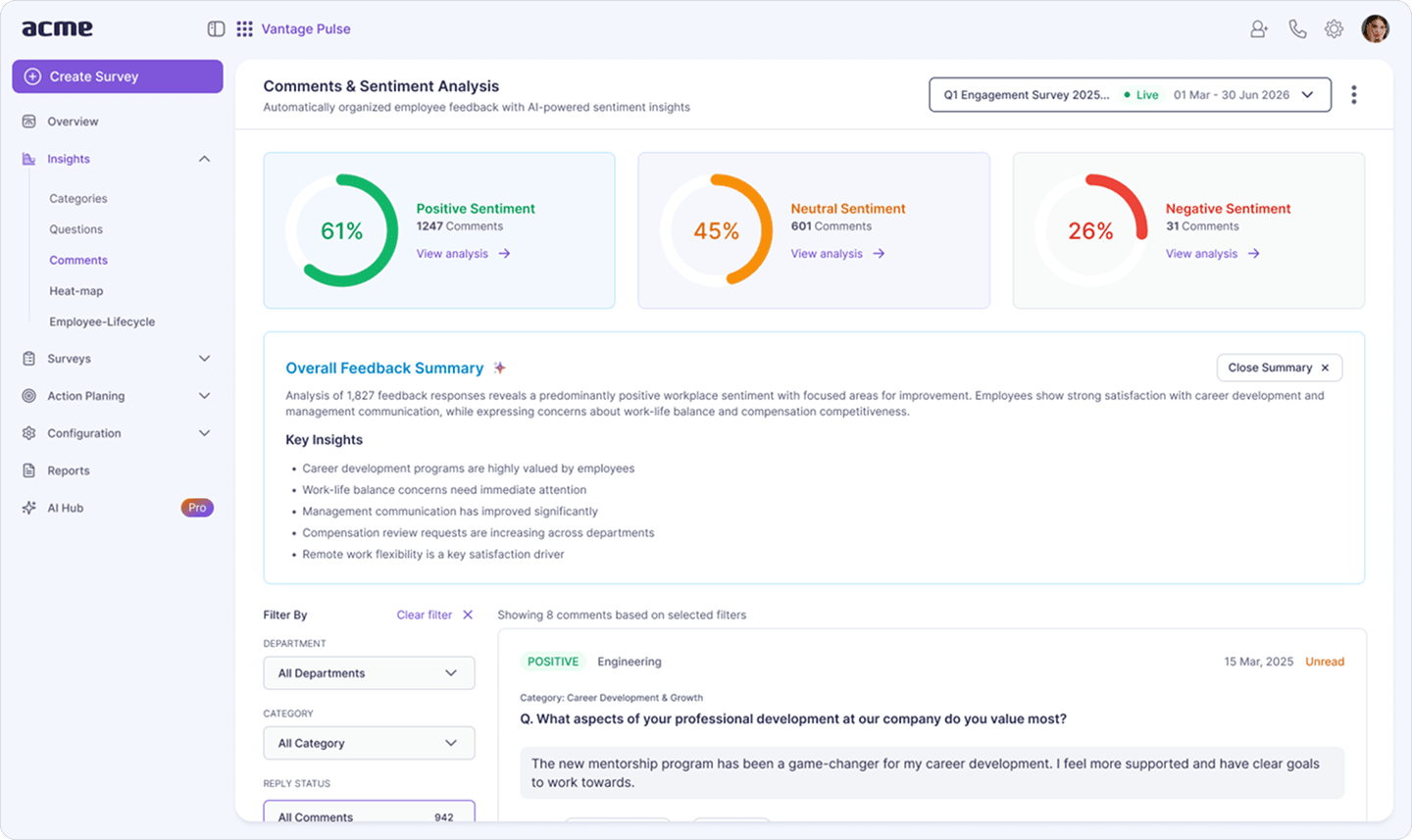
How to build it: Before the week ends, give one piece of specific feedback, positive or corrective, and name the exact situation it is about. Vague feedback wastes the moment it was supposed to fix.
8. Design a Better Work Environment
Work environment is the driver most shaped by physical space, and workplaces keep evolving as organizations embrace personalized setups and different working styles, from gig work to fully remote teams. Open floor plans and standing desks have replaced the wooden cubicles and white-washed walls of a decade ago, and workplace design improves employee productivity, reduces stress, and enables people to work harder. Letting employees personalize their own workstations goes further than any office-wide redesign, and something as simple as moving a meeting out of the boardroom or bringing in natural light measurably changes how cramped or high-pressure a space feels.
How to build it: Move one recurring meeting out of the conference room this month, somewhere less formal. People say more once the room stops looking like a performance review.
What Actually Moves the Needle Fastest?
Not all 8 drivers move engagement scores at the same speed. Recognition and feedback are the two fastest, and the data backs that up directly. Gallup found that employees who get both feedback and recognition from their manager at least once a week are 61 percent engaged, compared with just 38 percent among employees who get weekly feedback but recognition less often, a 23-point gap driven by recognition alone (Gallup, 2024). The same research found employees who feel they get valuable feedback from the people around them are 48 percent less likely to be job hunting and 57 percent less likely to report burnout.
Feedback cadence moves retention just as fast. When Adobe replaced its annual performance review with frequent check-ins in 2012, voluntary attrition dropped by roughly 30 percent, and the attrition spike that used to hit every February, right after employees read a disappointing annual rating, largely disappeared.
That pattern lines up with why recognition and feedback move faster than the other six drivers: both are visible, immediate, and something a manager can act on the same week a score dips, while drivers like work environment or role clarity take longer to shift and longer to show up in a survey. If your engagement scores are flat, recognition frequency and feedback cadence are usually the fastest two levers to check first, before a slower structural fix like a wellness redesign or an office overhaul.
That does not mean the other six drivers are optional. A team can recognize each other constantly and still burn out if workloads never let up, or trust their manager completely and still leave if there is nowhere left to grow. Fast-moving levers buy you time to fix the slower ones; they do not replace them.
Frequently Asked Questions
What are the 5 main drivers of employee retention?
The 5 main drivers of employee retention are competitive pay and benefits, real opportunities for career growth, a manageable workload with genuine work-life balance, consistent recognition, and a trustworthy relationship with a direct manager. Retention and engagement overlap heavily, since disengaged employees are far more likely to start looking for another job.
What are the 5 C's of employee engagement?
The 5 C's of employee engagement are Connection, Communication, Congratulate, Collaboration, and Care, a framework built around the idea that employees who feel known, informed, appreciated, included, and supported stay engaged longer than those who only get a paycheck and a job description. Read our full breakdown of the 5 C's framework for more detail.
What are the four main types of employee engagement?
The four main types of employee engagement are emotional, cognitive, physical, and behavioral. Emotional engagement is how connected someone feels to the company's mission, cognitive engagement is how focused they stay on their work, physical engagement is their energy and effort, and behavioral engagement is whether that translates into visible, consistent action.
How to drive staff engagement?
You drive staff engagement by building the 8 drivers above consistently: clear communication, accountable leadership, regular recognition, real wellness support, growth opportunities, defined roles, frequent feedback, and a workplace that supports focus. Consistency matters more than any single initiative, since a one-time engagement event rarely outlasts the next bad quarter.
What are the three key drivers of employee engagement?
If you can only prioritize three, focus on purpose, leadership, and growth, the same three threads covered above. A manager employees trust, work that connects to something they actually care about, and a visible path forward address most of the reasons people disengage in the first place.
What really drives employee engagement?
Employee engagement is really driven by purpose, supportive leadership, and continuous growth, the same three threads that run through all 8 drivers above. Employees stay engaged when their work connects to something that matters, their manager backs them consistently, and they can see a real path forward, not just a paycheck.
Conclusion: Start With the Two That Move Fastest
None of these 8 drivers works alone. A generous recognition program cannot offset silent leadership, and great development opportunities cannot fix a team that never gets real feedback. But you do not have to fix all eight at once: recognition and feedback move the fastest, so start there. Apply the one build step under whichever driver your team scores lowest below, then measure whether the score actually moves before you touch the next one.
Quick Self-Check: Where Is Your Team Strongest?
Score each driver from 1 (barely present) to 3 (consistently strong), based on how your team actually operates today, not what your policy documents say.
- Communication
- Leadership
- Recognition
- Wellness
- Development
- Clear roles
- Feedback
- Work environment
8 to 13: focus on your one or two lowest scores first, rather than trying to fix everything at once. 14 to 19: you have a solid foundation. Look for the single driver that is dragging the rest down. 20 to 24: your basics are strong. The next gain comes from consistency, not new initiatives.

Lupamudra is a content marketing specialist at Vantage Circle, where she has written 50+ articles on employee recognition, rewards, and workplace culture, alongside employee engagement, diversity and inclusion, and HR compliance topics, including how India's tax rules apply to recognition and rewards programs.
Connect with Lupamudra on LinkedIn.