3H In The World Of HR
Episode Overview
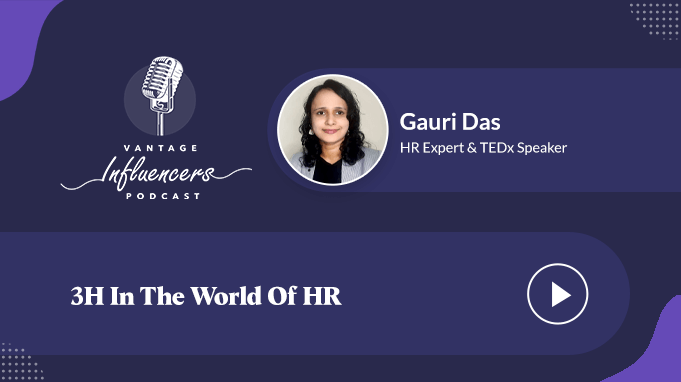
In this episode of Vantage Influencers, host Sushmita speaks with Gauri Das, an HR expert and TEDx speaker, about the 3H framework in HR. While most people know the 3Hs as Head, Heart, and Hands, Gauri introduces a new way to think about the three dimensions that drive human change and organizational success.
Gauri explains how combining these 3Hs creates a productive, successful company culture, and shares insights on women empowerment, possibilitarian mindset, and continuous evolution at work.
Episode Highlights
- The 3H framework goes beyond Head, Heart, and Hands to drive real organizational change.
- Combining these 3Hs is the secret to building a productive, successful company culture.
- HR leaders should focus on creating a possibilitarian mindset in employees.
- Women empowerment in the workplace requires deliberate support from HR and leadership.
- Success at work means continuously evolving and redefining what growth looks like.
About the Guest
Gauri Das - HR Expert and TEDx Speaker
Gauri Das is an engineer turned HR professional with double Masters in Human Resources and Psychology. She is a strategic, multi-award-winning HR leader with 16+ years of experience crafting and aligning HR strategy with business goals.
She supports businesses in setting the right culture, driving performance, reinventing employee experience, and improving capabilities. Her track record includes leading organizational change, talent management, D&I talent acquisition, and building executive teams aligned to deliver business objectives.
Gauri is a TEDx speaker who talks about creating a possibilitarian mindset, and she is passionate about women empowerment in the workplace. She has worked with both start-ups and well-established organizations, and is recognized for developing advanced systems to automate and digitalize HR processes.
Connect with Gauri on LinkedIn
Host
Sushmita - Vantage Influencers Podcast Host
What You Will Learn
- What the 3H framework in HR actually means
- How to apply the 3Hs to build a productive company culture
- Why a possibilitarian mindset matters for employees
- Practical ways to support women empowerment in the workplace
- How to define success at work and keep evolving continuously
Key Topics & Timestamps
| Time | Topic |
|---|---|
| 01:17 | Gauri's background and professional journey |
| 07:05 | What are the 3Hs in HR? |
| 15:50 | Women empowerment in the workplace and the possibilitarian mindset |
| 18:28 | How to define success at work and keep evolving |
Full Transcript
Read the full transcript
Sushmita: Welcome to the Vantage HR Influencers Podcast. This podcast is sponsored by Vantage Circle, the simple and AI-powered rewards and recognition platform for employee engagement.
Sushmita: When we talk about the 3H framework, we generally relate to the head, the heart, and the hands - the three areas where human change takes place. But our guest today has something more to talk about the 3H, going beyond head, heart, and hand. And talking about the corporate world, combining this newly propounded 3H is the secret to a productive and successful company. So, what are these 3Hs? Well, know all about the 3H in HR today, from Gauri Das, an HR expert and TEDx speaker, with innate support for women empowerment. And as usual, I am your host, Sushmita. So, let's get started with this brand new episode of the Vantage HR Influencers Podcast.
Sushmita: Welcome to the show, Gauri.
Gauri Das: Thank you, Sushmita. Thank you so much for being here today in our Vantage Influencers Podcast. And please tell us something about you now, before we start with the topic today.
Gauri Das: Thank you so much for inviting me here and creating this platform, where people can come and understand multiple aspects of HR. When I was growing up, it was not there. So, I was born in UP, brought up in MP, and many other places. So, I am in Maharashtra currently, and this is my 7th state. So, I am India's child, and I started my journey from a very small village in Madhya Pradesh. This was kind of a place where there was only one school, no English medium school. So, I started my journey from a Hindi medium school, no opportunities for personality development. I was anyways a very, very shy child. So, if there was a guest at home, I would hide behind my mom, and would not leave her until the guest stepped out of the house. So, this is how I was growing, but I was academically inclined. So, I grabbed engineering entrance test for the state, and I got admission in second ranking college of the state. When I went there, I met with all smart students who were from very good cities, large cities, good schools, and English was the mode of communication, because this institute had people from across the globe, had students from across the globe. So, I was very, very scared, and I would not open my mouth there. If teacher asked for a roll call, I would just raise my hands. I had no courage to speak. A village girl thinking that everybody is going to get me, and I am not good enough, and all those things. But finally, my father and my mother's learning helped me. I completed engineering, and then I went for MBA entrance, because in third year of engineering, a professor of management told me that I can go to HR. I was anyways not liking being with machines all the time. I was better off with people. But as you would know, if you know in our age, if you were good in academics, you would either become engineer or a doctor. Since I was very scared of blood, I chose engineering. So, I went for MBA entrance exams, but before I could go to the counseling center, I went to Mumbai and got married. And life took me to Kochi. And this was another like you plan something and life gives you something else. People told me, yeah, you're not going to get a job in Kochi. And Kochi was not known for creating careers for people, or offering good roles to people. So, I was told that it would not work out, but then I was determined and finally, after multiple efforts, I got a job. I could start my career from Kochi. Then life took me to Ahmedabad. Here again, the situation was not extremely good. There were not many opportunities for an engineer who wanted to do HR. And I restarted my career. There was a short break as well. I restarted my career within an educational institute. I taught MBA and BBA students. And then the time came for arrival of my bundle of joy. And it also coincided with our movement to Dubai. And after birth of my daughter, I was on second break. And this was close to two years. And then I re-entered the workforce. A large city. I was coming from a small place. I have had stayed in six states so far. And we had a nuclear family. I have had a long break also. And those were not the days when there were programs like bringing back women. People were not very appreciative of this idea of appointing women because with a young kid, the productivity would be low. And on top of that, nobody was able to trust me because I had been moving from one place to another. So after 100 plus applications, 13 plus interview rejections, I got a job with a company which was into baby products. It was a D2C company. And I got an opportunity to set up their HR department from scratch and also setting up their office. This was a great opportunity of learning, creating things, seeing how your actions are getting translated into results. But again, life had some other plans. So they decided to close this office in their operations in a year's time. And I was again looking for a job. Then I went to a company in BFSI. And this was a very good role. And the company was in major transition. So from being a private company with 30 years, they were recently acquired by an Australian MNC. So that MNC played a part and the transition gave me a lot of opportunities to learn. I did well going by the fact that I got a standing ovation from 300 plus employees on the last day of my exit. So that's how it happened. And then I moved to my current company. I started with HR, Head of HR. Then I took up Admin. And very simply, I've taken up Head of Marketing as well. So that's how the journey has been. Back to you, Sushmita.
Sushmita: Thank you so much, Gauri, for sharing your story. It's really inspiring for all of us. And moving towards the topic today, Gauri, would you like to tell us what is the 3H in the world of HR?
Gauri Das: Yes, HR is all about that. You call it human, you call it how many, you call it head, heart, hand. For me, the 3H are number one, high-tech experience. Now, look at a consumer today. All of us want a very high-tech experience. We remember, Sushmita, you will remember being in queue in a bank. And if you had to get your account opened, it would take weeks or months. But today, you get your account opened in a minute. So the high-tech experience that we are getting as a consumer is changing us as an employee as well. Or talk about the online shopping experience, which is very, very prevalent today. I was someone until pandemic hit that if I had to buy even a mobile, I would go to shop, have the touch and feel. And then only I would buy. But today, everything, 100% or I would say 99% things have moved to online. And the experience is extremely good. You order something, it arrives in a day or two. If you want to return it, it's very, very easy. So first H, even for an employee has become high-tech experience. Because if as a consumer, I am getting a high-tech experience, which is delightful. And as an employee, you take me back to ages ago, where I have to do everything manually. I am not going to be happy or engaged. So this high-tech experience, I would say, before both customers and employees has become first H. And why I bring in customers here? Because our employee is somebody else's customer. It can be our own customer also. And plus, HR needs to look at the trend, what's happening in market with customers. Because the way customers change, business change. And then we have to change the business, it happens with employees. So understanding what's happening with external customer is very important for HR. So that is H first H. Second H is harmony. So if our heart and mind are not in sync or in harmony, there will be cognitive dissonance. That's what I learned in psychology as a psychology student. Likewise, when team members and team leaders are not in harmony, there will be resignations. So that's where the next thing is harmony. Now, how do you bring this harmony? I think engaging with employees, understanding their concerns, supporting them in whatever way possible is very important. So if I get up in the morning and I think, oh no, I have to go back to work again. Then there is something missing that is no harmony in the system. So harmony is both HR and leaders, job managers, job. And there, the three H, again, the subset of three H comes into picture, which is head, heart and hand. Now, what is head here? So when we talk about creating that vision, or when we talk about giving employees a purpose, we are talking about that head piece of it. When head understands it, there is a vision out there. Then it goes to heart. So do we have that emotional connect? Is the second piece of this three H subset? And once we have that connect in terms of purpose, in terms of emotions, then the hands are there to get things executed. So having that connect between all three head, heart and hand is extremely important if we want to achieve the second H, which is harmony. So harmony is achieved through employee engagement, employee experience, giving them purpose, connecting with them heart to heart, and finally getting things executed in best possible way. Actually, if you have the two H with you, the subset two H with you, the head and heart piece of it, you don't have to do anything about it, because employees would be more than eager to get things done. So this is second H, which is harmony. And within the three H, within the three sets of H, which is head, heart and hand. Now the third H is holistic wellness, which was not taken into consideration earlier, but today holistic wellness is playing a very important role. I think mostly after the pandemic, these factors are coming up.
Sushmita: Absolutely. We very rightly said, and as Sushmita, if you remember, the organizations would be very proud having a lunchroom in the office, a titbit food according to their chart, and all of this. But the pandemic hit.
Gauri Das: Correct. When the pandemic hit, none of this was of any use, because nobody was going to office. There were people who used to take pride in working overtime all the time, and sleep was going for a toss. Although we were concerned about the gyms and the diet that we were offering to employees, but we were not focusing on sleep. And now we know that sleep is also extremely important. So the eight dimensions of holistic wellness that we talk about today are now in picture. Now which are these dimensions? Physical, we all knew. We had to just focus on sleep, and that is happening today. Now people don't take a lot of pride in sending emails at 2 AM. There are some, but things are improving a lot there. Next is emotional wellness. Do we have that connect? Like we spoke about the three subset of H. Do we have that resilience? Are we supporting people? Are we showing that resilience? Even spiritual. The purpose piece of it has become very important. Who am I and why am I here? When you connect your purpose with organization's purpose, and people are very, very delightful, they are much more engaged. Intellectual. Whether my intellect is being utilized for the right purpose. Environmental. The kind of place where I sit in and the safety piece was very, very important. So I remember an instance from my hostel days. For some time, I had a roommate who was not very, very clean and tidy. The way I would expect, I am not judging here, but the way I would expect she was not like that. So I would always have this dreaded thought of going back to room. From my college, that our classes ended, I have to go to that environment where things would not be tied up. And I will have to go and clean everything. So even environmental impacts us. Then financial. Financial is another piece of it. And we know how it happened during COVID that people, even at very senior levels, after three months of the job loss, they were broke. Because the financial wellness was not achieved. Then comes the occupational and social, the water cooler connect is extremely important. And when we connect with each other in this fashion, we actually have the bonding. So all eight dimensions of wellness is the third piece that I would say is in HR. And it is holistic wellness. So whatever we are doing, whatever we are planning as engagement activities, or as connect, communication, reward programs, everything should revolve around all eight dimensions. Otherwise, if someone, the physical wellness is good, but emotional is not. We now know there can be challenges with mental health. And ultimately, employees going to suffer, team is going to suffer, and even business is going to suffer. So this third H holistic wellness is also having a business case. So the first H is high-tech experience, harmony and holistic wellness.
Sushmita: So in general, let me say that 3H, when we talk about 3H in the workplace or HR, we generally talk about hand in hand, right? And that you have included in the second point that we mentioned that is harmony.
Gauri Das: Yes, harmony. Yes, right. Okay, it's clear now.
Sushmita: Okay, so Gauri, you have also graced multiple national and international forums as a keynote speaker and panelist. You are a TEDx speaker, and your talk is about creating a possibilitarian mindset. And at the same time, you are passionate about women's empowerment, right? So what has been your experiences of weighing in favor of women in the workplace?
Gauri Das: Yeah, it has changed a lot. And in my one and a half decade long career or more than that, I have seen drastic changes here. So people have started understanding the fact that there has to be equality, and there are policies, and people are very, very supportive. Like even governments have come forward. So I would say that from every area, there is support for women. There is support from government now. The maternity leave has been moved to six months. When I was, I had been seen, and those days it used to be three months. We are now talking about period leave. So those things are coming forward, and people are open to accept these things. There is very high awareness, and there is very high focus also on diversity and inclusion. And I'm not saying that diversity is only limited to women. It is about not many type of diversity, be it economic, be it sexual orientation, caste, creed, whatever. But yes, there is a lot of focus on that as well. Women themselves are coming forward, and they have started understanding their own rights. So they are vocal now. Some of the things that we used to say about women that they don't have aspirations, but now even they have it. Men have started changing both at home and work. So at home, men have started taking a lot of responsibility, even if it is not equal responsibility as yet, but yes, they have put some burden off the shoulders of women. And at work, they are also supporting as sponsors, as advocates for women. So I would say many changes I have seen in last 16, 17 years that I have been working. And this is one of the best time that women can utilize and women's potential can be utilized as well. So from both sides, from both business and for the workforce, it is a good time things are improving. But yes, lots need to be done yet. And I'm sure we are on the right path and we will be there very soon.
Sushmita: Okay, so if I ask you, Gauri, to define success at work, what would be that? And it would be great if you can share how we can keep evolving at work continuously.
Gauri Das: Thanks for bringing this, which would be very interesting and very important because so far when we were brought up and we were as a child, we will also relate to some of the things. There would be a lot of comparison at home. Parents would say he or she became an engineer or a doctor, and that's how they are successful. But today we know there is no one definition of success. Success for someone can be having control on how they utilize their time. For somebody else, it can be fame. So for someone else, it would be social work. Having that happiness or fulfillment from social work, even if there is not a lot of money involved. But for someone else, it can be money. So we now know that the definition of success has changed and people have started recognizing that one parameter is not going to work for success or happiness for that matter. And that's where even at the workplaces, when we are designing policies, so jokingly we are now saying in HR, there will be one employee handbook for each employee because you need to make it very, very personalized. And the reason is the definition of success, the definition of happiness is very, very personalized for people. So I would say go within, try to find out how does success look like for you. Definitely the minimum requirement is important for everyone as we know from Maslow's hierarchy. The basic needs are to be met. But beyond that, how does fulfillment look to you? How does success look to you? Maybe totally different from how does success look to me. So go within, find out what is it that brings you happiness and success and work accordingly. That would be my thought process on success here.
Sushmita: Great. So finally, Gauri would like to know how our listeners can reach out to you. And I would like to know more about the three Hs that you propounded.
Gauri Das: Yeah, I'm there on LinkedIn. I'm pretty active on LinkedIn so I'm reachable there. Or they can write to me on the email ID that is mentioned.
Sushmita: So these are the two ways to reach out to you. I'll be putting the link to your LinkedIn profile in the show notes. Great. Thank you so much, Gauri, for joining me in this podcast today. Thank you for sharing your insights. It was an excellent pleasure to have you on our show. Thank you once again.
Gauri Das: Thank you so much Sushmita.
Sushmita: Thank you for listening to the Vantage HR Influencers podcast. Please do subscribe to Vantage HR Influencers podcast on Apple Podcasts, Spotify and our YouTube channel for new episodes.
Resources Mentioned
- Gauri Das's TEDx talk on possibilitarian mindset
- Women empowerment initiatives in corporate HR
- HR digitalization and automation frameworks
FAQ
What are the 3Hs in HR?
The 3Hs in HR traditionally refer to Head, Heart, and Hands - the three areas where human change takes place. In this episode, Gauri Das expands this framework to include high-tech experience, harmony, and holistic wellness as the three dimensions that drive organizational success.
What is a possibilitarian mindset?
A possibilitarian mindset is the belief that possibilities exist and can be created. Gauri Das, a TEDx speaker, promotes this mindset as a way to drive personal and organizational growth, especially in challenging or uncertain environments.
How can HR support women empowerment in the workplace?
HR can support women empowerment by creating inclusive policies, providing mentorship and sponsorship opportunities, ensuring fair compensation and promotion practices, and fostering a culture where women's voices are heard and valued.
Why is the 3H framework important for company culture?
The 3H framework helps organizations align their people strategy with business goals. By addressing high-tech experience, harmony, and holistic wellness, HR can create holistic change that improves engagement, performance, and culture.
How do you define success at work?
Success at work is not just about achieving targets or promotions. It is about continuous evolution, learning, and finding meaning in what you do. Gauri emphasizes that success should be redefined regularly as you grow.
Related Reading
- Employee Engagement: Definition, Importance, Drivers, Strategies & Examples
- The Impact of Company Culture on Employee Engagement
- Women in the Workplace: Challenges and How to Address Them
- Leadership: Fundamentals, Evolution, Challenges & Future
This episode is part of the Vantage Influencers Podcast, where we bring HR thought leaders to discuss engagement, compensation, benefits, and everything related to HR.
Also listen on