Emerging HR trends post Covid-19 pandemic
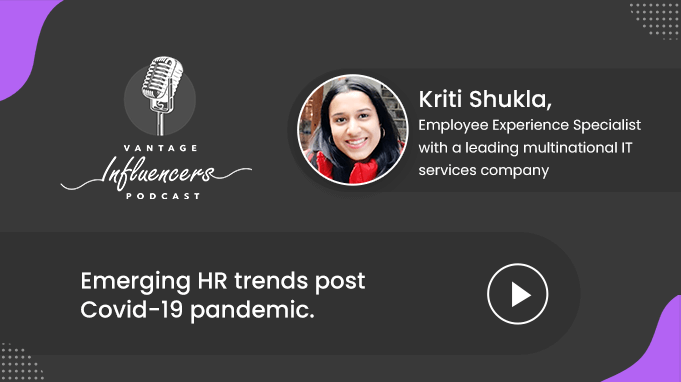
Episode Overview
Kriti Shukla argues that the pandemic pushed HR from the sidelines to the center of business continuity planning, and that four forces will define the function from here on: remote work that never fully reverses, a much harder reliance on data to judge productivity and sentiment, a shift toward gig and skills based hiring, and a sustained focus on employee safety and well being. She makes the case that "life will be back on track, but it will not be the same," pointing to hybrid workplace models, new rules around office conduct, and a talent acquisition mindset that increasingly hires for skills rather than fixed roles.
She also breaks down how organizations can act on those trends day to day. Rather than talk about individual engagement activities, she frames engagement around three drivers, transparent top down communication, continuous growth and development, and flexibility in how performance gets judged during a crisis. Running through all of it is her view that employee experience only works when it is treated as a shared business strategy rather than an HR only initiative, since the trust organizations rebuild now with employees is what will carry them through whatever comes next.
Episode Highlights
- Kriti's corporate journey began in 2016 after an MBA in HR and IT management, moving from talent fulfillment to HR generalist work before landing in employee experience.
- Four trends will define post pandemic HR: remote work, data driven decision making, gig and skills based hiring, and a stronger focus on employee well being.
- Hybrid workplace models mean HR has to design for two different employee experiences at once, office based and remote, rather than a single default.
- Three drivers keep engagement alive during a crisis: transparent top down communication, continuous growth and development, and flexibility around how performance is judged.
- Employee experience works best as a shared business strategy across departments, not an HR only initiative, backed by data and sentiment analysis.
- Trust, not compensation alone, is what the pandemic tested most, and rebuilding it depends on keeping employee experience and business strategy aligned.
About the Guest
Kriti Shukla, Employee Experience Specialist, Leading Multinational IT Services Company
Kriti Shukla has over 4.5 years of HR experience across talent management functions, including talent engagement, performance management, recruitment, and rewards and recognition. She began her corporate journey in 2016 after completing her MBA in HR and IT management from the SDM Institute, Mysore, starting out as a talent fulfillment specialist handling staffing for critical roles and workforce planning. She then spent a year as an HR generalist for a key banking client before moving into her current role as an employee experience specialist with a leading multinational IT services company, where she works to keep employee experience aligned with organizational priorities in the post pandemic "new normal."
Connect with Kriti on LinkedIn
Host
Susmita Sarma, Vantage Influencers Podcast Host
What You Will Learn
- The four HR trends Kriti Shukla believes will shape workplaces in the years following the pandemic
- Why HR shifted from a support function to a central player in business continuity planning during the crisis
- How to think about hybrid workplace models that need to serve both office based and remote employees at once
- The three drivers, communication, growth, and flexibility, that keep employee engagement strong during uncertainty
- Why employee experience needs to operate as a business strategy rather than a standalone HR initiative
- How organizations can rebuild and sustain employee trust once the immediate crisis passes
Key Topics & Timestamps
| Timestamp | Topic |
|---|---|
| 00:00 | Introduction and guest welcome |
| 01:08 | Kriti's journey into HR and employee experience |
| 02:44 | How COVID-19 reshaped the role of HR |
| 04:50 | Four HR trends shaping 2021 and beyond |
| 08:33 | Turning trends into action: hybrid work and skills based hiring |
| 11:03 | Three drivers of employee engagement during a crisis |
| 13:45 | Practical measures for rebuilding workplace experience |
| 15:14 | What the future of work looks like |
| 16:54 | Lessons learned and rebuilding employee trust |
| 17:57 | The HR leader Kriti admires: Leena Nair of Unilever |
| 18:51 | How to connect with Kriti |
Full Transcript
Click to read the full episode transcript
Welcome to the Vantage HR Influencers Podcast. This podcast is sponsored by Vantage Circle, the leading employee benefits and engagement platform. As the situation of the COVID-19 pandemic has been very complicated and unpredictable, many problems still have to be met by HR leaders and managers. The best way to solve this scenario with minimum loss is to keep up with the latest trends. Therefore, in today's episode, we'll be talking about the emerging HR trends post-COVID-19 pandemic.
Susmita Sarma: Hi, everyone. This is Susmita from Vantage HR Influencers Podcast. And for the same we have with us today, guest speaker, Kriti Shukla. Kriti has over 4.5 years of work experience in HR, especially in talent management processes, like talent engagement, performance management, recruitment, and rewards and recognition. Currently, Kriti is working as an employee experience specialist with a leading multinational IT services company. In her role, she strives to be aligned with every priority of her organization, keeping employee experience at the center, and she believes that a great employee experience is of extreme importance, especially in the new normal of the post-COVID era. Welcome, Kriti.
Kriti Shukla: Hi, Susmita. Thank you so much.
Susmita Sarma: Okay, so before we start with the topic, please let us know a brief about your journey in the corporate world.
Kriti Shukla: So my journey started in the corporate world in the year 2016, after completing my MBA in HR and IT management from SDM Institute, Mysore. I started off as a talent fulfillment specialist, where I was involved in staffing for critical roles and workforce planning. I then took up the role of HR generalist for a key banking customer. I did that role for a year, and then I moved to my current role of employee experience specialist. So the journey so far has been quite fulfilling and enriching, and I believe this is just the start, and definitely there's a lot more for me to learn in the years to come.
Susmita Sarma: Okay, right. So we can start with our topic today, that is emerging HR trends post-COVID-19 pandemic. So Kriti, over the last five years, technology has accelerated the digital HR revolution and has begun to build a new age in which people have more influence on how they work, what a better work-life balance entails, and are preferring to pick passion-driven projects and becoming path breakers. Just as things began falling into place, COVID-19 hit and started to interrupt human life, behavior, businesses, and the global economy. In the case of HR, we don't really know if we could ever go back to the pre-COVID reality, as this particular sector in the organization has faced the most critical phase during the crisis. So how do you believe COVID-19 has affected HR?
Kriti Shukla: Undoubtedly, this year has been the most challenging and difficult year for all of us, and also for organizations across industries. More so for HR, having to tackle never seen before issues pertaining to employee health, safety and well-being, and also areas like engagement and work-life balance. So when the pandemic hit us during the early months of 2020, we as HR professionals were on the front line, communicating with employees, addressing their concerns, queries and apprehensions, and we still continue to do that. In my opinion, during this crisis, HR has seen itself transitioning from being an enabler and support system to being at the center of the business continuity strategy. The sudden shift in work culture with the remote workforce has brought about a 180 degree change in how we are approaching people issues and handling their concerns. I also believe these demands have brought about a 180 degree change in the way we approach employee engagement and employee satisfaction. Fostering culture in a dispersed work environment, relooking at compensation structures, medical facilities and insurance, and also bringing focus on mental and emotional well-being: these are all demands that HR has to cater to, and there are many more such demands that will come up in the future.
Susmita Sarma: Right. So with a huge change in our systems of behavior and conduct, and the digital becoming the way of life, it is important that we evolve and change the way we all work. And as you rightly pointed out, HR needs to emerge as a navigator in such an environment, helping to maintain a balance between the organization and the needs of individuals. So according to you, what are the key trends that will shape HR in 2021?
Kriti Shukla: So I'd like to talk about the four key trends that I believe will shape the future of HR in the years to come. The first one being remote working. As you know, all of us, and the majority of the workforce across industries, is working from home, and there is a lot of uncertainty related to when we are going to return to office. This brings out a need for organizations across industries to invest in digitization and also in collaboration tools. Digital, as we call it, is here to stay, and we're already seeing years' worth of digital transformation coming forward in months. So I believe that remote working is here to stay, and this will play a crucial role in how HR pays its way in the post-COVID era.
The second key trend that I believe in is data-driven HR. HR will have to change its approach towards people management. We were only in the early stages of adopting data-driven decisions, while now we have to rely on reports and data that show us key indicators to focus on. How do we measure productivity? How many hours are employees working, and how are they feeling in the new workplace, that is, home? How do we measure performance in a remote work environment? So we will have to leverage data analytics and AI to create tailored interventions around these areas, and this is going to be the way forward.
The third key trend that is coming up, and is already being widely adopted, is the gig workforce. Workforce models are evolving post-COVID. The economy is seeing a fluid and dispersed workforce and an ever-increasing demand for niche skills, flexibility to work from anywhere, and not being confined to office spaces. Organizations are embracing the gig economy to meet the demands of cost saving and having a high performing, flexible workforce. This is not necessarily applicable only to new hires or external hiring; companies are also trying to bring this culture within their own organizations.
Finally, the fourth key trend that I feel will play an important role is that there will be more focus on employee safety, well-being and resilience. We may be used to working from home, managing kids and switching from online classes to online meetings, while also simultaneously managing our daily chores, but it doesn't mean the stress is any less. This is bound to continue, and so organizations will have to adopt a people-first culture and make employee safety and holistic well-being a priority. It's not just about organizations coming up with well-being activities and sessions for their employees, but also about how we bring about that change of taking care. It has to become a cultural change across organizations where they focus on taking care of employees. Flexible work routines and leadership with empathy will make a lot of difference in building employee trust in the organization. So I believe these are the key trends that will shape the future of HR in the years to come.
Susmita Sarma: Right. So given where things stand, how can these trends you mentioned be used effectively to speed up the situation and get work life back on track?
Kriti Shukla: Life will be back on track, but it will not be the same. And just like we have been experiencing changes in our work life and in the surroundings around us, employee expectations from organizations will also be drastically different. We will have to look at hybrid workplace models, where daily check-ins and meetings will have a different face. We will have to cater to both office and work-from-home environments, and while some people may be coming back to office, some teams may not even come back at all and may continue working from home.
So how do we understand what needs to be prioritized? That is where the power of data comes into the picture. Data will tell us what needs to be prioritized and what it is that the workforce wants. Also, talking about the landscape of talent acquisition and how it is changing: there is a shift in the way companies are hiring, a shift from individual roles to organization-wide skills. They may want to look at what skill a new hire is bringing into the organization, rather than the kind of role they will be playing, because they want to scale up their workforce so that employees are able to take up roles through their skills and scale up to meet upcoming demands.
So HR will have to facilitate this shift by addressing employee aspirations and making sure the organization paves the way for them to achieve those aspirations. Companies are also preferring scalable work models with a flexible workforce, and hence organizations will have to build resilience among employees and train managers to spot burnout. So in short, we will have to embrace risk and change, and that's how we will be able to meet the ever-evolving expectations of the workforce.
Susmita Sarma: So all of this, the whole workplace experience, is going to change in this emerging shift that is coming, whether we join back or continue working from home. So for that different workplace experience, employee engagement is also going to play a very important role. How can employee engagement activities be maintained?
Kriti Shukla: I would like to answer this question a little differently. Instead of talking about employee engagement activities, I would like to talk about the drivers that will play a pivotal role in enabling engagement at the workplace. I'd like to talk about three key drivers. The first of them is communication. As much as it is important to hear from employees about how they feel and what they want, it is equally important to have transparent communication from top to bottom. We have been doing annual surveys and polls to get employee feedback over the years, but now the demand is for more frequent connects between leadership and employees. We have to leverage leadership forums where they come together and communicate transparently. Supervisor check-ins are important. They need to ask their employees and their teams how they are doing, whether they are in trouble, whether there's any problem they're facing.
The second key driver is growth and development. The current scenario demands a holistic performance management process that is more regular and continuous. So having continuous feedback in place, cross-functional training available for employees to take up agile roles, and giving them the opportunity to perform outside their regular work, will instill a sense of belonging in the workforce. Also, understanding employee aspirations, what it is they want to do, what the next role is that they want to take, and providing learning opportunities pertaining to those aspirations, will enhance employee experience. At the same time, while doing these things, it is also important for organizations to remind employees about what's not changing as well.
The third key driver I'd like to talk about is flexibility, flexibility around work hours and productivity. We are in a time where we need to think and act with empathy. It is for managers and leadership to know that if someone on their team is not performing, it can be due to various non-work related reasons, and that's okay. What matters is whether we are trying to understand what the problem is.
Susmita Sarma: Right. So it goes the other way around too, Kriti, because employees need to be a bit flexible during this crisis as well, to meet the needs of the organization?
Kriti Shukla: Yeah, yeah.
Susmita Sarma: So, as an employee experience specialist, what measures do you suggest to our listeners, and most importantly, to those who are working so hard to rebuild workplace experience through this pandemic?
Kriti Shukla: Employee experience is usually explained as the sum total of all interactions that happen between employee and employer at every touchpoint during the life cycle. Organizations need to look at it from the lens of the employee and what they want. While this is true, it is also important for employees to understand what is expected of them in this post-COVID scenario. Approaches like design thinking and employee journey maps are being used by future-forward organizations, keeping the employee at the center and understanding key pain areas. So employee experience is not just an HR strategy, but a business strategy as well, one that requires key stakeholders from across the organization to identify concern areas and work towards improving them. This is not an easy task. It requires the help of data analytics, deep diving into sentiment data, AI, and most importantly, a mindset to adopt these technologies. As we say, we all have to start somewhere, and this is where we should be starting, if not already.
Susmita Sarma: Right. So how does the future of work look to you?
Kriti Shukla: In my opinion, the future of work is different for every organization, depending on when they are planning to return, or not return at all. There will be a sea change in the way employees and organizations perceive the workplace. Many organizations are planning to restart their offices, while others have declared permanent or extended work-from-home options. Looking at coming back, companies will require employees to wear masks at all times, redesign their office spaces to ensure social distancing, and restrict movement within office premises. So if someone is not wearing a mask or not following social distancing, what category of non-compliance does that fall under? Organizations have to be ready with their approach to discipline management, and they will need some new rules and regulations in the workplace going forward. This is going to be very different, and it will be more challenging as well. As we progress through the pandemic and experience its various phases, our mindsets are also changing and evolving. All these changes will impact future workplace dynamics.
Susmita Sarma: Right. So as you already said, companies are doing their best to protect their workers during the pandemic, and with a greater emphasis on personal productivity, well-being and personal resilience, working from home is working wonderfully for most of us, with huge growth in learning as well. So as a lesson learned for companies, what would be your conclusion regarding this crisis?
Kriti Shukla: The last ten months have drastically changed the way we look at work life, safety and health. It has also changed the way employees look at their company. It has gone beyond compensation, benefits and work culture. It now has more to do with the trust that employees have in the organization and its leadership. The COVID crisis has been a stress test for all industries in terms of how they adapt to unprecedented changes, and this has played a crucial role in reestablishing employee trust in the organization, the feeling that their company can protect them. So organizations will have to build on this trust, and this can be done only if employee experience goes hand in hand with business strategy. Unlike earlier, the two cannot exist in silos. A positive employee experience will lead to enhanced customer experience. I think that is where the key lies.
Susmita Sarma: Okay. So, any HR leader whom you follow?
Kriti Shukla: Yeah, so I really admire Ms. Leena Nair, who is the CHRO of Unilever. She is the first female and youngest ever CHRO of Unilever, and as an HR leader she inspires me greatly. The passion that she brings to HR is truly commendable. I really like what she said once, when she was asked what perception about HR she would like to change. Her answer was, HR is always filling the cracks for the business and not laying the road. And I can totally relate to this answer, because we as HR professionals have always been facing certain challenges, and we've been striving to keep up with changing business requirements. So I think that is something I really admire about Ms. Leena.
Susmita Sarma: Great. So lastly, how can our listeners reach out to you?
Kriti Shukla: I have an active LinkedIn account, and anyone who wishes to reach out can please feel free to contact me on it.
Susmita Sarma: Okay, that was a great conversation with you, Kriti. Thanks a lot for joining me.
Kriti Shukla: Thank you, Susmita. And I'd like to thank the team at Vantage Circle as well, for having invited me and giving me this opportunity to interact with you all. Thank you.
Susmita Sarma: Thank you.
Thanks for listening to the Vantage HR Influencers podcast, where we engage with HR influencers about human resources. Please do subscribe to the Vantage HR Influencers podcast on Apple Podcasts and Spotify for new episodes.
FAQ
What are the four HR trends Kriti Shukla says will shape the post pandemic workplace?
She points to remote work becoming a lasting fixture, a heavier reliance on data driven decision making, the rise of a gig and skills based workforce, and a sustained focus on employee safety, well-being and resilience.
How does Kriti Shukla define employee experience?
She describes it as the sum total of every interaction between an employee and employer across the entire employee life cycle, and argues it works best when treated as a business strategy that spans the whole organization rather than an HR only initiative.
What three drivers does she say keep employees engaged during a crisis?
Transparent, top to bottom communication, continuous growth and development opportunities, and flexibility in how performance and productivity are judged.
Which HR leader does Kriti Shukla admire, and why?
She names Leena Nair, the first female and youngest ever CHRO of Unilever, for the passion she brings to HR and for challenging the idea that HR should only "fill the cracks" for the business rather than help set its direction.
Related Reading
Also listen on