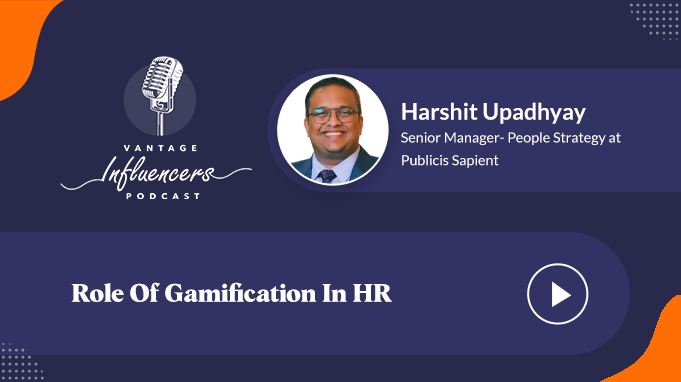
Role Of Gamification In HR
Episode Overview
Harshit Upadhyay argues that gamification's biggest hiring win isn't just making recruitment more fun, it's giving companies a faster, more revealing read on who candidates actually are. He walks through how quizzes, simulations, and hackathons let recruiters see how someone handles pressure, collaborates on a team task, or thinks on their feet, evidence that a stack of resumes and a panel interview rarely produce. Referral programs benefit too: he describes gamified referrals, where employees earn points for successful hires, as one of the more reliably effective levers he has personally seen work, both for speeding up hiring and for building a sense of pride and stake in the company's growth.
Beyond hiring, Harshit frames gamification as something that works because it taps into three basic psychological needs: autonomy, a sense of mastery or competence, and the need to feel connected to others. He carries that thinking into onboarding, learning and development, and employee wellness, describing an OTT-inspired learning journey he built at his current organization, complete with seasons, episodes, weekly leaderboards, and badges. But he's just as clear about the guardrails: a gamified process only stays fair if it's accessible by design, built for the right audience, kept simple enough to understand yet hard enough to master, paired with instant feedback, and reviewed constantly against real usage data to catch bias before it takes hold.
Episode Highlights
- Gamified assessments such as quizzes, simulations, and hackathons reveal how candidates handle pressure, collaborate, and think creatively in ways a resume or a traditional interview cannot.
- Gamified referral programs, where employees earn points for successful hires, speed up hiring and build a sense of pride in the organization's growth.
- Gamification drives employee engagement by activating three core psychological needs: autonomy, a sense of competence or mastery, and the need to feel connected to others.
- New hire onboarding, performance management, and learning and development are all processes Harshit has personally gamified using points, badges, and leaderboards.
- A fair and inclusive gamified process has to be accessible by design, matched to the right audience, simple enough to understand but hard enough to master, and backed by instant feedback.
- Gamification data helps organizations spot which colleges, teams, or individuals produce the strongest talent, information Harshit uses to refine both campus hiring strategy and reward decisions.
About the Guest
Harshit Upadhyay, Senior Manager, People Strategy at Publicis Sapient
Harshit Upadhyay is a strategic HR leader with over 12 years of experience in the HR space, holding an MBA specialized in HR. He began his career at Infosys as a management trainee, working across HR shared services, HR digitization, compensation and benefits, and performance management, before moving to the US as an HR business partner, where he led localization strategy, change management, and new HR process setup for the region. Back in India, he joined the organization development team at Infosys, where he built interventions for digital fluency and new-age skills and led the manager development and listening ecosystem functions. After more than a decade at Infosys, he moved to Publicis Sapient, where he now serves as Senior Manager, People Strategy, responsible for the people function across several industry verticals, with a focus on talent solutions, strategic people consulting, integrated talent management, and culture building.
Connect with Harshit on LinkedIn
Host
Sanjeevani Saikia, Vantage Influencers Podcast Host
What You Will Learn
- How gamified assessments such as quizzes, simulations, and hackathons can reveal skills that traditional resumes and interviews miss
- Why gamified referral programs help speed up hiring while building pride and engagement among existing employees
- Which psychological needs, autonomy, competence, and connection, gamification taps into to drive employee engagement
- How to gamify onboarding, performance management, and learning and development using points, badges, and leaderboards
- What it takes to keep a gamified process fair and inclusive: accessibility, the right audience fit, simplicity, and instant feedback
- How gamification data can inform smarter hiring, upskilling, and reward decisions
Key Topics & Timestamps
| Timestamp | Topic |
|---|---|
| 01:30 | Harshit's HR career across Infosys, an international stint in the US, and his current role at Publicis Sapient |
| 03:45 | How gamification transforms recruitment, from candidate assessments to referral programs and employer branding |
| 08:58 | The psychological needs gamification taps into to drive employee engagement |
| 11:03 | Gamifying onboarding, performance management, and learning and development across the employee lifecycle |
| 14:40 | Real-world examples of gamified learning journeys, leaderboards, and skill badges |
| 19:20 | Building fairness, accessibility, and inclusivity into gamified HR processes |
| 24:20 | Using gamification data to guide hiring, upskilling, and reward decisions |
| 28:01 | Closing thoughts and how to connect with Harshit |
Full Transcript
Click to read the full episode transcript
Welcome to the Vantage HR Influencers Podcast. This podcast is sponsored by Vantage Circle, the simple and AI-powered rewards and recognition platform for employee engagement. Welcome to yet another episode of the Vantage Influencers Podcast. I'm your host, Sanjeevani Saikia. Today we'll discuss how gamification is changing the game in HR and why it's so important to talk about. Businesses constantly seek innovative ways to attract and retain talent and keep their workforce motivated and growing, and this is where gamification steps in. It's not just about making work fun but about leveraging our innate human traits: our competitive spirit, our hunger for recognition, and a thirst for growth and challenge. Gamification in HR can lead to increased engagement, improved productivity, and a more positive work environment. To explore this subject further, we're joined by Harshit Upadhyay, Senior Manager of People Strategy at Publicis Sapient. With his wealth of experience and expertise, Harshit will provide invaluable insights into the application of gamification in the workplace. So let's begin the conversation.
Sanjeevani Saikia: Hi Harshit, thank you so much for joining in today's conversation.
Harshit Upadhyay: Hi Sanjeevani, I'm more than happy to be here, glad to have been invited to have a conversation with you.
Sanjeevani Saikia: Pleasure is all ours. Before we dive into today's topic, the role of gamification in HR, I'd love to hear about your professional journey so far.
Harshit Upadhyay: Sure. So I come with over 12 plus years of experience in the HR space. I completed my MBA with a specialization in HR, and after that I joined Infosys as a management trainee. During my first couple of years at Infosys, Sanjeevani, I got the opportunity to work on different facets of HR, like setting up HR shared services, several HR digitization projects, the compensation and benefits space, and performance management, among others. Then I got the opportunity to move to the US, where I worked as an HR business partner and worked on several exciting projects focused on localization strategy, change management, and setting up various new HR processes for the US region. That gave me the benefit of well-rounded international exposure. Once I moved back, I took up a role in the organization development team at Infosys and worked on several areas of talent management, creating interventions to enable employees to build their digital fluency in new-age skills. A lot of gamification was actually used there for employees to build on their skills. I also led the manager development and listening ecosystem chapters. After spending over a decade at Infosys, having done so many different things, I really wanted to experience the world outside, and I took up an opportunity in the people strategy team at Publicis Sapient. I'm currently a senior manager on that team, where I'm responsible for the people function for some of our industry verticals, with a primary focus on building creative talent solutions, strategic people consulting, integrated talent management, and of course being a culture champion. It's been an exciting journey and I'm very proud of it.
Sanjeevani Saikia: Great. Thank you so much for sharing your journey with us, Harshit. I really appreciate it. So with your permission, I'd like to begin today's conversation on the topic.
Harshit Upadhyay: Absolutely.
Sanjeevani Saikia: Great. Hiring the right people is crucial, but it's often easier said than done, and I believe that's where gamification steps in, turning the whole recruitment process into something more than just sifting through resumes. So I'd like to know from you how exactly gamification can spice up the recruitment journey, whether it's through interactive challenges, skill-based simulations, or engaging assessments, and what kind of advantages it really brings to the table.
Harshit Upadhyay: Absolutely, that's an interesting question, and I truly feel the biggest impact gamification has is in the recruitment and talent acquisition process. If you speak to a lot of candidates today, especially Gen Z and millennials, they'll tell you that traditional hiring processes and interviews can feel very draining. What gamification does is make the recruitment process more fun and engaging, and a lot of the time it also helps attract top talent that might not have even considered applying for a job otherwise, because young talent today is very well networked and connected. When they see an organization coming up with an interesting assessment process, they feel the fun of it, they feel the thrill of it, and they'd like to join. What we're increasingly seeing is that gamified assessments, like quizzes, puzzles, simulations, sporting exercises, and hackathons, can offer a far more dynamic and holistic way to evaluate candidate skills, especially around problem-solving abilities, decision-making, and teamwork. They go beyond traditional resumes and interviews because they truly reveal how a candidate reacts under a pressure situation, maybe in a simulation game, or how they collaborate when you give them a team-building exercise, or how they think creatively.
The other piece I see happening in organizations is that gamification also helps reduce time to hire. In a traditional process, there'll be multiple rounds of interviews, and it's time-consuming for a recruiter to coordinate with different people to get to the hiring managers. What happens is that gamification helps you skip some of the entry-level steps by identifying the right candidate for the job early on, so you're eliminating some steps and you already know you can go ahead with a candidate. That makes the whole process faster.
Another place I've personally seen it benefit hiring is through referrals. Gamification can help make referral programs succeed, and it can be extremely gratifying. It also encourages healthy competition among existing employees, since employees earn a referral point or reward every time they give a successful referral to the organization. In turn, it creates a sense of being included in the growth journey of the organization, and that's how you build pride among people. In all of this, you're also building a brand, because when you bring in gamified elements like points, badges, and leaderboards, different candidates can see where they stand in the whole gamification journey. It fosters a sense of achievement and healthy competition, and it keeps candidates motivated and invested through the whole process. That leads to improved candidate engagement and satisfaction, and I think also a stronger employer brand, which is very important.
We often talk about the candidate side of the picture, but a reality for a lot of organizations today is that when you're on a growth journey and want to hire in large numbers, keeping your hiring managers engaged is also equally difficult. So you can gamify the process for hiring managers too, bringing in elements of badges, points, and leaderboards for those doing quality interviews, where you're seeing a lot of candidates being converted. You recognize these hiring managers in larger forums, and it creates excitement in that group as well.
So to summarize, gamification in recruitment and the whole talent acquisition process offers benefits to both the company and the candidate. It creates an engaging experience that attracts top talent, and for the organization, it helps you actively select the right fit for the job. So yes, I think it brings huge benefits to the talent acquisition space.
Sanjeevani Saikia: Okay, I think it's pretty much a fact that every manager loses sleep over employee engagement. It's something they keep thinking about, and I'm pretty sure it's not just about keeping folks happy, it's about keeping them invested and excited about their work. That's where I believe gamification comes into play. So please help us understand some of the effective ways to implement gamification in the workplace to boost employee engagement, and perhaps more importantly, what kind of impact can organizations expect to see on things like morale and productivity when they incorporate gamification into their HR strategies?
Harshit Upadhyay: Yeah, before I answer that, Sanjeevani, it's important for us to understand how gamification can actually enhance employee engagement. This is a question that comes up for so many people when they're talking about introducing gamification into any HR process. I think the mechanics of gamification activate three or four elements of our own personal motivation system. First, all of us have a need to be autonomous, a desire to direct our own life, and gamification allows you to choose a path where you know what excites you and go after that. Second, we have a need to feel competent, a desire to be demonstrably effective, and games allow us to experience progress every time we move up a level, so we feel we're mastering the art of it. The third is our need to feel related, a desire to be connected with others, and games allow us to work with and against others, helping us build a community around shared interests.
Keeping that in mind, once you understand how gamification truly activates employee engagement, you can see various processes within the employee lifecycle where you can influence it. To begin with, the first place you can have a strong impact on engagement is by gamifying the new hire onboarding process. You can use gaming features such as leaderboards, point tables, and badges to have new hires complete important 30-to-45-day milestones, around important content or mandatory trainings you want them to go through. It also creates a spirit of competitiveness among new hires, and successful organizations with strong onboarding programs leverage gamification to the core to get this done. They build team-based gaming assignments that promote better engagement and integration. A lot of organizations have also started customizing experiences for new hires by personalizing the gaming environment based on the role, the responsibilities, and the work unit the individual is going to join. When you personalize the experience, people truly feel excited and engaged at the start.
There are so many other processes across the employee lifecycle, like performance management and learning and development, where if you articulate clear goals for what you want the gamification process to achieve, it can really help. There are a lot of ways to do that. One is recognition badges: a digital recognition badge that an employee can earn from various achievements or milestones, which they can display on their profiles, signatures, or social media handles. It adds an element of status and recognition. Companies are also creating leaderboards that assign points to different tasks or achievements and rank employees based on their points, with the idea of encouraging healthy competition among employees. A very interesting thing a lot of organizations are doing today is introducing point-based rewards or virtual currencies, where employees earn points when they accomplish a certain milestone, and as they accumulate enough points, they can choose gift cards, additional incentives, or time off.
One other place where engagement gets influenced through gamification, which people don't talk about as much, is employee wellness programs. Increasingly, organizations are trying to see how gamification promotes healthy habits, turning it into a shared goal, like walkathons where people track steps and those with the highest number of steps get awarded, or hydration challenges that promote water intake or healthy eating. It's not just beneficial for physical health, it also enhances social interaction and team building. So if you look at it holistically, right from onboarding to employee wellness to performance management and learning, gamification comes into play everywhere and can truly enhance and drive engagement if it's done with the right objectives and goals.
Sanjeevani Saikia: Yes. We all know that learning doesn't stop once you land the job. In fact, continuous growth is the name of the game, and gamified learning is somewhat like turning professional development into a video game, complete with levels, challenges, and rewards. But Harshit, does it really work at the end of the day, and can having a gamified approach actually make you better at your job? Do you have any examples of companies nailing this whole gamified learning thing?
Harshit Upadhyay: Absolutely. I think gamification can be a really strong lever to drive upskilling or reskilling in organizations, and I can take an example from my current organization, Publicis Sapient, where we've created a learning program for a group of employees in the junior career stages, focused on the professional development of skills of the now and the next. We've defined some skills they need to have in the job they do today, and skills they'll need to possess going forward, and then we've charted out a learning journey that's actually OTT-inspired. We've essentially created seasons for every skill we want them to go through, and each season has five to six learning episodes, made up of e-learning modules, recorded role plays, trainings, and podcasts. At the end of every week, there's a weekly episode rating and a leaderboard that gets published, showing where everyone stands on that learning journey. There are badges given to people once they complete every season, and once they can demonstrate that learning at work, validated by their supervisor, they get a super badge and the opportunity to be featured in a learning series that gets published widely, and to get recognized in various rewards and recognition forums. That's one example where I've seen it actually work, but it has to be done creatively, it can't be very plain vanilla. When you make it creative and people enjoy the journey while you're gamifying it in the process, they really appreciate that, and the feedback and adoption for us have both been great.
Another example is how we're using leaderboards across the organization to drive completion of Gen AI trainings. We want most of our people to go through Gen AI training, so we're creating leaderboards for different business units to see where people stand, and we recognize the people who are leaders in completing those trainings on the largest company forums.
One more example I can talk about, which I personally worked on while I was at Infosys, and I think a lot of other IT organizations are doing this too, is allocating points or virtual currencies every time an employee completes a learning module, training, or certification for newer digital skills we want them to adopt. You're essentially creating a learning journey for them, and telling them that as they pave their path on that journey, every milestone they accomplish earns them certain reward points. After they've earned a certain number of reward points, they receive what's called a skill badge, which makes them look like an expert and gives them the opportunity to work on projects that require them to demonstrate those skills. They can also show off those skill badges to everybody to let them know they've acquired a new skill, and as they accrue more points, they can start monetizing them, whether that's a bonus, gift points, or, in some organizations, additional vacation time. So learning is one place where gamification has truly helped people set out on the path of acquiring new skills, and it's been successful to a large extent. A lot more is also happening in this space, and with AI coming into the picture with more personalized learning experiences, I think it will take it much higher from here.
Sanjeevani Saikia: While gamification offers numerous benefits, as you've mentioned, ensuring fairness and inclusivity is paramount to its success in HR practices. Organizations must design gamified processes that are accessible to all employees, regardless of background or ability. So what strategies should organizations employ to ensure fairness and inclusivity in their gamified processes, and how can they potentially address any biases?
Harshit Upadhyay: That's a great question. I think it's really important for us to ensure there's an equal opportunity for anybody to succeed in the gamification system, and the starting point has to be accessibility. Gamification systems have to be accessible to people who may be partially blind, visually challenged, or have color blindness, and technology today is so advanced that systems can be made a lot more accessible, so that's something everybody should keep in mind. Beyond that, when you're creating a gamified system, you have to account for what the roles are, what the level of seniority is, and what type of work is going to be done. A very simple example: if I created a gamified system meant for a full-stack developer and gave it to an HR audience, I may not succeed, but if I'm creating something for people joining my team in the HR space, that's different. So it's important to understand who your target audience is.
The second thing that automatically makes gamification fair and inclusive is aligning it to business goals. It's important that your entire gamified process supports the broader business objectives, whether you want to improve sales, get people to upskill, or enhance customer service. When your gamification strategy supports those broader goals, it automatically helps eliminate bias in the system.
The other thing, which a lot of people feel isn't important, is that a gamification process should be kept simple but challenging. I read something very early on: the best games, the ones people love to play, are easy to understand but difficult to master. So make sure the rules are clear and the system isn't overly complex, because the right level of challenge is what keeps employees engaged over time.
The most important factor I'd also point to is providing immediate feedback. I'm sure all of us have played video games, and a lot of people still love gaming, and they provide instant feedback. Your gamification system has to let employees know what they're doing in real time. The moment instant feedback comes into the picture, people know the system is giving them real-time feedback, that it's bias-free, and that helps keep them motivated and lets them know they can course-correct at any point.
I'd also say that when people talk about gamification, they often make the mistake of getting so focused on making it competitive that they forget the whole point was collaboration in the first place. A bit of competition is healthy, but it's also important to continue fostering a collaborative environment where employees are working together toward common growth, facing similar challenges and sharing in the rewards. When you do that, everybody feels included in the process, which is something very important to keep in mind.
Lastly, I'd say use data to iterate constantly. If you're able to monitor how your employees are interacting with the gamification elements and you see any element of bias in the process, you need to stop at that point and refine your approach. What works for one team or department may not work for another, and if you're open to adapting and iterating and refining your system, at the end of the day people will feel it's bias-free. Those are some of the things I'd like to call out.
Sanjeevani Saikia: Now, shifting gears, Harshit, please underscore the significance of utilizing gamification data for HR decision-making. We've got all this data from our gamified HR processes, be it feedback or participation rates, but how do we make sense of it all, and more importantly, how can we use this data to make smarter decisions about hiring, training, and overall HR strategy?
Harshit Upadhyay: Absolutely, let me start with hiring, and I'll give a specific example so it's easy to follow. A lot of the time we use gamification when we're doing campus hiring. We go to campuses looking to hire, whether it's engineering students or MBA hiring at business schools, and across the board, when you run gamification processes tailored to the kind of colleges you're going to and the kind of talent you feel you're hiring, after a point you get a sense of the data on which colleges have students doing better, where a lot of people are actually clearing our assessments. That gives you two possibilities: either the talent at that particular college is genuinely stronger, or your evaluation and gamification assessment processes are too simple. Once you've corrected for that, and you start seeing pockets, regions, or colleges where there's better talent available, you know that the next time around, your hiring strategy will focus on those campuses. You don't have to go to all the campuses again, because you've now identified where you're getting better talent at the time of campus hiring. That's one way we look at the data.
Within organizations, gamification can provide us really valuable data insights on talent, skills, and performance. A lot of organizations today are pivoting toward skill-based talent management. Gone are the days when we were only looking at a job and a role; now we're looking at what skills are required for a person to be successful in a particular role or job. So skills matter a lot, and gamification helps us understand which employees are leading on the skill-based journey, who's upskilling, and who's actively going through training and certifications. What we're doing is bridging that data to see who the people are that you'd want on challenging projects, or that you'd want working in a particular space. A classic example is AI: a lot of organizations can now see which employees jumped onto the AI bandwagon early, who's learning, iterating, and working on test cases today. That helps us differentially reward people, so that those who are growing feel appreciated, and it also eventually helps us increase retention. So in a nutshell, gamification really helps us by giving us data on what truly motivates employees, whether somebody is driven by competition, by more learning opportunities, or by traditional rewards and recognition, and that lets us truly tailor our rewards mechanisms accordingly. Gamification has become a big source for us to understand employee personas and tailor our processes accordingly.
Sanjeevani Saikia: Great, so we've reached the end of today's episode. Do you have any message for our listeners? They'd be delighted to hear it from you. Our audience might also want to stay in touch with you after this podcast, so it would be great if you could tell them how they can reach out to you.
Harshit Upadhyay: Absolutely. The message I'd like to share with every HR professional out there is to continue to keep an eye on gamification. As we move into the future, gamification in HR is going to change beyond just leaderboards and badges. AI is going to come into the picture and truly influence gamification through hyper-personalization, a lot more advanced micro-learning, and a lot more social gamification. There's going to be a lot of advancement in this space, and it's going to be very exciting to see how it changes, so I'll just tell everybody to watch out for that. And of course, you can stay in touch with me. If you just search for Harshit Upadhyay, you'll find my profile, and I'm happy to be connected with everyone.
Sanjeevani Saikia: Great, thank you so much for joining in today's episode. Having you here, it was truly our pleasure. Thanks a lot for joining in.
Harshit Upadhyay: Thank you, Sanjeevani. It was great being here, and thank you for inviting me once again.
Thanks for listening to the Vantage HR Influencers Podcast. Please do subscribe to the Vantage HR Influencers Podcast on Apple Podcasts, Spotify, and our YouTube channel for new episodes.
FAQ
How does gamification improve the recruitment and hiring process?
Harshit Upadhyay says gamified assessments, quizzes, simulations, hackathons, and skill-based challenges, help recruiters see how candidates handle pressure, collaborate, and think creatively in ways a resume or interview alone cannot. He adds that gamification also speeds up hiring by helping recruiters skip unnecessary early-stage steps, and that gamified referral programs boost both hiring speed and employee pride in the organization's growth.
What psychological needs does gamification tap into for employee engagement?
According to Harshit, gamification activates three core needs: autonomy (the desire to choose your own path), competence (the sense of mastering something as you progress), and relatedness (the desire to connect, compete, and collaborate with others). He says understanding these needs is the starting point for gamifying any HR process effectively.
How can organizations keep gamified HR processes fair and inclusive?
Harshit recommends building systems that are accessible by design (for employees with visual impairments or color blindness, for example), matched to the right target audience, simple enough to understand but challenging enough to sustain interest, and backed by instant feedback. He also stresses using participation data to catch and correct bias on an ongoing basis.
How can HR teams use gamification data to make better decisions?
Harshit explains that gamification data can reveal which colleges or teams consistently produce stronger talent, informing where to focus future hiring. Within an organization, it can show who is upskilling fastest and what genuinely motivates each employee, whether that's competition, learning opportunities, or traditional rewards, which helps HR tailor recognition and retention strategies more precisely.
Related Reading
Also listen on