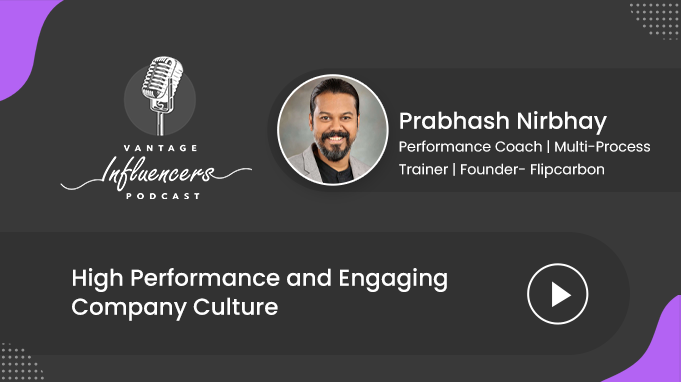
High Performance And Engaging Company Culture
Episode Overview
Prabhash Nirbhay opens by reframing company culture in the simplest terms possible: it is the action you take and the behavior you exhibit in pursuit of your vision, nothing more mystical than that. He argues most organizations write vision statements that sit framed on a wall while culture is what actually pulls that vision down and sets it walking the corridors of the business. When asked what separates leaders who successfully build a strong culture from those who don't, Prabhash lays out a simple ABC test: your actions have to match your stated values, you have to be willing to bite the bullet on high performers whose behavior doesn't fit the culture you're building, and you need a recurring culture calendar so the message gets repeated often enough to actually stick with people.
The conversation turns pointed when Prabhash unpacks "toxic high performance," a phrase he defines as getting work done without regard for people's physical or mental well-being, citing after-hours calls, guilt around time off, and deadlines set without checking if they're realistic as everyday examples. He connects this directly to diversity, arguing that toxic cultures quietly select for people who can absorb unlimited stress and filter out everyone else, which is the opposite of an inclusive workplace. Diversity, in his view, is what keeps an organization from getting "templatized" around one way of doing things, and inclusion means giving people room to work at their own pace and in their own way. He closes with an analogy about leadership itself: managers who run their teams by constantly checking the rearview mirror will eventually crash, and the ones worth following are the ones who keep their eyes on the windscreen.
Episode Highlights
- Company culture, in Prabhash Nirbhay's framing, is the action you take and the behavior you exhibit in pursuit of your vision, what makes a vision statement walk the corridors of an organization instead of sitting framed on a wall.
- Leaders can nurture culture through a simple ABC approach: match your actions to your values, bite the bullet on inappropriate behavior even from high performers, and keep a running culture calendar so the message repeats often enough to stick.
- High performance and high engagement work as two dimensions of the same culture. Performance without engagement burns people out, and engagement without performance becomes a fun and games organization that isn't delivering results.
- Toxic high performance means getting work done without consideration for people's physical or mental well-being, whether through after-hours calls, guilt-tripping people about taking time off, or deadlines set without checking if they're realistic.
- Toxic cultures are also anti-diversity, because they quietly filter for people who can absorb unlimited stress and screen out everyone whose life circumstances make that unsustainable.
- Diversity keeps organizations from getting "templatized" into one way of doing things, while inclusion means accepting that different people have different methods and paces for getting to the same result.
About the Guest
Prabhash Nirbhay, Founder, Flipcarbon; Performance Coach
Prabhash Nirbhay is the founder of Flipcarbon, a performance coach, and a multi-purpose trainer with over two decades of experience across various facets of HR at blue-chip companies. He has a proven track record in conceptualizing, designing, and implementing strategic employee communication interventions that foster high performance and high engagement culture. A subject matter expert on employee engagement, Prabhash has more than a decade of experience handling employee engagement surveys, action planning, and enterprise-wide initiatives.
Connect with Prabhash on LinkedIn
Host
Gautam, Vantage Influencers Podcast Host
What You Will Learn
- How to define company culture in concrete terms: the action you take and the behavior you exhibit in pursuit of your vision, not a poster on the wall
- A simple ABC framework for nurturing culture as a leader: align your actions with your values, bite the bullet on high performers who don't fit the culture, and repeat the message on a recurring culture calendar
- Why high performance and high engagement need each other, and what happens to a team when only one of the two is present
- How to recognize "toxic high performance" in your own organization, from after-hours calls to guilt around time off
- Why toxic cultures quietly work against diversity, and what that means for who ends up thriving on your team
- How to shift from a "rearview mirror" leadership style to a "windscreen" one that looks ahead instead of constantly checking what's behind
Key Topics & Timestamps
| Timestamp | Topic |
|---|---|
| 00:42 | Welcome to Vantage Influencers Podcast and introduction of guest Prabhash Nirbhay |
| 02:20 | Prabhash's career journey across construction, retail, and consumer goods over two decades |
| 04:36 | What company culture really means: action and behavior in pursuit of vision |
| 06:43 | The ABC framework leaders can use to nurture a great company culture |
| 10:08 | How high performance and high engagement reinforce each other to shape culture |
| 12:31 | What "toxic high performance" looks like and how it undermines culture |
| 17:35 | The role of diversity and inclusion in strengthening performance and culture |
| 21:41 | Closing thought: becoming a "windscreen leader" who drives the team forward |
Full Transcript
Click to read the full episode transcript
Welcome to the Vantage HR Influencers Podcast. This podcast is sponsored by Vantage Circle, the simple and AI-powered rewards and recognition platform for employee engagement. Companies with high-performance teams and enhanced employee engagement nurture great company culture. We must understand what company culture is, as the two are interconnected. A good company culture could be anything from being diverse and inclusive to providing employee perks and benefits. So let's know everything about employee performance, engagement, and company culture.
Hello, listeners. Welcome to Vantage Influencers Podcast. I am your host, Gautam. Today we talk about high employee performance, enhanced employee engagement, and how it helps nourish the company culture of any organization. To enlighten us on this topic, we have with us Prabhash Nirbhay, an ardent believer in the power of HR to enhance performance and deliver business results. Prabhash is the founder of Flipcarbon, a performance coach, and a multi-purpose trainer of repute. He has over two decades of experience in various facets of HR across blue-chip companies. He has a proven track record and ability in conceptualizing, designing, and implementing strategic employee communication interventions that foster high performance and high engagement culture. A subject matter expert on employee engagement, Prabhash has 10-plus years of experience in handling employee engagement surveys, action planning, and enterprise initiatives. Hello, Prabhash.
Prabhash Nirbhay: Hey, Gautam. Thank you for having me over. It's my pleasure to be talking to your listeners.
Gautam: Sure, sure. I'm great to have you with us today, and thank you so much for joining us today. And we look forward to having a great conversation with you, yeah?
Prabhash Nirbhay: Likewise. I look forward to this conversation. I think this is one topic which is very, very close to my heart, and I believe that the power of people drives performance. So I would look forward to talking to you and taking questions from you.
Gautam: Wow, definitely. Then we shall definitely get some enlightening answers from you. So, to begin with, would you tell us about yourself, something that I might have missed mentioning about you?
Prabhash Nirbhay: I think you did a fairly good job, but just to set the context in the times that I have built my career in: the time in which I built my career was the time when the IT revolution of India was happening. And within that zone of 2002 to 2022, I have built my career very, very differently. I have worked only in what I like to call the roti, kapda, and makaan industries. After completing my MBA, I started my career with a cement manufacturer, so that's what I like to call makaan, or construction. Then I went on to join the retail and garments division of a fashion retail group, and subsequently its successor brand. So that's what I like to call kapda, or retail fashion. And then my last and longest stint in the corporate world was with a nearly 130-year-old organization manufacturing some of the best beers in the world. So that's food, essentially, but I like to call it roti. So roti, kapda, and makaan is what I have worked at. And whether by design or accident, almost all the companies I have worked for are close to, or over, 100 years old. So I'm also a firm believer that good performance and good engagement in culture enhances the longevity of organizations, and that they can continue regardless of what's happening around them. For example, if you look at all of these companies, they have survived a couple of plagues, they have survived two world wars, and one even survived apartheid in South Africa, and they have continued to thrive and grow. So that's a little about me. I come from a small town with big ambitions. I've worked in corporate, built my own organization, and I believe in giving back to society. That's how I look at myself.
Gautam: Thank you so much. I think your achievements are worth mentioning, and we're so glad to have you with us so you can share your expertise and knowledge on this matter today. So, to begin this conversation, what, according to you, is company culture?
Prabhash Nirbhay: If I were to talk about company culture, I have two aspects to it. I would say that the action we take and the behavior we exhibit in pursuit of our vision, that, to me, is company culture. Let me explain that. A lot of people write these very fancy vision statements which go and sit on the walls. But culture is what makes that vision step down from the walls and start walking the corridors of the organization. So fundamentally, culture is what says that vision is not just a figment of our imagination, but that it can actually walk the shop floor, that people are clued in, and that they are willing to walk the talk in terms of the direction the organization wants to move in. So, in a way, culture and vision as a combination are like the electricity that passes through an electromagnet and makes everything point in the same direction. That's how I look at culture.
Gautam: Wow. I think even in my introduction, I mentioned that company culture is not as complicated as people think it is. I think it's more about understanding your workers, your employees, and creating an environment that is safe, secure, and equal for everyone. I'd like to believe in that as well. I don't know if you'd agree.
Prabhash Nirbhay: A lot of times we tend to forget that it's ultimately people who are driving the car.
Gautam: Yes.
Prabhash Nirbhay: Culture is an enabler. It gives you the best possible environment in which to give your best shot. And while there's always a theory around this in terms of people, I don't really believe that most people come to work to do a bad job. If you're not doing a good job, something is definitely wrong with the culture that's been built around your organization. So I think it's the core, the essence, of good performance. We talk about a high performance, high engagement culture all the time when we talk to our clients.
Gautam: Yes. So if I were to ask you, what is the most appropriate way for any leader to improve or nurture a great company culture in their workplace?
Prabhash Nirbhay: I think the word "leader" itself talks about somebody who understands how to lead people in a particular direction. If you qualify as a leader, then I think you already have it in you to figure out the right rules, the right mechanisms, the right processes, the right actions to lead people. We've seen enough evidence across the board, whether you're talking about business leaders, societal leaders, or people leaders in an unstructured environment: most of them are able to lead because they have it in them. In fact, I recently posted about this too, in the context of a veteran sports captain returning to lead his old team, that your ability to lead is actually independent of the size, shape, or nature of the group you're leading. You'll still be the same person and still need to bring the same skills to the table. But if I were to simplify this entire piece, I'd say it's like ABC. First, your actions need to speak. You can't build a culture if your actions are different from what you're talking about. Suppose what you're talking about is integrity, and a lot of organizations have that as a core value, but your actions don't reflect it. You won't be able to lead people toward a good culture, because you'll stop walking the talk. So your actions need to speak. Second, bite the bullet on inappropriate behavior, and be willing to lose performance in pursuit of culture. What I mean is that a lot of times you have managers who are anti-culture. They're not suitable for the culture you're trying to build, but they're great performers, and so as leaders we're willing to look the other way. That's not biting the bullet. We need to say: look, this organization will build its culture in a particular way, and irrespective of how great you are, we will not tolerate you if you're not aligned with that. So biting the bullet is also important for a leader. The third part, the C, is that you should have a culture calendar. This sounds transactional, but culture needs to be spoken about enough times to seed itself with people. For example, at Flipcarbon and with our clients, we continuously talk about high performance, high engagement culture, because it's possible to perform without the engagement part of it, but it isn't sustainable over the long term. And if you push performance without engagement over the long term, it leads to burnout. So we always say you need to look at it from two dimensions: the performance dimension and the engagement dimension.
Gautam: Right. And I think when you said that the moment the word "leader" is attached to you, you already have it in you, that's a very good quote for me to use in one of my blogs. I'm really enjoying this conversation. So, you mentioned how high performance and high engagement are interconnected with company culture. My next question follows from that: how do high performance and enhanced engagement help improve company culture? Could you elaborate a bit?
Prabhash Nirbhay: It's sometimes the cart behind the horse, and sometimes the horse behind the cart. Because if you look at it, high performance and high engagement is the culture you're trying to build. Most organizations are in the business of building a culture that has high performance as one element and high engagement as another. If you only have high engagement, you have a fun and games organization that isn't performing enough. And if you only have high performance without high engagement, you're constantly churning people, burning them out, and creating toxicity in the environment. So on one side, a high performance, high engagement culture is what we're striving for. But the other side is equally true: when you're a high performance organization, people want to work for you. Most people don't want to be part of failure, they want to be part of success. So a high performance organization attracts the right kind of people, the kind who want to, pardon my language, really deliver on performance. And when you attract the right kind of talent, you also attract people who are fair, unbiased, and objective, but who also bring empathy, and they help create a good culture from an engagement perspective. So if you have high performance and high engagement, the culture is moving in the right direction. And if the culture is moving in the right direction, you attract the right kind of leaders, managers, and individuals, people who like to collaborate and lift others up rather than put them down. That creates a really robust environment that's sustainable over a long period of time. Great goals, supported by great leaders, in an unbiased environment, is ultimately what high performance and high engagement is defined as. Unfortunately, we've also seen enough toxic high performance over the last couple of decades. That's possible too, but it isn't sustainable, and the organization starts to break down after a point.
Gautam: Sure. So when you mention toxic high performance, I think we've come across this term more lately. What is it exactly, and how does it relate to company culture? I think most of us may have heard the term but don't know much about it.
Prabhash Nirbhay: If you look at human behavioral dynamics between two people, it can either be full of empathy, grace, and respect for the other human being and for the job description, or it can go the other way. For example, I like to say that, on a per-dollar basis, my office assistant is more productive than my CEO.
Gautam: Ah, yes.
Prabhash Nirbhay: You need to understand that both are doing a job with a job description. One isn't superior to the other, because you're paying each of them for that job description. If you're in a more senior role, you're also being paid well for it, so you don't need to assert your superiority in other ways. That humility, of saying "maybe I'm not as specialized as I think I am," is the starting point of non-toxicity. But on the other side of it, the simplest definition of toxic is getting work done without due consideration for people, their physical well-being, their mental well-being, who they are as people, and their life beyond work. That's where toxicity comes in, and there are multiple examples. We're 24/7 organizations, especially when globally dispersed, and we take other people's time for granted. I know of one organization where the stated policy is that no calls can take place after 6 p.m. on Friday, and that's a great culture statement, but the ground reality is that they're doing 11 p.m. calls on Fridays as well. So you're not walking the talk. And then you set deadlines, calendars, and meetings without really checking whether other people are aligned to those timelines or those execution standards. The world will keep rotating even if you get one day wrong, but some people will stop rotating because you pushed them too hard. And then we have this habit of making our team members feel guilty about time off, needing to explain why they're going on vacation, which is complete nonsense in my opinion, because your actual work zone is only about 250 days out of a 365-day year, and the rest is your battery recharge time. Even beyond that, people sleep for about 25 years of their lifetime, so your total working time is only about two-thirds of your life, and we can't expect that to fill every portion of it. That only leads to burnout, mental health issues, and physical health issues: people not finding time to sleep, to repair their bodies, to pursue their passions, or to give time to their families. That's why toxicity comes in. And toxicity is also anti-diversity, because as human beings, our greatest strength is our ability to cope with adversity. Some amount of stress or toxicity, we can all take, but some people can take more than others because their personal circumstances are less demanding. For example, if I have to work long hours, perhaps I can. But a colleague of mine who has a child to take care of and a husband who travels all the time will find it very difficult to cope with unfair and unreasonable demands.
Gautam: True, true, very true.
Prabhash Nirbhay: So what happens is you end up creating an anti-diverse environment, because the people who cope will be your kind of people, the ones who think there's nothing wrong with never switching off.
Gautam: Yeah, definitely.
Prabhash Nirbhay: So you end up with your kind of people, creating clones who believe there's some joy in continuously striving for performance excellence without striving for emotional excellence as well. And that's definitely anti-diverse.
Gautam: Wow, I think that's a very good point, that there are people who are constantly trying to keep their bosses happy, or not taking enough time for themselves, without realizing that they also need to take care of their mental health.
Prabhash Nirbhay: Yeah, and when we talk about diversity and inclusion, different jobs, maybe an office assistant or a CEO, the degrees may vary, but their contributions shouldn't go unnoticed.
Gautam: I think that's what I believe in, and I think that's the kind of company culture we follow at Vantage Circle too, where we're small but significant, and very compact. So, when you mention diversity, I'd also like to ask: do you believe diversity and inclusion play an important role in enhancing employee performance and engagement in a way that positively impacts company culture?
Prabhash Nirbhay: Absolutely, it goes without saying. The biggest aspect of diversity is that it brings more than one way of doing things to a team. Otherwise we tend to get templatized by experience. If you have a certain number of years of experience of a certain kind, whether as an individual or as an organization, you tend to start operating in templates, a certain way of doing something. Diversity allows you to accept that an organization isn't made up of one top performer, but of one top performer supported by many meeting-expectations performers. We tend to forget that talent isn't defined only by top performers. Talent is defined by all sorts of performers who stabilize the pyramid. If your pyramid were made up of only top performers, it would collapse on itself. So accepting that there are different kinds of people, different mindsets, different thought processes, irrespective of gender, sexual orientation, or physical or mental capacity in the traditional sense, being inclusive of that diversity will always create an environment where the leadership is more competitive. That's the core of it. Inclusion, fundamentally, means allowing people their own methods and their own pace, accepting that different people have different methods and different ways of adopting and deploying them. That's where it helps in building culture. An organization is a reflection of society, and society isn't made up of clones. So why should an organization be made up of clones?
Gautam: Well, that's a great line, because I myself work in diversity and inclusion, and I've written quite a few blogs on it, on how leaders can set aside their prejudices and biases and treat everyone with equal dignity and respect. As long as you recognize every employee's differences and individual identity, I think that's what builds a great company culture and attracts more diverse talent, especially in this era of globalization, where we really need to expand. I think diversity and inclusion is one way to expand globally.
Prabhash Nirbhay: Absolutely. And we keep talking about unconscious bias as something to watch out for. I think one of the best things we can do as human beings is put up a small statement wherever we're sitting that says: "Look, I am unconsciously biased." That awareness is the starting point of building good culture, building diversity, building inclusion, and getting performance going. Because the awareness that I can be unconsciously biased about a lot of things doesn't make me a bad person. It makes me a person whose awareness of bias is currently low, and if I can improve that awareness, I can improve myself overall, as an individual, as a leader, and as somebody trying to enable performance. So I think that's one of the things we should all do: put that statement up.
Gautam: Yes, sure, and that's exactly our aim. Some people, due to privilege or certain backgrounds, might not know how different people are from each other, and I think you're doing a great job enlightening people on this. We're so glad to have you with us today, sharing this with our listeners. So, in the end, how would you like to conclude your thoughts on employee performance and engagement, and how it helps build a productive, diverse, and inclusive company culture?
Prabhash Nirbhay: I'd like to conclude by making people think about how they're leading their teams today. I think a large part of leading teams today happens with a rearview-mirror construct. If you were to drive a car looking constantly at the rearview mirror, you're going to crash. The right approach to driving a car is to look at the windscreen and use the rearview mirrors only for situational awareness. The rearview mirrors are for situational awareness; the windscreen is what makes you drive into the future. So become the windscreen leader, the windscreen manager, the windscreen individual, and you will create a great culture.
Gautam: Wow, thank you. Your analogies and comparisons, on how you've related life to company culture, have been really great. I think that's a wonderful way of framing this, and we're so glad to have you with us today. So how can our listeners reach out to you if they want to know more about you or your consultancy?
Prabhash Nirbhay: There are multiple ways. One, I'm very active on LinkedIn, so even a message there is enough for me to respond. You can publicly comment on my LinkedIn posts and I'll respond. If you want to reach out one-on-one, you can email me at prabhashnirbhay@flipcarbon.com, my first name and last name at my company name dot com. I don't mind sharing my number as such, but I'm more of a WhatsApp person than a phone-call person, so if you reach out that way, I'll respond over WhatsApp.
Gautam: Thank you so much, Prabhash. Now that we've come to the end of this enlightening conversation, I'd like to express my immense gratitude and appreciation to you. Thank you so much for joining us today and sharing your knowledge on employee performance and engagement, and how it helps build a great company culture.
Prabhash Nirbhay: Thank you, Gautam. The pleasure was all mine.
Gautam: Sure. And listeners, I'm your host, Gautam, signing off for today. Stay tuned to Vantage Influencers Podcast for more enlightening sessions on employee engagement, company culture, and HR best practices. We'll be back with more insightful conversations in upcoming episodes.
FAQ
What does Prabhash Nirbhay mean by company culture?
Prabhash Nirbhay defines company culture as the action you take and the behavior you exhibit in pursuit of your vision. He compares it to the electricity that makes an electromagnet work: culture is what turns a framed vision statement into behavior that actually walks the corridors of an organization.
What is the ABC framework for building company culture?
It's Prabhash Nirbhay's shorthand for how leaders nurture culture: make sure your actions match your stated values, be willing to bite the bullet on inappropriate behavior even from strong performers, and repeat the culture message often enough, through a running culture calendar, that it actually sticks with people.
What is "toxic high performance"?
According to Prabhash Nirbhay, toxic high performance is getting work done without consideration for people's physical or mental well-being, such as after-hours calls, guilt around taking time off, or deadlines set without checking whether they're realistic. He argues it's also inherently anti-diversity, because it rewards people who can absorb unlimited stress and pushes out everyone else.
How do diversity and inclusion affect company culture?
Prabhash Nirbhay argues diversity keeps organizations from becoming "templatized" into a single way of doing things, while inclusion means accepting that different people have different methods and paces for reaching the same outcome. Together, he says, they create a more competitive leadership environment and a stronger, more sustainable culture.
Related Reading
Also listen on