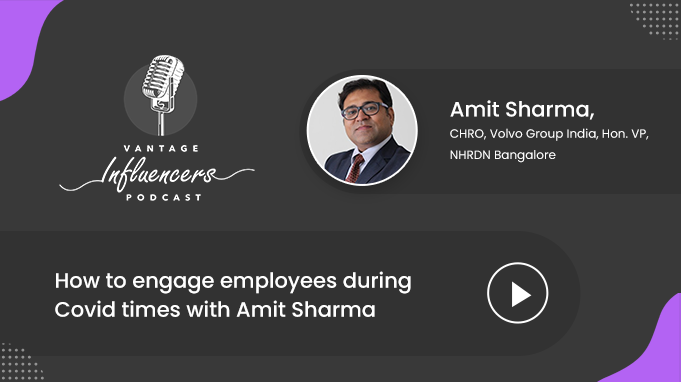
How to engage employees during Covid times with Amit Sharma
Episode Overview
In this episode of the Vantage HR Influencers Podcast, host Rohit talks with Amit Sharma about keeping employees engaged and productive through the disruption of the COVID-19 lockdown. Amit argues that it is culture, not policy, that holds an organization together in a crisis. Shared values around trust, transparency, and performance give people a reason to stay engaged even when the usual structure of office life disappears. He walks through the four global priorities his organization set once the pandemic hit: colleagues first, followed by customers, cash, and cost, plus two additional priorities added in India, supporting the surrounding community and keeping communication constant even when there was little good news to share.
The conversation moves into what that meant day to day. Amit describes rethinking manager effectiveness so leaders check in on how people are feeling before talking about deliverables, running virtual coffee sessions and informal team hangouts to replace the socializing that disappears when teams go remote, and building detailed safety protocols for employees who still had to show up at factories and plants, from thermal scanning and zig-zag seating to contactless sanitizer dispensers. He is candid about where remote work falls short too. Team cohesion and casual socializing take a real hit, and employees can lose the sense of being part of something larger when they can only see their own small piece of the work.
Episode Highlights
- Amit argues that culture, not a quick policy response, is what lets an organization move fast in a crisis, and points to Volvo's five core values of customer success, trust, passion, change, and performance as the foundation for that.
- He details Volvo's six crisis priorities: colleagues, customers, cash, and cost globally, plus community and communication added specifically in India.
- On manager effectiveness, he says leaders were coached to open conversations by asking how someone is feeling rather than jumping straight into work updates.
- He describes virtual "Tika" sessions, informal coffee and tea hangouts over video, used to keep socialization alive for factory and manufacturing teams that could not work from home.
- For employees still reporting to Volvo's plants, he outlines safety measures including thermal scanning, zig-zag seating, and contactless sanitizer dispensers.
- Amit is direct about remote work's downsides too: team cohesion, casual socializing, and a sense of connection to the larger organization all take a hit when everyone works from home.
About the Guest
Amit Sharma, Vice President - HR, Volvo Group India
Amit Sharma is an HR professional with 20 years of experience across various HR roles, the last 10 of them in leadership positions. He is currently Vice President - HR and a member of the Country Management Team at Volvo Group India, responsible for Strategic HR Leadership across the organization. Prior to this, he held an India Leadership role at TE Connectivity, a Global HR Leadership role for the Mobile Surgery Business at Philips Health Systems, an India Operations HR Leadership role at Johnson & Johnson Medical, and multiple specialist roles at Indian Oil and Ballarpur Industries. Amit is an alumnus of UBS Business School and holds an engineering degree from Thapar University.
Host
Rohit, Vantage Influencers Podcast Host
What You Will Learn
- Why company culture, built over time, matters more than any short-term policy when a crisis hits.
- How Volvo Group reprioritized around colleagues, customers, cash, and cost globally, plus community and communication in India, once COVID-19 struck.
- How to coach managers to open conversations by asking how someone is feeling before talking about work.
- Ways to keep teams socially connected remotely, from virtual coffee sessions to shared personal moments over video calls.
- What safety protocols look like for a manufacturing workforce that cannot work from home, from thermal scanning to contactless sanitizer dispensers.
- The real downsides of remote work, including weaker team cohesion, reduced socialization, and a diminished sense of connection to the larger organization.
Key Topics & Timestamps
| Timestamp | Topic |
|---|---|
| 0:00 | Introduction to Amit Sharma |
| 0:56 | Amit's path into HR and what drew him to the field |
| 1:56 | How Volvo Group values and recognizes employees |
| 5:08 | Engaging colleagues and the community during the lockdown |
| 13:53 | Refining company values and culture during a crisis |
| 15:24 | Team effectiveness and productivity while working from home |
| 19:58 | Safety procedures for employees returning to the workplace |
| 23:34 | The downsides of remote work and what may stick long-term |
| 29:20 | How Volvo recognizes long-service employees |
| 30:59 | Amit's favorite business book and HR mentors |
| 32:53 | Advice for young HR professionals |
Full Transcript
Click to read the full episode transcript
Welcome to the Vantage HR Influencers Podcast. This podcast is sponsored by Vantage Circle, the leading employee benefits and engagement platform.
Rohit: Hi, this is Rohit from the Vantage HR Influencers Podcast. And today I'm excited to have Amit Sharma, who's an HR professional with 20 years of experience in various HR roles, majorly in leadership positions. He's currently working as Vice President HR of Volvo Group India. Prior to this, he was in leadership roles at TE Connectivity, global HR leadership roles for Philips Health Systems and Johnson & Johnson Medical, and a number of other specialist roles at other companies. Amit is an alumnus of UBS Business School and has done his engineering from Thapar University. Welcome to the show, Amit.
Amit Sharma: Thank you, Rohit, and thanks for having me here.
Rohit: Awesome. So how did you get into the role of HR, and what got you excited about human resources?
Amit Sharma: That's an interesting question, Rohit. And if you really ask me, one of the things which I've always liked is how do you shape an organization's strategy through people. That is something which was always very exciting to me. And one of the subjects in my B-school, which is still my favorite, was business behavior, understanding an organization's behavior, and how we really apply those principles to get the best out of people, to make them go beyond their potential, to make them achieve more, and in that sense, help organizations grow. I think that's what really excited me when it was time to choose a specialization, and those were the factors that led me to pick HR, because it's a really fulfilling profession. Seeing people achieve what they can achieve, and helping them do that, I would say this is a very, very noble profession.
Rohit: Right. And you know, you've been with Volvo Group, especially during the stressful times of COVID. How do you value, and even before that, how do you value and recognize employees in a company?
Amit Sharma: So Volvo is a company which has a very strong employee orientation. As an organization, we have high values which we say are the bedrock of our organization. It's about customer success, trust, passion, change, and performance, and this is what kind of binds everybody together. So whatever we are doing, we look at it through this lens. And if you look at it, it all focuses around how we treat our employees. How do we really understand our customers? How do we build trust and transparency amongst employees? How do we really generate passion in employees? How do we help them undergo change? And how do we help them create and deliver better performance?
So those are the fundamental threads for us. Among our three global aspirations, one is to be the most admired employer in our industry. That's the second aspiration; the first is about customers, and the last is about financials. So for us, this aspiration comes even before the financial piece: how do we really make ourselves a great place that employees would love to work in. That's something which defines our organization.
We really value their time, we really value their commitment to the organization, and we also value the fact that people have lives beyond work. As an organization, we're very mindful of work-life balance and of the mental health of our people, apart from just looking at delivery, which is what most organizations generally focus on.
So those are some of the key elements that are really unique to Volvo, and this is something that helps us all come together and makes us proud to work at a company like Volvo. You'd be surprised: most of our leadership team members, and we have about 17 people on the country leadership team, most of them are homegrown. They've grown internally with the organization and have really long tenures at Volvo. I haven't seen that anywhere else, and I've worked across four different multinationals in my career. The kind of commitment and sense of pride employees have in Volvo comes down to how Volvo treats them. That's the key differentiator.
Rohit: You know, what is Volvo doing to engage with stakeholders, especially customers and employees, since the lockdown happened in mid-March? I'd assume manufacturing would have totally stopped then. How would communication happen between the important stakeholders from your side?
Amit Sharma: This entire crisis struck us somewhere in mid-March, and to be honest, like everybody else, we were surprised by the magnitude of this pandemic and how it unfolded in front of us. We started looking at what we needed to do and how we should engage with our stakeholders, and we came up with four priorities globally. In India, we added two more, so six priorities in total. Globally, our CEO said we needed to focus on, number one, our colleagues. That comes back to what I was saying earlier: we didn't say number one is customers, we said number one is colleagues during this period. So number one was colleagues, number two customers, number three cash, and number four cost. Those were the four broad priority areas our global CEO set, meaning the entire effort was focused on how we help our colleagues stay safe and still deliver without getting infected, how we continue to meet customer demands, how we manage cash since inflow slowed while costs like salaries continued, and how we further reduce costs as revenues dropped.
In India, we added two more priorities beyond those four. The first was community. As a responsible organization, the community is an equally important stakeholder for us, and how we support the community during a crisis says a lot about what an organization believes in. So we went out and helped migrant workers who didn't have food or shelter, and we supported what we started calling COVID warriors, the doctors, police, and other frontline workers dealing with the pandemic from the government and NGO side. The second added priority was communication. During a crisis, how you communicate makes a big difference. People were scared, with gloomy news on one side about rising COVID cases and, on the other, companies announcing job cuts, layoffs, and salary cuts. People were worried about whether their jobs would remain if work wasn't happening, so we made sure we kept communicating and reassuring employees that we were solidly behind them.
When we broke those priorities down further into what they actually meant for our colleagues, we looked first at competence practices. People were working from home and needed things like internet connectivity and a UPS at home, so we looked at our benefits framework to provide for those necessities. Effectiveness was another key piece: making sure employees had the right IT tools at home. We physically transported laptops to people's homes wherever they didn't already have one, and we sent out guidance on how to work from home and how to manage work and home life together, along with tips to help people stay effective.
Then there was manager effectiveness. We built a manager toolkit, because managing a team through two months of continuous work from home wasn't something our managers, largely from a manufacturing background, were equipped for. We coached them to have real conversations, calling people just to talk about what's happening in their lives rather than always talking about work, and we told managers that the first question they should ask is how the person is feeling, and whether anything is bothering them. That's a critical question, because people tend to suppress their feelings, and during a time like this, emotions run high. We put together a playbook on this and walked managers through it.
We also looked at team effectiveness, because people were suddenly detached from their larger teams. All the socialization that used to happen over a cup of coffee or tea, or over lunch, wasn't happening anymore. So we arranged virtual fun sessions and virtual coffee sessions, where everyone would show up with a cup of coffee in hand on Skype for Business or Microsoft Teams, just to chat about things other than work. Then there was health and wellbeing. We made sure people had support if they were dealing with any mental health issues from the lockdown and staying home, because that became a critical focus, making sure nobody felt socially isolated or stuck inside without an outlet. It takes a toll on people, so we stayed mindful of employees' mental health. The last piece was a focus on competency building. When workload was lighter for some people, we used that time to help them build new skills, so we rolled out some competency-boost projects during this period.
Rohit: What I can see is a lot of very thoughtful and insightful things that happened at Volvo. I really liked how you brought in community as one of the core values, and how you helped out the COVID warriors and migrant workers, and how communication happened with employees. But is it possible to refine company values and make quick decisions during a crisis, or is that something that has to already be imbibed in a company's culture?
Amit Sharma: These things are already there in the company culture. Culture doesn't change quickly, it has a lot of inertia, so a company is only able to do these things when there's enough momentum that's been carrying on from before. Otherwise, things won't suddenly happen. I was speaking with my MD sometime back, and he made an interesting statement: a crisis reveals who the true leader is, and who isn't. These things get highlighted during bad times, because in good times, everybody does everything well, since there are no real issues, money is coming in, revenues are strong, and everyone is engaged and motivated. It just goes with the flow, the tailwind is high. But when the headwinds hit, whether you can sustain that really shows the strength of the culture and the values an organization holds true to. They shouldn't change just because there's a crisis. These are fundamental things an organization believes in, and we continue to believe in them if we truly value them.
Rohit: You also talked about team effectiveness and the interesting things you've done to increase socialization among team members, and about employee wellbeing. But have engagement numbers and productivity levels actually gone up for a company like Volvo, especially with a large part of the workforce in manufacturing? Any thoughts on how to increase team effectiveness in a situation like this?
Amit Sharma: Productivity is something we're still trying to figure out in terms of whether it's increased or stayed the same. As much as our preliminary data shows, there hasn't been any dip in productivity. People have been fully engaged working from home, and we haven't seen anyone take advantage of the situation or shirk work, at least nothing has come to our knowledge, and everyone has stayed very focused. There's a real pride people have in working at Volvo, and across all our engagement surveys, that pride comes out as the highest score. I think that's what helps people stay focused on output and on what the company needs them to deliver, so that side has been fairly comfortable.
On team effectiveness, we're a very diversified company in India in terms of the kind of work we do. We have three manufacturing plants, a large global business services center with more than a thousand people, a large global technology center with almost a thousand people as well, and some back offices for global functions like purchasing and parts of our accounting services. The dynamics are very different across all of these. Then there's the sales and supply chain organization, which is part of our traditional brick-and-mortar structure. For each of these groups, the situation was different. Factory workers can't work from home; you have to physically be there to produce a truck, a bus, an engine, or construction equipment. But a technologist can work from home, and someone in IT can work from home too. So we had very different dynamics across different parts of the business.
For the people who could work from home, engagement happened on two levels. One was work engagement, since the deliverables, calls, and discussions were still happening, and teams were coming together around the work itself. In parallel, we also ran a lot of general virtual hangout sessions. One week, we had everyone showcase a talent on our internal chat groups, just a short video of whatever talent they had. Another day, we asked everyone to share throwback pictures, school pictures, college pictures, early-career pictures, and there was a lot of engagement around that. On another day, we asked people to talk about the most defining moments of their lives, and people opened up about that too. So for people who could work from home, both work engagement and socialization were happening in parallel.
For teams that couldn't work from home, like manufacturing, we focused more on that second piece, keeping that camaraderie and connection alive, because those employees felt more isolated from the rest of the organization. There isn't much a production supervisor can do sitting at home, since their work requires being physically at the plant. So there, we focused on what we call Tika sessions. Tika is a Swedish word for a short coffee or tea gathering, so we ran virtual Tika sessions, virtual socializing, and virtual celebrations to make sure team bonding continued.
Rohit: As you mentioned, you're a manufacturing company that makes buses, engines, and trucks. What processes is Volvo using to ensure safety procedures for employees who want to come back to the company? Or do you have checklists for onboarding these employees, or even new employees who are joining the company?
Amit Sharma: We put in place a very intensive protocol around infection prevention and keeping our offices safe. There was a complete sanitization of all our offices and factories during this period, and our real estate team did a fantastic job with that. We marked spaces for social distancing in the lifts, so no more than four people are allowed in at a time. Before anyone enters an office, there's thermal scanning, temperature checks, and a declaration for any symptoms. We also built a checklist so that if someone has traveled, shown any symptoms, met someone with symptoms, or been to a public place, we give them fourteen days of quarantine leave and ask them to stay home rather than worry about coming into the office.
Inside the offices, we've put sanitizers everywhere. In the cafeteria, we set up zig-zag seating so no two people are facing each other, and we mark out seats that need to stay empty to maintain distancing. We've also disabled our access controls and kept doors open, so people aren't touching handles, and we run cleaning and disinfection every hour to keep things safe. For transportation, we moved to two-by-two zig-zag seating, so the seat next to you always stays empty. That increased our transportation costs, but we felt it was necessary for the safety of our employees and colleagues who need to come into the office for their work.
We've made as much of this contactless as possible, including sanitizer dispensers, which now use a foot pedal so people don't have to touch them, and we provide masks to everyone entering the facility. So we've done what we can to keep people safe, and some employees who do come into the office say that the moment they walk in, they feel like they're in a completely safe and comfortable environment. Their families have told us the same thing, that they don't worry about their spouse or parent going in to work. We've maintained a policy of keeping the minimum number of people coming into the office, with work from home declared through the end of May, but for those who still need to come in, we've taken every precaution to keep that space safe.
Rohit: And you know, we all understand there are a lot of upsides to remote work, less travel, more time with family, but are there any downsides to remote working? And is this kind of remote work culture something that will stick around long term, not just for tech companies, but for other companies as well?
Amit Sharma: Yes, there are real downsides. The upsides are things like less commuting, especially in a city like Bangalore, where you save close to three hours of travel a day, which is a big win for an employee. There's also the work-life balance you get, being able to handle things at home while still working for the office, so that helps. Companies also save on costs if you look at it that way.
But if I look specifically at the downside, team effectiveness takes a dip if it isn't managed well, and that's why organizations have to focus more on keeping team effectiveness strong. I already talked about what we've done on that front, and I'm sure other good organizations are doing something similar in their own way.
The second piece is individual socialization. Human beings are social by nature, and we need those small breaks we normally get in an office, quick coffee chats, a bit of fun, joking around, teasing someone lightly. All of that helps us destress, connect with each other, and meet our social needs, and when you don't have anyone around you to do that, it becomes a real drawback. Companies need to find ways to keep that kind of socializing alive in a remote environment, because it naturally takes a dip when everyone is working from home.
The other thing that takes a dip is the connection to the larger organization. When I'm in the office, I see so much happening around me, and I feel like I'm part of a bigger picture, that whatever I'm doing is contributing to something visible. When you're sitting at home, you only see the piece you're working on; you lose visibility into everything else because you're not physically in the office or the factory. So it becomes important to help people feel like they're part of a larger ecosystem, not just a small part of the machine, and that they can see the whole picture, not just their own piece.
There's also a cultural angle. In India, and across Asian cultures generally, we tend to be high-touch cultures. We like to meet people in person, and those face-to-face interactions matter to us, so when they're missing, it can affect people's mental health. Those are areas that need attention in a remote working setup.
Rohit: Right. And during the conversation, you talked about several tools. What tools would you recommend to leaders for smooth communication in remote work?
Amit Sharma: I think all tools are equally good. It all depends on how effectively a leader uses them. Even something like WhatsApp is a great tool if you want group calls or video calls; people can use FaceTime too. Our official tools are Microsoft Teams, Yammer, and Skype for Business, and they're more than capable of handling socializing, sharing updates, and sharing fun facts, but the key is in how you use them. I've always seen that a leader sets the tone. How a leader uses these tools sets the tone for the rest of the organization, and in a lot of organizations, leaders hadn't used them much before this, so there was a learning curve. It's critical that leaders are supported in learning to use technology more effectively.
Thankfully, this COVID lockdown forced a lot of people to learn, and I'm seeing many people who were skeptical of working from home now become proponents of it. That came up as an interesting discussion in our last country management meeting, where people were much more open to working from home than they used to be, when there was a lot of resistance to even bringing up the topic. So that shift is happening, and it's been accelerated by COVID. But coming back to your question, it's not about the tools, it's about using those tools effectively. Every tool is good; it's about how well someone is able to use it.
Rohit: Interesting. And is your company using some sort of tool for rewarding or recognizing employees? Since Vantage Circle is a reward and recognition platform, I'm curious how you approach that.
Amit Sharma: So we do use one platform for long service awards. We have a long service award every five years, so we create a virtual website for the person, where everybody writes in all the fun moments, good moments, and memorable moments they've shared with them. The manager initiates it and sends the link to all the stakeholders, and everyone writes in or uploads pictures, or shares whatever they want to share. Then, on the day of their anniversary, the website opens up for that person, and it's a customized page just for them. That's created a good amount of positive energy, and people are genuinely excited about it. That's one area where we use technology extensively.
Apart from that, most of our other recognition happens through town halls, or through annual meetings and kickoffs. There isn't much technology involved in those, but we're looking at how we can use technology more broadly for our recognition and awareness practices.
Rohit: All right, Amit, I want to do a quick rapid-fire round. What's your favorite business book?
Amit Sharma: My favorite business book is, of course, Who Moved My Cheese. I love it. It's a very simple, very powerful message about change, about how you anticipate change and work toward it rather than letting change catch you off guard one day and leave you scrambling. It's one of my all-time favorites, and every time someone joins my team, I give them this book and tell them: look at it, embrace change, anticipate change rather than waiting for it to hit you hard.
Rohit: Do you follow any HR leader or CEO?
Amit Sharma: One of my HR mentors is someone who is currently the global HR head at Lupin. I worked under him at both Philips and Johnson & Johnson, and I've learned a lot from him. I think he's one of the finest HR professionals in the country, someone who is as business-focused as he is a human being. That's a quality I've tried to take from him: how to stay business-focused while keeping a human touch, staying connected to the emotional side of people, and helping employees get through tough times. That's why I really admire and follow him.
Rohit: And do you have any advice for young HR leaders looking to build their careers and move into leadership positions in HR?
Amit Sharma: I'd say most young HR professionals I see tend to spend a lot of time in front of their laptop rather than going out and spending time with employees. It's human resources, so you need to spend time with people to really understand them, and that's what adds value in the long run. So my advice to young professionals is, first, keep the focus on the human in HR. Don't let technology take away the human touch, and don't just rely on what people say in an email; try to understand the emotion behind it, because that's when you become a much more effective HR professional. HR isn't just about sitting at a strategy level with no connection to people on the ground; you need that connection, or none of the strategy will work.
Second, there's a difference between business partnering and being a business leader's yes-man. Partner with the business, but don't just agree with whatever the business leader says because they're the boss. If you think something isn't right, have the courage to discuss it with them so there's clarity, either they understand your perspective or you understand theirs. Don't be a yes-man; focus on what's actually right for the business. Those are the two things I'd tell every HR professional to focus on.
Rohit: Great advice. What's the best way for people to reach out to you and learn more about you?
Amit Sharma: Connect with me on LinkedIn, or on Twitter. I'm pretty open to accepting requests and interacting with people there. I'm happy to connect with people on those two platforms and share my thoughts and perspectives with them.
Rohit: Thank you, Amit, for taking the time to speak with us. I really enjoyed learning about what you're doing at Volvo and the employee engagement work you're doing.
Amit Sharma: Thank you, Rohit. It was really my pleasure.
Thanks for listening to the Vantage HR Influencers podcast. Please subscribe to the Vantage HR Influencers podcast on Apple Podcasts and Spotify for new episodes.
FAQ
Why does company culture matter more than policy during a crisis, according to Amit Sharma?
Amit argues that culture builds momentum long before a crisis hits, and it's that accumulated momentum, not a quick policy fix, that lets a company respond well when things go wrong. He points to Volvo's core values, customer success, trust, passion, change, and performance, as the foundation that let the organization move quickly once COVID-19 hit. As he puts it, a crisis reveals who the true leaders are, since good times mask problems that only surface under pressure.
How did Volvo Group support employees and the wider community during the COVID-19 lockdown?
Amit describes six priorities Volvo set once the lockdown began: colleagues, customers, cash, and cost globally, plus community and communication added specifically in India. On the community side, Volvo supported migrant workers with food and shelter and backed frontline "COVID warriors," including doctors and police. Internally, the company built a manager toolkit that coached leaders to ask employees how they were feeling before discussing work, ran virtual coffee and "Tika" sessions to keep teams socially connected, and sent IT equipment to employees' homes.
What downsides does Amit see in long-term remote work?
Amit is candid that remote work weakens team effectiveness if it isn't actively managed, and it cuts into the informal socializing, quick coffee chats, jokes, and casual conversations, that help people destress and connect. He also points to a loss of visibility into the wider organization: employees at home only see their own slice of the work and can lose the sense of contributing to something larger. He adds that in high-touch cultures like India's, the loss of in-person interaction can also affect mental health.
What advice does Amit Sharma give to young HR professionals?
He tells young HR professionals to spend more time with employees rather than in front of a laptop, since understanding people is the core of the job. He also draws a distinction between business partnering and being a business leader's yes-man: HR should have the courage to raise a differing view rather than simply agreeing with what a business leader wants, so decisions get real scrutiny rather than automatic approval.
Related Reading
Also listen on