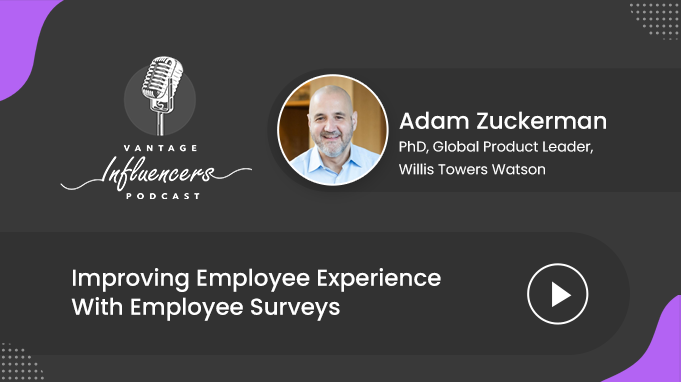
Improving Employee Experience With Employee Surveys
Episode Overview
Adam Zuckerman opens with a definition of employee experience that goes beyond typical engagement scores: it is the sum of every touchpoint and moment that matters between an employee and an employer. He breaks it down into four foundational pillars, purpose and people, which drive a sense of connection, and work and rewards, which drive a sense of contribution. For him, the real work of improving employee experience starts with an organization's intent to take it seriously, training managers to appreciate it, and creating multiple channels, one-on-one conversations, focus groups, and formal surveys, to actually listen.
The conversation turns to what makes employee feedback useful rather than symbolic. Adam pushes back on the idea that any single framework or survey tool matters more than commitment: the trick, he says, is choosing a model that resonates with your organization and then sticking with it long enough to act on what it reveals. He also stresses that surveys should combine quantitative benchmarks with open-ended questions, and that inclusive, demographic-aware analysis is essential to understanding how different employees experience the same workplace differently. He closes by calling employee experience one of the few genuine competitive advantages left to companies, precisely because it cannot be copied, only built.
Episode Highlights
- Employee experience breaks down into four foundational pillars: purpose and people (connection) and work and rewards (contribution).
- Organizations that treat employee experience as a priority start with intent, then train managers to recognize its importance.
- Listening works best through multiple channels: one-on-one conversations, focus groups, and structured surveys.
- The hardest part of any survey program isn't collecting data, it's committing in advance to act on what it shows.
- Feedback questions should combine quantitative benchmarks with open-ended qualitative input for richer insight.
- Diverse and inclusive employee feedback, including demographic-based analysis, is critical to understanding different employee experiences at scale.
About the Guest
Adam Zuckerman, Global Product Leader for the Willis Towers Watson Employee Engagement Software
Adam Zuckerman leads product for Willis Towers Watson's Employee Engagement Software, guiding its vision, strategy, and ongoing development. He also teaches Organizational Attitudes and Survey Development at the Chicago School of Professional Psychology, and previously taught Psychology, Social Research Methods, and Statistics at New York University, where his research on attitude formation and interpersonal responses to stress was published in journals including Psychological Science and the Journal of Personality and Social Psychology. He holds a Ph.D. in Social Psychology from New York University and a B.A. in Psychology from the University of Rochester, and is a member of the Academy of Management and the Society for Human Resource Management (SHRM).
Host
Gautam, Vantage Influencers Podcast Host
What You Will Learn
- How to define employee experience using the four-pillar framework of purpose, people, work, and rewards
- Why organizational intent and manager training are the starting points for improving employee experience
- What separates organizations that act on survey data from those that only collect it
- How to structure employee feedback forms using both quantitative and qualitative questions
- Why diverse and inclusive feedback practices matter for understanding the full employee experience
- Why employee experience is one of the few sustainable competitive advantages a company can build
Key Topics & Timestamps
| Timestamp | Topic |
|---|---|
| 01:35 | Adam's path into employee experience and survey research |
| 02:44 | Defining employee experience through the four pillars: purpose, people, work, and rewards |
| 04:04 | Why intent and manager training matter before any survey is sent |
| 06:24 | Turning employee feedback into meaningful action, not just data collection |
| 08:03 | Building a feedback framework: HPEX, quantitative benchmarks, and open-ended questions |
| 10:52 | Why diverse and inclusive feedback strengthens the employee experience |
| 12:16 | Employee experience as a lasting competitive advantage |
| 13:42 | Closing thoughts and how to connect with Adam |
Full Transcript
Click to read the full episode transcript
Welcome to the Vantage HR Influencers Podcast. This podcast is sponsored by Vantage Circle, the simple and AI-powered rewards and recognition platform for employee engagement.
Employee feedback or surveys add value, respect, and inclusivity to your company culture. Great employee experience is about trust, performance, and equal opportunity. And one must understand employees' needs and work on them to make their employee experience great. Thus, employee pulse or feedback surveys help you improve the employee experience for enhanced engagement, productivity, and retention.
Gautam: Hello, listeners. Welcome to Vantage Influencers Podcast. I am your host, Gautam. Today, we talk about the importance of employee surveys and how it helps improve employee experience in the workplace. And to shed light on this topic, we have with us, Adam Zuckerman. So who is Adam Zuckerman? Adam Zuckerman is the global product leader for the Willis Towers Watson Employee Engagement Software. He is responsible for leading the product vision, strategy, development, and ongoing enhancement. Adam also teaches organizational attitudes and survey development at the Chicago School of Professional Psychology. Hello, Adam.
Adam Zuckerman: Hello. Nice to be with you today.
Gautam: Good. So why don't you, to begin with, brief us about yourself and let our listeners know what you are all about?
Adam Zuckerman: Great. So I have a doctorate in psychology from NYU. And I started my career in the late 90s with a boutique consulting firm focused on employee surveys. That's what we used to call employee satisfaction. And that concept has evolved over time to employee commitment, employee engagement, and today employee experience. But the construct is similar and the work is similar. I've really been doing that work ever since in different forms, trying to help clients better understand the employee experience and make changes to improve it and improve business performance. My current role is focused on the software that clients use to survey employees, understand their views, and take action to improve the experience.
Gautam: Okay, that's great. So if we have to talk about employee experience, what is the true meaning of employee experience to you?
Adam Zuckerman: Well, in a generic sense, people define it differently, of course, and I think there's value in understanding it from different perspectives. I think the most generic way of understanding it is that employee experience is really all of the touch points, or moments that matter, between an employee and an employer. It's the full collective. In our view, that can be broken down into four foundational components, two of which relate to the sense of connection and two relate to contribution. So we would say purpose and people are part of the connection that the employee has, and the work itself and the rewards relate to the contribution, helping employees and shaping their contribution to meaningful work and rewarding them appropriately. So we would say purpose, people, work, and rewards are the four foundational components of the employee experience.
Gautam: Well, I mean, yeah, sure, there's no doubt contribution and connection play a very important role in shaping the employee experience for any organization, I believe. But, you know, what is the most significant way for any company to improve the employee experience in their company?
Adam Zuckerman: Well, I think starting with an intent to do so is probably the most critical thing. Recognizing the importance of the employee experience is valuable, and I think there's a growing recognition among companies today of the importance of it, especially today with the great resignation. But even before, I think it's really grown over time. So acknowledging its importance is critical, training managers and leaders in a way to appreciate the employee experience and the importance of the employee experience. Listening to employees in a variety of ways is really critical, interpersonally, individually, but also through things like focus groups, more formal means. And then, of course, organizational surveys, I think, is one of the most effective ways to listen to employees so that you understand the employee experience, and you can use that insight to guide actions to improve it.
Gautam: Well, I think, being a part of Vantage Circle myself, we do give a lot of emphasis on employee surveys, because ultimately, when you listen to your employees, you make them feel valued and wanted. And they would want to be more productive in their work, I believe, right?
Adam Zuckerman: Absolutely. I know the work you do there is terrific, and I think there are a lot of great firms today doing really valuable work in this space. And I often say that it's less about the particular tools you're using, and the particular models and frameworks, there are a lot of valuable ones out there. The key, to me, is to find the one that resonates with you and will work inside your company, and then really commit to it, make the most of it, get all you can out of it, that'll make the difference. And I think there's just more good work being done today in this area than ever before.
Gautam: Agreed, agreed. So if you'd like to believe that employee surveys or feedback surveys are the key to improving and enhancing the experience of a workplace, how would you speak about that, or how do you think it improves employee experience in the workplace?
Adam Zuckerman: Well, the key is not just to survey employees, not just to listen to them, although that's where it starts, but to take action on that information. That can be the real hard part, right? It's to actually convert those insights into meaningful change. And that's where a lot of organizations struggle. So there are some best practices there. First of all, make sure that what you're asking about upfront, you're really committed to act on. And if you're not committed to act on it, don't ask about it. Make sure that all the key stakeholders are on board. And then, when you get the information from surveys, make sure that you share it with employees quickly. Review it in a thoughtful way, have a plan for how to review it and prioritize it, which is really a critical step, because most surveys generate all kinds of things that you could focus on, but it's really important to prioritize the few that are most critical, and then make sure that you're willing to deploy resources against those priorities. In my experience, addressing just one or two things identified in a survey, even though it might surface a dozen things, and focusing on them, can have a great impact.
Gautam: Sure. So when we talk about review, when we talk about employees, when we talk about our own workers who give their immense contribution, very often we tend to forget what they might be feeling or what they are going through. So in that kind of situation, when we talk about employee feedback, what do you think, what type of questions or inputs must you incorporate in an employee feedback form?
Adam Zuckerman: Well, I think that's a great question. As I said before, it starts with listening, and we have a framework for identifying and measuring the employee experience, we call it the High Performing Employee Experience, and it's based on our research into financially high-performing companies, and the kind of experience they provide to their employees. We have questions that map onto that high-performing employee experience, or HPEX, and we would recommend that clients follow that structure if they find value in that framework and the research behind it. But again, I would say there are a lot of great frameworks and different models out there, and I think virtually all of them have value. The trick is to find one that resonates with you and will work inside your company, and then to stick to it and commit to it. That's sort of more important in some ways than the framework itself, because, again, I think there's a lot of value to a lot of the frameworks out there. But typically, they're going to include all of the standard dimensions you would imagine. So you want to ask about communications, collaboration, leadership, development opportunities, rewards, all of the things employees experience, and all of the touch points, or moments that matter, between employee and employer.
Gautam: Wow, I think that was great listening to you about that, because I think when we talk about a lot of companies, sometimes they think, so what do we add in our feedback? Just normal questions, how they feel, or what they feel. But I think it has to be more personal, as well as how they're doing in your organization. What do they feel being in your organization, right?
Adam Zuckerman: Absolutely. It's important to have some measure of connection to the organization, which is typically captured through engagement, we call it employee engagement. But it's also important to capture it in a variety of different ways. So people often think of surveys with quantitative data, multiple choice questions, which are really valuable, because you can benchmark it and track it over time and do advanced analytics. But I often find that adding open-ended questions for qualitative input is also extremely valuable, you get very rich information from that kind of question as well.
Gautam: That's nice. So now that, with all the globalization happening, with a lot of diversity and inclusion happening in most companies worldwide, especially after remote work is in place, do you believe that diverse and inclusive employee feedback helps improve employee experience tremendously?
Adam Zuckerman: I do. I think listening is one of the things that really helps a lot of the clients we're working with who are focused on DE&I issues. Starting with understanding the employee's perspective is really critical to those kinds of initiatives. It's very dangerous to assume things about diversity and inclusion related issues, and surveys are a great way to understand that particular topic.
Gautam: I think that's good, because more than forming prejudices, I think we really need to understand that every employee is different, and they might come from different backgrounds, right? And I think that is what can make a very good company culture, when we start recognizing that very often.
Adam Zuckerman: Absolutely. And that's also relevant not only to the surveys and the questions that you will ask, but the analytics that you do. Being able to look at the results as a function of various demographics, and multiple demographics at one time, really allows you to understand the employee's perspective at scale in a way that's very difficult to do otherwise.
Gautam: Well, thanks, Adam. That was great listening to from you. So in the end, how would you like to summarize your inputs on employee surveys and employee experience, and how does it help in building an equal, diverse, and engaged company culture?
Adam Zuckerman: Well, I think, to me, it's the most interesting and most valuable part of business. It's understanding people, and culture, and the employee experience is something that is one of the few remaining competitive advantages that companies have. It's something you can't steal, you can't copy, you have to develop yourself organically. And it can be a true differentiating capability if you do it right. And to me, it's at the heart of business success. You need a good strategy, you need good operations, you need a good execution strategy, you start with all that as important, but it starts with your people.
Gautam: Wow, I think it's great to hear that it starts with your people, because I think it's the people in the office that can truly make it, or break it, when it comes to employee experience. Because we never know what employees are going through, and I think more than judging them, I think we really need to understand them at the beginning, right?
Adam Zuckerman: Absolutely.
Gautam: So now that we are slowly approaching the end, I would like you to tell our listeners how they can reach out to you if they need to know anything from you.
Adam Zuckerman: Yeah, thanks very much. Well, you can always contact Willis Towers Watson on the internet. And I'm very active on LinkedIn as well, Adam Zuckerman, PhD. I'm regularly posting there on issues related to employee experience, culture, and leadership.
Gautam: Wow. Thank you. Thank you so much, Adam, for joining us today. Your knowledge and insights on employee experience have surely given our listeners a new direction towards improving the employee experience in the workplace.
Adam Zuckerman: Great. Thanks very much. Hope you have a great week ahead.
Gautam: You too. Thank you.
FAQ
What is employee experience, according to Adam Zuckerman?
Adam Zuckerman defines employee experience as all of the touch points and moments that matter between an employee and an employer. He breaks it down into four foundational components: purpose and people, which drive a sense of connection, and work and rewards, which drive a sense of contribution.
What is the most important first step to improving employee experience?
According to the episode, the most critical step is intent. An organization has to genuinely recognize the importance of the employee experience, train managers to appreciate it, and commit to listening to employees before any survey or program can be effective.
Why do many employee survey programs fail to create change?
Many organizations collect feedback but never commit in advance to act on it. The episode highlights best practices such as securing stakeholder buy-in before asking questions, sharing results with employees quickly, and prioritizing just one or two changes rather than trying to address everything a survey uncovers.
How does diversity and inclusion connect to employee experience?
Diverse and inclusive employee feedback, and analyzing survey results across multiple demographics, helps organizations understand how different employees experience the same workplace differently, which the episode frames as essential to building an equitable culture.
Related Reading
Also listen on