Pride Month Celebration- An Essential D&I initiative
Episode Overview
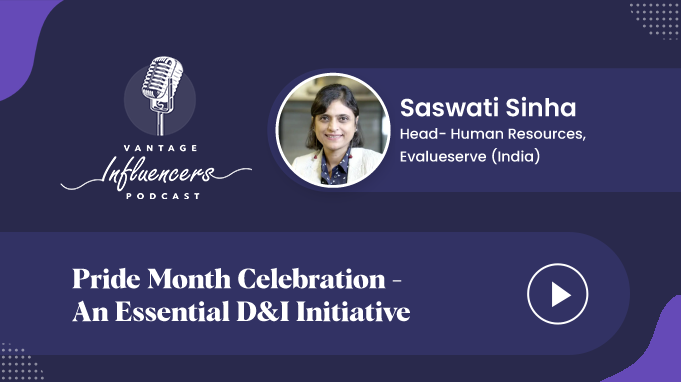
Saswati Sinha joins this episode of the Vantage Influencers Podcast to unpack what Pride Month should really mean inside a workplace, beyond the rainbow logos and social posts that show up every June. She argues that genuine diversity and inclusion should never need active promotion in an organization; it should function as hygiene, as automatic as any other operational standard, rather than a campaign that surfaces once a year. Drawing a direct line between conscious effort and unconscious bias, she explains why most inequity today is not deliberate cruelty but inherited conditioning, shaped by how people were raised and the cultural frameworks they grew up inside, and why that makes the work of dismantling it slower and more deliberate than any single Pride campaign can achieve on its own.
She then walks through what actually moves the needle: panel discussions that bring in outside voices, employee community groups where people can share their personal stories, and structured hiring goals that mirror the kind of quota-based thinking already applied to gender diversity. Saswati pushes back on treating inclusion as a plug-in, plug-out initiative that appears every June and disappears by July, framing consistency as the only real proof of commitment. She closes by urging listeners to look past sentiment and toward evidence, pointing to return-on-investment case studies as the argument that ultimately convinces organizations to keep going long after Pride Month ends.
Episode Highlights
- Diversity and inclusion should function as workplace hygiene, not a program that needs conscious promotion or a dedicated campaign.
- Most bias against the LGBTQIA+ community isn't deliberate; it's inherited from cultural conditioning and takes years of consistent effort to unlearn.
- Panel discussions, external speakers, and personal storytelling sessions help build empathy and shift mindsets across an organization.
- Structured hiring targets, similar to existing gender-diversity goals, can help bring more people into the mainstream regardless of orientation.
- Pride Month activities should never be a one-off, plug-in-plug-out gesture; the real goal is weaving inclusion into everyday processes year-round.
- Case studies showing measurable ROI from inclusion initiatives give organizations a business case that outlasts symbolic gestures like logo changes.
About the Guest
Saswati Sinha, Head of Human Resources (India) at Evalueserve
Saswati Sinha is an HR leader with more than 23 years of experience in people, process, and strategy, having worked across industries including IT, media, and business process outsourcing before leading HR and people functions for a Samsung Group company. Her work in the field has been widely recognized: she was named to the Top 100 and Top 101 HR Minds in India by the World HRD Congress in 2018 and 2019, won the Top 101 Fabulous HR Leaders award in 2020, received the Her-oes award for top women HR leaders from ObserveNow the same year, and was recognized among the Top 50 Leaders in HR by White Page International in 2021.
Connect with Saswati on LinkedIn
Host
Susmita Sarma, Vantage Influencers Podcast Host
What You Will Learn
- Why diversity and inclusion should be treated as workplace hygiene rather than a campaign that needs conscious selling.
- Why most bias against the LGBTQIA+ community is inherited and unconscious rather than deliberate, and why that makes it harder to unlearn.
- How panel discussions, external speakers, and personal storytelling sessions build empathy and shift mindsets across an organization.
- How structured hiring targets, similar to existing gender-diversity goals, can help bring more people into the mainstream.
- Why symbolic gestures like logo changes fall short, and what it takes to weave inclusion into everyday processes year-round.
- Where to find the kind of ROI-based case studies that help build a lasting business case for inclusion.
Key Topics & Timestamps
| Timestamp | Topic |
|---|---|
| 00:00 | Cold open: what Pride Month represents in the workplace |
| 00:37 | Host introduces the episode and welcomes guest Saswati Sinha |
| 01:36 | Saswati's professional background and journey into HR |
| 02:24 | The true meaning of diversity and inclusion |
| 03:23 | Why diversity and inclusion initiatives matter in the workplace |
| 04:25 | Workplace discrimination still facing the LGBTQIA+ community |
| 06:30 | How Pride Month connects to employee engagement and recognition |
| 07:58 | Practical ways workplaces can celebrate Pride Month and support LGBTQ+ employees |
| 10:19 | Moving beyond symbolic gestures like rainbow logos toward real inclusion |
| 12:19 | Summarizing why Pride Month should be a consistent, year-round initiative |
| 13:57 | Resources Saswati recommends for learning about inclusion ROI |
| 15:05 | Connecting with Saswati and closing thoughts |
Full Transcript
Click to read the full episode transcript
Welcome to the Vantage HR Influencers Podcast. This podcast is sponsored by Vantage Circle, the simple and AI-powered rewards and recognition platform for employee engagement.
Pride is a celebration of identity, gender, race, and sexuality, and every other minority. It is a fight for equal human rights, tolerance, and acceptance, especially at work. It also refers to the achievements of community members toward equal rights.
Susmita Sarma: Hello, listeners. Welcome to the Vantage HR Influencers Podcast. I'm your host, Susmita. Today's episode is all about fighting inequality and discrimination in the workplace, because it's June and we are discussing Pride Month today. Pride is an opportunity to promote diversity and inclusion alongside employee engagement in the workplace. It is key to an impeccable company culture that attracts diverse talent. Hence, Pride Month celebration is an essential D&I initiative, and to shed light on the topic, we have with us Saswati Sinha, the Head of Human Resources, India, at Evalueserve. Welcome to the show, Saswati.
Saswati Sinha: Thank you very much, Susmita. Thank you for having me.
Susmita Sarma: Thank you so much for being here in this conversation today, Saswati. It's June, and we are celebrating Pride Month this month. Before we start talking about the actual topic today, it would be great if you could brief us about yourself.
Saswati Sinha: Susmita, I head the HR department for India for Evalueserve, which works in research, data analytics, and artificial intelligence. I have more than 24 years of experience now in HR, and I've worked across industries including IT and media. Just before joining Evalueserve, I was heading HR and people functions for a company that is part of the Samsung Group. I've been based here for the last 25 to 26 years.
Susmita Sarma: Great. So talking about Pride Month, the first thing I'd like to know from you is: what is the true meaning of diversity and inclusion for you?
Saswati Sinha: Susmita, whenever we talk about inclusion or removing biases, I always feel, why are we even talking about it? It should have been hygiene by now. We should not have unconscious biases. We should be inclusive of every community. That should already be part of our whole framework, and we shouldn't have to consciously drive it, it should just be basic. In my mind, the ideal situation is one where you don't have to think about this: you're focusing on talent, on creating connections and relationships, without thinking about where the person is coming from. That's the true meaning, building a solution where you don't have to think about it.
Susmita Sarma: Okay. So tell me, Saswati, in your opinion, why are diversity and inclusion initiatives important in the workplace?
Saswati Sinha: Well, in the workplace, diversity and inclusion is one of the most critical aspects, and I'd say we've reached a point where we shouldn't have to consciously drive it, it should be hygiene. It's a given fact that only when different types of individuals, with different ways of thinking and different orientations, come together, can we drive innovation and creativity. Those are the buzzwords, right? The same type of thinking cannot drive innovation and creativity, and it can't help us reach the next level. If you want to go up the value chain, you need diversity in your thinking, and you need to include different types of thought processes to move forward. That's true not just for the workplace, but for society as a whole.
Susmita Sarma: Right, right, right. So do you believe the LGBTQIA+ community is still facing workplace discrimination, even after years of change in workplaces?
Saswati Sinha: Unfortunately, yes. Even today, after so much conscious effort, there is still discrimination, still inequality prevalent in workplaces. And this isn't a conscious inequality, at least I can speak for the organizations I've worked for. It's not a conscious bias; any community bias we carry is actually deep rooted, and that's why change is difficult to come by. It goes back to our whole societal framework, how we grew up, what the cultural scenario was. Even today, forget sexual orientation for a moment, even with gender diversity, we are still working toward it and haven't achieved the milestones we wanted. Simply because, if you go to the interior parts of the country in India today, there are still girls who aren't educated past a certain age. They'll eventually need to be included. Now, people coming out of those communities into the workplace won't suddenly change their mindset. It's a mindset, a whole belief system, and it takes a lot of time to realize that.
Susmita Sarma: It takes time, but I think our responsibility, as organizations and as individuals, is to drive this in every way we can, to create awareness so that more and more people's mindsets shift. And celebrating Pride Month, Saswati, is also deeply correlated with things like employee engagement, recognition, and acceptance. It's become an essential part of our everyday initiatives.
Saswati Sinha: Yes, 100%. Whenever an organization is driving D&I, and I think most evolved organizations are doing this at this point, we consciously say Pride Month is consciously celebrated. At Evalueserve, we've formed community groups for this, and we tell people, please join these groups, talk to each other. We create awareness through panel discussions, our leaders talk about it, we send out mailers. Our focus is more on education, awareness, and removing unconscious bias, because the more we talk about it, the more we realize how much of it is unconscious, things we don't even realize ourselves. That only gets mitigated through education and awareness, and then we consciously drive it across the organization.
Susmita Sarma: As you've mentioned what you're doing at Evalueserve, would you like to highlight a few other ways workplaces can celebrate this month and show support for the LGBTQ+ community and employees? We see many organizations taking part in diversity training or Pride events. What else would you suggest to the listeners, managers, and HR professionals listening today?
Saswati Sinha: Yes. The initiatives most organizations have found effective, first, as I said, is awareness and education, through external panel discussions, bringing in external speakers to talk about it, and explaining what's in it for the organization as a whole to ensure the community feels included. That's the first aspect. Second, what we're also doing, and what organizations have found very effective, is hearing people's stories. We encourage people to talk about themselves, what they've gone through, and what they'd want from the rest of the organization so they can grow. It creates empathy and builds more connection between the majority group inside the organization and people outside it. Third is engagement activities, activities that include this community, where we work together on certain projects, small gains and initiatives. I think these are some of the things organizations have found effective in creating inclusiveness for this community.
Susmita Sarma: Brilliant. I also believe there's more to it than just the visible gestures.
Saswati Sinha: Just changing the logo or adding the rainbow, these are all good, and I think we've been doing that year after year. But now, I think it's required that our whole fabric isn't just about the month of June. We should weave inclusion into our whole fabric. Let me give an example: in our hiring process, over a period of time, we've said that a certain percentage of hires should be women. We should apply the same thinking here. We should say that, wherever people are able to disclose their orientation, we ensure that percentage is brought into the mainstream. So slowly, it stops being just about inclusion for its own sake, it becomes about talent and skills. Nobody should care what orientation, background, race, caste, or gender you're from, it's all about talent and skills. But initially, we have to drive it, the organizational framework has to drive it. Just talking about it for a month, or really just a couple of days, isn't enough. All our effort should go toward making the process of accepting the community a lot more organic, not just something that creates a buzz once in a while and then fades. It's a mindset change, and it has to happen consistently over time.
Susmita Sarma: Very true, very true. So, in the end, how would you like to summarize your thoughts on Pride Month celebration being an important D&I initiative at work? Your end note for the show.
Saswati Sinha: I'm really passionate about this subject, I could go on and on. But to summarize, I believe organizations driving these initiatives and this inclusivity for the community shouldn't look at it as just a short-term D&I initiative. Whenever we're devising any policy, process, or program within the organization, we should keep in mind that this is a minority that can bring a lot of advantages to the organization, and we should keep involving them at every step of what we do. It shouldn't be a plug-in, plug-out approach. It should be consistent, working toward changing mindsets, which might take years, but if we don't start now, it's never going to happen. So let's start with consistent approaches rather than just a month of celebration. That's my humble request.
Susmita Sarma: Amazing. Thank you for those words, Saswati. Is there a book, podcast, or movie you'd want to suggest to our listeners, something you enjoyed watching or listening to?
Saswati Sinha: There are lots and lots of them, but I don't have one favorite. What I'd request our listeners to do, from a very practical standpoint, is to read or look up case studies where including this community has resulted in ROI, return on investment, where organizations have seen the benefits themselves. There are a lot of case studies available online. So I'd ask each of you, whatever resources you have, to go ahead, search, and look at case studies where there's a return on investment. It's not just about being a good human being, it's also about the benefits it brings to the table, if you look at it from the lens of an organization.
Susmita Sarma: Thank you, Saswati. After this podcast, our listeners might want to connect with you for a more detailed conversation, maybe even another podcast. How can a listener reach out to you?
Saswati Sinha: I'm very active on LinkedIn, so the best and fastest way to reach me is through LinkedIn.
Susmita Sarma: Yes, I'll share your LinkedIn link in the show notes, Saswati. Thank you so much for this conversation today. Thank you for taking the time and for beautifully answering all my questions. I really appreciate that we discussed such a sensitive issue today, and I'm sure our listeners will love this episode. So thanks again, and I hope to hear from you again soon.
Saswati Sinha: Thank you for having me on the show. And to all the listeners out there, even a small step of yours toward inclusivity will help us move ahead, as human beings and as organizations.
Thanks for listening to the Vantage HR Influencers Podcast. Please do subscribe to the Vantage HR Influencers Podcast on Apple Podcasts, Spotify, and our YouTube channel for new episodes.
FAQ
What does Pride Month really mean in the workplace, according to Saswati Sinha?
Saswati Sinha argues that Pride Month should be a visible reminder of a standard that already exists year-round, not a one-time campaign. In her view, genuine diversity and inclusion should function as workplace hygiene, something organizations don't need to consciously promote, because it's already built into how they hire, communicate, and make decisions.
Why is diversity and inclusion still difficult to achieve, even with years of conscious effort?
She explains that most bias isn't deliberate. It's inherited from the societal and cultural frameworks people grew up in, which makes it deep-rooted and slow to shift. Even organizations making conscious efforts still carry unconscious bias, which is why education and awareness, rather than one-time gestures, are needed to create lasting change.
What are practical ways for organizations to celebrate Pride Month beyond symbolic gestures?
Saswati points to three approaches that have worked well: external panel discussions and speakers that build awareness, personal storytelling sessions where employees share their own experiences to build empathy, and engagement activities that bring the LGBTQIA+ community into shared projects with the rest of the organization.
How can leaders make LGBTQIA+ inclusion a consistent practice, not just a one-month campaign?
She recommends weaving inclusion into everyday processes, such as applying the same kind of structured thinking used for gender-diversity hiring goals to LGBTQIA+ representation, rather than treating it as a plug-in, plug-out initiative that appears every June. She also encourages leaders to look at ROI-based case studies to build a durable business case for staying consistent.
Related Reading
Also listen on