Social Recruiting: Leveraging Social Media To Find Talent
Episode Overview
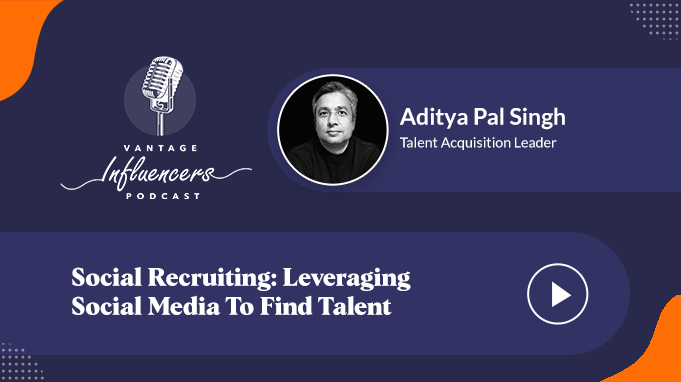
Recruiting has moved from newspaper classifieds to a landscape where every major social platform plays a distinct role in finding talent. In this episode of Vantage Influencers, host Sanjeevani Saikia speaks with Aditya Pal Singh, a talent acquisition leader with over 23 years of experience across consulting and large multinational hiring, about what actually works on LinkedIn, Instagram, Twitter, and beyond.
Aditya's core message: social recruiting isn't just about posting a job opening, it's about building brand presence and a future talent pool before you even need to hire, and being deliberate about which platform serves which purpose.
Episode Highlights
- Each platform plays a different recruiting role: LinkedIn for talent attraction and InMail outreach, Instagram for storytelling and employee advocacy (especially with Gen Z), Twitter/X for real-time brand feedback, and GitHub/Stack Overflow for evaluating technical talent through public work.
- Employee testimonials outperform polished company videos. Authentic, individual accounts of working somewhere resonate more than curated organizational content.
- The metrics that actually matter: engagement (likes, shares, follower reach), source-of-hire tracking (how many applicants actually came from social vs. other channels), time-to-hire, and long-term retention of people hired through social channels.
- One metric Aditya wants retired entirely: filtering candidates by "premier institute" pedigree. Hiring for skill, not brand-name education, should replace it.
- Social recruiting is cost-effective (job postings are often free) and removes geographic limits, but comes with real tradeoffs: information overload, inconsistent brand messaging across employee posts, and compliance differences by region.
- Looking ahead: AI and automation (sourcing, screening, generative responses), video and multimedia, VR/AR for virtual onboarding, and niche technical platforms will all play a bigger role, alongside data analytics tools like Power BI and Tableau becoming standard for recruiters.
About the Guest
Aditya Pal Singh — Talent Acquisition Leader
Aditya Pal Singh is a talent acquisition professional with over 23 years of experience in multicultural, matrixed environments across consulting and multinational corporations. He has designed and deployed global talent acquisition strategies, built recruitment tools and technology, and managed recruitment teams across large-scale hiring. He holds an MBA in HR from Symbiosis Institute of Management Studies and is pursuing a PhD. He is a visiting faculty member at IIMs, IITs, and other leading institutions, teaching future-of-work, design thinking, HR analytics, and Industry 4.0, and is a frequent keynote speaker and panelist at forums including GWFM, NHRD, and People Matters.
Connect with Aditya on LinkedIn
Host
Sanjeevani Saikia — Vantage Influencers Podcast Host
What You Will Learn
- How social recruiting actually differs from traditional recruiting methods
- What LinkedIn, Instagram, Twitter, and technical platforms like GitHub each do best for recruiting
- What kind of content genuinely captures top talent's attention (hint: employee testimonials over branded videos)
- Which KPIs actually measure social recruiting success, and one metric worth retiring
- What emerging technologies (AI, VR/AR, data analytics) are likely to reshape talent acquisition next
Key Topics & Timestamps
| Time | Topic |
|---|---|
| 00:55 | Aditya's corporate journey so far |
| 02:45 | What social recruiting actually is, and how it differs from traditional methods |
| 05:48 | Advantages and common challenges of using social media for recruiting |
| 09:10 | Using LinkedIn, Twitter, and Instagram effectively for recruiting |
| 13:42 | Best practices for engaging posts and multimedia |
| 16:43 | Key metrics and KPIs for tracking social recruiting effectiveness |
| 20:52 | Emerging platforms and technologies poised to reshape talent acquisition |
Full Transcript
Read the full transcript
Sanjeevani: Welcome to the Vantage HR Influencers Podcast. This podcast is sponsored by Vantage Circle, the simple and AI-powered rewards and recognition platform for employee engagement.
Sanjeevani: Finding the right talent can feel like searching for a needle in a haystack, that's where social recruiting comes in, using the power of social media to identify, attract, and engage top talent. Social recruiting lets HR professionals tap into vast networks, connect with candidates in real time, and showcase company culture to a broader audience. It's a genuine game-changer that turns traditional recruitment on its head. Hello and welcome to yet another episode of the Vantage Influencers Podcast, I'm Sanjeevani Saikia, your host, and today we have a fascinating topic: social recruiting, leveraging social media to find talent. Joining us is Aditya Pal Singh, a seasoned talent acquisition leader who'll share insight into how social media is transforming talent acquisition. Let's start the conversation. Hi Aditya, thank you so much for joining in today's conversation.
Aditya Pal Singh: Hi, great to be here, looking forward to it.
Sanjeevani: Before we dive into today's topic, could you share a bit about your professional journey?
Aditya Pal Singh: Thank you for having me. I've been in talent acquisition for about 23-24 years, initially in consulting companies, and a good chunk of my career split between two organizations, Accenture and Informatica. I've built strong experience hiring at scale, as well as for product companies, that's been my biggest strength, building talent acquisition from a future-workforce standpoint. It's been a genuinely interesting journey, and talent acquisition is one of the most fast-moving, constantly changing spaces in HR, there's never a dull day in it.
Sanjeevani: With your permission, I'd like to begin today's conversation. Social recruiting has become a buzzword, but many still wonder how it truly differs from traditional methods. Can you explain what social recruiting is, and how it stands apart from traditional recruiting?
Aditya Pal Singh: Let me answer that by going backward a bit. When I started recruiting, the traditional method, at least in India, was the newspaper, the classifieds people referred to for job openings, or job forums people would visit to search and apply, or reaching out to companies directly. It's evolved enormously since then. Technology is the biggest change, think about how everyone uses mobile phones today and no one thinks about landlines anymore, none of us probably even have one right now. Social recruiting platforms, LinkedIn, Naukri, Monster, Facebook, Instagram, are where companies can now attract future talent and build a talent pool ahead of time. The advantage is real scale, you're touching a much wider, more global talent pool, not just within one country. Everything's more connected and accessible, and things move much faster than they used to, easier for employers, easier for candidates looking for the right fit too.
Sanjeevani: Leveraging social media for recruitment brings real advantages, reaching a broader audience, engaging candidates more interactively, but I'm sure it isn't without hurdles. What are the key benefits of using social platforms for recruiting, and what challenges might companies face implementing these strategies?
Aditya Pal Singh: First, as you mentioned, it gives you access to a wider, more diverse talent pool, and lets you build a potential talent pool proactively. You also gain the ability to reach passive candidates, reeling them in with the kind of work your organization does and the brand you've built, so people start thinking about your organization even before they're actively job-hunting, that builds brand awareness and gives organizations a real chance to showcase themselves. It's also very cost-effective, posting a job on most social platforms today is often free, and it enables hiring across geographies entirely, something COVID really proved was possible when we realized work could genuinely happen remotely, from anywhere.
Of course, with those benefits come real considerations. There's a lot of information overload, since anyone can post anything, so as a candidate you need to sift through what's actually relevant. Brand consistency is another challenge, organizations are usually careful about their own messaging, but individual employees posting informally may present a different picture, which creates its own kind of risk. And compliance and what's considered socially acceptable content varies significantly by location, and even by organization and by individual. Information security matters too, of course. But overall, the benefits outweigh the negatives, and as we all mature in how we use this space, those negatives will keep shrinking over time.
Sanjeevani: Different platforms have unique features and reach distinct audiences. LinkedIn is often seen as the gold standard for professional networking, while platforms like Twitter and Instagram offer other kinds of value. Could you share insight on using LinkedIn, Twitter, or Instagram effectively for recruiting?
Aditya Pal Singh: Let's go through a few. LinkedIn is genuinely strong for talent attraction, everyone's on it today, so it's the right place to reach both passive and active candidates, especially through their InMail approach. You also get real competitive intelligence through groups and company pages, and LinkedIn has tools like Talent Insights that give you a solid view of the talent landscape to plan your recruiting strategy around, a genuinely effective tool worth using well. Facebook is very cost-effective, more useful from an insights and engagement standpoint, understanding what's happening and using it for branding, employee voices work well there too. Instagram started as a Gen Z-heavy platform, but honestly everyone's there now, so not being present there is a real gap. It's a targeted audience, best used for storytelling, engagement, and showcasing what an organization stands for, a great place for employee advocacy. Twitter, or X, is more about real-time feedback on your brand, but it's short-lived in nature. YouTube works well for branding and deeper engagement around what your brand stands for. And if you're in tech, GitHub and Stack Overflow let you see a candidate's actual coding ability and public work, people are reachable there too. Every platform has its own strength and a fairly defined target audience, so as an employer, you need to choose deliberately based on what you're trying to accomplish.
Sanjeevani: Do hiring managers actually lean heavily on LinkedIn specifically, or is it more like a 50-50 split with traditional methods?
Aditya Pal Singh: It really depends on the role. If I'm hiring, I need to know which companies my target talent pool is likely coming from, and I'll use LinkedIn heavily for that, but I'll also use other channels depending on the position, since it's not just about posting a job, it's about actually reeling in the right candidates. Broadly speaking though, LinkedIn is quite effective from a hiring standpoint.
Sanjeevani: In the crowded space of social media, the type of content you share makes a real difference. What kinds of content do you find most effective at capturing top talent's attention on social platforms?
Aditya Pal Singh: Your employee value proposition needs to show up here. Job postings should be genuinely engaging, visually appealing, and speak to what your organization stands for and what your culture actually is, whether that's video or a written piece, because today it's not just about the job for a candidate, it's about the whole ecosystem they'd be walking into. Beyond that, one of the biggest things now is employee testimonials, genuine, authentic accounts from people about their own experience carry far more weight than a polished, pre-made organizational video, people connect with that authenticity and can actually picture their own career trajectory through it. Unbiased review sites like Glassdoor and Google Reviews matter too, as does visible thought leadership from organizational leaders about where they see the company heading. Hackathons, coding contests, and similar events also help attract talent, and organizations increasingly host podcasts, video content, and webinars just to talk about their own perspective, which candidates absolutely factor in, since they want a genuine, holistic view of the organization before they decide to walk in.
Sanjeevani: Shifting gears, how can recruiters measure the success of their social recruiting efforts, and what metrics or KPIs should they actually be tracking?
Aditya Pal Singh: Recruiters genuinely need to be socially active themselves. You want to track engagement, likes, shares, click counts, on your posts, using available tools, and pay attention to how many followers and how much reach individual recruiters themselves carry, since recruiters end up playing something like an influencer role for the organization, it's not just about filling one role right now, it's about seeding long-term brand awareness in someone's mind. Beyond engagement, you should track source-of-hire, when someone applies, ask where they heard about the role, so you can later break down how many hires actually came through social versus other channels, that gives you a real picture of your CV source mix. Time-to-hire matters too, a shorter time-to-hire in certain channels tells you how effectively your recruiter is working the market, including how well they're using employee referrals. And I always say, the right candidate doesn't always land in your lap immediately, you sometimes have to actively "fish" for them over a longer period. The last, more qualitative piece: how long people hired through social channels actually stay with the organization, retention matters enormously here, because long-term, I believe organizations will invest more in moving talent internally than in constantly hiring fresh from the market, so internal mobility, and the recruiter's role in enabling that movement, matters just as much.
Sanjeevani: You've highlighted the metrics HR should track. Is there a specific metric or KPI you think HR should stop using altogether?
Aditya Pal Singh: Yes, the "premier institute" filter. We should shut that off completely, the idea that the best candidates only come from a small set of elite institutions. Post the role openly, let the right person walk in through the interview process based on skill, not pedigree. Hiring for skill over anything else, and opening the door to candidates outside a narrow set of "premier" institutions, is exactly where organizations need to move away from.
Sanjeevani: As technology and social media keep evolving, so will the future of social recruiting. What trends do you foresee, and are there emerging platforms or technologies that could reshape how we find talent?
Aditya Pal Singh: AI and automation will play a big role, depending on organizational need, machine learning for sourcing, NLP tools for screening, generative AI for automated candidate responses at various stages, it's a lot of technology converging, but the right mix depends on each organization's specific needs. Video and multimedia will matter more too, for brand storytelling and the insights you can pull from social engagement. You'll also need to get comfortable with niche platforms specific to what you're hiring for, GitHub and Stack Overflow for tech talent, for instance, knowing exactly where your target talent pool actually lives matters. Virtual and augmented reality will play a bigger role too, COVID showed us that clearly, with organizations virtually onboarding people, and that kind of usage will only grow. Remote work will remain a major factor in delivering talent anywhere. Data analytics in recruiting, using both predictive modeling and historical data to plan hiring strategy, will become standard too, recruiters will need real fluency as end users of tools like Power BI and Tableau. And DEI will remain critical, and it varies a lot by geography, at its core, the reason we need diverse workforces is straightforward: two differently-wired people will give a single manager two different perspectives to weigh, and if everyone on a team thinks the same way, you won't get the range of input that leads to the best outcome. DEI will remain a major factor as we move further into this future.
Sanjeevani: You've addressed all our questions, Aditya, I'm sure our listeners will benefit enormously from this. We've reached the end of today's episode, any final thoughts or a message for our listeners, and how can they reach out to you afterward?
Aditya Pal Singh: My one point of view for employers and listeners: focus on building soft skills, adaptability, emotional intelligence, cognitive flexibility, collaboration, critical thinking, resilience. These will matter enormously going forward. Hard skills have a shorter shelf life, and it's genuinely difficult, by the time you adapt to one new skill, something else has already emerged, but these softer skills will remain valuable no matter what changes. I'm reachable on LinkedIn, my handle is posted there, feel free to reach out directly.
Sanjeevani: Thank you so much, Aditya, for joining today's episode, it was incredible to have you, and thank you for sharing your insights.
Aditya Pal Singh: Thank you.
FAQ
How does social recruiting differ from traditional recruiting?
Traditional recruiting relied on newspaper classifieds and job forums, reaching a limited, local pool. Social recruiting uses platforms like LinkedIn, Instagram, and Twitter to reach a far wider, more diverse, and often global talent pool, while also building brand awareness and a future talent pipeline before a role even opens.
Which social platform is best for recruiting?
It depends on the goal. LinkedIn works best for talent attraction and direct outreach, Instagram for storytelling and employee advocacy, Twitter/X for real-time brand feedback, and GitHub or Stack Overflow for evaluating technical talent through their actual public work.
What content actually attracts top talent on social media?
Authentic employee testimonials tend to outperform polished, pre-produced company videos, since candidates connect more with genuine accounts of someone's real experience. Visual, culture-focused job postings and visible leadership thought leadership also help.
What hiring metric should companies stop using?
Filtering candidates by "premier institute" pedigree. The recommendation is to hire based on demonstrated skill rather than which college or university a candidate attended.
Related Reading
- Company Culture: The Complete Guide to Building a Great One
- How Employee Referral Programs Get Benefited By Employee Engagement
This episode is part of the Vantage Influencers Podcast, where we bring HR thought leaders to discuss engagement, compensation, benefits, and everything related to HR.
Also listen on