The Role of HR in Performance Management
Episode Overview
Zubair Bhura joins the Vantage Influencers Podcast to make the case that performance management is a much bigger discipline than most organizations treat it as. Rather than reducing it to an annual appraisal or a single conversation about pay, he argues that performance management touches remuneration, promotions, disciplinary decisions, and how work gets designed and communicated at every level of a company. He explains why the businesses that manage to align all of these pieces, from the most senior leader down to the newest hire, tend to outperform the ones that treat performance as a once-a-year event.
He also pushes back on rigid, one-size-fits-all approaches to managing people. Zubair walks through why short, frequent check-ins beat long annual reviews, why managers need to define goals clearly before they can spot skill gaps, and why sorting employees into generational buckets misses what actually drives each person. He closes with a practical framework for building a fair, well-rounded performance system, plus a reminder that HR leaders who want a real seat at the table need to learn to speak the language of finance.
Episode Highlights
- Performance management is a much broader discipline than performance appraisals, tying together remuneration, promotions, disciplinary decisions, and development plans across every level of an organization.
- Short, frequent goal-setting conversations beat long annual review cycles because they let managers catch misalignment and redirect performance in weeks instead of months.
- Managers need to define and communicate clear goals before they can properly assess an employee's skill gaps or shortcomings.
- Continuous feedback loops have real upside, but they can frustrate strong performers who feel micromanaged, so leaders need to calibrate the balance carefully.
- Sorting employees into generational buckets to predict how much ownership they take of their performance is unreliable; individual circumstances matter far more.
- A well-rounded performance management system rests on three pillars: clearly defined jobs, an honest read on people and performance, and pay that's benchmarked against the market.
About the Guest
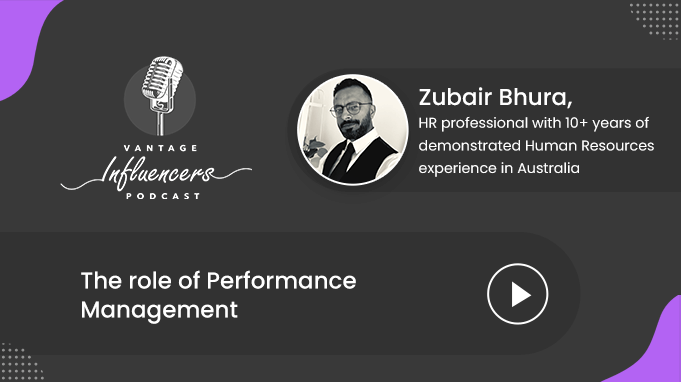
Zubair Bhura, Senior HR Professional
Zubair Bhura is a senior HR professional with more than 10 years of experience across Australia, spanning distinct ownership models and global organizations in retail, FMCG, hospitality, aviation, and logistics. He has supported senior leadership teams through critical transformation and change projects, including new business ventures, diversification, and organizational restructures, and is a long-standing certified practitioner of the Australian Human Resources Institute.
Connect with Zubair on LinkedIn
Host
Arindam Senna, Vantage Influencers Podcast Host
What You Will Learn
- Why performance management is a much broader discipline than performance appraisals
- How short-term goal setting beats long annual review cycles
- What managers need to define before they can properly identify skill gaps
- The real pros and cons of a continuous feedback culture
- Why generational labels are a poor way to predict ownership of performance
- The three-part framework behind a fair, well-rounded performance and rewards system
Key Topics & Timestamps
| Timestamp | Topic |
|---|---|
| 01:22 | What drew Zubair into a career in HR |
| 03:00 | Why performance management is bigger than performance appraisals |
| 04:35 | Short-term goal setting versus long-term annual reviews |
| 07:27 | What managers need to define before assessing skill gaps |
| 09:07 | The pros and cons of a continuous feedback culture |
| 13:15 | Why generational labels don't predict ownership of performance |
| 15:07 | The building blocks of an effective performance management system |
| 18:10 | Zubair's advice for young HR leaders |
Full Transcript
Click to read the full episode transcript
Welcome to the Vantage HR Influencers Podcast. This podcast is sponsored by Vantage Circle, the leading employee benefits and engagement platform.
Arindam Senna: Hi everyone, welcome to the Vantage HR Influencers Podcast. On today's episode, we are going to learn about the role of HR in performance management, and I'm very happy to have with us Mr. Zubair Bhura as our HR guest speaker. Zubair is a master's degree qualified senior HR professional with more than 10 years of demonstrated human resource experience in Australia, with a proven history of working with distinct ownership models and global organizations spanning unionized and non-unionized environments, including retail and FMCG, fast food, hospitality and customer service, aviation and airlines, specifically ground handling, transport, warehousing, and logistics. Throughout his career, he has directly worked with large portfolios spanning up to 1,200 employees and independent contractors, including sales and marketing, business support, customer service, and various operational roles in the blue-collar sector. Along with that, he provides support to senior business leadership teams during critical transformation and change projects, including new business ventures, diversification projects, and restructures, while being a long-term certified practitioner of the Australian Human Resource Institute, which is the professional body for human resources in Australia. I'm very excited to have you here, Zubair. Before starting with the topic, I'm very curious to know what motivated you to pursue a career in HR.
Zubair Bhura: Yeah, sure. Thanks. First of all, thanks so much for giving me the opportunity to be here today and to speak. I'm just going to answer your question in one second, but before I do, I want to get something out of the way. Anything I share today reflects my own views, and I'm not representing any of my current or former employers. I just thought I'd say that upfront and hopefully that's clear from the start.
My journey with HR started when I was in my teens, actually. I was quite confused, like every other teenager, not sure which direction I wanted to take in life and in my career. I stumbled across a book my sister-in-law was using while pursuing her MBA specializing in HR. I started reading it and felt this was something I understood and could do. I then spoke with one of my cousins, who was also pursuing a master's in HR in the UK, and got more information about human resources from him. I decided to move to Australia and pursue my master's as well, at the University of South Australia, in 2007. I graduated in 2009, got my first job, and transitioned from student life to professional life. I realized even more that this was the profession I was made for, and I've never looked back since.
Arindam Senna: That's really inspiring, actually. And having said that, I'd love to know, since every organization has a performance management system in place, and the purpose of a performance management system is, goes without saying, to improve performance, yet often we find it's not really delivered, what are the most important problems with today's widely used performance management systems, in your view?
Zubair Bhura: Yeah, that's a good question. Performance management is a broad topic and comprises various elements that need to tie together to be effective. To keep things simple, I'll use how the Australian Human Resource Institute defines performance management. It states that performance management is an all-encompassing term used to describe the practice that drives decisions about performance, remuneration, promotions, disciplinary procedures, transfers, and development needs within an organization. So it's a much broader concept than just performance appraisals or a disciplinary process, and it includes different facets such as job design, recruitment and selection, training and development, career planning, and so on. In my view, companies that combine and align all of these elements together, strategically and operationally, down to the most junior level, are the ones that are likely to thrive, and the ones that don't fall behind.
Arindam Senna: I really agree with you on this, Zubair. Moving on to the next question, the business environment is indeed turning more agile and fast-paced, and organizations are keeping near-term goals instead of longer-term ones. Also, an organization's goals and values should be reflected in performance planning to ensure an individual's performance aligns with the overall strategy of the organization. Do you think that's important?
Zubair Bhura: Yeah, look, in my view, short-term goal setting and having frequent discussions are more effective than longer-term goals and discussions. If employees are aware, on a more frequent and regular basis, of where they're going and how they're actually performing, and whether there needs to be any realignment, it's easier for everyone to change, and managers are able to steer them in the right direction quickly, rather than waiting six to twelve months to have those discussions. Resistance to change is harder later, and motivation drops too. So I'm more of an advocate for short-term goal setting and discussions.
Arindam Senna: So you believe that reviewing employees' performance in the short term is more convenient and also more necessary these days?
Zubair Bhura: Look, that's my personal view. If you look at different types of organizational settings, you've got advocates of MBO, management by objectives, a theory set out by Peter Drucker sometime around the 1940s and 1950s. There are companies that still use his philosophy and operate in 2021 using long-term goals, where discussions happen on a six-month or annual basis. It works for some companies, but it doesn't work for many others. Personally, I think having discussions on a regular basis, maybe fortnightly or monthly, is very effective, because it gives managers the opportunity to provide constant feedback and build relationships with their employees, and it allows managers to keep a handle on performance and steer behavior in the right direction. So there are a lot more pros to having quick catch-ups or touch points than waiting six to twelve months before letting employees know how they're doing.
Arindam Senna: Yeah, totally, totally. So having said that, what are the necessities to keep in mind as a manager, primarily to identify drawbacks in an employee's skills?
Zubair Bhura: Yeah, look, I think as a manager, you first need to know what you're looking for. That needs to be identified and defined very clearly first. Once you know what you're trying to achieve as an organization, team leader, or manager, you need to communicate that clearly to your employees. After that, you can start monitoring and assessing everyone's performance, shortcomings, and strong points.
Arindam Senna: So when we look at it from a broader perspective, how would you frame the whole process?
Zubair Bhura: I was just saying that before you start assessing employees' skills, strengths, weaknesses, and development plans, the first thing managers, or senior managers, need to do is define what their goals are, and then communicate those goals very clearly to employees. Once that's done, you have discussions about who's met those objectives and who hasn't, and why. That's when the conversation about strengths, areas of improvement, and development plans comes in.
Arindam Senna: That's really important, our viewers can take note of that. Moving on to the next question. Interestingly, organizations like Adobe, General Electric, and Deloitte, among other leading companies, are getting rid of traditional annual performance reviews and rankings. Instead, they've started implementing more of a frequent feedback loop. In your view, what are the advantages, and if there are any, the disadvantages, of a continuous feedback process?
Zubair Bhura: Look, everything has its pros and cons, and no process is perfect. One of the cons, in my experience, is that frequent feedback sessions can sometimes frustrate your top performers or good performers, who feel it's a waste of time because they're already doing a good job, so why give them feedback on something they're already good at. There's also a risk that people feel micromanaged, that they have to report on everything they do, and that their decision-making is constantly being questioned. So getting the balance right is extremely critical.
Arindam Senna: How do you make people accountable for their performance? They should be just as interested, if not more, and more responsible for improving their performance, because at the end of the day, it's their career and their future at stake. So how do you make people more involved and accountable for their performance?
Zubair Bhura: Yep, that's a good question. It goes back to our previous discussion on setting clear goals, objectives, and expectations. So that's part one. Part two is the process of consulting with them. Now, without going too much into the academic side of things, there are two schools of thought here. One is that there's a best practice approach, and the other talks about a best fit approach to performance management. The best practice approach talks about a universal set of ideas that companies can adopt, which works across any organization. The best fit approach basically says there is no universal fit, you have to align and change your performance management strategies based on the specific organization you're working for. I'm more inclined towards consulting with employees and making sure they're part of the goal-setting process, because employees who are consulted during the process are more invested than those who aren't. I also believe people should be reasonably accountable for their own performance, whether they're a call center operator, a sales professional, a truck driver, or even a senior marketing manager. When I say reasonable, I mean the goals themselves have to be reasonable and achievable, you can't expect a junior account manager to make a high-level strategic procurement decision, for example. But when goals are reasonable and achievable, I believe teams and individuals must work sincerely towards achieving them. Sometimes, even after a manager's best efforts, people still aren't performing to expectations, and unfortunately, one of the things companies resort to is disciplinary procedures, to make expectations very clear and achieve that behavior modification, or sometimes introduce team or individual incentives, which can work too.
Arindam Senna: I agree with you on this, Zubair. Do you see it also as a generational thing, in terms of millennials, Gen Y, and Gen X taking more ownership of their careers? Since they tend to be more loyal to the profession than to the organization, do you feel they're more open to taking ownership of their performance management in that sense?
Zubair Bhura: Yeah, look, I think it's a good question. Although placing people into age brackets and generational groups can provide organizations with some valuable information, I also feel that generalizing any group based on any attribute, whether age or gender, and making conclusive decisions about that group, isn't wise. Out of ten people between the ages of 30 and 40, there will be at least one who's different from the others in terms of what motivates them at work. So developing and implementing strategies based on that kind of generalization could miss the mark. I think a better approach is to consider people's individual circumstances, because each person's circumstances are unique. We're all different, our motivation levels are different, our wants and needs are different, our financial circumstances are different, and our drives are different. Some people want to move up the corporate ladder, others are happy where they are. So the key is to understand those differences and what people want, and then alter your strategies accordingly, with the ultimate aim of helping a person take ownership of their own career.
Arindam Senna: That's true, actually. And we've come to the last question of our podcast. Can you share some basic elements that are necessary for effective performance management, for our viewers?
Zubair Bhura: Yeah, sure. Look, I think it's all about getting the structure right. I'm not sure if you've heard of Robert Mosley, he's one of the leading global experts on compensation and benefits and performance. He talks about something called the golden triangle of rewards management. The triangle is made up of three things: jobs, people and performance, and pay markets. Jobs means getting your job definitions right, through proper job analysis, creating job descriptions, and establishing KRAs and KPIs. All of that links to a person's performance and behaviors. Some companies have a competency framework they use, and some don't, smaller companies usually don't have one, but larger global firms tend to have an established competency framework. Linking the jobs, the performance, and the person to the external market, and figuring out what pay strategies would work for your organization, whether through pay surveys and benchmarking exercises, helps establish your remuneration strategy. So a good, well-rounded performance management system should have a combination of all of these elements.
Arindam Senna: This will be really helpful for our viewers, I can say that. So as we come to the end of the podcast, before concluding, there are a few favorite questions I always ask our guests, which help me add more value for our audience. Is there a favorite business book you'd recommend?
Zubair Bhura: Absolutely. One of my favorite books is called HR from the Outside In, written by Dave Ulrich. He's a management educator and HR guru who has been shaping the HR profession for years. What he talks about is how he sees HR evolving from a traditional role into a more strategic business partner. I highly recommend that book to anyone getting into the profession, or an already established senior leader looking to add more value to their business. He's written a lot of books, but this is probably one of the best I've read.
Arindam Senna: Do you follow any HR leader as a role model?
Zubair Bhura: Absolutely. His name is Dr. Armin Trost. He's an HR professor at a university in Germany, a thought leader and author. He's written several books on performance and talent management, appraisals, and human resource strategies. He's one of the people I really look up to.
Arindam Senna: Before we end this podcast, I'd really like to know, what's one piece of advice you'd give to young HR leaders?
Zubair Bhura: Sure, look, learn the language of finance, and get a basic understanding of how profit and loss statements, balance sheets, and those kinds of things work. One of the best books I've read on finance is called Financial Intelligence, by Karen Berman, it's also available on Kindle. The reason I say this is that finance is one of the core languages of business, and it's important for HR professionals to learn to communicate with their stakeholders in a language they understand.
Arindam Senna: Thank you very much, Zubair, for taking time out of your busy schedule to help us dig into this topic. We're really looking forward to connecting with you again sometime.
Zubair Bhura: Absolutely. Thanks so much. Likewise. Thank you. Take care. Have a good day.
FAQ
Why is performance management more than just performance appraisals?
According to Zubair Bhura, performance management is an all-encompassing term that drives decisions about remuneration, promotions, disciplinary procedures, transfers, and development needs. It includes job design, recruitment, training, and career planning, not just an annual appraisal conversation.
Are short, frequent check-ins better than long annual performance reviews?
Zubair argues that short-term goal setting and frequent discussions, on a fortnightly or monthly basis, are more effective than waiting six to twelve months for a review. Frequent check-ins let managers catch misalignment early and redirect performance before it becomes a bigger problem.
Should companies replace annual performance reviews with continuous feedback?
Continuous feedback has real benefits, including stronger manager-employee relationships and faster course correction, but it isn't without downsides. Zubair notes that top performers can feel micromanaged by overly frequent feedback, so leaders need to calibrate how often and how deeply they check in.
Does generation affect how much ownership employees take of their performance?
Zubair pushes back on generational stereotypes. He argues that sorting employees into buckets like millennials, Gen X, or Gen Z to predict their attitude toward ownership is unreliable, since individual motivations, circumstances, and goals vary far more within a generation than between them.
Related Reading
Also listen on