
Employee Recognition is acknowledging an individual or team for their hard work, efforts, and accomplishments in the organization.
Employee Recognition is paramount in the workplace. It creates a friendly atmosphere and induces a sense of belongingness and closeness. Altogether it nurtures a supportive work environment.
Before we get into the 6 ways to implement it, here's a quick look at how employee rewards and recognition have evolved over the years:
How important do you think it is to build a workplace recognition culture?
Do you think you need to go the extra mile to make your employees feel appreciated at work?
The answer to this is a whopping YES!
If there is one thing that business giants agree on, it’s that staff recognition is a vital element to drive the financial returns through the roof:

Only 23% of employees worldwide are engaged at work, and 77% are not engaged or actively disengaged, according to Gallup's State of the Global Workplace report.
When employees are engaged, they are willing to invest their time, talent and energy to add value to their organization. They work harder and feel committed to contribute to the success of the company.
Related article: 7 Effects of Employee Recognition on Business
Naturally, employee disengagement is directly related to loss of productivity. Disengaged employees cost organizations an estimated $84 billion annually, according to the same Gallup report.
Millennials, Gen Z, and Employee Recognition
Millennials and Gen Z together make up the majority of today's workforce, and both generations expect recognition to look different from what worked a decade ago.
They're creative, tech-savvy, and quick to adapt, but they also want to see the results of their work right away. A single annual performance review doesn't cut it anymore.
Organizations need to understand what actually drives these employees and build a recognition rhythm that goes beyond the conventional once-in-a-blue-moon work review.

Rewards and Recognition Induce Motivation
Employee motivation is a fundamental element to take your company to the top. Timely rewards and recognition are proven drivers of motivation among employees.
Motivation is the art of getting people to do what you want them to do because they want to do it. ~Dwight D. Eisenhower
We can split workplace motivation into intrinsic motivation and extrinsic motivation.
Intrinsic Motivation:
Intrinsic Motivation is the motivation that comes in the employees for their true love and passion for the work they do.
It comes when their work provides them satisfaction. Employees want to achieve goals and develop professionally.
Extrinsic Motivation:
Extrinsic Motivation is solely for money and other benefits.
One can derive extrinsic motivation from factors like pay, promotion, and other programs designed to appeal to them.
To get your organization to the top, you need to ensure positive work motivation.
People often say that motivation doesn’t last. Well, neither does bathing – that’s why we recommend it daily. ~Zig Ziglar
A combination of both intrinsic and extrinsic motivation is the perfect combination for any workplace.
Inducing motivation can be tricky and time-consuming, but it is undeniably beneficial to your organization.
Framework for a Rewards & Recognition Program
1. Well defined criteria
Before coming up with a rewards and recognition program framework, the management should indulge in rigorous brainstorming sessions.
You should consider all the factors that can help the overall growth of the employees.
They should also give detailed guidelines for their criteria to the employees, and keep updating their categories according to growing trends. There should be distinct recognition for individual and team efforts.
2. Fairness
The program should be at all times fair to the employees.
Clarity and transparency are vital in the rewards and recognition program.
If more than one individual succeeds in fulfilling the predefined norms, make sure every one of them receives the reward or recognition, not just one.
3. Variety
As an employer, you should acknowledge the different traits of your employees. There should be a range of categories from which employees can earn recognition, such as camaraderie, sportsmanship, work ethics, etc.
The categories shouldn’t be too predictable for the employees.
It will not only motivate the employees but at the same time will help the organization in excelling over a range of areas and expertise.
4. Timeliness
Employee recognition should be a timely affair. It should always maintain its consistency.
There is a close link between employee recognition and the reason for which they are being recognized.
Recognition, like any form of motivation, fades if it isn't reinforced regularly. That's where a structured approach helps.
6 Ways to Build Employee Recognition Into Your Workplace
1. Perks and Rewards
It is not something new or unheard of, but offering perks and rewards still is the best way to instill recognition among employees.
Everybody loves a little extra! There is probably no greater joy for an employee than receiving a little extra than promised.
Traditional employee benefits like paid holidays, salary hikes, maternity/paternity leave, adoption leave, and retirement benefits are no longer considered rewards.
In a Glassdoor Employment Confidence Survey, more than half of workers said perks and benefits are among the top things they consider when accepting a job, and most said they would prefer new benefits over a pay raise.
Employees love it when you provide them with a plethora of benefits and perks.
Places that offer unique, out-of-the-box corporate perks and employee benefits consistently rank higher on "Best Places to Work" lists.
For example, according to an article in Inventiva, HCL is one of the top companies in India, and here is why:
At HCL, employee satisfaction holds as much importance as customer satisfaction. The company maintains this balance through its 'Employee First' program, which centers on five things employees need most: support, knowledge, recognition, empowerment, and transformation.
Employers can reward their employees with gift cards & vouchers on special occasions, festivals, bonuses, etc.
Also, they can provide them with an employee benefits platform where employees can get access to exclusive employee discounts in small to big purchases.
To make things simple for you, here's a list of rewards and recognition ideas you can give to your employees.
2. Employee Appreciation
Being thankful and expressing your appreciation is important.
But how often are you doing it?
For example:
- A small token of appreciation like a “Well done”, “Thank you”, “Congratulations” note now and then.
- A shout-out at the end of a tiring workday.
- A special mention at a gathering or a meeting.
- Or the good-old employee of the month ritual.
Related article: 50 Best Words of Appreciation for Employees You Can't Ignore
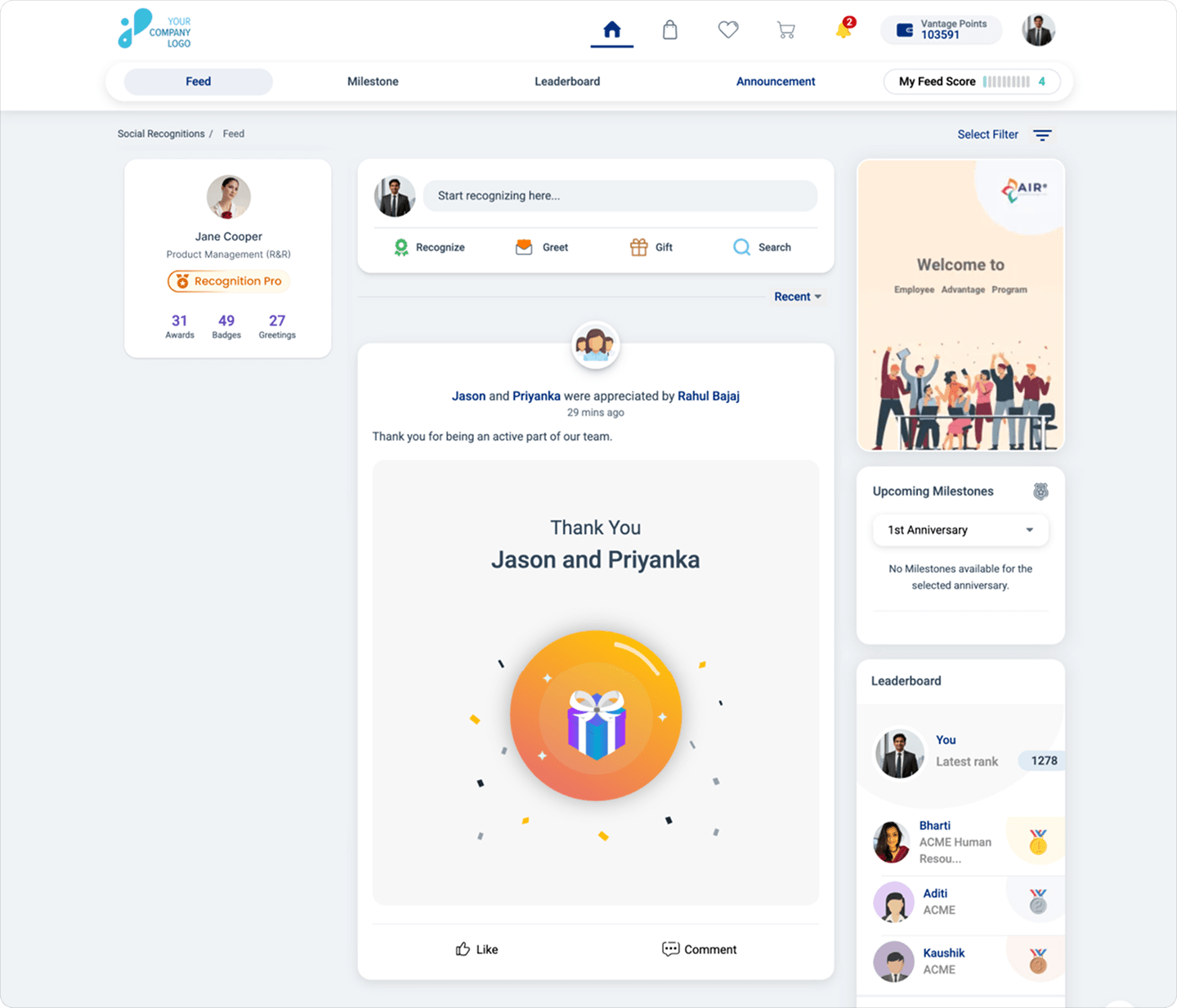
Picture courtesy: Social recognition feed on Vantage Circle's Vantage Recognition platform
You can also create your employee award certificates and cheer them for the good work.
These small but thoughtful actions can go a long way in an organization.
After all, in this highly competitive atmosphere, everybody craves some appreciation.
Appreciation doesn’t necessarily always mean praising. More than praising, employees want to feel respected in the organization.
When employees are treated with respect, they too do the same in return. Organizations should treat employees as valuable assets to the company who are capable of making intelligent choices. The first Friday of March is celebrated as Employee Appreciation Day every year, a good reminder to make this kind of recognition a habit rather than an afterthought.
3. Customized and Personalized Rewards and Recognition
Gone are the days when employers could implement a “one size fits all” formula for all their employees.
To gain employee satisfaction, they have to acknowledge that different employees have different needs.
For example, some might want to use their reward for personal fulfillment like buying new gadgets, whereas someone else might want to use their reward for the love of what they do, like traveling.
Giving away a turkey on holiday to all the employees might have worked in the past, but it definitely won’t work anymore.
Employees feel valued when they receive personalized recognition and custom benefits that are tailor-made for them.
The easiest way to do that would be to provide them with a platform to get an array of benefit choices to choose from.
This makes recognition easier to administer at scale while still feeling personal to each employee.
4. Social Recognition
Recognition-driven cultures see 92% employee retention compared to 76% in low-recognition cultures, and 91% of employees report feeling motivated compared to 73% elsewhere, according to Vantage Circle's Recognition Effect Report.
That gap shows up directly in employee engagement.
Social Recognition gives employees a visible way to share and celebrate their hard-earned appreciation with the wider organization.
Annual, monthly, and weekly awards are a significant driving force in increasing performance levels in workplaces.
Social media is probably the most effective channel for social recognition to motivate the workforce today.
Today's workforce, from millennials to Gen Z, are digital natives who've grown up immersed in social media.
Getting recognized in social media will give them a larger platform to boast about their hard-earned achievements, especially through peer-to-peer recognition.
Employers of big companies can even try to provide the employees with a cloud-based social recognition platform to share their accomplishments. This will ensure interconnectivity, camaraderie, and healthy competition among employees.
5. Building positive morale in the workplace
Employee morale is how satisfied, motivated, and positive employees feel about their work and workplace. Building positive morale isn't just another item on the recognition checklist, it's foundational to it.
When morale drops, it shows up fast as disengagement, apathy, and a general lack of interest in the work, and it directly jeopardizes the business.
Employers and managers can turn this around by focusing on a few things:
Communicate openly. The first step to fixing low morale is effective communication. As James Humes put it, "The art of communication is the language of leadership."
Listen and involve employees in decisions. The best way to value your employees is to listen to them. When they feel like part of the process of shaping company culture, they're more likely to speak up instead of staying silent.
Protect work-life balance. Make sure employees have a healthy work-life balance and aren't feeling overburdened with work. Flexible work timing and the occasional day off to pursue a passion go a long way toward keeping employees engaged.
Make room for fun and growth. Employees should enjoy working in the organization. Recognize exceptional conduct, and invest in training that helps people develop a positive work attitude.
6. Non-professional Benefits
All work and no play doesn't just make the employees dull, it makes the workplace monotonous and unexciting too.
Non-professional benefits for employees can be many.
It can be organizing events where the employees can showcase their hobbies and interests. Conducting activities promote the physical and emotional well-being of the employees.
Sometimes it can also encourage employees to take up a task or learn a skill that will be beneficial in the long run.
Take a look at these amazing non-professional benefits and activities for employees:
- REI gives employees two paid "Yay Days" each year to spend on their favorite outdoor activity (REI).
- Salesforce employees get seven days of paid volunteer time off a year, and those who use all seven can direct a $1,000 grant to a nonprofit of their choice (Salesforce).
- Airbnb gives employees a $2,000 annual travel stipend, paid quarterly, to stay at Airbnb listings anywhere in the world (CNBC).
- Burton gives employees discounted season ski passes and flexible hours to ride before work, tied to its "Front Line Commitment" program (Burton).
You don't need a big-tech budget to borrow the idea. A few paid hours off for a hobby or a small stipend for a passion project can have a similar effect on morale.
Conclusion
Employee Recognition is the key to bringing your organization to life. It's no longer an option but a must-have, especially when it comes to reducing employee turnover.
It goes far beyond the conventional ways like Employee of the month, and it requires mindful planning and execution.
75% of the causes of employee turnover are preventable.
~(Source: HR Dive)
Although keeping your employees satisfied is not entirely in your hands, giving them the proper recognition at the right time still is. Good employee recognition programs can help a company in many ways. It is a proven way to encourage employees to work harder and drive employee engagement.
Implementing these 6 steps will help you build an employee-oriented recognition program, and a workforce that's more engaged, loyal, and less likely to walk out the door.

Susmita Sarma is a Digital Marketer at Vantage Circle, making employee recognition less of a checkbox and more meaningful - helping organizations say we value our people and truly mean it.
Connect with Susmita on LinkedIn.