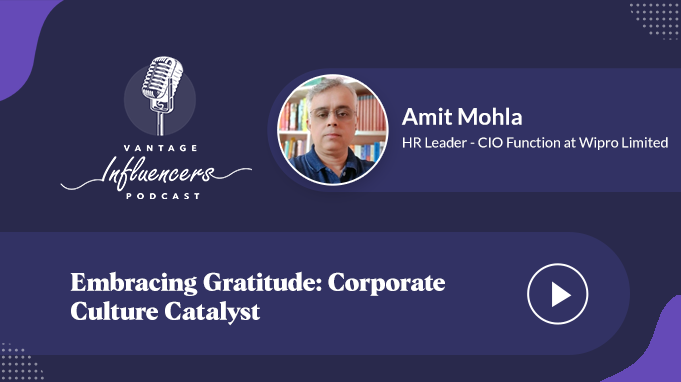
Embracing Gratitude: Corporate Culture Catalyst
Episode Overview
Amit Mohla joins host Susmita Sarma to explore why gratitude deserves a permanent place in workplace culture, not just a once a year event. He argues that despite gratitude's proven links to well being, job satisfaction, and lower turnover, most organizations still treat it as a checkbox: a CSR outing, a Thanksgiving themed week, or a round of "pat on the back" notes. He walks through why the daily grind of deadlines, targets, and back to back meetings crowds out the pause required to notice and appreciate what is going right, and why leaders sometimes resist promoting gratitude because saying thank you can feel like admitting weakness or ceding control.
Amit also shares a real example from his own HR practice: coaching an employee who was struggling in a new role to keep a daily gratitude journal, noting three small things she appreciated each day, and watching her mindset shift as she began to notice progress in stakeholder relationships that once felt invisible. He opens up about his own habit of intentional gratitude, a practice he credits to training as a happiness coach roughly six years ago, and describes how it helped him stay grounded through the pandemic. He closes with concrete advice for HR professionals: build real conviction before launching a program, start with a small group rather than the whole company, and remember that gratitude is hardest, and most valuable, to practice when things are going wrong rather than right.
Episode Highlights
- Amit Mohla explains that after the pandemic reset how people noticed small things, most organizations slid back into the pre-2019 rat race of targets and deadlines, making a deliberate gratitude habit more important than ever.
- Gratitude at work is linked to better physical and mental well being, higher job satisfaction, lower turnover, stronger collaboration, and ultimately better customer experience.
- The biggest measurement challenge is that gratitude's benefits, like reduced absenteeism and attrition, only show up as a long term trend, not an instant KPI.
- Many leaders hesitate to model gratitude because thanking someone can feel like admitting the other person controlled the outcome, making them appear less capable.
- Amit shares how a daily three thing gratitude journal helped a struggling employee shift from a negative spiral to genuine appreciation for small wins.
- His advice for HR teams: build genuine conviction first, pilot with a small group, and treat gratitude as an ongoing practice rather than a once a year event.
About the Guest
Amit Mohla, HR Leader, CIO Function, Wipro Limited
Amit Mohla is an accomplished HR leader who heads the HR team for the CIO function at Wipro Limited. Across a career spanning more than 25 years, he has worked with a range of large organizations, starting out at an advertising agency before moving into business process outsourcing during the industry's boom in the mid 1990s, and later holding roles at American Express, HP, and Dell. For more than a decade, he has worked as an HR business partner, driving people strategies while delivering on business goals, and he is known as a strong communicator, collaborator, and motivator who is equally comfortable with performance management, talent planning, employee engagement, and HR metrics. Amit is also a certified happiness coach and hosts The HappySapiens Podcast, where he explores the science of happiness and what it takes to live a calmer, more meaningful life.
Host
Susmita Sarma, Vantage Influencers Podcast Host
What You Will Learn
- Why the pandemic era reset people's awareness of small things, and why most organizations slipped back into a rat race that crowds out gratitude.
- How gratitude at work connects to well being, job satisfaction, retention, collaboration, and ultimately customer experience.
- Why gratitude's business impact shows up as a long term trend rather than an instant, tangible KPI.
- Why leaders sometimes resist expressing gratitude, and how that resistance can be reframed.
- A simple exercise, a daily three thing gratitude journal, that can shift a struggling employee's mindset.
- Practical steps for HR professionals who want to introduce a genuine, ongoing culture of gratitude rather than a one time event.
Key Topics & Timestamps
| Timestamp | Topic |
|---|---|
| 00:56 | Introducing Amit Mohla and his role at Wipro |
| 01:08 | Amit's 25+ year career journey before joining Wipro |
| 02:26 | Why a culture of gratitude matters in a post pandemic workplace |
| 05:41 | The challenge of tying gratitude to hard metrics like retention |
| 09:12 | Why getting leadership buy-in for gratitude is difficult |
| 12:07 | Why saying thank you can feel like a loss of power |
| 13:05 | A real story: using a gratitude journal to turn around a struggling employee |
| 16:49 | How Amit practices gratitude personally, and how it helped during the pandemic |
| 19:43 | Amit's advice for HR professionals starting a gratitude practice |
| 24:05 | Where to find Amit and his podcast, The HappySapiens Podcast |
Full Transcript
Click to read the full episode transcript
Welcome to the Vantage HR Influencers Podcast. This podcast is sponsored by Vantage Circle, the simple and AI-powered rewards and recognition platform for employee engagement. Fostering a mindset of gratitude can be a game changer. In this episode of the Vantage Influencers Podcast, explore how adopting gratitude within the corporate setting can fuel success and reshape your workplace culture.
Susmita Sarma: Hello, listeners. This is Susmita, your host for the show, and today we have with us Amit Mohla, an accomplished HR leader who heads the HR team for the CIO function at Wipro Limited. We are absolutely thrilled to have you here with us today.
Amit Mohla: I am very glad and privileged to be invited to the Vantage Influencers Podcast. Thank you for inviting me.
Susmita Sarma: Great, Amit. So to kick things off, could you take a moment to walk us through your remarkable corporate journey and share some insights about your current role at Wipro Limited?
Amit Mohla: Sure, happy to do that. I've been working for more than 25 years now, and in that time I've had the opportunity to work with some large organizations. I started my career with an advertising agency, and then, in 1996, when the BPO industry was booming, I joined G-Captain International Services. From there I moved on to work with American Express, HP, Dell, then Aeon, and now Wipro. It's been a fulfilling and very enriching journey across all these 25 plus years. Along the way I've had the opportunity to do different roles: business operations, a vendor relationship manager role, and for the last 10 plus years I've been in an HR business partner role. Currently, I'm the HR leader for the CIO function at Wipro.
Susmita Sarma: So you've had the opportunity to wear many hats, and that definitely demands a unique blend of skills and expertise. It's truly inspiring. Now let's dive into the heart of today's discussion: the idea of fostering a gratitude mindset in a corporate environment is something we've been hearing a lot about lately. Could you help us understand why cultivating this mindset is so critical to shaping a vibrant and productive workplace culture?
Amit Mohla: The reason it's important is that the way our lives changed over the last three or four years, and I don't need to repeat what everybody already knows, is that it reset the clock. At least it reset us to the point where, during the pandemic, we all started noticing the smallest and littlest things happening around us and being mindful of that. But as we came out of the pandemic, I think we went back to where we were before 2019: the rat race, the mad rush of achieving one target after another. So it's increasingly important for us to instill the practice of being thankful or grateful at the workplace, because it has multiple benefits. Science has proven that being grateful improves well being, both physiologically and mentally. Improved well being also helps with greater job satisfaction, and it's been linked to lower turnover rates. It creates a positive environment among employees in an organization, and it helps improve relationships: when you feel thankful for something someone has done, it creates a sense of trust, mutual respect, camaraderie, and belonging, which helps people collaborate better. And when you collaborate better, you're able to do more and achieve more. I think the most important aspect is that every business is running for revenue or profit, which is driven by customer satisfaction. So if you have grateful employees who go the extra mile to solve customer problems, it brings a positive experience to the customer and helps drive business success. And last but not least, if an employee feels motivated or acknowledged for what they bring to the organization, it creates a positive environment, and everything I just described starts to make sense and starts to create a good environment.
Susmita Sarma: True, that's a powerful way to put it. And as you mentioned, there's a very clear relationship between gratitude and employee engagement and retention. So if we talk about metrics, what do you use to calculate or track the levels of engagement in your gratitude programs? Is it a combination of things like employee satisfaction scores or retention rates?
Amit Mohla: That's a very interesting question, and it touches on one of the challenges we face when we try to build a culture of gratitude: we try to link everything to a tangible metric, a tangible KPI. There could be latent metrics or KPIs that a culture of gratitude can improve, but it's a long process. When I say long process, I mean that cultivating a culture of gratitude isn't something you achieve by doing one session with your employees and saying, "we should be thankful to each other, we should be mindful of what's around us." That's not enough. Even if you do it consistently, it will take time before people start implementing it. The KPI only comes into play when you do something consistently over a period of time and employees have equal buy-in in implementing it. In terms of what it can impact: if you foster a culture of gratitude consistently over time, it definitely helps reduce absenteeism, first and foremost, because people feel more engaged and more connected to the culture of the organization. When they see that they're respected as individuals, not just for what they bring to the table or what they do for the organization, but as people, it increases their connectedness with the organization. Over time it also helps reduce attrition, again because of that connectedness, that stickiness with the organization. It starts showing up in how they perform, how they connect with people, and ultimately in how they deliver results to the customer. So I'd say it's a long run process. Let's be very honest about it: it's not like some other interventions that have a more immediately tangible metric. This one can have a tangible metric, but only over a period of time.
Susmita Sarma: And calculating those metrics is, as you mentioned, a challenge all the way through. I think another big hurdle is engaging leaders, getting them on the same page and asking them to be enthusiastic advocates of a culture of gratitude. That seems to be a struggle in most organizations.
Amit Mohla: That's one of the challenges, and I won't put all the blame on leaders. I think the challenge in building a culture of gratitude at the workplace is that, unfortunately, gratitude or being thankful has largely been restricted to once a year CSR activities, where you spend time with underprivileged children at a nearby school because it's part of a CSR activity, and that gets equated with being kind and grateful. Or it's restricted to observing a particular week or day, like a Thanksgiving or a week of gratitude, where everybody gets together and it becomes more of an HR event: people are asked to be grateful, thank everybody, pat each other on the back, write thank you notes. Until now, I think that's what's acceptable to corporates as an occasional event, and that's fine. But when you try to drive it as an ongoing thing, what comes into play is that everybody who works in a corporate culture operates with one target: to be the best at what they do, driven by day long meetings, deadlines, targets, quarterly business reviews, and so on. It's such a fast paced day that every corporate employee spends at work that they don't find the time, and they don't feel it's important, to pause and reflect on what they have to be thankful for as an employee. That's a big challenge. And when you don't appreciate that yourself, and when it isn't driven as a culture by the organization, it takes a back seat. So I won't only blame the leaders, but collectively, as organizations, there's a need to drive the idea that you have to pause, sit back, and be thankful and mindful of what you have as an employee. The other challenge is that, since everybody is trying to be the best at what they do, when we say you need to be thankful to others, it can be seen as giving away your power to somebody else. Because what are you thankful for? You're thankful for how another person behaved with you, how they supported you on a project, how your manager or colleagues helped you. In some ways that gets seen as a sign of weakness, as though it's not in your control, as though you're only thanking them because they helped you, and it may make you look weaker or less capable in front of others. So that's another challenge.
Susmita Sarma: Absolutely. And on the other hand, I'm sure there are several remarkable success stories related to gratitude initiatives. Would you share an anecdote or story about a gratitude initiative that made a memorable impact on the workplace? It can be from Wipro or from any other organization you know of.
Amit Mohla: I can tell you about one instance where someone was struggling to perform in a new role. She had taken up a new role and was struggling to perform in it, and I happened to speak with her. In the course of that conversation, I told her that I was glad she'd gotten the role, that she'd spent so much time in the organization and had to sit through three rounds of interviews as part of the internal job posting process before she got it, and that even if it was taking her some time to start performing, it was fine, it would come. But she wasn't in a position to appreciate or acknowledge that this was a coveted role she had earned. She'd gotten into a negative spiral of feeling that she wasn't able to do it. So what we did was suggest she start a gratitude journal: every day, write down three things she was grateful for that she observed while doing this role, even very small things. Initially there was hesitation, because when people aren't familiar with the concept, some of them find it foolish. They say, "what is this, this doesn't really help." But after some insistence, or persuasion, she was able to pick it up and started doing it. I left it at that and moved on, and after some time she reached out to me and said she just wanted to thank me because she was feeling much better about the role. I asked what happened, and she said she started noticing the good things happening related to the role on a daily basis, and those were very small things. For instance, she was struggling to get through to a stakeholder who wasn't giving her time to connect, and she was worried that if she couldn't connect with that stakeholder, it would reflect on her. Slowly she was able to make headway, and these small things, like getting a response to her email from that stakeholder, she started being thankful for. There was at least an acknowledgement. Now, these things generally get seen as trivial: it's a table stakes expectation that if you write an email, the person is expected to respond. But think of someone like her who was struggling to even get that response. When she started getting it, she genuinely felt thankful for it, and that's how she cultivated her mind to notice and be grateful for whatever good things she was observing. That's how she came back and said she was really thankful for what she'd been able to achieve. So that's one example that comes to mind.
Susmita Sarma: Really impressive. On a personal note, how do you approach practicing gratitude in your own daily life? I'm sure that's influenced your leadership style as well.
Amit Mohla: Honestly, I'm not saying I've been doing this for years. I started practicing gratitude, or being intentionally mindful and grateful, about six years ago, when I completed a course to become a happiness coach. That's when it got instilled in me. I started the practice of being grateful on a regular basis for whatever I have, whether it's a personal or professional friend, or my family. I don't do it by telling ten people or telling my family; in my own free time, in what I'd call "me time," I try to just be thankful for what I have. I started because it was also given to us as a practice during the course, and I was equally skeptical about the benefit of doing something like this, but I thought, let's see what happens. I started doing it, and gradually, one thing led to another, and I began feeling calmer and more accepting of whatever was happening around me. Then COVID struck, and of course everybody's life changed, and that practice really helped me wade through some of those tough times, because by then it had become a habit. Now it's something I continue to practice.
Susmita Sarma: All I can grasp from this conversation is that creating a culture of appreciation and gratitude should be a daily practice, not just an occasional one.
Amit Mohla: Correct. It's a habit you have to form. Think of it the way you'd think about exercise, or going to the gym, ideally daily, or at least three to four times a week. This is like exercising your brain. Of course, you won't build muscle if you only go to the gym once a month, and similarly, you won't train your brain if you only do this once a month, or occasionally.
Susmita Sarma: For our listeners, many of whom are looking to introduce gratitude practices into their organizations, what words of wisdom would you share with them?
Amit Mohla: Before anyone wants to introduce a culture or habit of gratitude, it's important that they first understand what they're getting into, because until you, as an HR professional, understand what you want to drive and why, you won't have the conviction to communicate it effectively to people. If you don't have that conviction, it ends up becoming just an HR event: you tell people you'll observe an appreciation week or a gratitude week, everyone is expected to thank each other and pat each other on the back, and it becomes a mechanical exercise where people just thank each other for anything. This is the most common thing that happens in organizations: they say they're driving a culture of gratitude, but doing it for just one week out of fifty-two is not driving a culture, it's running an event. Please understand, there's a difference: an event only has so much impact or recall value. So if you want to drive it, you have to be convinced this is something you genuinely want to do. Second, don't start by trying to roll it out across the whole organization at once. Try it with a smaller group first, over a period of time, see how it goes, check in with the people who went through it, see how they feel the difference, and then expand from there. There's no rush to cover ten thousand people in one go; you'll never be able to do that properly. It's also important to communicate the benefit of doing this, because people's mindset is often, "I'm here to hit my targets, not to thank people," so you have to change that thought process. And when you do roll it out, don't make it a single event; sustain it over time. There are different ways to build it in: starting meetings with a gratitude practice, observing a certain period as a gratitude period, whether that's fifteen days, ten days, or a week, or asking people to write about what they like about another person, not what that person does, but who they are, because it's important to be grateful for who someone is, not just what they do. It's also easy to be grateful when things are going well, when everything is rosy, when you're successful, when you're getting rewarded. But the most difficult, and most important, time to practice gratitude is when the chips are down, when your mind finds it hardest to look for things to be grateful for. That's also very important. And, as you mentioned earlier, having leadership support matters a great deal. Start small, get your leaders on board by convincing them of what you want to do, because starting small is easier than trying to cover a large part of the organization at once. Those are some of the things that come to mind. There's a lot more, but if somebody wants to start, these are a few things to begin with.
Susmita Sarma: Very wise advice. Amit, before we wrap up, could you tell us how our listeners can reach out to you?
Amit Mohla: Yes, they can reach out to me on my LinkedIn profile, under Amit Mohla. They can also reach out to me on my podcast, The HappySapiens Podcast, which is available on Spotify. That podcast is specifically where I talk about the science of happiness, and how one can lead a meaningful life, a life where people are happy and living not just a fast paced life, but one of peace, calmness, and tranquility.
Susmita Sarma: Lovely. I'll put the links to your podcast channel and your LinkedIn profile in the show notes. Thank you so much, Amit, for sharing your valuable insights and experiences on cultivating a gratitude mindset in the corporate world. It's been a pleasure having you on our podcast today.
Amit Mohla: Thank you, Susmita. Thanks again for inviting me, I'm glad I could be part of your podcast. Thank you very much.
FAQ
Why does Amit Mohla think workplace gratitude needs to be a daily habit rather than an occasional event?
Amit explains that most organizations restrict gratitude to once a year CSR activities or a single "appreciation week," which turns it into a mechanical HR event rather than a genuine practice. He compares gratitude to exercise: doing it once a month won't build the mental habit, but consistent, ongoing practice reshapes how employees relate to their work and to each other.
How can gratitude at work be measured?
Amit is candid that gratitude resists instant, tangible metrics. Its impact, such as reduced absenteeism, lower attrition, stronger collaboration, and better customer outcomes, only becomes visible after a culture of gratitude has been sustained consistently over time, not after a single session or event.
Why do some leaders and employees resist expressing gratitude at work?
According to Amit, thanking someone can unconsciously feel like admitting that an outcome was outside your control, which some employees interpret as a sign of weakness or reduced capability. Overcoming that requires reframing gratitude as a strength rather than a concession of power.
What is a simple way to start building a gratitude habit at work?
Amit points to a daily gratitude journal as an easy entry point: writing down three small things you're grateful for each day. He shares how this simple exercise helped a struggling employee shift her mindset and rebuild confidence in a new role by training her to notice incremental progress.
Related Reading
Also listen on






You might also like
 Employee Recognition
Humanizing the Workplace Through Recognition
 Employee Recognition
Scaling Culture Without Losing Its Soul as Recognition Drives Growth Inside and Out
 Employee Recognition