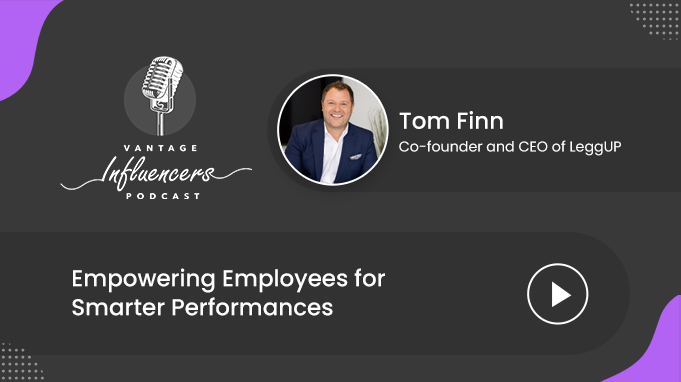
Empowering Employees For Smarter Performances
Episode Overview
In this episode of Vantage Influencers, host Susmita Sarma speaks with Tom Finn, Co-Founder and CEO of LeggUP, about what it actually takes to move an organization from talent management to talent empowerment. Tom explains why he built LeggUP after being told, as a corporate executive, that coaching was too expensive for him personally: a global network of certified coaches, matched to employees through AI, that measures 12 areas of productivity and wellbeing so coaching outcomes are backed by data instead of anecdote. He walks through his "talent insurance" model, an annual, affordable, scalable way for employers to offer coaching to every employee rather than a hand-picked few.
The sharpest point Tom makes is about what he calls inverting the triangle: leaders reframing their role from directing people to serving them, supporting not just their business output but their personal growth and career aspirations. He backs this with a concrete stat, that 52% of the workforce was actively job hunting at the time, and ties it directly to his five pillars of talent empowerment: personalized programming, on-demand support, an inclusive environment, ongoing skill development, and treating personal and professional growth as one blended experience rather than two separate lives.
Episode Highlights
- Tom Finn co-founded LeggUP in 2017 after his own request for coaching was turned down as too expensive, and set out to make professional coaching affordable and accessible to every employee, not just executives.
- LeggUP pairs AI-based coach matching with a global network of over 300 certified coaches across 20 countries and 10 languages, and employees keep the same coach for the length of their program to build a real working relationship.
- The company tracks 12 measurable areas of productivity and wellbeing, six each, so coaching results can be tied to data rather than anecdotal feedback.
- Tom's "talent insurance" concept borrows the logic of traditional insurance: an annual, affordable, scalable model that lets employers cover coaching for their entire workforce instead of a small group.
- He lays out five pillars of talent empowerment: personalized programming, on-demand support, an inclusive environment, ongoing skill development, and blended personal and professional growth.
- Tom argues that "inverting the triangle," where leaders see their job as serving and developing their people rather than directing them, drives stronger productivity, wellbeing, and retention than traditional top-down management.
About the Guest
Tom Finn, Co-Founder & CEO, LeggUP
Tom Finn spent his early career in the health insurance industry in the United States, working alongside HR leaders, CFOs, and CEOs on employee benefits strategy. After asking for executive coaching himself and being told it was too costly to justify, he left the corporate world about eight years later to found LeggUP in 2017, a professional development and coaching platform built to make that same support affordable and accessible for every employee. He also hosts the Talent Empowerment Podcast, where he speaks with HR leaders, founders, and executives across industries about building organizations that put people first.
Host
Susmita Sarma, Vantage Influencers Podcast Host
What You Will Learn
- Why coaching has historically been out of reach for most employees, and how technology and scale can change that
- How AI-based coach matching combined with a global coach network supports a lasting, trust-based coaching relationship
- The value of measuring coaching outcomes with data across productivity and wellbeing, instead of relying on anecdotal feedback
- What "talent insurance" means, and how it changes the economics of offering coaching to an entire workforce
- The five pillars needed to build an effective talent empowerment strategy inside any organization
- Why "inverting the triangle," a leadership model built around serving employees, outperforms traditional top-down talent management
Key Topics & Timestamps
| Timestamp | Topic |
|---|---|
| 00:13 | Introducing the episode and guest, Tom Finn of LeggUP |
| 01:07 | Tom's career background and path from healthcare to coaching |
| 01:41 | What LeggUP does and its founding mission |
| 03:16 | Measuring coaching outcomes across productivity and wellbeing data |
| 04:02 | Delivering coaching virtually through a global coach network |
| 05:08 | The personal story behind why Tom started LeggUP |
| 06:16 | A client story on how coaching changed a career and a marriage |
| 08:18 | The toughest challenges of entrepreneurship, and LeggUP's hiring philosophy |
| 09:58 | The qualities that make an effective coach |
| 11:07 | Shifting from talent management to talent empowerment |
| 12:48 | The five pillars of a talent empowerment strategy |
| 16:22 | Understanding the "talent insurance" model |
| 19:11 | An update on the state of employee benefits |
| 21:12 | Final advice for HR leaders |
| 21:47 | How to connect with Tom Finn |
Full Transcript
Click to read the full episode transcript
Welcome to the Vantage HR Influencers Podcast. This podcast is sponsored by Vantage Circle, the simple and AI-powered rewards and recognition platform for employee engagement.
Susmita Sarma: Hi everyone, I'm Susmita and you are tuning into a brand new episode of the Vantage HR Influencers Podcast. In this conversation, we'll learn about employee empowerment: how the concept has changed in recent times, how employee benefits play a role in it, how to build our own talent empowerment strategy, and more. For all of these discussions to happen in this conversation, please join me to welcome my guest today, Tom Finn, the co-founder and CEO of LeggUP, the first company to ensure employee productivity, well-being, and retention for their clients. Welcome to the show, Tom.
Tom Finn: Susmita, thank you so much for having me. Pleasure to be with you.
Susmita Sarma: Thank you so much for joining me today for this conversation, Tom. And I would like to know about you. Brief about your background first.
Tom Finn: Well, I currently lead a company called LeggUP, which is a professional development and coaching platform. And I host a podcast called the Talent Empowerment Podcast for HR leaders.
Susmita Sarma: Yes, I was listening to that today.
Tom Finn: Yeah, and prior to that, I was in healthcare in the United States and have always been in employee benefits, working with HR leaders, CFOs, and CEOs to ensure that the employee experience is something differentiated from their competitors.
Susmita Sarma: Would like to know more about LeggUP, Tom.
Tom Finn: Yes, so LeggUP started five years ago, in 2017. And our mission is really to improve the lives of employees by providing a professional coach and professional development coaching to all employees in an organization. This is an area that's an emerging market around the world, and employees have been seeking this type of tool for a long time. It's just been far too expensive for employees to get their hands on it. And so we pulled the cost out. We built a global network of expert providers, and we're able to deliver, through AI coach matching, a fabulous coach match where people feel safe and empowered to have conversations that can really impact their career.
Susmita Sarma: Right, so do your clients come to you individually, or do corporates come to you directly for all their employees?
Tom Finn: So our customer is the HR and CFO role at large organizations. They are typically going through a transformation where they are looking to upskill managers, they are looking to develop new managers, or they have some leadership development that they're looking for across the organization, for either a group of leaders or for all employees, to upskill their employees. So we very much work with HR leaders hand in hand, and their CFOs, on the budget items.
Susmita Sarma: Brilliant, so it's definitely having a great impact on workplace performance for all the customers that you are serving.
Tom Finn: It is. I think the most important part is the outcomes for members. So we measure 12 areas of productivity and wellbeing, six in each. And the reason we do that is because coaching, prior to LeggUP being in the marketplace, has been very anecdotal: did you like your coach, is it going well? But what we wanted to do is put data behind those conversations. And so now we're really able to measure people's emotional health, their leadership skills, their job satisfaction, their engagement. And so we've been able to put data and metrics, call it people analytics, behind coaching.
Susmita Sarma: Yeah, so I also wanted to know if you carry out your sessions online or offline.
Tom Finn: All of our sessions are done virtually. And I think we've learned over the last couple of years that that works, and it can be highly effective in operating our businesses, but it's also highly effective in supporting employees. So we have over 300 coaches in 20 countries speaking 10 different languages, and that gives us the accessibility to support all different types of employee needs around the globe.
Susmita Sarma: Yeah, so for example, if I talk to one coach today, for the next sessions also I get the same coach for me, right?
Tom Finn: Yeah, you got it. The most important thing we can do is create a relationship between you and the coach, because that's where you're going to drive, in this example, the highest level of results for yourself and your organization. So what we believe is that once you go through our assessments and our learning style assessments, we're able to match you to your perfect coach, and you're going to stay with that coach through the duration of your program.
Susmita Sarma: That works actually. So Tom, what actually motivated you to work in the area between performance and coaching? Is there any story behind it?
Tom Finn: Yeah, so for me, when I was younger, I was running large teams and large parts of big corporations, and I just felt like I needed a little more support in my own performance. And so I reached out and asked for a coach. I reached out and asked for support to say, I'd like to do this a little more effectively, I'd like to be better at my job. And they said no. They said it's too expensive, you're doing a great job, just keep doing what you're doing, which was nice to hear, but at the same time I wanted to improve, and that option wasn't available to me. So fast forward about eight years later, I left those big companies and started LeggUP, so that nobody has to receive that answer again. We can provide support to every employee. Just like we get food delivered to our house, Amazon can deliver anywhere in the world, our goods and services should be able to have coaching on demand.
Susmita Sarma: So Tom, you guys have been changing people's lives, both professionally and personally. Is there any specific story that you would like to share with your audience today regarding your coaching changing and impacting people's lives?
Tom Finn: I think the best part of my job is when I hear that we've really impacted somebody's work and home life in a way where they feel better about their partner and their marriage, they're feeling better about their kids, they don't want to leave an organization. So I'll give you a great story from one of our clients. She was a woman in her early 30s, she's a young mom, she's married and she's got two kids. And she was feeling like she was going to leave her company because the stresses of the business and her young family were really making her feel like this was the wrong place for her to work, and she was going to seek out new employment. And what ended up happening is she went through six sessions of coaching with her coach. They got under the hood and figured out what was going on, and they realized it wasn't actually the company, it was the way she was organizing her work life that was impacting her personal life. It was bleeding into her personal life where it really didn't stop, but it was completely within her control. So she was able to take that coaching, work through it in 12 weeks, and 12 weeks later she wrote this beautiful review explaining how she had transformed herself in her work life. She was in full control, and she understood that she was going to stay at her company for a long time because she did love the people she worked with, and her relationship with her husband got better over that period as well, because she was managing her work more effectively and managing her home life as well. And I think those are the stories that sit with me that really show that we're making a difference and make me feel like we're on the right path.
Susmita Sarma: Very true, and very good work from your entire team. So in this journey till date, what has been your toughest challenge as an entrepreneur, forming an excellent team of people all with the same motive of helping people?
Tom Finn: I think the hardest part as an entrepreneur is really staying the course. There are lots of different opportunities that pop up for an entrepreneur, especially when you're doing it correctly, and staying the course and sticking to your business plan and making sure that you execute well, I think, is probably the most important thing. Not getting too sideways with other opportunities. But I think in terms of forming a team, you've really got to focus on who you want to bring in, and understand that people are the lifeblood of your organization. And so we take hiring very seriously. During the interview process, we try to understand what people's motives are, what empowers them, what moves them personally. And we take a little different spin on backgrounds. I'm not looking for a particular background, I'm looking for a particular motivation and a particular character set of ethics, and people that work hard. We can teach you everything else in the business, but we can't teach you good character, and we can't teach you to respect other people. Your parents had to do a good job there, and once your parents have done that good work, we're able to teach you about the business.
Susmita Sarma: So everybody actually cannot be a coach. First of all, I think the very important quality a coach should have is patience, and then I think they should be self-motivated too.
Tom Finn: Oh, absolutely. So all of our coaches are certified by the International Coaching Federation, which is the gold standard in coach certification around the world. And from that group, there's about 50,000 of them around the world. From that group, we hand-select our coaches that fit what we're looking for. And as you said, patience is absolutely one of the items that we look for. The other one is inquisitive questioning. And the reason I say that is, in the coaching models, it's really important that a coach can be thoughtful in their response, but ask really good questions that inspire thoughts. And that's the most critical component to what we do in this space: asking those critical, and sometimes difficult, questions that require thought.
Susmita Sarma: Yeah, the right question at the right time is very important here.
Tom Finn: That's right.
Susmita Sarma: Okay, Tom. So when we talk about coaching, it's also important to focus on the broader talent culture, without which coaching might not be as fruitful as possible. So how do you see the move in HR from the outdated perspective of talent management, or top-down management, to talent empowerment?
Tom Finn: Well, I think this is a really important concept, because for years people have been talking about EAP programs, team meetings. We've had hierarchies and organizations where you simply do what the boss says, or you get in trouble and might be asked to leave. And those days are really gone, they're behind us. And thankfully so. What's really changing in corporate cultures, the good corporate cultures, is that leaders are inverting the triangle. And what that just means is they are taking a traditional organizational chart, where they're at the top and everybody else is below them, and they're sort of lifting it above their heads and saying, you know, I report to you, I am your boss, but my job is to serve you, and my job is to help support you, not only in your business, but in your personal aspirations and your career growth. And so that model is far more effective for employers today. And quite frankly, the next generation of employees responds very, very well to this model. You get increased productivity, increased wellbeing, and it serves the organization and the employees far better than the days of talent management.
Susmita Sarma: Right, so it would be very interesting to understand from you, is there a way we can build our own talent empowerment strategy in our organization?
Tom Finn: I think of it in a very straightforward way, that there are five pillars of talent empowerment. And you really want to hit on three or four of the pillars to have an effective strategy. You can hit on all five, but I know that's a stretch for some folks. So the five pillars are very straightforward. You need personalized programming: gone are the days of group trainings and huge group meetings, everything needs to be personalized at the employee level, and that is the first part of empowering your organization. The second is making sure that you have on-demand support: we can't have employees waiting months and months for new programs or to be supported in their career, they need to have access to a platform or a tool that can support them when they need it, right now. Third is providing an inclusive work environment: this is really important globally, there's a lot of movement about inclusivity, and I think it's really important to the modern workforce. If you are not thinking about how to be inclusive, you are really behind the times. And so in our models we see inclusive work environments as the third pillar, and incredibly important to creating an empowerment strategy for all employees. Fourth is ongoing skill development: this simply means that people want to be developed, people don't want to be told what to do, they want to be empowered to create their own path, and that takes ongoing skill development. So if you're not developing your people, they're probably going to leave. 52% of the population right now is looking for new jobs, and those are the folks that are not being developed or told they have a chance to grow in the organization. And then last, and certainly not least, is personal and professional growth. And this is really important. For decades we've said, when you come to the workplace, you're an employee, please leave your baggage and your personal life at home, you walk through the office door and you become the office version of yourself, and when you leave you're welcome to be the personal version of yourself. And those days are gone. We know that we're all blended, we're all the same person, whether we're having breakfast at the kitchen table or we're in a boardroom having a much more serious discussion, we're the same person. I think we need to understand that those lines have blurred, and create programming and support that empowers people in their work and their personal life.
Susmita Sarma: Right, so I'd like to rewind the five pillars: the first one you mentioned is personalized programming, the second one is on-demand support, third being the inclusive work environment, fourth being ongoing skill development, and fifth is personal and professional growth.
Tom Finn: Yeah, you've got it. And if you take all of that and you tie it to analytics for an organization, so if you can take that and tie it to numbers and data and facts and logic, then all of a sudden you're able to measure the empowerment of your employees, and how people are feeling, which leads to higher productivity and greater retention.
Susmita Sarma: Brilliant. So Tom, I was actually reading a press release from last year that said LeggUP is strengthening employee benefits with a product named talent insurance. Would love to understand the term talent insurance.
Tom Finn: Well, talent insurance is very simply the productivity, wellbeing, and retention of employees, to empower your people. The idea came from the fact that we have all different types of insurance, and they typically work on an annual basis. When you work for a company, you get certain types of insurance, depending where you are in the world. And what we decided was, we wanted our customers to be able to, number one, afford coaching for all of their employees and support. That was very important to us, that it's affordable. We wanted it to be scalable, and we wanted it to be accessible, so everybody can gain access to this. And that really leans into the model of insurance. And so what we've been able to do is create a product that's affordable, accessible, and scalable, and it allows for an employer to provide this service to their employees every year. They don't just have to come in and pick a certain number of people and only support a small group because it's too expensive. Talent insurance really allows every employer the opportunity to provide productivity, wellbeing, and retention for their entire work group.
Susmita Sarma: Brilliant, it's nice to know what the talent insurance term means. We are almost moving towards the end of this podcast conversation today, so any final words for our HR listeners?
Tom Finn: Well, here's what we tell everybody in HR: you have the most important job in your business. And if you don't feel that way, which it's okay not to, start to really look at all of the people you have the opportunity to impact. Because whether it's a large or a small company, if you have 50 lives or 50,000, the head of HR and the HR team really has the opportunity to lift up those individuals. Now, conversely, done poorly, they have an opportunity to hurt those individuals. And so I always feel like HR is absolutely the most important job within an organization, because you touch so many people. So my message to HR is, I hope you feel that way, I hope you feel empowered, and you have this absolutely wonderful platform to help others and be others-focused. And I think that's just a beautiful role in our organizations, and one that should be rewarded and lifted up.
Susmita Sarma: Right, so as you mentioned about our platform, there's something that I want to ask you: during this ongoing pandemic, there has been a lot that's been changing in the corporate sector, from budget constraints to difficult operational needs. So among all the important things that have come up, employee benefits have become a very important employer retention strategy, but they have also become a very significant burden for the employers. So would you like to give an update on the world of employee benefits, that would be fantastic for our audience?
Tom Finn: Yeah, look, employee benefits have been around a long time, and many of the programs were put in for legacy companies back in perhaps the 70s or 80s or 90s, and they haven't changed. And the cost, as you mentioned, can be very high for the employer. What I would recommend is everybody take a deep look at what you're spending money on. I know that there are organizations that are spending money on countless apps that have no utilization, nobody's using them, but the employer is paying for them every day. And the feeling is, oh my gosh, I can't take this away from my employees, what will they say about me, what will they say about my leadership if I take something away? And I think we have to flip that conversation and say, it's 2022, my friends, this is a modern workforce, what are the right employee benefits to have at this time in history, what are the things that we actually need, eliminate the things that we don't, even though they might be legacy contracts, and focus on what are the new products and services that really impact my workforce. And I think if you take that approach, you're able to manage your budget, you're able to manage employee expectations, you're able to manage your leadership shadow. And that is a strategic approach to managing employee benefits in the modern world.
Susmita Sarma: Okay, thank you for the insights, Tom. Also, finally, how can a listener reach out to you?
Tom Finn: Well, the best way to find me is on LinkedIn: Tom Finn, LeggUP, is a great way to find me. You can also find me at talentempowerment.com, which is an easy way to tune into our podcast if you're interested in hearing from other HR leaders around the world. And I think, finally, check out leggup.com if we can serve your business in any way.
Susmita Sarma: Yeah, so thank you so much, Tom, for joining me and sharing your insights today. There's actually so much more to talk about employee empowerment, I would like to keep that for another conversation with you, so hope to meet you soon here again on the Vantage HR Influencers podcast.
Tom Finn: Thank you so much for having me. Great to be with you today.
Thanks for listening to the Vantage HR Influencers podcast. Please do subscribe to the Vantage HR Influencers podcast on Apple Podcasts, Spotify, and our YouTube channel for new episodes.
FAQ
What is LeggUP, and what problem is it trying to solve?
LeggUP is a professional development and coaching platform co-founded by Tom Finn in 2017. It was built because executive-style coaching had historically been too expensive and too limited in access, available only to a small group of senior leaders. LeggUP pulls the cost out through a global network of coaches and AI-based matching, so any employee at a client organization can get coaching, not just executives.
What does Tom Finn mean by "talent insurance"?
Talent insurance is Tom's term for LeggUP's model of offering coaching the way traditional insurance works: on an annual, affordable, and scalable basis that covers an entire workforce rather than a hand-picked few. It lets an employer provide productivity, wellbeing, and retention support to every employee every year, instead of only being able to afford coaching for a small group.
What are the five pillars of a talent empowerment strategy?
Tom describes five pillars: personalized programming instead of one-size-fits-all group training, on-demand support employees can access when they need it, an inclusive work environment, ongoing skill development, and treating personal and professional growth as one blended experience rather than two separate lives. He recommends organizations aim to build on at least three or four of these to have an effective strategy.
What does "inverting the triangle" mean in Tom Finn's view of leadership?
It describes flipping the traditional organizational chart so leaders see themselves as serving the people below them rather than directing them from above. Instead of a boss simply issuing instructions, the leader's job becomes supporting each person's business results as well as their personal aspirations and career growth. Tom argues this model drives higher productivity, wellbeing, and retention than traditional top-down talent management.
Related Reading
Also listen on