Importance Of Workplace Counseling And Coaching
Episode Overview
Nimish Ramesh's path into workplace coaching started with an unplanned cycling trip from Mumbai to Pune, friends and family told him he'd never manage it, but once he completed it in six hours, those same skeptics started hitting the gym and going for morning runs themselves. That accidental proof of influence became the reason he moved deeper into HR, self-help writing, and TEDx speaking. His definitions of counseling and coaching are deliberately plain: counseling is the ability to regulate emotions (anger, sadness, stress, excitement) so employees can perform at their best; coaching is helping someone reach a goal by asking the right questions rather than handing them the answer.
His clearest illustration of coaching in action is a manager-employee exchange: instead of telling a struggling employee what to do, ask "why do you think this is happening," then "what should be done," then "what stops you from doing it." Because the employee arrives at their own solution, they take subconscious ownership of it, and ownership is what actually drives follow-through. He's equally precise about the difference between the two disciplines: coaching is typically short-term and goal-bound, while counseling can extend indefinitely, since regulating emotion is an ongoing need, not a problem with a fixed endpoint.
Episode Highlights
- Workplace counseling, in Nimish Ramesh's simple definition, is the ability to regulate emotions like anger, sadness, stress, or excitement so employees can perform at their best.
- Workplace coaching is about helping an employee reach a goal by asking the right questions rather than handing them the answer, which invokes a more creative thought process in them.
- A concrete coaching sequence: ask "why do you think this is happening," then "what should be done," then "what stops you from doing it", the employee arrives at their own solution and takes subconscious ownership of it, which drives real follow-through.
- Good workplace counseling raises employee self-worth and self-esteem, which cascades into better work quality, higher organizational productivity, and even stronger employer branding.
- The key difference between the two: coaching is typically short-term and goal-bound, while counseling can extend indefinitely, since regulating emotion is an ongoing need, not a problem with a fixed endpoint.
- The skills differ too, coaching needs sharp questions and thick skin for pushback, while counseling needs active listening, genuine empathy, and real intent to help.
About the Guest
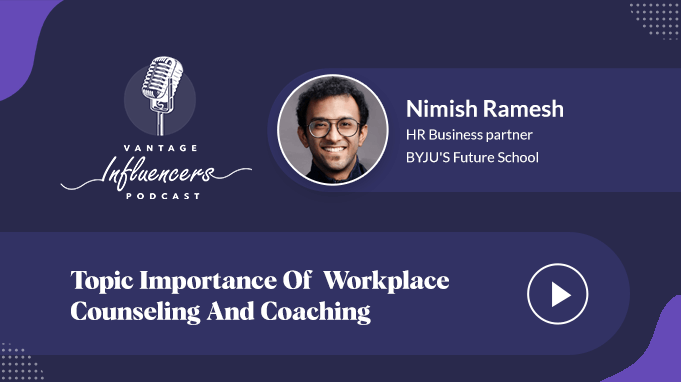
Nimish Ramesh, TEDx Speaker, Author & Millennial Life Coach
Nimish Ramesh is an engineer turned MBA turned senior HR professional turned TEDx speaker, author (Potential Plus), and millennial life coach. He helps millennials get clarity in their lives and become self-sustained, driven individuals working toward specific life outcomes.
Connect with Nimish on LinkedIn
Host
Gautam, Vantage Influencers Podcast Host
What You Will Learn
- Simple, practical definitions of workplace counseling (regulating emotion) and workplace coaching (goal achievement through better questions)
- A concrete question sequence managers can use to coach an employee toward their own solution, rather than dictating one
- Why counseling that builds self-worth and self-esteem cascades into better work quality and organizational productivity
- The key difference in timelines: coaching is typically short-term and goal-bound, counseling can be ongoing
- The distinct skill sets each discipline requires: sharp questioning and thick skin for coaching, active listening and empathy for counseling
Key Topics & Timestamps
| Timestamp | Topic |
|---|---|
| 02:15 | About the speaker |
| 05:35 | What workplace counseling actually means |
| 07:00 | How workplace counseling benefits today's workforce |
| 10:55 | What workplace coaching is |
| 11:55 | The importance of conducting workplace coaching sessions |
| 15:00 | Similarities and differences between coaching and counseling |
| 17:50 | Nimish's final thoughts on workplace counseling and coaching |
Full Transcript
Click to read the full episode transcript
Workplace counseling has many folds in today's workplace, and along with it comes workplace coaching. These sessions include specificity around mental health, stress, anxiety, work pressure, alienation, performance, and productivity. Counseling and coaching in the workplace are about employee engagement, experience, and wellness. So in today's episode, let's understand the importance of workplace counseling and coaching.
Gautam: Hello listeners, welcome back to the Vantage Influencers Podcast. Today's episode is about understanding the importance of workplace counseling and coaching, and how it enhances employee engagement and work experience. To shed light on the topic, we have a very special guest, Mr. Nimish Ramesh. Nimish is a 27-year-old engineer turned MBA turned senior HR professional turned TEDx speaker, author, and millennial life coach. He helps millennials get clarity in their lives and become self-sustained, driven individuals working toward specific life outcomes. Hello Nimish, welcome to the show.
Nimish Ramesh: Thank you so much for the warm welcome, and for inviting me to this podcast, where I can contribute to the audience and, of course, the HR fraternity.
Gautam: We're extremely grateful to have you here to discuss an important topic that people usually tend to avoid, thinking it's of lesser importance to speak about in the workplace. Before we begin, could you brief us about yourself, anything I might have missed mentioning?
Nimish Ramesh: Sure. I've had a fairly typical journey, graduation in engineering, followed by a postgraduate degree, an MBA in my case, and now I'm working a job. But one particular event that changed my life was a small journey: cycling from Mumbai to Pune. One random day, among friends and family, I mentioned the idea of cycling from Mumbai to Pune, and I got severe backlash immediately, "why would you even think of it, you need so much stamina," and so on. I took a step back, absorbed it all, slept on it, and the next morning decided this was something I genuinely wanted to do, and not something nobody had ever done before. As far as safety goes, that risk exists for anyone at any time, you just take the right precautions. So I gave myself three months to prepare, developed my body and mind, and then went for it, completed the journey in about six hours.
The interesting part happened the next day, the very same friends and family who'd questioned me started saying I was an inspiration, started hitting the gym, going for morning jogs. I thought, if I can inspire people unknowingly, why can't I do it knowingly? That's how my turning point happened, I started delving deeper into HR, deeper into the self-help space, wrote a book, started contributing to the broader workforce, and that's how my TEDx opportunity came about. It all happened because of that one small journey, and that's when I decided my whole focus would be helping employees get clarity in their lives and contribute more effectively to their workplaces.
Gautam: That's a genuinely inspiring, adventurous journey, pushing you toward inspiring other people too, and trying new things, since monotony can be so boring at times. Let's move to today's topic, workplace counseling and coaching. Starting with counseling, when we talk about workplace counseling, what exactly does it mean?
Nimish Ramesh: In very simple terms, workplace counseling is the ability to regulate one's emotions. Humans work in a job role, and being human, emotions are naturally present, anger, sadness, stress, anxiety, excitement, any emotion. The ability to regulate these emotions in the right way, to maximize the benefit to both the individual and the workplace in terms of productivity, is essentially counseling. Who can provide it? It could be a manager, a third person, or a trained professional. In simple terms, it's about providing emotional support to help employees regulate their emotions.
Gautam: If explained in such simple terms, I think everyone would be far more interested in these sessions, because a lot of people carry a fear in their heads, "will it be scary, I can't speak my mind", and tend to avoid it. On that note, how is workplace counseling beneficial for today's workforce?
Nimish Ramesh: It's beneficial in a lot of ways. Imagine a scenario where all the employees at a company are genuinely happy, excited to learn, excited to make mistakes without fear, if you have that kind of environment, there's absolutely no need to worry about productivity. That's the major advantage. Take a simple example, an employee has a small argument with a colleague, a superior, or someone reporting to them. That's the moment a manager can step in and act as a sounding board, getting to the root of why it happened in the first place. Just being a sounding board and offering advice, because the manager has likely faced similar situations themselves, matters a lot.
If counseling is done right, the first advantage is that it gives employees a strong sense of self-worth, self-understanding, and self-acceptance, their self-esteem improves. What happens when all of this improves? Work quality improves. And when work quality improves, organizational productivity increases, cascading all the way up. And when an employee performs well at work, it starts reflecting in their personal life too, I personally don't differentiate much between personal and work life, because they're interlinked in a lot of ways; if someone performs well in one area of life, it tends to spread into other areas too. That's the second advantage. The third advantage is that if a company's culture is genuinely good, and good counseling is part of that, it has a ripple effect, in today's social-media-driven world, word gets out, employer branding improves, and the company gets better applications for open roles, giving the talent acquisition team a stronger pool to choose from. So a simple act, being an active listener to the people who report to you, has a real advantage for overall organizational productivity.
Gautam: That's a great response, especially considering that Vantage Circle is mostly focused on employee engagement, experience, and nurturing company culture through rewards, recognition, and other benefits, workplace counseling seems like a great medium for enhancing both engagement and productivity. You made a great point that self-worth and self-esteem are essential for an employee to perform well and contribute to a company's success. Let's move to workplace coaching, what is it, in your view?
Nimish Ramesh: Coaching is something I'm personally deeply interested in. Coaching is essentially about helping an individual, typically someone reporting to you, achieve a particular goal, by invoking a certain thought process in them, asking the right questions. When you ask someone the right question, they think more, they think differently, and other opportunities they weren't even aware of start to surface. It makes them more creative. So essentially, coaching improves how an employee thinks and behaves, which in turn leads them to act, get results, and ultimately achieve their objective. That's coaching, in very simple terms.
Gautam: Got it. In today's modern workplace, what's the importance of conducting workplace coaching sessions specifically?
Nimish Ramesh: How does a manager improve the performance of someone reporting to them, or guide them to become the leaders of tomorrow? Coaching is one tool that really helps. Let me give you an example, say I'm reporting to you, and I'm facing an issue. You have two options: you could just tell me what to do, and I might succeed or might not. Or, you could ask me questions that generate my own thought process and compel me to act in a way that gets results, that's coaching. I come to you with a problem in my job role, and you ask, "why do you think this is happening?" I'll come up with two or three reasons. Then you ask, "what do you think should be done to address it?" I'll come up with two, three, maybe four ideas. Then you ask, "what stops you from actioning these?" At that point, I might realize either nothing actually stops me, or I identify the real barriers, could be stakeholder management, could be a missing tool or skill, could be anything. Your manager then helps address those specific barriers.
What's happening here is that you're compelling me to think, I come up with the answer myself, and because I arrived at that solution myself, I subconsciously take ownership of it. Once I take ownership, I'm far more likely to actually act on it. And if I act on it, it's bound to produce results, and those results feed into the broader objective you originally wanted to achieve. That's the effective use of coaching in today's workplace, and it has real long-term benefits, it makes an employee independent. Once someone is independent, even if you're not around for a day or a few weeks, they know what their job is and can operate on their own. That's how you create future leaders.
Gautam: Great analogy for how workplace coaching works. We've discussed counseling and coaching as two separate things, you used words like self-worth and self-esteem for counseling, and independence for coaching. What are the similarities and differences between the two, and which do you think is more beneficial?
Nimish Ramesh: In the long run, neither is "more beneficial", they're just different tools, both aimed at improving an employee's performance in their role, and indirectly, the company's broader objectives and performance. Coaching is more about invoking thought, making employees think through a solution to achieve a specific objective. Counseling is about regulating emotions. Coaching improves an employee's capability, the skill sets needed to perform better in their role. Counseling improves self-worth, self-acceptance, and self-esteem, which is really a hygiene factor required for someone to perform well in the first place. Another difference is duration: coaching tends to be shorter, aimed at achieving a specific outcome, and the session concludes once that's done. Counseling, on the other hand, can extend over a much longer period, potentially a lifetime, because humans can't function without emotions, they naturally go up and down, and counseling helps keep the right emotional balance most of the time.
Gautam: What I take from this is that they're quite different tools, but if there's a similarity, it's that they both work toward helping a person become a better version of themselves, especially at work, improving their skills, their game, their productivity, and their engagement.
Nimish Ramesh: Definitely, definitely.
Gautam: We're slowly approaching the end of this conversation, and I know we could keep going, but time won't permit it. My last question, how would you summarize your thoughts on counseling and coaching?
Nimish Ramesh: To summarize, coaching and counseling are both really important tools managers, or anyone else, can use to improve an employee's performance, and indirectly, a business's overall results. Coaching focuses more on invigorating thought processes in an individual. Counseling is more about regulating emotions and being a genuine sounding board for employees. Any manager can be both a coach and a counselor, though counseling is a more specialized skill, and you may want to bring in a trained professional if a condition persists for someone. The main purpose of coaching is to improve an employee's capabilities and motivate them toward their goals; counseling is more about improving mental health and well-being, which, of course, feeds back into performance if an employee is genuinely well. The skill a coach needs most is the ability to ask the right questions, and thick skin, because sometimes the people you're coaching push back and expect specific answers. Counseling requires active listening, genuine intent to help, and real empathy. In terms of timeline, coaching tends to be short-term, while counseling is relatively longer-term, depending on the needs of the employee involved. I hope that was a helpful, concise summary, I tried to keep it as simple as possible for listeners.
Gautam: That was amazing, the whole conversation was crisp, simple, and easy to understand. Thank you for helping our listeners learn more about workplace counseling. If listeners would like to reach out to you about counseling or coaching, how can they find you?
Nimish Ramesh: I'm readily available across social media, you name the platform, I'm there, so feel free to ping me. I also have a website where people can reach out, and I'm happy to help and contribute in any way I can.
Gautam: Thank you so much, Nimish, for taking the time to lend your voice and knowledge to Vantage Circle and our listeners. Thank you for being part of the Vantage Influencers Podcast today.
Nimish Ramesh: Thank you so much for inviting me and letting me contribute.
Thanks for listening to the Vantage HR Influencers Podcast. Please subscribe to the Vantage HR Influencers Podcast on Apple Podcasts, Spotify, and our YouTube channel for new episodes.
FAQ
What is the difference between workplace counseling and workplace coaching?
Nimish Ramesh defines counseling as the ability to regulate emotions like anger, stress, or anxiety, while coaching is about helping someone reach a specific goal by asking the right questions rather than giving them the answer. Coaching tends to be short-term and goal-bound; counseling can extend indefinitely since managing emotion is an ongoing need.
How does workplace counseling benefit productivity?
Nimish Ramesh argues good counseling raises employee self-worth, self-acceptance, and self-esteem, which cascades into better work quality, higher organizational productivity, and even stronger employer branding as positive word spreads externally.
What is an effective coaching question sequence for managers?
Nimish Ramesh recommends asking, in order: "why do you think this is happening," then "what do you think should be done," then "what stops you from doing it." Because the employee arrives at their own solution, they take subconscious ownership of it, which drives real follow-through.
What skills does effective workplace counseling require?
According to Nimish Ramesh, counseling requires active listening, genuine empathy, and real intent to help, distinct from coaching, which relies more on sharp questioning skills and thick skin for pushback.
Related Reading
Also listen on