Incorporating New Hires Into Work Cultures
Episode Overview
Leena Sahijwani joins Rohit to talk about a problem most onboarding playbooks never anticipated: welcoming new employees into a culture they can only experience through a screen. Her core argument is that culture cannot be handed to someone in a policy document, it has to be felt, and when onboarding goes virtual, HR and managers have to manufacture that feeling deliberately instead of letting it happen organically in a hallway or a cafeteria.
She walks through the specific mechanics that make this work: pre-boarding checklists that settle laptops and logistics before day one, a digital induction journey that lets new joiners absorb an organization's history at their own pace, and an evening session with zero work talk where people just get to know each other. Leena also pushes back on the instinct to over-formalize remote management, arguing that regular check-ins should build trust rather than monitor output, and that engagement during a crisis has to be led by genuine, empathetic listening rather than top-down programming.
Episode Highlights
- Culture cannot be handed to someone in a policy document, it has to be felt, so onboarding needs deliberate human touchpoints when everything moves virtual.
- A pre-boarding checklist that sorts out laptops, logistics, and paperwork before day one makes the first day noticeably smoother for a new hire.
- A structured digital induction journey lets new employees absorb an organization's history and values at their own pace, wherever they happen to join from.
- An evening session with zero work talk gives new joiners a low-pressure space to share anxieties and bond with teammates as people, not just colleagues.
- Regular manager check-ins should build a sense of direction and trust, not function as disguised monitoring of a person's day.
- Performance is still measured on outcomes, but how leaders check in, support people, and plan a safe return to the workplace all needs to shift for a distributed team.
About the Guest
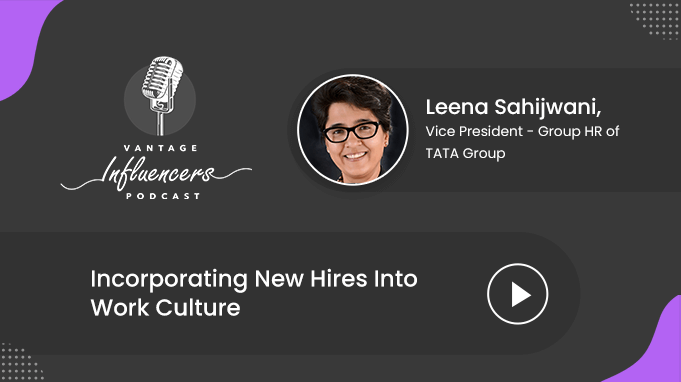
Leena Sahijwani, Vice President - Group Human Resources at TATA Group
Leena Sahijwani is a Vice President - Group Human Resources at TATA Group, where she leads group performance, rewards, diversity, and digital transformation initiatives, in addition to heading the HR function for Tata Sons. Earlier in her career, she held HR leadership roles at Sun Pharmaceuticals, GE, Accenture, Aon Hewitt, and GlaxoSmithKline Consumer Healthcare, working across performance management, talent strategy, and organizational transformation.
Connect with Leena on LinkedIn
Host
Rohit, Vantage Influencers Podcast Host
What You Will Learn
- How to structure pre-boarding so new hires feel ready before day one
- Ways to replicate informal, culture-building conversations in a remote environment
- Why regular manager check-ins matter more, not less, when onboarding remotely
- How to keep recruitment rigor and reference checks intact in a fully virtual hiring process
- What genuinely drives engagement during periods of prolonged uncertainty
- How to plan a phased, safety-first return to the workplace
Key Topics & Timestamps
| Timestamp | Topic |
|---|---|
| 00:38 | How Leena found her way into HR |
| 01:51 | Onboarding new hires into a remote work culture |
| 06:12 | Structuring online training for new remote employees |
| 10:34 | Building trust through regular manager check-ins |
| 12:10 | Adapting recruitment and hiring for remote work |
| 14:51 | What genuinely drives employee engagement right now |
| 19:06 | Measuring performance in a distributed, remote-first team |
| 21:45 | Planning a safe, phased return to the office |
| 24:57 | A favorite business book and HR voices worth following |
| 26:38 | Advice for young HR professionals starting out |
Full Transcript
Click to read the full episode transcript
Welcome to the Vantage HR Influencers Podcast. This podcast is sponsored by Vantage Circle, the leading employee benefits and engagement platform.
Rohit: Welcome to the Vantage HR Influencers Podcast. Today I'm delighted to have Leena Sahijwani with us, a seasoned HR leader with a successful track record across HR leadership positions managing global portfolios. She's currently VP, Group HR at TATA Group. Welcome to the show, Leena.
Leena Sahijwani: Thank you so much, Rohit, for having me over. I'm looking forward to the conversation.
Rohit: Absolutely. I wanted to ask you, how did you get into HR? What made you excited to be in the field of HR?
Leena Sahijwani: That's a good question. It goes way back, I think. I didn't have very detailed thinking around the process. Post my graduation, I was looking to do an MBA and I got into an institute which specialized in HR. That's how, by default, I landed in HR. I don't think it was a very informed decision at that point, but no regrets, I love being in the HR space. In fact, early in my career, Rohit, I had also taken up a role in sales as a cross-functional move back at GSK, and at that time I had an option to continue in sales. But I chose to get back to what I had studied at campus. HR is a passion for me, and I'm happy that even though not by design, I landed where I did.
Rohit: Interesting. We are recording this during the COVID times. I want to talk about how companies can onboard new hires into their work culture, and what HR leaders should do to make sure new employees get to understand the work culture of a company.
Leena Sahijwani: It's a very important question you asked, Rohit, because you don't get a feel of the company as you're joining in, and it's very difficult to replicate that feel virtually. People can get lost if it's not done carefully. So for us, when we moved into the lockdown, after a couple of weeks we had to put some thought together on how to onboard the offers we had already made to our prospective employees. There's good engagement that my team does ahead of someone's joining, to ensure all required formalities are taken care of ahead of the joining date, so that the first day at work is smooth. We go to the extent of figuring out if the employee needs a laptop or is comfortable working on their own, so we can plan accordingly and make sure the person is up and running from day one. In addition, there's more involvement from the manager and the team around the person to ensure they feel comfortable, along with touch points from HR through the journey to make sure the person settles in.
At a group level, we also launched Embrace, a digital induction module for the TATA Group, hosted on TATA Tomorrow University, which we also launched during the lockdown. Employees from across the group can go through a journey curated for them through Embrace, which covers the Tata history, the Tata legacy, and information around our businesses, so that people coming in from outside get to understand the culture and legacy of our community. In addition, we created a work-from-home newsletter that was circulated to all our employees daily. It featured our employees and their stories, so new joiners had an opportunity to share about themselves and to learn about other departments and the activities they could participate in. We even had a few new joiners participate in virtual talent shows we held during this time. You have to make sure you're including people who are joining you, giving them an opportunity to get to know others and for others to get to know them, even though it's virtual.
Rohit: How can new remote workers continue their online training and build trust and rapport with their teams?
Leena Sahijwani: We encourage our managers to have a regular cadence with their teams, which gives a good sense of direction to team members. It's especially important because you don't have the day-to-day chit-chat you'd have had in the office. Some of that can be replaced by a standing meeting that gives a good sense of direction to the employee as they start out. I'd encourage managers to implement this practice with their teams if they haven't already.
On the employee side, it helps to regularly check in with the manager, especially in the first 30 to 60 days, seeking input on the role and understanding nuances they might otherwise pick up by being in the office, through regular dialogue with the manager. And to the manager, I'd say make sure you create informal channels for the team to connect with each other. The standing meeting can be a fairly formal structure focused on the work you need to accomplish, so in addition to that, informal get-togethers with the team really help new employees settle in and understand the team.
I had two people join my own team during this time, and they were quite apprehensive about joining a team without knowing anyone. There was some anxiousness ahead of their joining, but the informal chats we have, including an evening session where we don't talk about work at all, really helped them get to know each other better. We talk about everything else under the sun. It's also a good platform for people to share what's on their mind, their anxieties. It's basically time we've created to let off steam, and it helps new joiners get to know each other personally, not just through work-related conversations.
Rohit: How should a leader lead remotely during this time? Should a team lead interact with new joiners every day? How should a leader build more transparency with employees during the pandemic?
Leena Sahijwani: I would never recommend micromanagement as a way to manage a situation, but check-in points are important. I'd even suggest creating a calendar of sorts for the employee to meet with others, encouraging them to talk to stakeholders during this time, and making sure the person is introduced within the department and the group so they can start conversations with a broader set of the team. The check-in is important not just from the team lead but also from the person's next-level manager, to ensure there's adequate comfort for the person in the situation.
It's also important to know about the employee's circumstances, whether the person is staying alone, for instance, since these are very challenging times for everyone. You need to understand these situations and make sure you're supporting the individual, not just through work and getting them up and running in the system, but also providing security and emotional support if required during this time. Regular check-ins are important, whether that's two or three times a day. Each person has their own way of settling in, some need more hand-holding, some are quicker to run on their own. So after the first week or two, you may have to revisit your approach, and that's what I'd encourage people to do.
Rohit: And how is TATA Group approaching hiring for remote roles?
Leena Sahijwani: It was a very seamless move from managing recruitment activities face-to-face to doing everything online. In fact, I think it's become faster and simpler because you're not asking people to come to your office, you're doing everything on a call, like we are right now. I think it's become more efficient, if you ask me. What we anticipate over a longer period is that some companies will even think about remote working as the way to go in future. That opens avenues to a larger talent pool being accessible to you. If you're not looking at your office being location-centric, you could hire from cities you've never targeted before, because earlier you wanted people to move to a city like Mumbai or wherever your office was. I think that will really change the game for companies that look at remote working on a more permanent basis, beyond the pandemic, and that's something we're gearing up for.
The use of technology has been seamless, and the effectiveness of interviewing through collaboration tools has been very high. At the same time, I tell leaders that we need to ensure the same rigor is maintained and the same details are sought when recruiting remotely. Another aspect we've tried to emphasize more is the reference check, because you're not getting to see the person face-to-face, so we've enhanced that in addition to the normal interview process. I'm not talking about the background verification check, but an additional reference check.
Rohit: Have you seen engagement rising over the last couple of months, and what can an HR leader or a team do to drive more engagement?
Leena Sahijwani: I believe engagement should be led by people. HR is definitely a catalyst in that process and needs to take an active interest, but the engagement through this time needs to be led by people, totally. It's important to know what appeals to people. Initially I remember companies were actively trying to promote learning, and then I started reading about "death by webinar" in the news. So I think it's important today to ensure your ears are to the ground, that you're hearing what people have to say. I'd call it empathetic listening, to ensure you're not just seeing the individual but really understanding the context of what they're saying. Those conversations really help you determine what needs to be done and what kind of activities will work.
I'll give you an example. The first few weeks were so stressful for people that we quickly put together a mindfulness program, which was very well appreciated. I mentioned the work-from-home newsletter earlier; through that newsletter we opened a lot of channels, people started writing in, giving ideas, some even offered to help out. We kept improving our initiatives based on the input we received through the team. It was also a good opportunity for us to keep connecting with people.
I'm not sure if engagement is high, we haven't done a pulse survey to be able to tell you that. If the number of hours a person is putting into work measures engagement, then yes, it may be high, because you definitely see people working a lot longer, and that's also sometimes concerning. It's getting to a point where, in a normal situation, people would have taken vacations, time off, gone away with family. None of that has happened, and I think those aspects will certainly impact the overall mindset of our people. One needs to create solutions to take care of different aspects of an employee, not just the work but also how they must be feeling. If you need to take initiatives to give people time off, just today I was talking to my team and I offered to keep one day free of meetings so people could clear their inboxes, because if you're in back-to-back meetings the whole day, you can't do that, and then you end up working late. So those kinds of things may need to be done locally by team leaders to make sure there's no burnout. Engagement scores may be high right now, globally there was a study done on this, but I anticipate it will eventually dip if the situation continues, and one needs to be prepared for that, or ensure we're giving people adequate breaks to manage their well-being.
Rohit: Since we're not working physically and the nine-to-five structure has shifted, how is your team looking at measuring performance?
Leena Sahijwani: Performance should always be measured based on outcomes, and that remains the same, there's no change to that. What needs to shift is how you're proactively managing performance in today's context. I talked about having a regular cadence with the team, and I think that's very important today because there are shifts happening in the way we're working, and all the more reason the team needs to know which way we're headed. Having a regular discussion with the team on what you're focusing on overall is very important.
How a team leader should view this is by ensuring there's a daily connect on what to focus on today and agreement on that, then chipping away at things slowly and taking stock at the end of the week to check on progress. At the same time, there needs to be an appropriate understanding of an individual's capacity, since you don't see them day-to-day, you need to make sure the person isn't overloaded. At the end of the year, it's the outcome that will determine an individual's performance assessment, and it comes down to having clarity on what needs to be achieved and by when, on a more frequent basis than before. I think that's the mantra, especially in remote working times.
Rohit: There may come a time, a few months down the line, where employees have to go back to the office. What should companies do to make sure employees return safely, and what percentage of employees should start moving back?
Leena Sahijwani: It depends a lot on the layout of the office. Safety and security are important, you need to take necessary precautions as people step into the office, create norms, and educate people not just on how to manage during office hours but beyond that too, so you're not exposing the rest of your staff if someone is careless. A lot of pre-education and awareness needs to happen, not just for the employee but for their families as well.
I'd also say companies should look at who could come into work. Of course there's a job requirement to consider, but also whether the person is taking public transport, has anyone with comorbidities at home, has elderly parents or a small child, or has someone at home in essential services with high exposure, doctors, for example, who are currently serving in COVID hospitals. Knowing that background helps in planning carefully, ensuring office capacity is planned with social distancing norms in mind. If that means calling in a fraction of people on a rotation basis, that's what one should do.
One of our employees suggested that initially we should start with a few hours instead of a full day, to ease people into a different situation, since they're used to working from home and it may be tiring to come back in on day one. As we start to look at office resumption, I'm sure we'll get more suggestions from the team. Again, I'd say keeping your ears to the ground is important, take input from people before you devise a strategy. It'll be much more effective. Make sure you're planning to capacity, and while government guidelines exist, you can be more conservative than those guidelines if your office space doesn't have adequate measures for social distancing.
Rohit: What's your favorite business book?
Leena Sahijwani: I recently read a book, it's actually not that recent, called Powerful, written by a former HR executive at Netflix. It was a very good book for me to read, it helped me rethink some of my own thinking around HR. I'll look up the author's name and share it in the show notes.
Rohit: Do you follow any HR leader or CEO whom you think our listeners should also follow?
Leena Sahijwani: I follow quite a few of them, and I read a lot as well. On my reading list are a number of firms doing research in the HR space. Some of my favorites include Deloitte's research on HR trends, I regularly go through their reports. I also follow a few well-known HR industry analysts. Those are the ones that come to mind immediately, and of course I follow many more. I'm generally interested in understanding what's happening in this space, and whatever comes up as a good read on LinkedIn is usually what I end up reading.
Rohit: What's the one piece of advice you'd give to young HR leaders who want to build a career in HR, who've just passed out of business school?
Leena Sahijwani: I'd say three things. One, make sure you build expertise early in your career, it's helpful and very useful before you branch out. Two, ensure you have adaptability in the way you work, adaptiveness is going to be very key for any leader or employee going forward, it's a very important quality to have in a professional. Three, for an HR person, make sure you understand the basic requirement well. A lot of times people go after the latest buzz without understanding what it actually does for the business and the employees. Keeping business and employee interests at the front of any process change or decision will really help you throughout. That's a compass of sorts you should have. Challenge your process, the process isn't designed for us, it's designed for our customers, whether that's a business stakeholder or an employee. Those are some simple tips I'd leave for the younger generation.
Rohit: Thank you so much for sharing your insights. What's the best way for people to reach out to you and know more about your work?
Leena Sahijwani: LinkedIn would be the best way to reach out.
Rohit: Thank you so much for taking the time to speak with us, I really enjoyed the conversation.
Leena Sahijwani: Thank you so much, Rohit. I enjoyed the conversation too, it was refreshing.
Thanks for listening to the Vantage HR Influencers Podcast. Please subscribe to the Vantage HR Influencers Podcast on Apple Podcasts and Spotify for new episodes.
FAQ
How can companies help new hires feel connected to company culture while onboarding remotely?
It starts before day one, with a pre-boarding checklist that handles laptops, logistics, and paperwork so the first day is smooth. From there, a structured digital induction journey, more manager involvement, and regular HR touch points all help a new employee build a real sense of the organization's culture without ever setting foot in an office.
What role do informal conversations play in remote onboarding?
They matter more than most companies assume. An evening session with zero work talk gives new joiners a low-pressure way to share their anxieties and get to know teammates as people first. That kind of informal bonding is hard to replicate in a purely task-focused standing meeting, but it is often what actually helps someone settle in.
How should managers measure performance when teams are working remotely?
The outcome still matters most, that part doesn't change. What shifts is the process: daily check-ins on priorities, a weekly stock-take on progress, and a realistic read on each person's capacity, since a manager can no longer see workload building up simply by walking past someone's desk.
What should companies keep in mind when planning a safe return to the office?
Plan around the office's actual layout and social distancing norms rather than a fixed headcount, bring people back on a rotation or partial-hours basis to ease the transition, and factor in individual circumstances like public transport use, dependents, and household members with high exposure risk before deciding who comes back first.
Related Reading
Also listen on