Jobs Of The Future: Key Trends To Expect
Episode Overview
Christian Vetter joins this episode to unpack how work itself is being redrawn, one skill at a time. His central claim cuts against the doom-laden headlines: most of today's job titles will survive the next decade, but the tasks hiding underneath them will look almost unrecognizable. He points to the automotive engineer, a role that has existed for a century yet has quietly shifted from a mechanical craft to something closer to software engineering. That reframing sets up the whole conversation: change is not about jobs disappearing overnight, it is about the skill set stapled to a job title turning over again and again.
From there, Christian walks through what is fueling this shift, from digitalization's pressure on entire business models to the rise of blockchain engineers, IoT specialists, and sales automation roles that barely existed a few years ago. He argues that the winners will not be companies chasing pure technology or those clinging to old playbooks, but the ones that blend soft skills with technical depth, what he calls fusion skills. The conversation closes on people, not process: Gen Z is adapting just fine on its own, he says, and the real burden falls on employers and HR teams to build workplaces where employee experience, not just engagement metrics, keeps pace with a workforce that expects to be heard.
Episode Highlights
- Job titles will likely survive, but the skills underneath them are changing fast, Christian uses the automotive engineer, once a purely mechanical role, now closer to software engineering, as proof.
- Roughly 20-30% of today's jobs may disappear, but a similar share of new ones will emerge, a pattern he says has repeated since the steam engine.
- Digitalization, not automation alone, is the real driver forcing companies across every industry to rethink their business models.
- New job families are forming around data and analytics, alongside emerging roles like blockchain engineers, IoT specialists, and sales automation engineers.
- The strongest future employees will combine soft skills with technical depth, described as fusion skills that sit at the interface between people and machines.
- HR needs to shed its administrative reputation and become more strategic and cross-functional, while employee experience becomes the real driver of employee engagement.
About the Guest
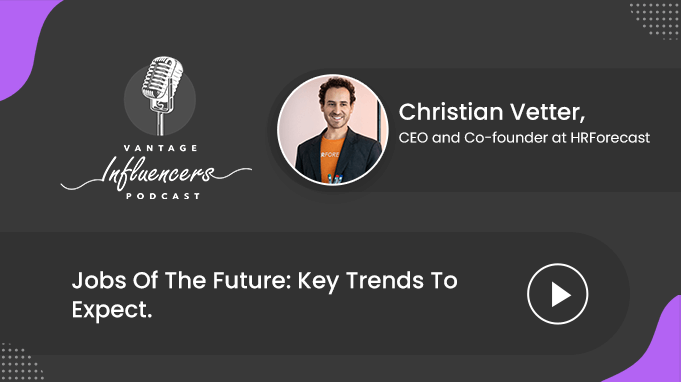
Christian Vetter, CEO and Co-founder, HRForecast
Christian Vetter is the CEO and Co-founder of HRForecast, a German HR tech company specializing in people analytics and strategic workforce planning software. He has spent his career at the intersection of workforce data and business strategy, working with hundreds of large-cap organizations on how artificial intelligence and big data are reshaping talent decisions.
Connect with Christian on LinkedIn
Host
Susmita Sarma, Vantage Influencers Podcast Host
What You Will Learn
- Why most job titles will survive the next decade, even as the skills behind them change dramatically
- How digitalization, not just automation, is forcing companies to rethink their business models
- Which new job families and roles are emerging around data, analytics, and automation
- Why "fusion skills," the blend of soft skills and technical depth, will define future hiring
- What HR teams need to change to prepare for a more strategic, cross-functional future
- Why employee experience is the real driver behind employee engagement
Key Topics & Timestamps
| Timestamp | Topic |
|---|---|
| 01:15 | Christian's corporate journey and career path |
| 02:31 | Will future jobs remain the same as today |
| 03:24 | How relevant today's conventional jobs will be in the future |
| 04:32 | Factors fueling the change in jobs |
| 05:27 | New job sectors and roles emerging |
| 06:49 | Skills and talents the future job market will demand |
| 07:57 | How Gen Z should prepare for future jobs |
| 08:56 | How HR should prepare for the future of work |
| 10:29 | Balance between humans and machines in future jobs |
| 11:18 | Employee experience vs employee engagement: what matters most |
Full Transcript
Click to read the full episode transcript
Welcome to the Vantage HR Influencers Podcast. This podcast is sponsored by Vantage Circle, the simple and AI-powered rewards and recognition platform for employee engagement.
If you're just starting out in the workforce, you might have already realized that there are multiple choices out there in each profession. Moving forward, these choices are also going to expand. Of course, people and machines will have to collaborate in the future of work to accomplish tasks that neither can perform alone.
So what new jobs are going to be produced in the future that isn't available now? What can we do to get ready for the future of jobs? What skills or talents will be required? Let's know everything in today's episode.
Susmita Sarma: I'm your host, Susmita Sarma, and today I have with me Christian Vetter, CEO and co-founder of HRForecast, a German HR tech company. Christian is an HR tech expert with a focus on cutting-edge technology like AI and big data. Welcome to our show, Christian.
Christian Vetter: Hello, how are you?
Susmita Sarma: I'm good, how are you?
Christian Vetter: Excellent. Thanks for having me.
Susmita Sarma: Okay, thanks a lot for joining me here, actually. Okay, so we'll start with the topic today, but before that, it would be great if you can brief us about your corporate journey.
Christian Vetter: Good to see you. So first of all, I started studying while I was 18, and at the same time I already entered my journey into the corporate world. I started working at Siemens, which is one of the largest German companies, as a dual study student, which is a very special German thing where you study at university while you work at the same time. The great opportunity was that I was able to see many different departments in the first four years while I was still at university. I went from controlling to finance to sales, but I was always the number-driven guy. I never really had the chance to look into HR departments. Then, after finishing my studies in 2010, the idea of HRForecast came up, and it took us four more years of thinking and developing before we decided to leave. After I had been with Siemens for quite a long time and in different functions, I went on to work with HRForecast in 2014. Since then, I've worked with hundreds of mostly large-cap organizations.
Susmita Sarma: Wow, great, okay. So the topic today, as I already mentioned, is the jobs of the future. What trends we can expect, right? So my very first and obvious question to you is, do you think jobs of the future will remain the same as today?
Christian Vetter: Definitely, the answer is no. As we speak, they change, or they are already changing. In the end, it's all the time the same news all over again. There are studies you read nowadays talking about how 20 to 30% of the jobs we know today will go away, and at the same time, 20 to 30% of new jobs will evolve. To be honest, this could also have been a newspaper headline in the 18th century or whatever, because even back then, technological advancements led to the development of new jobs. It's basically been the same since the introduction of the steam engine, but the speed of it is really increasing rapidly.
Susmita Sarma: Okay, so Christian, how relevant do you see the conventional jobs of today in the future?
Christian Vetter: I believe many, maybe most of them, will remain highly relevant. But there's something to it. Let's take the automotive engineer as an example, that job has been around for, I don't know, a hundred years probably, maybe a bit more. We still call it automotive engineer today, but if you look below the title, you'd see that a hundred years ago the job was purely mechanical, all about mechanical skills. Later on, it became electrical, moved into electrical engineering, and in our days an automotive engineer is very similar to a software engineer. So I really don't like to talk about how jobs will remain relevant, because titles are just titles, it's really about the skills. And skills are obviously under continuous change. So to answer your question, I'd say the jobs might keep the same name, but the relevance of the skills will rapidly change.
Susmita Sarma: Yeah, we'll talk about skills, I have a question prepared for you on that. But before that, I'd like to know, what according to you are the factors that are going to fuel the change?
Christian Vetter: What we discover is that in all industries today, they're undergoing rapid changes, all driven by the internet and the new business models that come with it. Even if you look at very machine-heavy industries such as farming or chemistry, or people-heavy industries like professional services, they're all changing now. The fuel is digitalization, or let's say digitalization is causing the need to rethink business models. And then we talk about digital mindset, digital skills, but it's not only about tech, it's of course also about much more.
Susmita Sarma: So Christian, can we expect some new job sectors? Are there any new jobs that you think would be coming up in the future? Because people say it's the time of automation and artificial intelligence, and that manpower is going to reduce in companies. So in that case, is there a chance of no new jobs coming up?
Christian Vetter: Yes, I mean, most of the topics you already talked about are happening, but not to a large extent yet. We do already see blockchain engineers, IoT specialists, sales automation engineers, we see all of that going on in the labor market when we evaluate job postings. But I think in the coming years these jobs will be hired at a much larger scale than today. There will be new job families developing. Currently, when we look into companies' job architectures, they usually put everyone who works with data somewhere either in IT or wherever, but in the end these will be massive job families with a large proportion of people working in them. So I guess everything around handling data and being analytically minded, those will be the biggest new jobs we can expect for the future, but that doesn't mean the old ones are going away.
Susmita Sarma: Okay, so just a few minutes back you spoke about skills and talents, that it requires new skills and talents to be in the market, right? So what are the skills that the jobs of the future will demand, according to you?
Christian Vetter: We've done some studies on that, actually a data-driven study analyzing millions of job postings out there in the world. And it doesn't matter which industry you look at, in the end we see two main things going on. The most important thing is that soft skills, despite all the technology around us, are becoming increasingly important and in demand, whether it's creativity, an analytical mindset, or networking, these things really matter. Of course, there are also the deep tech skills. What we believe is that the most successful companies in the future will not be the ones that hunt for only soft skills or only tech skills, but the ones that manage fusion skills the best, skills that sit at the interface between people and machines.
Susmita Sarma: Okay, great, I really like that answer. So coming to the next question, how do you think Gen Z needs to prepare themselves for the jobs of the future?
Christian Vetter: I don't think Gen Z needs to prepare much, it's more that employers, the companies, need to prepare, because in the end we're all humans, it doesn't matter whether we're Gen Z or not, humans adapt super fast to change. We've always adapted very fast, otherwise we'd be extinct. So I think it's less about the people and more about the companies needing to change. Of course, there are some gaps if we look at the way we behave, maybe a bit too social-media-heavy and less active in the real world, also driven by the pandemic. But I guess with some good education that becomes more speedy and agile, everybody would always be ready and prepared.
Susmita Sarma: Okay, yeah, so again, how according to you do HR teams need to prepare themselves for the jobs of the future?
Christian Vetter: Since HR is part of the corporate side I've just been talking about, the employer, I see much more need for HR to change and get prepared. I think HR of the future will be much less administrative, that's going to fade out, and strategizing, anticipating, and planning is going to be on the winning side. We already see that in job postings, much less need for administrative roles, while there's a real range of new analytical and strategic functions popping up at scale. So HR must become more data-minded, digitally minded, and analytics-driven, and I also believe it's super important that it becomes more cross-functional. I don't like to look at HR just as a silo, HR really needs to be connected with the organization, needs to understand the business model, and only then can it anticipate the talent of tomorrow.
Susmita Sarma: Right, I also read some articles where most of them had a common thread, that the future of HR is that the human side of HR should become more prominent in the future. So I believe that's right too.
Christian Vetter: Yes, yes, besides all the tech developments, we also see in HR that this is actually great, because it automates things that took a lot of time. So there's hopefully more time for the human part of HR jobs.
Susmita Sarma: Yeah, so that's a common belief, that the jobs of the future will be more technologically oriented. So does that mean machines will completely take over humans at work? How much of a balance between man and machine will the jobs of the future demand, according to you?
Christian Vetter: Yeah, I already touched on that topic before when I talked about fusion skills. I'd say it's neither the companies that focus purely on being the best in technology, nor the ones that try to avoid it and stay with whatever they've been doing in the past, that will be the winners, but the combination of both. So yeah, it's not like machines will take over humans, because somebody needs to teach machines what to do, and then, even with the data, someone needs to be there in the end to interpret it.
Susmita Sarma: Okay, okay, so last question, I have something from our genre, that is employee experience and employee engagement, two terms that sound very similar but have a lot of difference in them. So what do you think will matter the most in the jobs of the future, employee experience or employee engagement?
Christian Vetter: The way I understand it is that employee engagement is, in the end, what companies need, because you need engaged, happy, and productive people, and employee experience is a driver that leads to employee engagement. So I think both are important. We live in an age of gamification, everybody wants to be entertained, we talked about Gen Z before, they think differently, but in the end they're all humans, they want to feel committed to doing something good for the world or for themselves, and also for their employers. So I guess employee experience is going to be very important in driving employee engagement. That's one of the big topics, I'm assuming, that HR, but not only HR, also leaders, need to incorporate into their actions, because I also hear from Gen Z people that they're really uncomfortable with the way they're being managed. And I think that's also one of the big topics we need to change.
Susmita Sarma: Right, okay, so finally, Christian, would you like to give some suggestions to our listeners today?
Christian Vetter: Well, my suggestion is to not believe that all the changes we're heading toward are going to be negative. There are also going to be many more possibilities and opportunities rather than challenges. And I guess if somebody wants to develop himself, it's always good to think about tech skills, but never forget about the soft side of things, soft skills. Our clients, when they talk about digital skills, really like to emphasize that it's not about technology, it's about mindset. So I guess that's something everybody should take along, that digitalization or digital skills are really a whole range of different topics combined together in the perfect package.
Susmita Sarma: Okay, great, so what is the best way to reach you?
Christian Vetter: Well, you can reach me on LinkedIn, you can also reach me at many congresses, though currently most of them are virtual, but I'm really easy to reach. So the best way is just go on LinkedIn and look for HRForecast, the company I'm heading, or look me up directly, and you'll be able to connect with me, and let's engage.
Susmita Sarma: Okay, brilliant, that was a great conversation with you, Christian. Thanks a lot for joining me on the Vantage HR Influencers podcast.
Christian Vetter: Thank you so much for having me, it was fun for me as well.
Thanks for listening to the Vantage HR Influencers podcast. Please do subscribe to the Vantage HR Influencers podcast on Apple Podcasts, Spotify, and our YouTube channel for new episodes.
FAQ
Will most jobs disappear in the future?
No. According to Christian Vetter, most current job titles will remain relevant, but the skills required to perform them will keep changing. He points to the automotive engineer, a role that has gone from purely mechanical to nearly identical to a software engineering job, without ever changing its title.
What new job roles are emerging in the market?
Roles like blockchain engineers, IoT specialists, and sales automation engineers are already appearing in job postings, and Christian expects these to be hired at a much larger scale in the coming years as new job families form around data and analytics.
What are fusion skills, and why do they matter?
Fusion skills sit at the interface between people and machines, blending soft skills like creativity and networking with deep technical expertise. Christian argues that companies focusing on only one side, pure tech or pure soft skills, will lose out to those that combine both.
How should HR prepare for the future of work?
HR needs to move away from administrative tasks and become more strategic, data-driven, and cross-functional. Christian believes HR must be closely connected to the business model of the organization to accurately anticipate the talent needs of tomorrow.
Related Reading
Also listen on