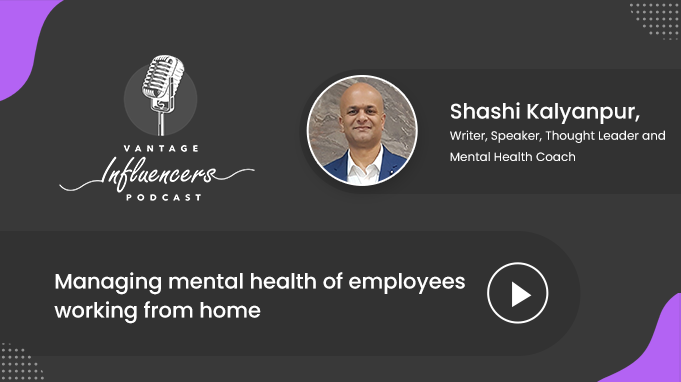
Managing mental health of employees working from home
Episode Overview
In this episode of the Vantage HR Influencers Podcast, host Susmita Sarma talks with Shashi Kalyanpur, a writer, speaker, and mental health coach, about why remote work during the COVID-19 lockdown was creating so much anxiety among employees. Shashi traces his own path from a 25 year competitive badminton career in Karnataka into 25 more years in sales and marketing, eventually reaching chief marketing officer, before stepping away about four years before this conversation to focus on mental toughness coaching for CXOs, entrepreneurs, and corporate teams. His central argument is that working from home is not inherently stressful: companies in IT have used it for years, and without a daily commute or office friction, remote work can actually be less draining. What was really hurting employees during the pandemic, he says, was uncertainty about pay, job security, and what the future would look like.
His sharpest, most concrete advice is about routine and honesty. He tells listeners to keep the exact same wake up time, get dressed, and start work at a fixed hour every weekday, and says some of his clients even step outside their apartment and walk back in before sitting down, just to signal to their brain that the workday has begun. On the management side, he pushes leaders to admit when they are scared instead of pretending to have every answer, arguing that a CEO who says "I'm worried too" earns far more loyalty from a workforce than one who hides behind false confidence, even if that same company has to cut pay for a few months to survive.
Episode Highlights
- Shashi built his mental toughness over 25 years as a competitive badminton player for Karnataka before spending another 25 years in sales and marketing, and only started coaching mental health professionally around four years before this conversation.
- He argues that working from home is not inherently stressful; the real driver of pandemic era anxiety was uncertainty about pay, job security, and an unclear future, not the loss of a commute.
- His top routine tip is to keep the exact same wake up time, get dressed, and treat the workday like an office day; some of his clients even step outside and walk back into their apartment before sitting down to work.
- He urges managers to admit their own fear openly rather than pretend to have all the answers, saying that honest, vulnerable leadership builds far more loyalty than false confidence, even during pay cuts.
- His daily mental health toolkit includes ten minutes of morning meditation, regular exercise, eating well instead of binge eating, and writing down emotions on paper before burning it to let them go.
- He warns against tracking COVID case counts like a scoreboard and scrolling negative news or social media, urging people to guard their minds with positive input instead.
About the Guest
Shashi Kalyanpur, Writer, Speaker & Mental Health Coach
Shashi Kalyanpur is a writer, speaker, and mental health coach who spent 25 years as a competitive badminton player for Karnataka before building a 25 year career in sales and marketing that took him to chief marketing officer level. About four years before this conversation, he stepped away from corporate sales to focus full time on helping people build mental toughness, working with CXOs, entrepreneurs, professional athletes, and corporate teams on staying emotionally steady under pressure. He is careful to note that he is not a doctor, psychologist, or psychiatrist; his approach draws on personal experience, extensive reading, and years of coaching rather than clinical training. His articles have appeared in several publications, and his YouTube channel, Shashi Kalyanpur, shares further content on emotional and mental toughness.
Connect with Shashi on LinkedIn
Host
Susmita Sarma, Vantage Influencers Podcast Host
What You Will Learn
- Why remote work itself isn't the real source of stress, and what actually drives anxiety during a crisis.
- How to build a daily routine that signals to your brain that it's a working day, even without a commute.
- Why keeping small promises to yourself, like a fixed wake up time, builds real mental toughness and confidence.
- What honest, vulnerable communication from leadership does for employee loyalty during uncertain times.
- Simple daily habits, including meditation, journaling, and diet, that help you manage stress you can't avoid.
- Why setting personal goals around your biggest fears during downtime can push you past long standing blocks.
Key Topics & Timestamps
| Timestamp | Topic |
|---|---|
| 00:00 | Introduction and Shashi's journey from athlete to mental health coach |
| 02:33 | Reframing remote work and building a consistent daily routine |
| 04:46 | Uncertainty as the real driver of pandemic era employee stress |
| 07:19 | Honest leadership communication and building employee loyalty |
| 12:00 | Daily mental health toolkit: diet, meditation, journaling, and personal goals |
| 16:21 | Mental health exercises: guarding the mind and reframing negative thoughts |
Full Transcript
Click to read the full episode transcript
Welcome to the Vantage HR Influencers Podcast. This podcast is sponsored by Vantage Circle, the leading employee benefits and engagement platform.
Susmita Sarma: Hi everyone, this is Susmita Sarma, Vantage HR Influencer Podcast. Today we have with us Mr. Shashi Kalyanpur, who is an author, a speaker and a mental health expert. Hello sir, welcome to the show.
Shashi Kalyanpur: Thanks Susmita, thanks for having me.
Susmita Sarma: So before we get started, I would like to know a little more about you, about your journey as a mental health expert.
Shashi Kalyanpur: Yeah, basically I started off as a sportsman, so I played Karnataka Shuttle Badminton for over 25 years of my life. After that, I was in sales and marketing for 25 years. So I have been, you know, going through mental toughness from the age of seven or eight.
After my sports career, three or four years back, I had reached the top of the sales profession as a chief marketing officer. After that, I thought, okay, let me start following my passion, which was how do I make people mentally tougher, you know? Because it's more about prevention than cure, which means, why do you want to go to a depressed state? So I wanted to see how we can prevent it. I started this journey four years back, and now I focus on CXOs, entrepreneurs, and corporates, to see how I can help them be in a good emotional state most of the time, because that's so necessary to increase your productivity in anything.
So that has been my journey in short. My articles have been published in various publications and stuff like that, but just for a disclaimer, I'm not a doctor, I'm not a psychologist or a psychiatrist. It's all based on life experiences and a whole lot of reading, all along that I share with viewers.
Susmita Sarma: Yeah, great. So let's start with our topic today. Because of the current COVID-19 pandemic, a lot of employees have started working from home, but there is also this growing concern that remote working could harm our mental health, increase anxiety and stress. And that's exactly what we are going to discuss today: managing the mental health of people working from home. So how do you prioritize mental health in working from home?
Shashi Kalyanpur: See, basically I think people have made it seem like a bigger deal than it actually is, working from home, right? Because if you look at it, IT companies had started this concept quite a while back, to ensure that they don't have to travel much. But for people like us, for example, who are in the sales profession, we have to go out of the house to get business, right? So it's just a change of mindset.
But the most important thing about working from home is that you have to have a routine, like a working day. It can't be that you're on vacation and then trying to work from home. It's very difficult to change your mindset unless you look at it like a working day, which means the same routine: you get up at the same time, you get dressed, then come to your desk or wherever, and start working.
So when you get into that mindset, and a lot of my clients have told them, wear your shoes, wear your dress, and just go down and come back into your apartment, right? So that your mind will say, okay, I'm going to work, I'm in the office.
So it's all about how you prepare your mind. Because I don't understand why people are taking it as stress. It's absolutely not stress. If you're working from home, you're saving time on the road, you're not getting caught in traffic, you're not going to get pushed around by somebody. So you're actually stress free at home if you look at it, right? You're not facing the world outside on the way. And you're not having tiffs with your employees, colleagues, and your bosses on a daily basis.
So I think the best way to do it is, I've told all of my clients to have a proper routine, don't change the routine, you know? Saturday and Sunday can be a holiday, but on weekdays, run the same routine that you've been following, which means you exercise, you eat the proper stuff, you don't binge eat. Because when you sit at home, you start eating the wrong stuff and everything goes haywire, right?
Susmita Sarma: Yeah, true. So what are your views about how this lockdown can impact the mental health of employees working from home?
Shashi Kalyanpur: See, the main problem that employees are facing now is uncertainty. They don't know what is going to happen. Are they going to get full salaries? Are they going to get salaries at all? Are they going to keep their jobs? There are so many unanswered questions that are scaring them.
So what I suggest is that everybody should look at growing through this problem, right? Which means start increasing whatever you're doing, become much better at it, and start learning new skills. For example, if you're a programmer, start looking at something that can increase your value in the market. Because if you lose your job, somebody else should be able to take you on for the additional skills you've picked up over this period of time.
Because it's very easy to sit and creep into the negative side of it, saying, they've retrenched me, I've lost my job, I'm not getting my salary, and that becomes endless, right? So instead of going into that loop of negativity, it's better to look at the positives that have come out of it. Everybody was cribbing earlier that they don't get time to spend with the family, don't get time to do what they want to do, like learning a new skill or upskilling their existing skills. So all of this can be done now, right? Everybody should look at the positives they've got out of it. That's when you'll grow through this, because I'm sure the world post COVID is not going to be the same. We are going to come out of the lockdown and see a totally different world, and you need to be prepared for it mentally. Otherwise, you're going to be left out, because the entire world is going towards that side, and if you're still in the same cocoon you were in earlier, that's the old normal. It's going to be the new normal: social distancing, working from home is going to be much more normal now.
Because look at it, companies are saving a lot of money on travel, right? So companies are going to look at that, and the future is going to be very, very challenging. So anybody who's mentally strong will get past it. But if you're not able to handle your emotions at this point of time, you need to pull up your socks and start learning how to do that.
Susmita Sarma: Yes. So the role of employers in supporting employees' mental health is also a major role, right? What do you think employers should do?
Shashi Kalyanpur: Employers, especially the CEOs, see, what happens is everybody is looking at the management for answers, right? And in this situation, the management also doesn't have the answers. Management should be really, really honest with their employees. Because if they don't know, they should say they don't know, because none of them know. This is a new situation for everybody, right? It's not like a regular situation where the company isn't doing well or sales aren't happening. It's a situation where nobody knew and nobody was prepared for it. Even the CEO or the owner of the company doesn't know what is happening and what is going to happen tomorrow.
So I think they should empathize with the employees and say, okay, I know you're scared, so am I. If the management is vulnerable by saying, I am also scared like you, then employees will feel much more comfortable that it's not only them who's going to get affected by this, that they have somebody taking care of them, right?
Because employees losing jobs will happen, you can't help it. It's part and parcel of this, it can happen anytime. It's not only this, but this will take a lot more jobs than usual, and that is for certain. But management should listen to the employees. First, get the scare out of the employees, you know? Because every employee sitting at home is scared that they don't know whether they're going to have a job later. And right now, there are a lot of companies putting a lot of pressure on employees to work from home and try to achieve objectives, which is unreasonable, and that should stop.
I think at the management level, companies should now empathize, put themselves in the shoes of the employee, remove the hat of the employer, get into the employee's shoes, and see how best they can keep the team together. Because it's all a family, right? The way they keep their family at home together, they should look at keeping the company family together. That's the most important thing, because if you keep them together now, you're going to win their loyalty, right? Even if you don't pay salaries for a month or two, the way you treat them, people are not going to leave you.
That matters so much, because that's the key, you know? So all my CEO clients have been told, just call every employee of yours, even if there are a thousand of them, just go on a call, a resume call, whatever, and just tell them, I'm with you, don't worry. Even if you lose your job, I'll get you another job, you know, to that level, right? Saying, okay, don't worry, even if I can't keep you, I'll see that a friend of mine hires you, something like that.
So it's not a situation where, like earlier, you don't give a notice period, you just say, from tomorrow don't come, or you say 30% of employees are out of jobs. That will add to the stress that is already there. Because everybody has their own commitments, like EMIs and taking care of their households. And it's mostly affecting people who have come from outside Bangalore, or from outside anywhere, who have left their families and come to work. Most of them are staying alone at home, or staying with friends. So they are getting affected much, much more, because everything depends on this job. And everybody knows that if they lose this job, getting another one is difficult, because every company is going through the same cycle.
So it is very important for employers and companies to keep the jobs. And you can tell them frankly, I'm not able to afford this, I'll pay you 30 or 40 percent, but I'll make it up at the end of the year, that's not an issue. But you'll have your jobs, you'll have to manage with a lesser salary, but don't worry, we'll take care of you when it becomes better. So that comfort is most important, because I see all employees being really stressed out, really not knowing what will happen. Will they have their house? Will they be able to pay rent tomorrow? So a lot of questions in their head, and that has to be addressed. I think a lot of companies have done that. CEOs have sent letters to employees saying, this is what the situation is, this is what you can expect. So that's the most important thing, and communication is the most important. Honest communication, not giving false hopes, not lying to employees, and things like that.
Susmita Sarma: So would you like to give some mental health tips and suggestions to our listeners? That's the most important thing we're looking forward to.
Shashi Kalyanpur: Absolutely, absolutely. So there are a couple of tips that I want to give. First is that you take care of your diet. Start eating stuff that will keep you very, very energetic, so eat good vegetables, fruits, and stuff like that, which you need to maintain regularly.
And then just try to meditate for the first 10 minutes of the day, as soon as you get up. Meditation is nothing big, just focusing on your breath for 10 minutes a day, and you're going to calm down. All your stresses are not going to just vanish, but it's going to give you the peace that will help you manage that stress. You cannot get away from stress, but you have control over how you manage it. So 10 minutes of meditation daily, and 10 or 20 minutes of exercise, which means when you start sweating, you're going to release chemicals that will help you manage that stress. That's the most important thing.
And start writing down your emotions, and burning it. Every morning, I wrote in a diary, just two weeks back, exactly the same steps: just write down whatever you're going through, don't look at language, don't look at anything, just write down whatever is in your mind, and then burn it. Just burn the paper and do this on a daily basis, and see how you get past this.
Getting mentally tougher is all about keeping promises to yourself, that's also confidence. So whatever you say, for example, you say I'm going to wake up at 5 tomorrow, you wake up at 5 tomorrow. Every time you keep the promises you make to yourself, that's when your confidence increases. Plus you're going to be much more mentally stronger, because you know that whatever comes, I keep my promises to myself, what I make to myself, forget about what you make to others. The day you start keeping the promises you make to yourself, that's the day you start getting much, much better mentally.
And the last one is you start keeping small wins every day, which means during this lockdown especially, put small goals on a daily basis, and the goals have to be things you're really scared of. For example, the goal can be to talk to my mother who I haven't spoken to for a couple of years, maybe something's wrong with the relationship, right? So some kind of personal goal, personal goals that you're scared of. Start now, because this is the time you can manage it. If you're scared of public speaking, just go on Zoom and do a talk, right? So this is the time you can actually face your fears and start becoming much more mentally active.
And then the last one is learn a new skill, which could be anything, guitar, could be anything you want to sing, you want to read books, you want to do anything, just to keep your mind occupied and not go through that negativity.
So these are the steps everybody should look at, and stop looking at the score of COVID. It's not a cricket match. People should stop looking at how many cases today, how many cases tomorrow, because it's going to scare them all. And stop watching the news if possible, because only negative things are shown there. Also, I think social media is the same. People have all the time now to scroll through all these social media apps, and all the apps are just giving all negative news. So I think, I'm not saying get away from social media, but at least get into groups that are into personal development, into things that are very positive. Just step away from whatever negative comes up, because it's better not to think negative at all, since it's so easy to get into the negative mode. Because if you talk to somebody and say something negative, they're going to tell you 10 things, and then the whole discussion goes negative. So that's the thing that is most important.
Susmita Sarma: So would you also suggest some mental health exercises that we can do from our home desk?
Shashi Kalyanpur: Yeah, this is what it is. So mental health exercises, basically, if you want to increase your brain power, you should start doing a lot of puzzles, for example, to stimulate your brain. But I think right now, brain stimulation is quite a bit for everybody.
In terms of mental health exercises, this is what it is: it's a habit, it's not a one day thing, mental health is a habit. So once you start working on these things, because unless you actually clear your emotions, because emotions are energy. So if energy gets blocked in your system, that's going to affect your thoughts. All of us are beings who think, and that thought becomes a feeling, and then the feeling becomes an action, right? So we have to be very careful about how we think.
So the exercise I would suggest, if you ask me for an exercise, I would say start converting your negative thoughts to positive. Stand guard of your mind and start looking at how you can feed your mind with positive, or I would call them optimistic, thoughts, right? Saying, okay, don't worry, it's going to be fine, because make your mind your friend, right? Make your mind your friend. When you make your mind your friend and treat it like a really good friend, not your enemy, that's when you're going to get past these mental health issues, or whatever you call it.
Because what is depression? Depression is basically when you're not able to handle those negative emotions and negative thoughts that are coming in, and then you succumb to it, you know? Because what happens is, the energy then gets into your body, right? It's still in your mind, but then the thought becomes a feeling. So before that thought becomes a feeling, change it to positive, so that the feeling becomes positive, right? So that's the most important thing.
So start guarding your mind, and read, read, read, look at YouTube videos, feed your mind with only positive stuff. It could be anything, it could be work related, it could be anything, but see that you grow on a daily basis. So start learning something that helps you grow every day.
Susmita Sarma: Okay. Our listeners might want to have a personal conversation with you. So what's the best way people can reach out to you?
Shashi Kalyanpur: I have my website, they can log on to it. They can also get to my LinkedIn profile under the same name, Shashi Kalyanpur, and send me a message there. Or they can reach me through the contact details listed on my website.
Susmita Sarma: Okay, great. Thank you so much for your time. It was great having you on our show.
Shashi Kalyanpur: Absolutely, thanks. It was a pleasure.
Thanks for listening to the Vantage HR Influencers podcast. Please do subscribe to the Vantage HR Influencers podcast on Apple Podcasts and Spotify for new episodes.
FAQ
Does working from home actually cause more stress than working from an office?
According to Shashi Kalyanpur, no. He argues that people have overstated how difficult remote work really is: without a daily commute or friction with colleagues and bosses, working from home can actually be less stressful, not more. The real driver of pandemic era anxiety was uncertainty about pay, job security, and the future, not the remote setup itself.
What is the single biggest habit that helps people cope with working from home?
Keeping an unchanged daily routine. Shashi tells his clients to wake up, get dressed, and start work at the exact same time every weekday, treating it like an office day rather than a vacation, so the mind stays in work mode. Some clients even step outside their home and walk back in before sitting down at their desk.
How should managers communicate with employees during a crisis like a pandemic?
Honestly, even if that means admitting they don't have all the answers. Shashi says leaders who openly share their own fear, telling employees "I'm scared too," build far more trust and loyalty than those who pretend everything is under control. He points out that even companies forced to cut pay can retain loyalty if they communicate honestly and stay committed to their people.
What daily practices does Shashi recommend for better mental health?
He recommends eating well instead of binge eating, meditating for ten minutes each morning, exercising until you sweat, and writing down emotions before burning the page to let them go. He also suggests setting small personal goals built around long standing fears, learning a new skill, and staying away from negative news and social media scrolling.
Related Reading
Also listen on