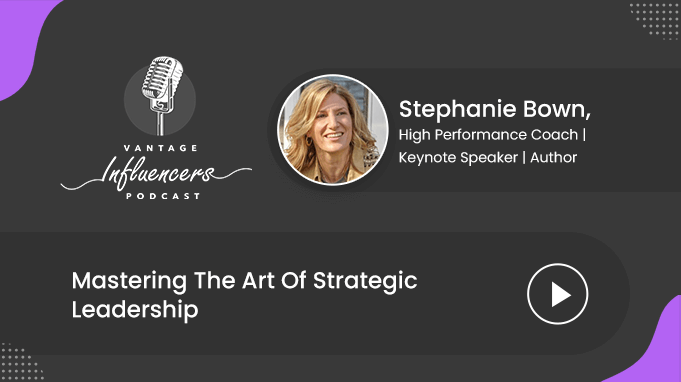
Mastering the Art of Strategic Leadership
Episode Overview
Stephanie opens with a distinction that reframes the entire conversation: having a plan is not the same as having a strategy. She points to research showing that organizations typically capture only a fraction of a strategic plan's intended value, and argues the shortfall rarely comes from a bad strategy. It comes from a broken link between planning and execution. Her answer is what she calls a strategy system, a repeatable process built on three habits: creating clear and actionable goals, cascading and aligning teams around them, and reviewing performance on a regular rhythm, so that strategic thinking spreads beyond the executive team instead of stalling at the top of the org chart.
From there, Stephanie turns to where strategic leadership can go wrong. She warns that leaders who over index on results and forward planning can end up neglecting the culture and people side of performance, and argues the fix is a strength based approach: pair a strategic leader with people who excel at culture and development, rather than trying to fix every personal gap alone. She also makes the case that setting the wrong goals is the costliest mistake a leader can make, since goals shape how an entire organization spends its time and effort, and she points to Netflix's disruption of video rental and Apple's overhaul of the phone keyboard as reminders that strategic leaders need to think about disrupting a market, not just adapting to it. She closes with a challenge to listeners: block real time in the calendar for thinking, not just doing, and stop waiting for permission to lead strategically.
Episode Highlights
- Strategic leadership works as a repeatable "strategy system," not a personality trait: creating clear goals, cascading alignment across teams, and reviewing performance are the three habits that separate strategic leaders from the rest.
- Organizations typically capture only about 60% of a strategic plan's potential value, and the gap usually comes from weak execution and alignment, not a flawed strategy itself.
- Traditional command and control management only works in highly standardized environments; as automation grows, the skills that matter most are the ones strategic leadership builds, including creativity and complex problem solving.
- The biggest risk for strategic leaders is over-focusing on results at the expense of culture and people, which is why pairing strategic strengths with teammates who excel at culture and development works better than trying to fix every gap alone.
- Setting the wrong goals is described as a leader's costliest mistake, since goals determine how an entire organization prioritizes its time and effort.
- A simple 80/20 rule, spending roughly a fifth of time on thinking and planning and the rest on execution, is a practical starting point for building a strategic thinking culture at any level.
About the Guest
Stephanie Bown, Business Performance Specialist
Stephanie Bown works with founders and leaders the way a personal trainer works with an athlete, sharpening their leadership fitness through an evidence based approach that regularly draws on some of Australia's most recognized entrepreneurs and business leaders. Her background spans years of study in psychology and organizational dynamics alongside professional accreditation in psychometric tools, and she spent time as a management consultant before serving as an in house Performance Partner for Swisse Wellness ahead of its sale to Hong Kong listed Biostime. She later relocated her family to Byron Bay, NSW to found her own consulting practice, and in 2020 she published her book, Purpose, Passion & Performance: How Systems for Leadership, Culture, and Strategy Drive the 3Ps of High Performing Organizations.
Connect with Stephanie on LinkedIn
Host
Susmita Sarma, Vantage Influencers Podcast Host
What You Will Learn
- How to tell the difference between having a plan and having an actual strategy system.
- The three habits strategic leaders repeat consistently: creating clear goals, cascading alignment, and reviewing performance.
- Why traditional command and control management is losing ground as automation increases.
- The most common blind spot strategic leaders have, and how a strength based approach helps solve it.
- Why setting the wrong goals is one of the costliest mistakes a leader can make.
- Practical ways to build a strategic thinking culture, including the 80/20 rule for time management.
Key Topics & Timestamps
| Timestamp | Topic |
|---|---|
| 01:07 | Stephanie's path from psychology into corporate performance consulting |
| 03:31 | Defining strategy versus strategic leadership |
| 05:56 | Three things strategic leaders consistently do well |
| 08:23 | How strategic leadership differs from traditional management |
| 13:16 | The weaknesses and blind spots of strategic leaders |
| 16:19 | The most critical decisions a strategic leader has to get right |
| 19:18 | Building a strategic thinking culture across a whole organization |
| 23:01 | Why core values anchor strategic decision-making |
| 26:13 | Quick tactics for sparking creative thinking in teams |
| 29:07 | Real-world examples of strategic leadership in action |
| 34:00 | Stephanie's closing advice for aspiring strategic leaders |
Full Transcript
Click to read the full episode transcript
Welcome to the Vantage HR Influencers Podcast. This podcast is sponsored by Vantage Circle, the simple and AI-powered rewards and recognition platform for employee engagement.
Susmita Sarma: Hi everyone, this is Susmita from the Vantage HR Influencers Podcast. And in today's episode, we are going to discuss strategic leadership. Yes, so we'll know the definition, we'll know how it's different from the traditional manager's approach, we'll know its pros and cons, and we'll know how to encourage and develop it. We'll also know the role of creativity, which is very important in organizations today, and we'll give you some real-life examples of strategic leadership situations, along with some good suggestions from our speaker. Speaker today is Stephanie Bown, who is a business performance specialist. Like a personal trainer for businesses, Stephanie works with founders and leaders to improve their leadership fitness. Welcome to the show, Stephanie.
Stephanie Bown: Thank you, Susmita. Thanks for having me.
Susmita Sarma: Great. Okay, so before we start with the topic, please brief us about your journey in the corporate world.
Stephanie Bown: Well, it's an absolute pleasure to be here talking to your audience today. For me, my journey really began a long time ago. I wasn't really clear about what I wanted to do from a very early age, from the age of about 15 years old. I was sitting down with my uncle, who was a psychologist, and I wanted to study psychology. We'd run a series of psychometric tests for me to confirm that it was the right choice for me. But he asked me at that point, you know that you want to be a psychologist, but all you need to decide now is whether you want to work with sick people or well people. And I knew straight away that I wanted to work with well people, and I wanted to help people towards high performance. So my journey began really as an interest in the corporate world, all the way back then when I was 15. I studied for seven years of tertiary education in psychology and neuropsychology, and where I started life in the corporate world was in big consulting companies, PwC for a while and other large consulting firms, but I've worked with literally hundreds of leaders across every industry. The most seminal experience was with Swisse Wellness. They're an Australian based pharmaceutical company that produces multivitamins, and I was with them for a number of years, from 2014 to 2016. In that time, that was really where I got to put all of the things I'd learned to the test inside a single organisation and see how they all landed and impacted the performance of the business. Over that period, they grew revenue from 300 million to 750 million, and they actually sold to a Hong Kong listed company called Biostime for 1.7 billion, which was a landmark transaction at the time. So that experience gave me a lot of confidence to really start my own consulting practice, and my mission is to help individuals and teams find and keep their performance edge. I've been squarely focused on performance in the corporate world for a long time.
Susmita Sarma: Okay, so today's topic is strategic leadership, which I already mentioned. It's thought to be something that must be learned rather than something that comes naturally, right? So as a result, learning about the mindset and behaviors one wants to represent will help one become a better strategic leader. So what are the characteristics of a good strategic leader that you want your listeners to know? I think that would basically cover what strategic leadership is all about, doesn't it?
Stephanie Bown: Yeah, I completely agree with you. And I think if we're going to be talking about what strategic leadership is and what good strategic leaders do, I like to start with the idea of what strategy is to begin with. Really, at its most basic form, strategy is a plan for realizing a vision. But what's really interesting about strategy is that companies typically only realize about 60% of their strategic plan's potential value. And that's not because strategies are flawed; we often come up with really good strategies that represent value and growth to organizations, but where we fall down is in the planning and execution of strategies. This was a piece of research published in the Harvard Business Review. So it's not just enough to have a plan; we need strategic leadership. What strategic leadership is about is harnessing the collective intelligence of teams to align on a plan and execute with confidence. I talk about strategic leadership in terms of leaders putting in place strategy systems: the process for strategy creation and strategy execution that enables your organization to remain adaptive in your chosen market and really realize the full value of your strategic plan. Strategic leadership is about putting these systems for strategy in place, and what a strategy system does is fuel performance and growth by ensuring that all team members set and are accountable to results. So strategic leadership believes in putting in place a process where teams align on goals and work together to achieve them, and creating a system for that so it's perpetual, an ongoing process within an organization. I think strategic leadership is a mindset that leaders adopt, and it's also a set of habits and behaviors that leaders adopt.
Susmita Sarma: Right, great. So what are the key things that strategic leaders do consistently well?
Stephanie Bown: Yeah, so if we're going to talk about strategic leadership as a set of behaviors and a mindset, it really is a verb, it's a doing word, it's something that you do. There are three things that strategic leaders do consistently well, and they perpetuate these things in an ongoing manner. First, they create clear and actionable strategy. We can't execute a plan if we don't have a plan, so they create strategies that are super simple and super clear, so that people understand what they're being asked to deliver in support of an organization's purpose. The second is that they cascade and align teams. They're constantly working to align teams to work collaboratively together in pursuit of a goal for the organization, and they do this systematically by creating consistent habits and patterns, whether that's a quarterly team planning meeting where teams review progress against goals, or monthly individual sessions where leaders talk with their people about individual goals and how they're performing. They're taking the big picture goal and breaking it down into sub-goals at a team level and an individual level, helping individuals understand how what they do is relevant to the business. The third thing they do consistently well is review and evaluate performance. They're constantly looking at the impact of their work, what the measure of performance is for a goal, and how they know if they're tracking well or not. So they create a system or process for reporting and reviewing results. When leaders do these three things well, creating clear and actionable strategy, cascading and aligning teams, and evaluating and reviewing performance, they're implementing a strategy system, and it takes strategy from being stuck in people's heads or outdated, to ongoing, clear, actionable, and relevant. That's what creates alignment and allows teams to work together in pursuit of common goals.
Susmita Sarma: Yeah, so do you believe that strategic leadership is better than the traditional manager's approach?
Stephanie Bown: Yeah, look, I think this is a really interesting question, because it makes me think about what traditional management is. When I think about traditional management, I think about command and control, hierarchical styles of management which were prevalent in the industrialized era. In those styles of organizations, and they still exist now, strategic thinking, creativity, and innovation happen at the top of the organizational tree, and the doing and execution happen at the bottom. They separate strategic thinking from execution. This approach only works in really standardized organizations where repetitiveness is a must. Think about McDonald's, for example. It only works if workers follow very specific standards to produce products that look and taste the same anywhere in the world. That's exactly what McDonald's customers want; they want the same product no matter where they go. You don't want workers at McDonald's inventing new ways to make the fish fillet better; you just want them to do the same thing over and over again. The issue with that traditional style of management is that we're seeing a rapid increase in artificial intelligence and automation, and that means standardized jobs are shrinking. In fact, the World Economic Forum produces a Future of Jobs report every year, and they state that by 2025, the number of work tasks performed by humans and machines is going to be equal for the first time in human history, which I think is a pretty astounding statistic. So what that's telling us is that where things can be automated, they will be, and this change is going to accelerate over the next five years. So I think traditional management, where we separate strategic thinking from execution, is going to become outdated very soon. In fact, the top skills of the next five years are really all about strategic leadership. The Future of Jobs report listed things like analytical thinking and innovation, active learning and learning strategies, complex problem solving, critical thinking and analysis, creativity, and originality. These are all things that require strategic leadership. So I think the pros of having strategic leaders in a business are that they're adopting these skills themselves, but they're also actively encouraging everyone in the business to use their skills and think strategically about how they deliver their work. It doesn't matter where they sit in the organizational hierarchy; what we want is strategic leaders encouraging strategic ways of operating everywhere in an organization. This helps organizations on two major fronts. First, it ensures businesses stay ahead of the change curve and adapt and respond to their market. McDonald's is in a fairly stable market, but there aren't very many organizations that don't need to continuously adapt and evolve to stay relevant. The second thing having strategic leaders does is it develops the skills in people to help them stay relevant, so they don't become irrelevant with skills that machines will soon be able to do. Can you imagine working in a world where fast food is served by robots and buses, trains, and planes are driven by AI? That world isn't far off. So strategic leaders are looking ahead, seeing these risks, activating intelligence in the people around them, and asking themselves and their people to solve problems we've never had to deal with before. Strategic leadership is an absolute necessity in this constantly changing and dynamically evolving world.
Susmita Sarma: So basically, they are working to make work smarter rather than harder, right?
Stephanie Bown: Correct. It's also about adapting to the changing market and this dynamic marketplace we live in, finding new ways of being relevant, and recognizing that we don't want to devolve thinking to just the people at the top of the tree. We want everyone in organizations to think, come up with new ideas, and be able to respond effectively to whatever challenges the market presents on any given day.
Susmita Sarma: Okay, but like almost everything else, Stephanie, strategic leadership is also not something without flaws, right? It would be great if you can highlight the weaknesses of strategic leadership.
Stephanie Bown: Yeah, I love this question. I think we need to look at both the light and the dark side of everything, don't we? Look, if anything, strategic leaders focus on goals, results, thinking ahead, planning, prioritizing, and coming up with new ways to solve existing challenges. So if anything, they could be at risk of over-focusing on results and not thinking about people. Strategy is really important, strategy drives performance, but it's not the only equation for driving high performing organizations. I think there are two other key ingredients: culture and leadership. Culture is really important because culture drives passion by connecting people to shared systems of values and beliefs. And leaders are super important because leaders drive purpose; they connect people to their purpose in the organization and develop the capability of people to achieve. Strategic leadership is great, it drives performance, but where strategic leaders could misstep is in thinking about culture and how to enable and develop people to achieve outcomes. What we want to see is those three things working together, because when they work together, they generate incredible performance and drive high performing organizations. There's a system for each of them: a system for strategy, a system for culture, and a system for leadership, and strategic leaders are all about creating strategy systems. So where they need to think about applying their knowledge and skills is in also recreating the system for culture and leading in systematic ways too. I really like a strength based approach to this: if your strength as a strategic leader is in planning, organizing, thinking ahead, and coming up with different ways of doing things, don't focus on your gaps. The strength based mindset is, don't fix a weakness, amplify a strength. So if you're a strategic leader, I'd suggest you partner with people who are all about driving culture or exceptional leadership. Get those people on your team, create a team of complementary strengths, and continue to develop your strengths as a strategic leader while leaning on people who focus on culture and the personal and professional development of others at work, and ask them to help you execute with a coordinated approach between all of you.
Susmita Sarma: I really loved that answer, Stephanie. So with this, there are also a couple of other things that come up, one of them being the decision-making factor. Many corporate leaders fail as a result of poor decisions made in their positions. Undoubtedly, they must embrace the importance of good decision-making, isn't it? So having said that, as a strategic leader, what are the most critical decisions one can make?
Stephanie Bown: Yeah, that's a pretty good question as well. Look, because strategic leaders are so focused on achieving goals and visions, their worst mistake could possibly be setting the wrong goals. Strategic leaders are all about setting goals and targets, but that actually determines how everybody else in the business prioritizes their time. If we don't have the right goals in place, then we're not prioritizing our time and effort effectively, so wrong goals equal wasted effort and stalled performance. When strategic leaders are thinking about setting goals, they need to think about setting goals across three different focus areas. First, they want to set self-set goals that enable us to perform to our expected standards. But we also want to be looking at how we are adapting to the market; the market shifts and changes, and if we just keep setting goals according to our own standards each year without looking outside the organization, we start losing touch with the reality of the market. So strategic leaders need to set goals for their own teams and organizations, but also in relation to their competitors, really understanding what their customers are asking for. And the third thing strategic leaders need to think about is how to not just adapt but disrupt, and the companies that seek to disrupt tend to be the ones we remember in history. Some really good examples of this are companies like Netflix. Netflix completely disrupted the market with on-demand streaming, and what happened to their competitor Blockbuster, who didn't adapt and only set self-set goals without looking outside their organization at what was happening in the market? Blockbuster became irrelevant, and Netflix charged forward. Another example is Apple: Apple created touch screen technology that disrupted the entire mobile market, and BlackBerry, who had their touch-type keyboards, became irrelevant. So as a strategic leader, you need to be thinking not just about adaptation to the market, but disruption of the market, and what you can do to change the nature of the game. Those tend to be the companies that really evolve, catch our eye, and stay on our lips.
Susmita Sarma: Right, okay. So how do you encourage and develop an overall strategic thinking organization?
Stephanie Bown: Yeah, I think this is a really important one to consider, because what we don't want to do is conform to outdated, hierarchical, standardized, industrialized notions of leadership, where strategic thinking happens at the top and everybody else just does what we tell them to do. What we want is for everybody to adopt strategic thinking capabilities and really think about how they can do their jobs, work smarter rather than harder, and continue to evolve the way we're doing things. To encourage a strategic thinking organization, I think there are two things leaders can do. The first is inclusion in the strategy creation process, and this happens as a cascade model. Let's imagine an executive leadership team gets together annually to reset the business's goals and priorities in relation to, say, a five-year vision or plan, and they release a document with the new goals and targets for the year. What needs to happen then is that, for example, the operations executive needs to get their team together, and they all need to go through that same process: looking at what the organizational goals are and figuring out what their operational team's goals and targets are, and how they're going to work together this year to achieve what the organization is asking of them, and so on. Then the operations team leader needs to get their logistics crew together and do the same process. So it's involvement in the creation of the goals and targets, so that every person feels a sense of buy-in and accountability to the overall plan. I think that's really important, and I think it's often missed; executive teams come out with a plan and publish it, then just expect everybody to set their own individual plans in accordance with it, without that step in the middle where everybody aligns as a team on what they're going to work together to do. The other thing is to build a strategic mindset in the organization by adopting an 80-20 rule. It's not just about getting together in teams and having strategy sessions, but about living by 80-20, where 20% is strategy creation and 80% is strategy execution. Everybody needs 20% of their time in their week, month, or year to actually get engaged in planning and thinking about how they do their work. You've probably heard of 3M, who produce the Post-it Note; 3M are really famous for their 15% time, where they tell everyone in the business they want them to spend 15% of their time on innovation, and the Post-it Note was born from that 15% time. Google uses 20% time; Google Maps and Gmail were born from 20% time. So what we actually want is to create a mindset where everybody spends roughly 15 to 20% of their time thinking, planning, and being strategic about how they do their work.
Susmita Sarma: Yeah, so like you mentioned, Stephanie, strategic thinking consists of three phases: where we are now, where we want to be, and how we'll get there. For this, we need certain components to be in place, and that might range from tools for analysis, action planning, a strong vision, and, most importantly, I believe, strong core values. So what are your thoughts on the importance of core values in strategic leadership? How do you make sure that your company and its actions are in line with them?
Stephanie Bown: Yeah, I think values are absolutely core. They sit at the heart of an organization, and they influence how we go about working together in pursuit of our purpose. If our strategy determines what we're going to work on to achieve our purpose, our values determine how we're going to work together and how we want people to behave when working together. We want our values to be meaningful, so it's not enough to have a set of values and post them on the website or put them on the wall; essentially, that's paying them lip service. What we actually need to do is embed values in the way we work. Strategic leaders think about values in relation to the decisions they're making when it comes to deciding what we're going to work on. They think about what living respect or living integrity means if we need to make a choice about where to prioritize our efforts, and how living those values determines where we focus our efforts and energy this year. For a lot of organizations throughout COVID, that meant either scaling down expectations of people so they could adapt to working from home, or ensuring people have the right support systems in place, that they're clear on the work they've got and have the tools they need. It may have meant they needed to slow down for a while before speeding up again, and that determines how they want to work together. So it's partly about using your values as a benchmark against which you make decisions about what you're going to work on and what pace you're going to work as an organization. I also think it's about how you're going to live your values in the way you deal with people. I talk about the culture system and how to create a plan that's all about how you live your values at each stage of the employee life cycle, your commitment and your company's commitment to living your values. A culture plan should have as much emphasis in a business as a business plan; they need to work together, because people can't achieve the objectives of an organization unless they're enabled to do so. The culture plan is about how we live our values in the way we deal with people, so we can support and enable them to be the best versions of themselves and perform to the standard we need. These two things play off each other: values are important both in influencing the decisions you make about what you're going to focus your time on, and in how you actively work with, develop, and support your people so they can achieve your company's goals.
Susmita Sarma: Right, yeah. So again, along with planning and strategies, as you mentioned, creativity is no longer optional in organizations today. In fact, people are saying that creative thinking is the only business strategy we need now. So it would be fantastic if you could provide a few fast tactics for sharpening creative juices in strategic leadership.
Stephanie Bown: I totally agree with this. Creativity is no longer an option; in fact, it was listed as one of the top five skills required in the next five years by the Future of Jobs report. I think a tactic for creative thinking is to inspire your team. Leaders who inspire are leaders who see potential, have a vision, and paint the picture of that vision to their team. A great way to stimulate creative thinking is to get teams together, and before jumping straight into "what are our goals, what are our targets" type heavy-hitting conversations, step back a little and ask, what do we all believe is really possible here? What is our vision? What is our purpose? What do we exist to do for our company, for our community? What's really important to us? When you open up those different kinds of questions, it stimulates different kinds of thinking about how we want to work together to pursue our company's purpose and realize our potential. For example, if your organization exists to stimulate innovation and creativity in the way you deal with customers, a people and culture team, if asked to come up with a business plan or strategic plan, I'd encourage them to first sit down and consider why they exist. What's the purpose of a people and culture team? Some answers could be that they exist to create the conditions where people can thrive, or to create the conditions where people can turn up to be the best versions of themselves at work. People and culture teams are responsible for putting in place the systems and processes that enable, empower, and support people to perform at their best. If a people and culture team can rally around that, they're going to start thinking differently and hopefully more creatively about how they go about their work, and really question the status quo and the way they're doing things, without fear of attack or retribution for having a crack at new ideas. It's really about saying, okay, we've done it this way, what's a different way, what's a new way we can work together that will make our jobs more enjoyable but also enable us to deliver a better product to our customers, whether they're internal or external.
Susmita Sarma: Right, yeah. So Stephanie, you've already given some examples from McDonald's and Netflix. Is there any other example from real life of strategic leadership situations that you want to share today?
Stephanie Bown: Oh, I should say there are so many examples of strategic leadership situations. I think a couple of quick ones we've all seen through COVID: people who very quickly pivoted their approaches, for example distilleries of gin and whiskey producing hand sanitizer. They quickly saw a change in the market and used their existing resources to produce a new product that would enable them to survive through a very tough period. Fashion houses producing personal protective equipment, restaurants suddenly turning into home delivery services. We saw a lot of change occur through COVID, with businesses large and small all coming out with new ways to keep their people working and produce products and services that the market needed, which I thought was really creative. But there are a couple of bigger examples I wanted to highlight. From personal experience, when I worked at Swisse Wellness, which I mentioned at the start of the call, one of the things that really led to their success was pivoting their sales channel. Typically, Swisse Wellness sold multivitamins through large retailers like chemists and supermarkets, but they noticed there were cross-border online resellers who buy and sell products across borders, starting to sell into the Chinese market. These were small, single-operator resellers just buying products from a chemist and selling them across to China. This channel allowed a fast-track movement of Australian-based products to China without having to go through all the usual cross-border restrictions, so the company decided to actually feed those channels, those cross-border resellers, which was a huge market disruption at the time. But it created access for their products in the Chinese market, grew the brand in a huge market, and elevated its market value, which ultimately attracted the eventual buyer and created an extremely strong sale price for the business; it was a record sale at the time. So that was one example of a strategic leadership pivot. Another example I really admire is an Australian retail brand that launched as a manufacturer of electronics and whitegoods. What they realized was that manufacturing a product like a fridge overseas and then bringing it to market in Australia could take seven, eight, sometimes twelve weeks, which limited cash flow in the business, and they knew they needed cash reserves to grow. So what they did to build cash reserves was become a reseller of electronic goods and whitegoods for major brands such as Samsung and others in the space, and not only did they become a reseller, they also found ways to offer the most competitive prices in Australia by buying those goods from overseas contract manufacturers at much lower prices. This let them very quickly generate the cash reserves they needed to continue growing their own branded goods. In addition, they created additional revenue channels by becoming wholesalers of services, launching their own mobile and insurance offerings through partnerships with telecom resellers. It was a very clever strategic leadership opportunity where the leaders of that business kept asking how they could grow cash flow, get better prices, and find other ways to wholesale, and they created all of these opportunities and became one of the fastest growing businesses in Australia at the time. So strategic leadership really is about looking at your market, looking at the way you operate, and constantly asking these questions of yourself and your people to keep coming up with great ideas so you can remain adaptive and responsive in your market.
Susmita Sarma: Amazing example, thanks for sharing this, Stephanie. So what would be your suggestions to the leaders listening to us right now?
Stephanie Bown: Look, I think there are probably four things. Don't wait to be given permission by the powers that be to be a strategic leader; it's a choice you make with how you use your time. Think 80-20: dedicate 20% of your time to reviewing, planning, and asking yourself strategic questions, and 80% to getting stuff done, to executing, but keep yourself disciplined about how you use your time. The second thing is get your team together to think creatively. Schedule a quarterly catch-up with your team, ask them these questions, set goals together, set KPIs, and look at and celebrate your achievements as a group, but make this a quarterly thing, book it a year out in everyone's calendars, and arrange everything else around these sessions. That creates an expectation that you're all going to get back together, look at how you're tracking, and think about how you work, and it creates an operating rhythm that everybody starts to align with. Third, it's important to set goals, definitely set a goal, but make sure your goals are measurable; don't just set an open-ended goal, it has to be tangible and measurable so people know if they have or haven't achieved things. It's not so much about whether you've achieved a goal or not; there's so much to learn from not achieving a goal too. If you haven't, understand why, what got in the way, was it the wrong goal, what can we learn from the challenge of pursuing and achieving a goal? And the last thing is to look for inspiration: look for inspiration in your market, dream about what's possible, look for the potential in your business, ask yourself how you can adapt, and ask yourself how you can disrupt. Those are the ways you can continue to push elevation, growth, regeneration, and really exciting opportunities through your whole organization.
Susmita Sarma: Okay, brilliant. So if I may, Stephanie, how can listeners reach out to you?
Stephanie Bown: You can reach out to me on my website, StephanieBown.com. Stephanie is spelled the usual way, and it's Bown, not Brown; I often get people telling me they can't find me, and I ask, did you search Brown or Bown? So it's StephanieBown.com, you can find me there. You can also find me on LinkedIn, or you can email me at Stephanie@StephanieBown.com.
Susmita Sarma: Okay, thanks for that. That was really a nice conversation, a great conversation in fact, with you, Stephanie. Thanks a lot for joining me on the Vantage HR Influencers podcast.
Stephanie Bown: Thank you so much, and thank you to your listeners as well.
FAQ
What is strategic leadership, according to Stephanie Bown?
Stephanie defines strategic leadership as the practice of putting "strategy systems" in place: repeatable processes for creating clear goals, cascading and aligning teams around them, and reviewing performance on an ongoing basis. She describes it as both a mindset and a set of habits that leaders repeat consistently, not a one-time planning exercise.
How is strategic leadership different from traditional management?
Traditional management separates strategic thinking, which happens at the top of an organization, from execution, which happens at the bottom, and only works well in highly standardized settings. Strategic leadership pushes strategic thinking down through every level of an organization, which Stephanie argues matters more as automation shrinks the number of purely standardized jobs.
What is the biggest mistake a strategic leader can make?
Stephanie says the costliest mistake is setting the wrong goals, since goals determine how an entire organization prioritizes its time and effort. She recommends setting goals across three areas: internal performance standards, competitive positioning in the market, and opportunities to disrupt the market rather than just adapt to it.
What is Stephanie Bown's advice for building a strategic thinking culture?
Stephanie recommends two things: involving people at every level in the strategy creation process through a cascade model, rather than just publishing goals from the top, and adopting an 80/20 rule where roughly a fifth of everyone's time goes toward thinking and planning while the rest goes toward execution.
Related Reading
Also listen on