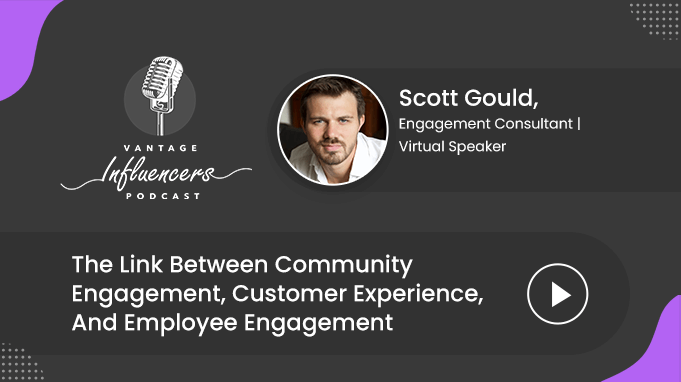
The Link Between Community Engagement, Customer Experience, And Employee Engagement
Episode Overview
Scott Gould, a former church minister turned engagement consultant and author, joins host Susmita Sarma to make the case that employees, not customers, deserve first priority. Drawing on his years in pastoral work and consulting across charities, businesses, and community groups, Scott argues that engagement is fundamentally the same process everywhere: it is "togetherness," whether that togetherness is built with employees, customers, or the wider community. He explains that when leaders invest in a healthy, engaged workforce first, better customer experience tends to follow, because engaged employees are simply better positioned to serve.
The conversation gets concrete fast. Scott points to Fifth Third Bank, whose branches build authentic local ties (community adoption programs, local leadership training, financial literacy classes) rather than the token community boards other retail chains put up and forget. He also cites Gallup research showing that companies optimizing for both employee and customer engagement together outperform average organizations by a factor of up to 6.2, far more than the sum of the individual gains. In one of the episode's most memorable examples, he describes Gravity Payments, the Seattle company whose founder capped his own salary and raised every employee's pay to $70,000, a move that cut turnover, grew revenue 500%, and even prompted employees to start families they previously felt they could not afford.
Episode Highlights
- Employees come first: a healthy, engaged workforce is what makes it possible to serve customers well, not the other way around.
- Fifth Third Bank shows how genuine local community involvement (not a token bulletin board) builds real employee and community engagement.
- A 10 minute weekly check in call, remembering names, ages, and hobbies of a team member's family, is enough to build a culture of real care.
- Gallup research finds companies that optimize for both employee and customer engagement outperform average organizations by up to 6.2 times.
- Loyalty points and reward schemes build calculative commitment, not the emotional, affective commitment that keeps people loyal for the long term.
- At Gravity Payments, capping executive pay and raising every salary to $70,000 cut turnover, grew revenue 500%, and let employees start families.
About the Guest
Scott Gould, Engagement Consultant & Author
Scott Gould is an author and an authority on engagement. Formerly a church minister, he left pastoral work to bring his skills in connecting and caring for people into the world of business, and has spent the years since consulting and speaking on employee, customer, and community engagement. He is the author of The Shape of Engagement: The Art of Building Enduring Connections with Your Customers, Employees and Communities, which lays out seven models, including six psychological levels of engagement, for understanding how people come together. Today he works with a wide and diverse range of organizations, helping them engage employees, customers, and communities in both face-to-face and virtual settings.
Connect with Scott on LinkedIn
Host
Susmita Sarma, Vantage Influencers Podcast Host
What You Will Learn
- Why prioritizing employee wellbeing leads to a better customer experience, not a worse one
- How genuine, sustained community involvement builds deeper engagement than one-off gestures
- A simple weekly habit that helps managers build real, lasting care with their teams
- What Gallup's research reveals about the combined payoff of employee and customer engagement
- Why reward and loyalty schemes fall short of building true, lasting employee loyalty
- How one company's radical pay decision transformed its culture and its bottom line
Key Topics & Timestamps
| Timestamp | Topic |
|---|---|
| 00:55 | Scott's journey from church minister to engagement consultant |
| 02:00 | Richard Branson's "employees come first" philosophy |
| 03:50 | Low cost, high impact ways to boost community and employee engagement |
| 06:50 | Why genuine care builds loyalty while transactional care backfires |
| 13:03 | What customer experience can teach us about employee engagement |
| 16:49 | Why reward and loyalty schemes fail to build true motivation |
| 21:45 | Scott's book, The Shape of Engagement |
| 23:05 | Advice for aspiring HR and engagement professionals |
| 24:08 | Scott's book recommendation, Gung Ho |
Full Transcript
Click to read the full episode transcript
Welcome to the Vantage HR Influencers Podcast. This podcast is sponsored by Vantage Circle, the leading employee benefits and engagement platform. One of the most significant advantages of community engagement is that it helps companies engage their employees on a variety of levels, ultimately driving employee engagement in the company. At the same time, employee engagement is at the heart of workplace transformation that leads to greater customer experience. So we know there is a strong link between community engagement, customer experience, and employee engagement, and that is what we'll be talking about in this episode.
Susmita Sarma: Hi everyone, this is Susmita Sarma from the Vantage HR Influencers Podcast, and the guest joining me today is Scott Gould, who is an author, a speaker, and a consultant in engagement. Welcome to the show, Scott.
Scott Gould: Hi, thank you for having me. It's great to be here.
Susmita Sarma: Great. So before we proceed with the topic, please let us know a brief about your journey in the corporate world.
Scott Gould: Sure. So I used to be a church pastor, a Christian minister, which is not a usual career path for most people. But I was, at a young age, really drawn to helping people and serving people. I subsequently left ministry, and I began to use my skills in connecting people and engagement with businesses and organizations. So I've kind of got this wonderful mix of working with charities and working in religion, but also working with a range of different organizations. I should also say that I've always been running my own businesses on the side, so I've always had my feet in business. But the last six years in particular, I've been consulting and speaking on the topic of engagement.
Susmita Sarma: Right, so that's why we have taken the topic, the link between community engagement, customer experience, and employee engagement. So let's begin. Richard Branson said that clients do not come first, employees come first. If you take care of your employees, they'll take care of your clients. Of course, the customer remains the king, but employees are the ambassadors of a brand. So Scott, what do you put first, employee engagement or customer experience?
Scott Gould: That's a really, really good question. That statement from Richard Branson is really true. Another way of putting it: if you think about being on an airplane, they always tell you that you should put the mask on yourself before you put a mask on someone else. I remember when I was a Christian minister, I used to serve other people, and sometimes I'd put them in front of my own family, and whenever I did that, that was always a mistake. I think in the same way, your employees come first. If you have a healthy organization, you are then able to serve other people. If you serve other people and you do not put your own health as an organization first, it will only be a matter of time before you are unable to continue serving your customers. So, yeah, for me it's clear: you serve those that put the most in, that's your employees, and then together you are able to serve your customers. You never serve a customer at the cost of looking after your employee. Actually, let me correct myself there, there might be extenuating circumstances, and occasionally you might need to, but in the long run, you look after employees first, definitely. There's a lot of research that actually says that if employees are engaged, then they are in a better place to engage customers. So ideally, you need to have both working at the same time.
Susmita Sarma: Okay. So while going through research on the topic, I came across this recent Fortune report that says the most successful companies are figuring out how to use community engagement, such as charitable activities, to link workers to their jobs, and as a result, create a more efficient and engaged workforce. This is a clear description of how positive psychology can help improve employee engagement. What are some other low cost, high impact ways to boost community engagement and employee engagement at the same time?
Scott Gould: Yeah, there's a really great example with Fifth Third Bank in the United States. Fifth Third Bank has branches all over the United States, but each branch is really engaged in its local community, and I don't say this in a tokenistic way. If you go to a local Starbucks or a local grocery store that's a chain, you might find a pinboard that says "our local community," and you'll find it's empty, or you'll find that the things on there are a few years old. Whereas Fifth Third Bank really ingratiates itself into the fabric of a community. They do things like support employees with local adoption, they have programs that help employees adopt children locally, and they've created their own programs to help with that. They allow anyone to go on leadership training, and they source leadership training experts from the local community, so they're putting back into the local community. When they do something like a fundraiser for a local community project, it's generally because they've been involved in the community enough to know who those people are. So the company really is paying back into the community, and of course that does engage people, because ultimately people want to have a sense of place. They want to feel valued within the area of their community, and that goes a long way toward engaging people because it considers their whole life experience, and people like to give back. Another thing they do is provide financial education to their local communities. So again, this is a great example of a chain: it's a bank chain, but every branch is encouraged and given the autonomy to find ways to serve its community. What they don't do is national community programs, they only do local ones, so they always remain involved in the community. I think the important thing to underline here is that this is helping employees with their life outside of work, and that's where community engagement really matters. People, at the end of the day, are humans before they are employees, and so it's giving consideration to our shared human experience. That, to me, just makes sense.
Susmita Sarma: Yeah, right, okay. So coming to the next question, Scott: post any difficult time, customers always recall how you handled them when they were in need, and your employees must be assisted and cared for to be ready for that challenge. So we can call it a superpower, but employees can tell if their bosses are really concerned, and when they sense that the care has other agendas or other motives, they become suspicious. True caring can catalyze satisfaction, engagement, and loyalty, but a transactional version of care can suffocate it. So, to wrap up everything, leaders and employers must really care in order to deliver a great customer experience and employee engagement, but each effort must be unadulterated. What are your views on being genuinely caring for each other at this crucial time of crisis?
Scott Gould: Well, I think you've already said it: it's a superpower, as you said, when employers really care, and also when employees really care, it's a superpower for that organization. The most important statistic on this comes from Gallup, and they found that if a team leader is fully engaged, 65% of their team will be fully engaged, whereas if a team leader is not fully engaged, only 0.04% of those team members will be fully engaged. In other words, the manager of a team of five, six, seven, eight, nine, ten people is the most important factor in an organization's engagement, and therefore productivity. Investing in your managers is the most important thing, and if managers don't feel cared for, it will be hard for them to care for others. So the first thing I think an organization needs to do is ask: are our managers really cared for? Managers normally make up 10 to 30% of an organization. Are those people really cared for? Do we appreciate the stress they go through, managing people as well as tasks? Do we really care for and look after those people? Because then, in turn, they will be cared for and therefore more able to care for those on their team. It really is like a chain, and care moves down and down.
Now, there is one thing I disagree with. You said that true care can create satisfaction and engagement, but transactional care can perhaps suffocate it. I get what you mean, that if it's on your checklist, "check in with someone," and you have to make sure you get it done on a regular basis, that might be suffocating because it's not genuine. But I would rather somebody transactionally cares for me than doesn't care for me at all. I'd rather that somebody demonstrated care because there was a standard operating procedure whereby they checked in with me on my well-being, than there was nothing at all. Now, what I would prefer beyond that is that the genuine care of the manager was there, but the genuine care of a manager will only come if it's being modeled to them. This is the critical thing, because in many organizations, the higher up you go, the less they model genuine care. In fact, managers are afraid to show genuine care because maybe they think they're overstepping the mark. We don't train people in pastoral skills, in the skills of, I'm not saying counseling skills, just low level care. We don't train people in how to do that.
So let's just quickly look at some examples of how you do it. It's as simple, in my mind, as a phone call saying, "Hey, I've got 10 minutes, just tell me, how are you?" Remember the names of people's family and ask about them. Remember the names and ages of their kids, ask about them. If you've got five to ten people on your team, you can do that for all your team members. Find what each person's hobby is and just inquire about that every now and then. That's where it starts, and then it moves up a bit. When you do that, you become a bit more mindful, and then when you have a meeting, you're able to say, "Hey, how's everyone doing?" and they know that you actually really mean it, because over the last couple of months you've asked them several times how they are, and you've shown interest. All of this can be done in a 10 minute phone call once a week. Now, if that 10 minute phone call is transactional at first, that's where you start, and then you get better, and the more you practice care, the more caring you become. I think it's simple, but we do need to be intentional and recognize it might well feel transactional, it might feel uncomfortable at first. I remember when I was pastoring people, and often these people would be older than me, and it would feel uncomfortable for me to say, "So tell me, how's your heart?" I'd feel uncomfortable, but I made sure I did it, and eventually I did so much that it came to a point where it was easy for me, and I was no longer afraid to say it, it no longer felt transactional, it felt genuine. So that would be my slight point of clarification I'd want to make there.
Susmita Sarma: Yeah, so it means you just need to take the first step in showing your care, and then it becomes easier for everyone, right? For anybody, saying to someone, "how are you, really," can actually feel really nervous the first time you say it.
Scott Gould: No, exactly, but you've got to step up a little bit. And actually, people want us to ask those questions. Most of my years as a pastor, people would not tell me how they really were unless I asked, but when I did ask, they had so much to tell me. It just begins with a conversation. It's the power of a simple ten minute call. We could do it right now, I could just ask, "how are you, really?" And that's a powerful question.
Susmita Sarma: Powerful. Right, okay, great. So, according to research conducted over the last decade, high levels of employee engagement and retention contribute to a greater emphasis on the customer, leading to a great customer experience. After all, it's the employees who are in charge of driving customer focus, maintaining customer loyalty, and improving customer relationships within a company. Employees who are disengaged from their jobs would not go above and beyond for customers. But the other way around, there are a lot of things that customer experience can teach us about employee engagement. Is that something you'd agree with?
Scott Gould: Yeah, you raised a few points there. I think, first of all, an important piece of research to point to was done in 2007, again by Gallup: 214,000 respondents interviewed across over 2,000 business units, I think it was, and they found that organizations that optimize for customer engagement outperform the average organization by a factor of 1.7, almost double. Likewise, they found that if you optimized for employee engagement, you would outperform the average by a factor of 1.7 again, almost two. So you'd add those together and think, okay, that means I'd outperform someone by up to, say, 2.14. But no, they found that organizations that optimized for both employee and customer engagement outperformed the average organization by a factor of 3.5, even up to 6.2 times, which is huge. What we know is that employee engagement drives customer engagement, and good customer engagement drives employee engagement, because both of them provide a mission, both of them provide an opportunity for us to become better as a team, and so forth.
I think one of the things that customer engagement and customer experience are really good for, and that's the title of this podcast topic, of course, is that it can teach us an awful lot about good employee engagement. One example of this is the trend toward what's called internal marketing, internal communications: the idea that we need to speak to our employees and market things to them in the same way we've been doing with our customers. That's actually a really fresh concept. Now, I don't necessarily like the idea of an "internal market," I don't think that actually exists, but what we recognize is it's not good enough to speak to my employees in a very bland way and then make it look really cool when I speak to my customers. Actually, I need to learn from the good communication I use with my customers, and go, in the same way that I think long and hard about how I communicate to customers, how can I do that with my employees too? I think long and hard about how I can really be of service to my customers, how I can give them a good experience. In the same way, we're now learning that we have to think about the same thing with our employees, because the job market is so competitive, that has to be something you offer as an advantage.
I think the main thing that customer engagement and customer experience can teach us about employee engagement is good communication. If I'm training anybody in employee engagement, I always tell them: read some marketing books, and then think about how you apply that back to your employee communication. Things like slogans, making memorable phrases, thinking graphically, developing logos for a team even. A lot of these are really good human techniques of engagement. We've predominantly used them for customers, but we can also use them for our employees.
Susmita Sarma: Nicely explained. So then coming to consumer loyalty, or customer loyalty: in the fight for that, rewards and recognition are like big weapons for everyone. The same principle applies to employees, maybe more dramatically. Employees love it when someone notices what they've been up to, they love rewards, especially when they have a choice. Unfortunately, when most companies keep customer loyalty points, they tend to forget about their employees. So what are the true motivators for employees today, considering traditional motivating strategies don't work anymore?
Scott Gould: Yeah, again I'd have to voice a slight disagreement with you here, and although I know you might have some data that proves me wrong, the data seems to show that loyalty schemes, reward schemes, and recognition schemes are good for transactional services, but they aren't actually good for fostering genuine, heart based loyalty. There's a difference here between what's called calculative commitment and affective commitment. Calculative commitment is being committed to someone because it makes sense given the points you're given, and that's very much a "head" motivating technique, whereas affective commitment is being loyal not because of any points, but because of the emotional bonds you've built. A simple way to prove this is that your family doesn't give you points, but you're still loyal to them, and your friends don't give you points, but you're still loyal to them. You're looking at deeper things around behavior and alignment.
So, yes, for employees, the number one question about a job is generally, "what's the pay?", because it needs to pay enough. The second important question for organizations will be about health care provision, which we could merge into pay, though for some countries this isn't relevant. I'm based in Europe, so health care isn't something I'm thinking about with an employer. Then it immediately jumps to issues around work flexibility: can I still live a good life, can I still have the hours and flexibility to pick up my kids, work remotely, and so forth? We find that the biggest thing that influences whether somebody stays at an organization is actually how their manager treats them. There's a great saying that people don't leave companies, they leave managers. If you have a manager who ensures you're paid fairly, and I do think most companies underpay, I'll give an example of that in a minute, people are looking for: am I paid fairly for what I do, do I have some flexibility, and do I have a manager who believes in me? Do I have a job that lets me do my best work? And generally it's the manager who enables you to do your best work, because they're the one who needs to customize your role around your strengths. Do I have an opportunity to progress in what I do? These are the standard employee engagement questions, and you'll notice none of them are things like, "do I get rewards?" People want to be recognized and praised for what they do, yes, but even if we think about a recognition scheme like "employee of the month" for the best salesperson, only one person wins that out of hundreds or thousands of employees. So actually the most important motivating factor, and we found this out during the pandemic, is that people want flexibility of work. They want to be able to work and live, not work to live. It's that simple.
Now, the example I like to look at here is a company called Gravity Payments, based in Seattle. The founder used to pay himself millions, and then he read an article based on some positive psychology research that said $75,000 a year is the amount people need to make to be happy; if you make more than $75,000 a year, your happiness doesn't really increase that much more, but your happiness massively increases up to that $75,000 mark. So what he did was give himself a pay cut. He started paying himself $70,000, and he made sure everyone in his company was paid at least $70,000. Basically overnight, nobody left the company, why would you, for that pay? People were happier, and they grew their revenue 500%, because people loved their jobs, cared, and felt safe. But the thing he points to as the most important change was that people started having babies, because up until then very few people had babies, because very few people could afford to. Now you look at an employer that matters: you're thinking, "I want a job, and there's a job going at Gravity Payments," you're going to go for that, even if the pay was less, because it's a place where people can have families and their work doesn't cannibalize their lives. These are the things that matter, and the pandemic has taught us this. I really hope managers are listening.
Susmita Sarma: Okay, so Scott, tell us more about your book, The Shape of Engagement: The Art of Building Enduring Connections with Your Customers, Employees, and Communities.
Scott Gould: Well, thank you for asking. The book is almost four years old, and it lays out seven shapes that provide a visual way of understanding how engagement works. The thing with engagement is, even though we're talking about it now, we haven't really defined what engagement is, and in the book I go on to explain that engagement is togetherness: togetherness with employees, togetherness with customers, togetherness with communities. What I also say is that the process of engagement, the process of coming together, is the same whether it's for employees, customers, or communities, but what happens is that these different fields tend to learn their own lessons and not share them. What I try to do is show, through these seven models, that we can learn a lot from other forms of engagement that will help our own form of engagement. I think perhaps the most important model in the book is the chapter that looks at the six actual psychological levels of engagement, which is great because then people know what to do. Engagement is no longer this mythical power, it's something they can understand, and they know the stages of it and can grow accordingly. So that's the book.
Susmita Sarma: Okay, amazing. So finally, any suggestions for the aspiring HRs and employee engagement enthusiasts listening to us now?
Scott Gould: I think it's recognizing that it really is about people living a rich life, a happy life, and your best policies will be the ones that enable people to do that. I think the pandemic has shown us people's appetite and ability to work remotely, to live a more integrated home life. If you can find a way to move people to a four day week, if you can organize around outcomes rather than hours, if you can position yourself so that managers are well supported to support their teams, and you keep your eye on what the customer needs in the same way, I think you'll do very, very well. I hope that's what we can do as a species: move toward no longer living to work, but living and working in equal measure and enjoying both.
Susmita Sarma: Okay, now any HR leader you follow, or any HR book you'd recommend?
Scott Gould: My favorite HR book, the one I keep coming back to again and again, is a very old book called Gung Ho, by Ken Blanchard, who wrote The One Minute Manager, and it is the best book, page for page, on HR. Gung Ho, G-U-N-G H-O, by Ken Blanchard and Sheldon Bowles. It's amazing. Do yourself a favor, spend five quid, five dollars, five euros, five rupees, whatever you have, and get yourself that book. If you haven't read it, it's amazing, and it will change your life for the good.
Susmita Sarma: Great, I'll link this up in the show notes of this podcast. So finally, how can listeners reach out to you, Scott?
Scott Gould: You can check out my website, scottgould.me. You can email me at scott@scottgould.me. I love speaking to people, and you can find me on different social media as @scottgould. I love chatting with people, so please don't be shy about saying hello, it's a joy for me to respond to any questions.
Susmita Sarma: Okay, so that was great connecting with you, Scott. Thanks for joining me on the Vantage HR Influencers Podcast.
Scott Gould: Well, thank you for inviting me, and all the best.
Thanks for listening to the Vantage HR Influencers podcast, where we engage with HR influencers about human resources. Please do subscribe to the Vantage HR Influencers podcast on Apple Podcasts and Spotify for new episodes.
FAQ
Should companies prioritize employee engagement or customer experience?
Scott Gould argues that employees come first, not because customers matter less, but because a healthy, engaged workforce is what makes it possible to serve customers well in the first place. He points to Gallup research showing that when a team leader is fully engaged, 65% of their team will be fully engaged too, compared to just 0.04% under a disengaged leader. In his view, organizations should invest in employees and managers first, and strong customer experience follows as a result.
What is the difference between calculative commitment and affective commitment?
Scott explains that calculative commitment is loyalty based on what you get, such as points from a rewards scheme, while affective commitment is loyalty based on emotional bonds. He notes that loyalty and reward schemes work well for transactional services but do not build the deeper, heart based loyalty that keeps employees genuinely committed over time. Family and friends do not give you points, he says, yet you remain loyal to them because of the relationship itself.
How can managers show genuine care for their team members?
Scott recommends starting small: a simple 10 minute weekly phone call in which a manager asks how someone is really doing, remembers the names and ages of their family members, and asks about their hobbies. He acknowledges this can feel transactional or uncomfortable at first, but says that consistent practice, modeled from pastoral experience, is what turns it into genuine care over time. He would rather care start out transactional than not happen at all.
What happened when Gravity Payments raised every employee's salary to $70,000?
Scott describes how the founder of Gravity Payments, a Seattle based company, cut his own pay and set a minimum salary of $70,000 for every employee, based on research that happiness rises sharply with income up to about that level. The result was near zero turnover, a 500% increase in revenue, and employees who felt secure enough to start families for the first time. He offers it as proof that pay and flexibility, not loyalty points, are what truly retain people.
Related Reading
Also listen on