Unlock People’s Potential And Win The Talent War
Episode Overview
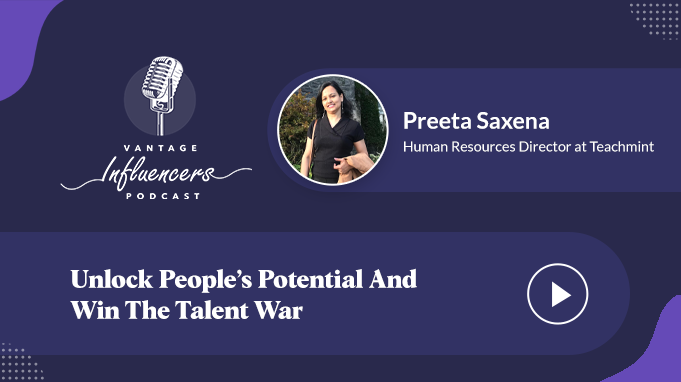
Preeta Saxena believes the war for talent isn't won by out-hiring the competition. It's won by out-developing your own people. In this episode, she argues that most HR playbooks are built backwards: leaders chase new talent instead of investing in unlocking the potential already sitting inside their teams. New hires need time to ramp up, she points out, so the fastest lever available to any leader is helping existing employees become better versions of themselves. That means shifting focus away from teaching specific skills, which go stale as fast as the tools around them, and toward building problem-solving competencies that outlast any one technology cycle.
Preeta also makes the case that diversity and inclusion cannot be treated as a seasonal talking point. She frames D&I as a business imperative that compounds over time: teams that embrace different viewpoints get better at drawing insights, admitting when they are wrong, and working through disagreement productively. Add a genuine sense of purpose, a workplace where people can clearly see how their daily work connects to something bigger, and organizations create the kind of brand ambassadors who make hiring and retention easier by word of mouth alone. For her, winning the talent war ultimately comes down to building a learning culture where managers coach rather than command, and where every employee gets a fair shot at growing into their best self.
Episode Highlights
- Winning the talent war requires redesigning the entire HR playbook, not just tweaking sourcing and retention tactics.
- Investing in existing employees delivers faster returns than chasing new hires, since new talent always needs a ramp-up period.
- Building problem-solving competencies matters more than training on specific tools or skills that can become outdated quickly.
- Diversity and inclusion should be treated as a business imperative, not a passing trend, because it strengthens collective decision-making.
- A strong employer brand grows organically when employees can connect their daily work to a larger organizational purpose.
- A learning culture, where managers act as coaches rather than supervisors, is the foundation for sustained employee growth and retention.
About the Guest
Preeta Saxena, HR Director, Teachmint Technologies Pvt Ltd
Preeta is an HR professional with experience designing HR strategies and managing the employee lifecycle across established organizations and early-stage startups. She describes herself as a people person with a strong interest in using technology to speed up the outcomes of HR interventions across the value chain. At Teachmint, an edtech startup based in Bangalore that scaled rapidly across many countries in a short span of time, she is responsible for fostering a workplace culture that embraces constant change and brings out the best in people.
Connect with Preeta on LinkedIn
Host
Susmita Sarma, Vantage Influencers Podcast Host
What You Will Learn
- Why redesigning your HR playbook matters more than simply acquiring and retaining talent
- How investing in existing employees can unlock faster, more sustainable returns than new hires
- Why building problem-solving competencies beats training on skills alone in fast-changing environments
- How treating diversity and inclusion as a business imperative improves collective decision-making
- What it takes to build a learning culture where managers coach instead of supervise
- How an unconventional employee referral approach can strengthen hiring outcomes
Key Topics & Timestamps
| Timestamp | Topic |
|---|---|
| 00:00 | Cold open: framing today's episode on hiring and unlocking potential |
| 00:43 | Host welcomes listeners and introduces Preeta Saxena |
| 01:03 | Preeta's professional background and an introduction to Teachmint |
| 02:30 | Understanding the war for talent in today's workplace |
| 04:15 | What it means to unlock people's potential and win the talent war |
| 05:56 | Diversity and inclusion as a business imperative |
| 07:27 | Best practices in hiring and recruitment |
| 09:17 | Building an equitable, learning-driven company culture |
| 11:21 | The story behind Teachmint's employee referral program |
Full Transcript
Click to read the full episode transcript
Welcome to the Vantage HR Influencers Podcast. This podcast is sponsored by Vantage Circle, the simple and AI-powered rewards and recognition platform for employee engagement. Hiring the right talent is difficult, but retaining them is another challenge. Often, HRs and leaders spend a lot of time and money finding the right talent. And again, finding diverse talent is not easy. Hence, today's episode is all about hiring and how leaders can unlock people's potential and win the war of talent.
Susmita Sarma: Hello listeners, welcome to the Vantage Influencers Podcast. I'm your host, Susmita. And to enlighten us on the topic of unlocking people's potential and winning the war of talent, we have with us today Preeta Saxena, the Human Resources Director at Teachmint. Hi, Preeta. Welcome to the show.
Preeta Saxena: Good morning, Susmita. Thank you so much.
Susmita Sarma: Thank you so much for being here on the Vantage HR Influencers Podcast, Preeta. So before we start today, would you like to give us a brief about yourself and about Teachmint?
Preeta Saxena: Sure, Susmita. First of all, it's a pleasure interacting with you and the entire Vantage Influencers Podcast team. I'm Preeta, an HR professional with experience in designing HR strategy and managing the entire employee lifecycle across established organizations and early-stage startups. At core, I'm a very people's person who's a big fan of using technology to fast-track outcomes of HR interventions across the value chain. And currently, I'm working as an HR Director at Teachmint Technologies Private Limited, Bangalore, and I'm responsible for fostering a workplace culture that embraces non-stop change and bringing out the best in people. A quick brief about Teachmint Technologies, though it requires no introduction. We are an edtech startup based out of Bangalore, and we've scaled rapidly to serve customers across many countries over the last several months. So that's a bit about myself and Teachmint.
Susmita Sarma: Yeah, so you basically serve school management, teachers, students, and their parents, right?
Preeta Saxena: That's right.
Susmita Sarma: And for doing that, Preeta, I'm sure that you guys hire diverse talent and you have a very streamlined hiring process. Having said that, Preeta, coming to the topic today, I would like to know how do you describe or how do you feel about the war of talent that is going on in the present scenario of workplaces?
Preeta Saxena: All right, so Susmita, as we all know, the war of talent refers to the changing landscape around attracting and retaining talent, and trust me, it is showing no sign of dwindling because the landscape around us is constantly changing. What is more important is how do we win the war of talent? So I think it's important that all HR professionals and stakeholders recognize that the war goes beyond simply identifying the talent, acquiring them, and trying to retain them. It actually calls for redesigning the entire HR playbook. It requires one to introspect and understand the nuances of the business requirement across different levels, recognize that employees are actually attracted to different kinds of benefits at different life stages and different levels, and you need to customize your strategy to match those needs. One size doesn't fit everyone. It has to be tailor-made, it has to be customized. One of the things that I have seen really working well in the current scenario, especially in these changing times, is that people are choosing to work for companies that can clearly articulate their reason for being. And if you can connect the work that they're doing on a daily basis to the greater good, you will have the strongest brand ambassadors who will be the strongest bets to win this war of talent for you. So that's my take on winning this war of talent. I think we need to go back to the basics and simply ensure that the vision and strategy are well documented and communicated.
Susmita Sarma: And again, what do you have to say about unlocking people's potential and how can leaders win the war of talent? If you want to share any strategy that you people use at Teachmint.
Preeta Saxena: Sure, absolutely. So Susmita, we are all living in times where change is the only constant. In fact, we are living in a time where rapid, constant, and disruptive change is now the norm. And what succeeded in the past is no longer a guide to tell us what is going to succeed in the future. So we can only thrive in these changing times when the team as a whole is agile. So what we really need is to be creative and innovative to stay ahead of the curve, now that we know traditional methods have clearly become redundant. So the question is, what do we do now? One of the things which I have seen working is that we have to start investing in giving training on new tools and new concepts. But on the other side, if the tools and concepts themselves are changing, then I would rather invest in building problem-solving ability in my team than just solving the problem myself. So I would put equal focus on developing the competencies of the team, not just skills. And as our people and teams keep coming up with better versions of themselves, it will help us stay ahead of the curve and have an unmatched competitive edge. On the other side, if you ask me about unlocking people's potential, I'd say I'd rather invest in that, because new talent has a gestation period, and I can only make the most of what I already have on my plate.
Susmita Sarma: And Preeta, what do you have to say about a very trending thing that we see over social media, on LinkedIn, on Twitter, that is diversity and inclusion in the workplace? I think that approach also matters a lot in winning the war of talent and unlocking people's potential. What do you have to say about that?
Preeta Saxena: Absolutely. So Susmita, first of all, D&I, diversity and inclusion, should not be taken as just the flavor of the month. It needs to be treated very explicitly as a business imperative. It's a magnet for attracting talent, and it results in higher retention and commitment. Now, if we take D&I as part of our culture, what it helps with is that teams start to learn to embrace new ideologies. They start understanding how to willingly go beyond their comfort zones, to admit when they are wrong, or to recognize that a better idea is coming from another corner. Even in those tough conversations, everything leads to a productive outcome. And it's very crucial to ensure that as an organization, there is a gradual increase in the organization's capacity to have teams that can draw insights, appreciate understanding the same problem statement from various other lenses, recognize that there are differences, yet have productive and open conversations. All in all, D&I should help us tap the collective intelligence of the organization.
Susmita Sarma: Also, Preeta, I think having the best of the best hiring and recruitment practices also has a very crucial role to play in this.
Preeta Saxena: Absolutely. So Susmita, the war for talent is not about fighting for average performers. We are fighting for the very best, and it calls for better preparedness and much deeper understanding. So first thing first, we actually start with having world-class job descriptions. It's important to get granular about the skills and the value additions that you are looking for, so that the same is reflected in the job description. Since the JD is actually the starting point, and as they say, a good start is half done, we put our focus on the job descriptions. The second part, again, is that we put the D&I approach here, and we want to remove any unconscious bias from the recruitment and selection process. So you can use a lot of tools, you can use a lot of technology, and you can have a diverse group of interviewers to ensure you get results minus these biases. One of the things that really works well at Teachmint is that when our own people become the brand ambassadors, we have seen very positive results from this. And that's the reason we're driving an employee referral program at Teachmint. So it's not just about diversity and inclusion. I think the overall workplace culture, which is the basis of a high-performing team, is the secret weapon in the talent war, and it attracts and sustains exceptional people in the workplace.
Susmita Sarma: Right, Preeta, you are absolutely bang on. So do you have anything to say about company culture that we should maintain, the top things that a company should have inbuilt in their culture that help you win the war of talent, and unlock people's potential?
Preeta Saxena: Sure. So I would like to say that the one thing that will sustain your talent is a learning culture, where everyone has fair opportunities to grow. And that is what I would call an equitable company culture. So again, my focus is back on having a learning culture. I would say a learning culture would unleash fresh energy, innovation, and commitment. A culture where you are constantly shifting gears from doing it all to learning it all. A learning culture where managers play the role of coaches. And what I mean here is not just the efforts of external consultants who are hired to help executives build personal and professional skills, but something that is ongoing and driven across the layers in the organization. While outside coaches and expertise are important, they have their limitations, because that kind of coaching is probably expecting something which is not exactly plug-and-play, whereas ongoing coaching helps a person pick up a better version of themselves. I would also like to emphasize that nowadays, coaching is no longer just a benevolent form of sharing. Sometimes you have to talk to somebody who is less experienced, and you have to tell them how to do things. But it's also the other way around. You have to ask them the right questions to make them think better. And the whole idea is to support your people rather than to judge them. And if you can build this kind of culture, you will always stay ahead of the curve.
Susmita Sarma: Yeah, that makes a great employer brand as well, and that goes on to being able to hire diverse and top talent in this talent war.
Preeta Saxena: Absolutely.
Susmita Sarma: Preeta, would you like to talk about your introduction of an unconventional referral program for hiring like-minded people, the one you named the Teachmint referral program?
Preeta Saxena: That's right.
Susmita Sarma: Yeah, would you like to say something about it?
Preeta Saxena: So as I covered initially, Susmita, the first thing is that your own people need to have absolute trust and confidence in the vision and values of the organization. They should resonate well with the values, and this doesn't happen overnight. It happens over a period of time. You build that culture, you let the culture grow within your own people. And when they are so convinced and excited about what they are creating, what we are creating as one big team, then when they're talking to somebody outside, that person gets interested in becoming part of it. They find that excitement, in fact. So the whole concept of the referral program is all about building a great culture and letting our own people do the talking. And trust me, we've had awesome results from this, simply because everybody feels that they belong here, and they're excited about sharing it in their own respective circles.
Susmita Sarma: Great, brilliant, Preeta. We are almost at the end of this podcast. So is there something that you want to add, or would you like to summarize your thoughts on our topic of discussion today?
Preeta Saxena: Sure. Towards the end, Susmita, I would just like to add that people are people, and they tend to achieve more in a more sustainable way when they are in a positive state, both psychologically and physically. So we should create a culture for them so that they feel energized and empowered to improve. And if you provide this opportunity to your own people, I think you would win this war. That's it.
Susmita Sarma: Right. Thank you, Preeta. Thank you so much for all that you shared today. So our listeners might want to connect with you and know more about the war of talent. So for that, you'll have to tell us how our listeners can reach out to you.
Preeta Saxena: Absolutely. So Susmita, as I said, I'm a very core people's person, and I love catching up with people from different walks of life, especially over the weekends. The best way to reach out to me is on LinkedIn. I'm very much available and active on LinkedIn. Anyone is most welcome. I'm happy to connect with you.
Susmita Sarma: With this, we have come to the end of this episode. You just heard Preeta Saxena talk about unlocking people's potential and winning the talent war. We'll be back with more such enlightening episodes. Until then, stay tuned to the Vantage Influencers Podcast.
FAQ
What does it mean to win the "war for talent"?
Winning the war for talent means moving beyond simply sourcing and retaining employees. It requires redesigning the entire HR playbook to match evolving employee expectations across life stages and career levels, then following through with a workplace culture people actually want to stay in.
How can leaders unlock their employees' potential?
Leaders can unlock potential by investing in problem-solving competencies rather than narrow skills training, since new tools and processes change constantly. Building a team's ability to adapt and solve problems creates a lasting competitive edge that specific technical skills alone cannot.
Why is diversity and inclusion considered a business imperative?
Diversity and inclusion is a business imperative because it directly improves how teams make decisions. When D&I is embedded in culture, teams learn to consider different viewpoints, challenge their own assumptions, and turn disagreement into productive outcomes, which strengthens retention and commitment.
What role does company culture play in the talent war?
Company culture, specifically a learning culture where managers coach rather than supervise, is what sustains talent over the long term. Organizations that give every employee a fair opportunity to grow create the kind of workplace that attracts strong candidates through word of mouth alone.
Related Reading
Also listen on