What Makes A Future-Proof Workplace?
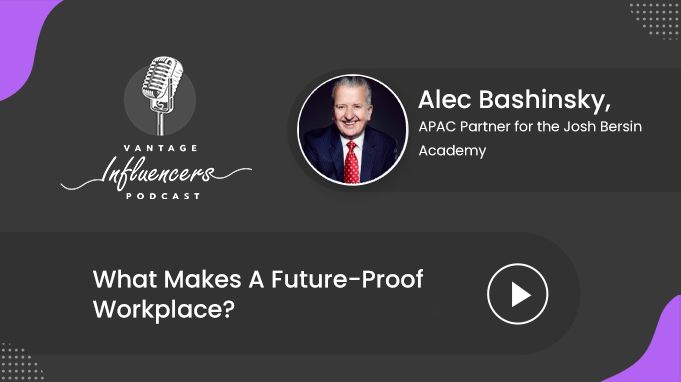
Episode Overview
Alec Bashinsky opens with a blunt diagnosis: most companies spent the years before the pandemic avoiding the demands of a changing workforce, and COVID-19 forced a reckoning they could no longer postpone. He argues that businesses now need to fully re-evaluate how they employ, engage, and develop people rather than patch old systems with new labels. That means flatter organizational structures, faster decision-making, and leadership models built for managing people remotely instead of in a shared office.
The conversation turns to HR's expanded post-pandemic mandate, from redefining performance measures to owning employee experience as a corporate strategy. Alec also tackles the tension between digital communication tools and genuine human connection, acknowledging that video calls and messaging platforms aren't going away even as isolation and mental health concerns grow. His answer isn't to retreat from digital tools but to be deliberate about when human-to-human moments matter most, while building the wellbeing safeguards a future-proof workplace demands.
Episode Highlights
- Alec argues that post-pandemic organizations need a full re-evaluation of their business models, not just incremental patches to old protocols.
- HR has moved from a supporting function to a seat at the executive table, advising leadership on wellbeing, organizational structure, and employee communication.
- Flatter, faster-moving organizational structures are replacing rigid hierarchies as companies adapt to remote and hybrid work.
- Leadership training increasingly blends empathy and patience with clear accountability, since managers now lead people they rarely see face to face.
- Digital communication tools are here to stay, but Alec cautions that organizations still need to protect space for genuine human connection and employee mental health.
- Skills, data analytics, and early AI adoption are becoming core HR capabilities as workforce planning shifts from tenure-based thinking to skills-based thinking.
About the Guest
Alec Bashinsky, APAC Partner, Josh Bersin Academy
Alec Bashinsky is a strategic business thinker and future of work specialist who disrupts traditional talent and HR models to align people strategy with business outcomes. He is the Managing Partner of Blackhall & Pearl Talent Advisory, which focuses on HR and culture transformation, the future of work, talent experience, and diversity and inclusion through advanced AI tools and insights. Before this, Alec was the Asia Pacific CHRO for Deloitte, leading a talent team of 55,000 people across more than 120 cities in over 20 countries, and spent 12 years as CHRO, National Partner, People & Performance for Deloitte Australia, reporting directly to the CEO. His earlier roles include Senior Director of Human Resources for PeopleSoft in Japan and Asia Pacific, Group Manager of Human Resources for Cisco Systems Australia/New Zealand, Asia Pacific HR Manager for 3Com, and HR Director for the market entry of Toys R Us into Australia.
Host
Susmita Sarma, Vantage Influencers Podcast Host
What You Will Learn
- Why post-pandemic organizations need to fully re-evaluate their business models instead of patching old systems
- How HR's role has expanded to advising the C-suite on wellbeing, structure, and communication
- What leadership skills matter most when managing distributed and hybrid teams
- How to balance digital communication tools with the need for real human connection
- Why mental health has become a board-level priority rather than a nice-to-have benefit
- Which HR capabilities, like data analytics and skills-based planning, will define the future of work
Key Topics & Timestamps
| Timestamp | Topic |
|---|---|
| 00:00 | Introduction and welcome to Alec Bashinsky |
| 01:22 | Alec's background across HR leadership roles |
| 02:23 | Re-evaluating business strategy for a future-proof workplace |
| 03:43 | The evolving role of HR in a post-pandemic world |
| 06:32 | Why leadership training matters more than ever |
| 07:54 | Balancing digital communication with human connection |
| 10:55 | Prioritizing mental health as a board-level issue |
| 12:53 | Predictions and advice for HR leaders and managers |
| 18:09 | Resource recommendations for HR professionals |
| 19:04 | How to connect with Alec Bashinsky |
Full Transcript
Click to read the full episode transcript
Welcome to the Vantage HR Influencers Podcast. This podcast is sponsored by Vantage Circle, the leading employee benefits and engagement platform. We don't really know what will happen in the future, but we can plan for it to some extent. It's called future-proofing, and it's a wise plan for organizations. Future-proofing your organization will give you an advantage in a competitive market, keep you sustainable, and set you up for long-term success, especially in unpredictable times.
Susmita Sarma: Hi everyone, this is Susmita from the Vantage HR Influencers Podcast, and in today's episode we'll be learning more about what makes a future-proof workplace and how we go about building one. I'm so excited and proud to welcome our guest speaker today, Alec Bashinsky. Alec is a strategic business thinker and future of work specialist who disrupts traditional talent and HR models and aligns people focus to deliver business outcomes. Alec is currently the APAC Partner for the Josh Bersin Academy, the first global professional development academy for HR. He is also the Managing Partner of Blackhall & Pearl Talent Advisory, which focuses on HR and culture transformation, the future of work, the talent experience, and diversity and inclusion through the facilitation of advanced AI tools and insights. Welcome to the show, Alec.
Alec Bashinsky: Hi, welcome, and how are you?
Susmita Sarma: I'm fine, Alec, thank you. So Alec, before we start with the topic today, can you please brief us about your experience in HR?
Alec Bashinsky: Wow, I'll try and do that in a very short way. It's a fairly long set of experiences. I've had about 35 to 40 years in human resources. I originally started my career in retail and then moved to technology. I've worked for global technology companies in Asia Pacific, such as 3Com, Cisco Systems, and PeopleSoft, and then I've spent about the last 15 years as the CHRO, firstly for Australia and then Asia Pacific for Deloitte. So in my career I've done interesting jobs, including the CHRO role for the market entry of Toys R Us into Australia. It's quite an extensive career in HR.
Susmita Sarma: We'll share more about that in the content we post after our podcast. So let's start with the topic then, Alec. As businesses have begun to reopen, employers are challenged with how to set their organizations up for success. Do you feel organizations should re-evaluate their approach to business, or augment their existing protocols to remain competitive and create a future-proof workplace?
Alec Bashinsky: Look, I think the very short answer to that is yes. Businesses today, post the COVID pandemic, absolutely need to totally re-evaluate their business models and how, in particular, they are employing, engaging, and developing their people. Our Josh Bersin Academy research, which we call the Big Reset, has already identified that new protocols and systems need to be established. Things such as a new approach to employee wellbeing, a total HR transformation in itself, and new approaches to leadership and culture. In particular, everybody is talking about new back-to-work practices and a strong focus on how employees actually engage with their managers.
So yes, HR teams have had to improve their organizational agility since the pandemic started, in order to keep up with the rapid, unforeseen changes to their workplaces, including a major move to remote work. As the pandemic threatens to place many companies' futures in jeopardy, prioritizing and caring for workers has become really crucial in making a future-proof workplace. I believe HR has always been responsible for this, but now it has taken on a really new sense. HR has actually had to be front and center in this pandemic. If we weren't seen as a valued resource to the CEO and the executive team before, that has absolutely changed, because we really needed to be able to advise the CEO and the executive on what needs to happen during the pandemic, and indeed how roles will change post the pandemic.
Organizations need HR's help to redefine what their organizational structures look like. For example, less of a hierarchical structure, which makes decision-making slow, and one that is faster and easier for making decisions. New leadership models, where leaders need to adapt to a new set of skills to be able to lead and manage their people remotely. HR needs to be at the forefront of communicating with employees, and also helping their leaders understand how to communicate with employees, especially if they're working from home. Another issue being discussed a lot is that HR needs to help the business re-evaluate performance measures, because there are so many different things happening in the way we work that old performance measures, in many cases, just don't work at all.
Other things, like employee experience, have now become a corporate strategy, and HR must lead that change and challenge. They need to help the business look at employee segments, employee journeys, and how the role of service delivery centers will change, and what an organization needs to do to adapt to that. Probably the biggest thing from a change perspective for HR is that they need to transform themselves, the way they operate, their operating models, and their focus on digital. That's a very big change element for HR during and post the COVID pandemic.
Susmita Sarma: Right, right. So you also mentioned leadership challenges. I believe it's actually very crucial to have leadership training for tenured managers, and also new ones, to cope with the new situation in the workplace.
Alec Bashinsky: Certainly. When you start to talk about leadership training, we're talking about the executive team here as well as managers at all levels, because firstly, they need to be trained to be sensitive to diversity and inclusion. They need to be trained to understand wellbeing and the impact on employees, and how employees are feeling. They need to build their supportive skills, and we also need to understand when our fellow managers are under stress. Overall, a new set of leadership skills have become important, things that maybe have not been that strong in a leader's armory, and that is for a leader to have patience and to be more forgiving in the current environment. Yet, just as importantly, there's a need for the leader to make accountability very clear. If anything, the pandemic has accelerated the leadership shift to one of being more supportive, one of being a coach, and one of being a more facilitative style of leader.
Susmita Sarma: Okay, so as staff and office leaders have struggled to adapt to the new normal, whether that's working from home or adapting to the required technologies, and most importantly, digital communication, all of this has become a requirement rather than an option. Do you think the overabundance of digital communication, resulting in social and physical isolation, is sparking more need for actual human connection? To create a future-proof workplace, don't you think we should seriously focus on the human side of HR from now onwards?
Alec Bashinsky: Look, I hear that a lot, and I think, in part, I agree with it, but the new world of work is one of digital transformation. I think employee engagement becomes more important. In the past, when we looked at employee surveys and other sorts of digital transformations, it basically meant let's simplify a system, let's integrate, or let's build a digital work experience. Now we've got products like Microsoft Teams, Zoom, WebEx, all of those sorts of things. That sort of communication platform is sweeping the world. Everybody's probably sick of doing Zoom calls and those sorts of things, but that won't go away. Again, our research at the Josh Bersin Academy is showing that more global organizations are going out there and looking at the type of digital communication tools that are available, and yes, there are hundreds of them out there. But we have to accept that it's the way we're going to work, and we have to find the best tools that suit our organization. We may also want to consider hiring people who understand data, systems, and communications, particularly communications, because it's never been a strong part of the HR framework.
So yes, we'd all love to come back to the office, but our research is showing very clearly and very strongly that most global companies' employees are telling them one of three things: do you want to come back to the office full time, do you want to come back to the office a few days and work from home for the other few days, or thirdly, do you just want to work from home. Many employees have found that working from home has been a real blessing. So it's going to be really difficult to get many employees back to the office. If you can get them back for specific events, specific launches, specific communications, you can have that human-to-human element, but we have to get used to the fact that the way we will work moving forward will be with digital communication with our employees.
Susmita Sarma: Really nicely explained, Alec. So during the pandemic, we were all threatened by the increasing risk of the virus, and almost all of us have lost a relative or a friend, which has a persistent impact on the mind, causing post-traumatic fear. Is this the right time to realize the importance of mental health and take preventive measures for employees?
Alec Bashinsky: Absolutely. I think, again, the Josh Bersin Academy has just done some research around 2021 HR predictions, and one of the key elements of that is that wellbeing has all of a sudden become a board-level awareness and accountability. It's not just critical for employee safety, but the organization, and especially HR, has to ensure a safe working environment. The impact of what they do, how they do it, coupled with mental health. I've heard some stories where a lot of employees are sitting by themselves in a one-bedroom apartment, and they have little communication with anybody except on Zoom or other digital channels. They're feeling very isolated. They don't have a lot of people to talk to, and because of the lockdowns from the pandemic, their mental health has become quite fragile. At the Josh Bersin Academy, we talk with HR leaders all the time, and we hear the same thing over and over, and that is employee health, wellbeing, and safety now has to be embedded as part of corporate culture. Before, it might have been a nice benefit to have; now it's absolutely critical to ensure that it's embedded in an organization's corporate culture, and that every HR leader and every business leader knows what to do in certain circumstances to preserve employee wellbeing.
Susmita Sarma: So when we talk about the future of the workplace, it's no longer molded around what has worked, but instead what will work moving forward. Would you like to share some insights on this with our HR professionals and aspiring managers?
Alec Bashinsky: Certainly, it's one of the most asked questions that I get, and I do a lot of presentations and a lot of work around helping organizations develop a strategy for the future of work. So, a couple of points for HR leaders and aspiring managers. Firstly, as strange as this may sound, there's a new war for talent out there. Research again shows that there are as many jobs already out in the marketplace as there were 12 months ago, but the focus seems to be shifting to more service-related roles. You may replace an operational, internal role with a service-focused role. So the war for talent, as organizations come out of the pandemic, is absolutely going to be back on the agenda, and HR needs to be ready for that.
The second element I would say is, and it's probably the other area where I spend most of my time, is that HR transformation will occur, and it will become very strongly linked to digitizing HR. HR leaders tomorrow need to be aware of what tools and applications exist. They need to understand analytics and how to not just analyze the workforce from an age and tenure point of view, but also from the point of view of the type of skills that are available and where to find them, and what insights they can bring to business decisions. So analytics, data, and digital are three key areas.
The fourth one I would say to HR leaders is that they need to start to read about and understand that, as part of this technology and digital transformation, HR tools are starting to adapt to artificial intelligence. So the AI concept, and being able to use artificial intelligence to look at the way employees behave and understand where key influences are, is going to become a key element. I mentioned employee experience before; it's absolutely critical. I hear more and more stories of new employees starting with a company and being onboarded from their own home. So onboarding is actually changing; it's no longer in the office. The way you do that is critical to the employee experience: the way you communicate, the way you manage, the way you provide feedback. So employee experience is probably the next key element.
The other two things I'd say to you are that there will be an even heavier focus on skills and capabilities. A lot of HR practitioners have got caught up in competency models with all sorts of different requirements, so the ability to understand how to build a skill within HR matters. Again, I talked about data analytics and digitization as two capabilities. There will be a far greater emphasis on what skills employees have and what capabilities they can bring to a job. In fact, we've developed a capability assessment diagnostic that's been in huge demand, because it helps HR departments do a diagnostic on their function, understand where the gaps and strengths are, and then understand where they need to either develop or recruit. So there's a heavy focus on skills and capabilities.
The other area changing dramatically is that learning and development will continue to be disrupted. We're seeing huge change in the way learning systems are being pushed out. More and more programs are being offered to employees, and the take-up is increasing, upwards of 50%, because employees are sitting at home and feel they have an opportunity to develop. So the adoption rate is very strong, and you're seeing more providers try to get into that space. If I'm a company that primarily does employee surveys, I'm starting to look at how I can increase my capabilities by building learning and development capability. So different and unique providers are now starting to move into employee communications and learning and development. Those are probably the five or six key things we see changing, particularly for the future of HR, and what HR leaders and practitioners need to focus on as we move further into 2021 and into 2022.
Susmita Sarma: Amazing, I really loved listening to that, and I'm sure our listeners will find it really helpful. Is there any HR book you'd suggest our listeners read?
Alec Bashinsky: That's a really hard one. I think the best thing we need to do is look at some of the webinars being put out by respected industry practitioners who are actually talking about what's happening in the future of HR. Your best opportunity is to try to connect with what's happening out there and use those webinars to build your own knowledge and education. Unfortunately, things like HR textbooks have a very limited lifespan, because by the time they're written, the information is already out of date.
Susmita Sarma: Okay, so Alec, how can listeners reach out to you?
Alec Bashinsky: That's fairly easy. You can contact me by email, and I'll share the details in the show notes so listeners can reach me directly. I'm doing a lot of work with clients in Asia Pacific, and some really interesting things are coming out of the advisory work we're doing. So happy to have a conversation, happy to steer people in the right direction, and wherever I can help, I'll be glad to do so.
Susmita Sarma: I'll put that up in the show notes. Alec, that was a really interesting and insightful conversation. Thank you so much for being a part of the Vantage HR Influencers podcast.
Alec Bashinsky: Thank you very much for the invitation. I hope your listeners got something out of it this afternoon. Thank you, bye-bye.
Thanks for listening to the Vantage HR Influencers Podcast, where we engage with HR influencers about human resources. Please subscribe to the Vantage HR Influencers Podcast on Apple Podcasts and Spotify for new episodes.
FAQ
What does it mean to build a future-proof workplace?
A future-proof workplace is one built around what will work going forward, not what worked in the past. Alec Bashinsky argues this means re-evaluating business models, flattening hierarchies for faster decision-making, and building leadership models suited to managing distributed teams rather than assuming everyone will return to a shared office.
How has HR's role changed since the pandemic?
HR moved from a support function to an advisory seat at the executive table. Leaders now expect HR to help redesign organizational structures, redefine performance measures, own employee experience as a corporate strategy, and guide the business through digital transformation.
Is digital communication replacing human connection at work?
Digital tools like video calls and messaging platforms are here to stay, but Alec cautions against letting them fully replace human connection. He recommends using in-person moments for specific events and launches while accepting that day-to-day work will increasingly happen through digital channels.
What skills will define the future of HR?
Alec points to a mix of capabilities: data analytics, workforce skills mapping, early adoption of AI tools, and a renewed focus on employee experience and wellbeing. HR leaders who build these capabilities will be better positioned to guide their organizations through ongoing change.
Related Reading
Also listen on