Why You Need Workforce Planning In 2021?
Episode Overview
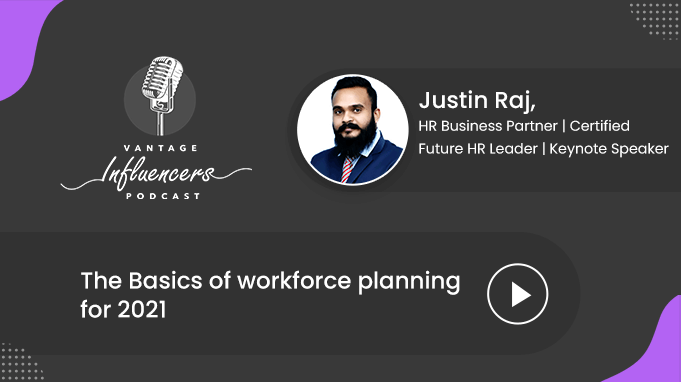
Justin Raj's route into HR started as a detour. Engineering was the family's plan for him, but after a year he realized it wasn't the right fit, so he switched to a BA in English Literature followed by a PGDM in Human Resources. He began his corporate career as an HR trainee in 2018, worked across the telecom and ed-tech sectors before moving into tech, and at the time of this conversation served as an HR Business Partner for the research and development function of an American multinational in the healthcare industry. That winding path, he says, has shaped how he thinks about workforce planning heading into 2021.
His core argument is that 2021 will demand agility and resilience from HR, after a year that forced most workforce plans to be torn up and rebuilt mid-course. He points to a global workforce study showing that more than half of employees feel less engaged than they did before the pandemic, and argues the response has to combine hard data with a genuine human touch: more personalized and digital employee experiences, a stronger focus on people analytics and employee wellbeing, and employees themselves staying adaptable as roles shift. His sharpest, most concrete point is that remote work's future isn't universal. It will keep expanding in industries like tech that boomed through the pandemic, while other sectors will have to work it out case by case, at least through the first quarter of 2021.
Episode Highlights
- Workforce planning for 2021 needs to lean on agility and resilience, after 2020 forced most organizations to rebuild their plans mid-year.
- A global workforce study Justin cites found that more than half of employees feel less engaged than before the pandemic, which is pushing employee experience up the priority list.
- Employee experience in 2021 is shifting toward more personalized, digital, one-on-one engagement rather than one-off surveys or generic programs.
- Remote work's future depends heavily on industry: sectors like tech that boomed through the pandemic are likely to stay remote longer, while others will decide case by case.
- HR needs to be people-oriented and data-driven at the same time, using analytics without losing the human touch in decisions.
- Employees themselves are expected to take ownership of staying agile, upskilling, and stepping into new roles as business needs shift.
About the Guest
Justin Raj, HR Professional
Justin Raj is an HR Business Partner for the research and development function of an American multinational in the healthcare industry. His path into HR wasn't the plan his family had in mind: he started an engineering degree before realizing it wasn't for him, switched to a BA in English Literature, and completed a PGDM in Human Resources before starting his corporate career as an HR trainee in 2018. Outside his day job, Justin is a storyteller, blogger, and keynote speaker who shares his thoughts under the name CHANAKYA4U, and describes himself in HR circles as something of an HR mystic. He was one of the youngest participants in Jombay's HR 40 Under 40 2020 list and holds a Future HR Leader certificate, earned at the age of 25.
Connect with Justin on LinkedIn
Host
Susmita Sarma, Vantage Influencers Podcast Host
What You Will Learn
- How to approach workforce planning for 2021 with more agility and resilience.
- Why employee experience is shifting toward personalization and digital-first design.
- What recent workforce data reveals about employee engagement and remote work adoption.
- How remote work policies are likely to play out differently across industries.
- Why data-driven decisions still need to stay rooted in the human side of HR.
- What employees can do to stay relevant and adaptable through uncertain times.
Key Topics & Timestamps
| Timestamp | Topic |
|---|---|
| 01:35 | Justin's journey into HR and the corporate world |
| 03:30 | What workforce planning for 2021 looks like |
| 08:36 | Whether remote work will continue in 2021 |
| 10:00 | Employee experience as a measure of organizational health |
| 12:00 | Getting started on improving employee experience |
| 14:15 | Why employees, not just organizations, need to be agile |
| 15:53 | Advice for HR managers |
| 16:50 | How to connect with Justin |
Full Transcript
Click to read the full episode transcript
Welcome to the Vantage HR Influencers Podcast. This podcast is sponsored by Vantage Circle, the leading employee benefits and engagement platform.
With the complexity that 2020 has brought, successful workforce planning in 2021 will be extremely difficult. When organizations recover from the pandemic, work performance, innovation, teamwork, and employee engagement will all carry a fresh new meaning. Most HR leaders are still clueless and looking for what and how they need to adjust to serve their people in the coming year, because now is the time to prepare HR for 2021: to navigate growth, to plan, to get flexible and agile, and to quickly adapt as rules and regulations develop.
Susmita Sarma: Hi everyone, this is Susmita from Vantage HR Influencers Podcast. In today's episode, we are going to discuss the basics of workforce planning for 2021. Today's guest is Justin Raj. Justin is an HR mystic who is highly passionate about his professional journey in the field of HR. He is currently working as an HR Business Partner for the research and development tech department of an American MNC in the healthcare industry. He is also a storyteller, a blogger, and a keynote speaker, and keeps sharing his thoughts under the name CHANAKYA4U. He was one of the youngest participants of Jombay's HR 40 Under 40 2020 and holds a certificate for Future HR Leader at the age of 25. Welcome to the show, Justin.
Justin Raj: Thank you so much, Susmita. It's a privilege and an honor to be here with you on this podcast. Thank you.
Susmita Sarma: So before we start with the topic, please let us know about your journey in the corporate world.
Justin Raj: Well, I started off my corporate journey as an HR trainee, as part of a young HR leader program that happened in 2018. I was the first one to be part of the first batch. In the first place, I was never going to be in the HR field. My parents and everyone back in the family wanted me to be an engineer, for so many reasons. But I understood it wasn't my cup of tea. I did engineering for one year and then I dropped off, because that was something I didn't feel like I'd be giving my best in. After that, I pursued my BA in English Literature and then did a PGDM in HR. Today, after three years into corporate life, I can see that it's been a very wonderful career option for me so far. I had the privilege of working with organizations in the telecom industry and in the ed-tech space, both leaders in their own particular industries, and the transition from telecom to tech, and now into what I'd call a human data science company, has helped me a lot, both personally and professionally. My journey in the corporate world is still just a few years, but yes, it's been a really enriching one. Currently, I'm working as an HR Business Partner for the research and development solutions wing of an American MNC.
Susmita Sarma: Okay, great. So at the very start, I wish you very good luck for your future, Justin.
Justin Raj: Thank you.
Susmita Sarma: So let's start with the topic: the basics of workforce planning for 2021. As we can see, HR patterns show that HR experts will continue to have plenty of work to do in the coming year. For years, workforce planning has topped the wish list of HR managers, but it has consistently been one of the most daunting projects to launch within HR. There are multiple approaches to workforce planning, but according to you, Justin, how does workforce planning for 2021 look?
Justin Raj: Okay, so as you rightly mentioned in the question itself, workforce planning has always been a tricky project for HR, and this question becomes especially challenging this year, for a number of reasons. First, 2020 has been like a perfect storm for all of us. On a personal front, we've come across the loss of our dear ones this year, and on a professional front, we've seen unexpected and unprecedented revenue and profit loss, and a startling number of layoffs and salary deductions. Also, midway through the year, many businesses and individuals had written 2020 off as a complete loss, and had to shelve a lot of the plans they'd made. Now we're looking forward to a better and brighter 2021, of course.
Definitely, what I feel is that even if the pandemic subsides toward the end of 2020, the decisions that HR leaders and managers are going to take for 2021 are going to be highly critical, because I'm sure many organizations had to revamp and repiece together their complete workforce planning strategies for 2020, and going into 2021 we may need to do so again. When I talk to HR leaders across industries, what I could understand is that the workforce planning strategy they had in 2020, they had to completely restructure it in a lot of ways, be it in terms of talent retention or in terms of coming up with new opportunities. It's been a very challenging phase. I personally know many organizations, many HR leaders, who had been planning for things like campus hiring, and 2020 completely changed that arena for HR.
That said, the future is always unpredictable. But 2020's workforce planning, and the complete disruption it caused, has, I think, made leaders and HR understand the need to be resilient and agile for 2021. I'm sure this is going to be the first item on the agenda: preparing for workforce planning for 2021.
I've been going through some recent studies, and a recent global workforce study found that 55 percent of employees currently feel less engaged in their work compared to before the pandemic, that 67 percent of businesses will be making their expanded remote work policies longer and more permanent, and that 45 percent of HR professionals are looking at redefining workforce productivity dynamics and other things related to it. So I think workforce planning for 2021 will be more strategically inclined toward making the current workforce more engaged, and also more productive, that's what I feel looking at the current trends.
I'm not sure exactly how the strategy is going to look for 2021, that's something even I'm trying to figure out. But looking at the trends, I feel there's a lot happening around building and adapting new skills, and the focus will be more on learning and development, building employee experience, people analytics, and of course employee wellbeing. So I'd like to conclude this by saying we're still in a very uncertain phase, and it's hard to make a firm call yet. All we can hope is that 2021 will be a better year, and that we'll be better equipped for it than we were for 2020, of course.
Susmita Sarma: Yeah, I heard somewhere that the best thing about 2021 will be that it won't be 2020.
Justin Raj: So I think, yeah, we can hope so.
Susmita Sarma: So as you pointed out, Justin, can we say that remote work is going to continue in 2021?
Justin Raj: Well, yes, of course. It has the potential to increase in some places, or fall in others, it really depends on the industry. Some industries have seen a boom altogether through this pandemic. If you look at tech, where I had the privilege of being for some time, 2020 has been a complete boom, working from home has actually helped the tech industry. So yeah, I think some industries will continue with work from home for a while. The rest we'll have to see, and just yesterday I was reading an article saying that Google has planned to extend work from home until September 2021. So yes, if not the whole of 2021, I'm sure some organizations are planning to run their business from home for at least the first quarter, of course.
Susmita Sarma: So you also mentioned employee experience. Why will employee experience be a critical measure of an organization's health now, and are we going to notice a renewed importance of it?
Justin Raj: Yes, of course. Employee experience has always been critical, both from an HR and an organizational perspective. But in 2021, HR and leaders need to support their workforce through increasingly difficult times, people are facing a lot of mental health challenges, childcare struggles, grief, and COVID-19-related challenges. There need to be strategies built to drive business performance, of course, and also to focus on employee satisfaction. I think a lot of focus will shift from customer satisfaction to employee satisfaction, because you need to help manage employees' stress and make them feel more encouraged, and at the same time, engaged in their work. Working from home is a challenge because people don't always feel engaged in their work, it's like they're putting their time into personal things and into a professional structure at once. So employee experience is going to be a priority for sure. According to LinkedIn's Global Talent Trends 2020, HR professionals themselves ranked employee experience as a top trend changing the way talent is attracted and retained, and that survey happened at the beginning of 2020. So even at the start of 2020, the focus was already on employee experience. I'm sure it's going to be the next big thing. I personally feel that employee experience for 2021 should be more meaningful, personalized, and digitalized.
Susmita Sarma: So what are your ideas about how to get started on improving employee experience in 2021? You already mentioned personalization and customization. Any other strategy you'd suggest?
Justin Raj: No, not really, this is exactly what I feel would be my strategy too. The experience will be more meaningful, more personalized, and more digitalized, so the one-to-one connects we used to have with our employees are going to turn into more regular sessions going forward. I believe you need to get in touch with your employees on a one-to-one level and understand the challenges they're going through in their daily lives. When we were working from the office, you'd meet people and connect with them naturally, and maybe HR's role in employee experience was smaller then, with managers and business leaders more directly engaged with employees. But I feel 2020 has taught us that HR needs to step in now, more as an employee-experience-building function. We need to get into the core of our employees and understand them, and HR needs to be more strategic about how people are managed going forward, that's how it's going to be in 2021.
Susmita Sarma: So that's what HR should learn from 2020?
Justin Raj: Yes, that's one of the biggest learnings HR should take from 2020. And if you ask me, the learning for HR will be to stay people-oriented but data-driven too. The H in HR needs to stay rooted in humanity going forward in 2021, the human touch in whatever we do, whether it's a strategic decision or any other decision we take, needs to be both more data-driven and more people-oriented.
Susmita Sarma: Justin, it's not just businesses that need to be agile. Employees themselves should also be able to change their duties, be accountable, and step up when they're most needed. What would be your quick suggestion for them?
Justin Raj: Yes, of course. Employees going forward need to be more agile and more resilient, in terms of updating their skills and competencies. They have to make sure they stay relevant as talent in the marketplace, stay sociable, and going forward, they also need to be more solution-oriented. COVID has taught us one more thing: that every employee, regardless of what department they work in or what exact job profile they hold, has had to adapt to the situation many times over. We've seen salespeople working from home, technical people working from home, people from very diverse profiles coming into this particular way of working and doing it together. So employees can't just stay away from what's happening, they need to be adaptable and open to learning and upgrading their skills, that's going to be the focus area for them for sure.
Susmita Sarma: Right, so any suggestions for HR managers?
Justin Raj: I'm not sure whether I'm the right person to give suggestions to HR professionals, but some of the suggestions I've picked up from my leaders, and from the people I look up to in the HR fraternity, is that you need to focus more on the people aspect, even as an HR business partner. You need to focus on your people and be more data-driven, and be more strategic as it comes into play. And of course, this is the best phase to come out with a lot of new practices, you need to shed the traditional approaches, this is the right time to experiment with things and put them across to your stakeholders for sure.
Susmita Sarma: Okay, so last but not least, how can a listener reach out to you?
Justin Raj: Oh, I'm always available on LinkedIn. I'm a person who loves networking and connecting with people, so I feel they can always reach out to me there.
Susmita Sarma: Sure, I'll just link to your LinkedIn profile in the description of this podcast. That was a wonderful conversation with you, Justin. Thanks a lot for being a part of the Vantage HR Influencers Podcast.
Justin Raj: Thank you so much, thanks a lot for this opportunity. Thank you.
Thanks for listening to the Vantage HR Influencers Podcast, where we engage with HR influencers about human resources. Please do subscribe to the Vantage HR Influencers Podcast on Apple Podcasts and Spotify for new episodes.
FAQ
Will remote work continue in 2021?
Justin Raj said it depends heavily on the industry rather than being a blanket trend. Sectors like tech saw a boom during the pandemic and were likely to keep remote or hybrid arrangements going longer, and he pointed to news at the time that Google planned to extend its work-from-home policy until September 2021. Other industries, he said, would have to work it out as they went, but at least the first quarter of 2021 was likely to stay remote for many organizations.
Why does employee experience matter more in 2021?
Because employees were dealing with mental health struggles, childcare pressures, grief, and pandemic-related stress, Justin argued that organizations need to shift some of the focus they've historically put on customer satisfaction toward employee satisfaction instead. He pointed to LinkedIn's Global Talent Trends 2020 survey, where HR professionals ranked employee experience as a top trend even before the pandemic hit, and said 2021's version of it needs to be more personalized and digital.
How should HR balance data with the human touch?
Justin's advice was to be people-oriented and data-driven at the same time, not one instead of the other. He said the human element of HR needs to stay front and center even as decisions increasingly draw on data and analytics, whether the decision is strategic or day-to-day.
What should employees do to stay relevant going forward?
Justin said employees need to take ownership of their own agility: staying open to upskilling, being solution-oriented, and adapting to whatever role the situation demands. He pointed to examples like salespeople and technical staff who had to change how they worked in 2020, and framed adaptability and a willingness to keep learning as what will keep someone employable going forward.
Related Reading
Also listen on