Employee engagement in the hospitality industry means the emotional commitment shift-based, frontline, and hourly staff bring to guest service, retention, and team performance. It behaves differently than office-based engagement because the workforce behind it works in rotating shifts, gets paid by the hour, and rarely shares a room with a manager long enough for a real check-in.
The stakes are real. Workers in accommodation and food services quit their jobs at a rate of roughly 4.3% a month, the highest of any industry the U.S. Bureau of Labor Statistics tracks (BLS JOLTS, 2026). Most engagement advice online is written for salaried teams who log into the same intranet every morning. This article is written for the shift.
What Does Employee Engagement Mean for a Shift-Based Workforce?
Employee engagement for a shift-based workforce is the degree to which hourly, rotating-shift staff feel committed to guest outcomes and to the team they clock in with, measured less by annual survey scores and more by whether they show up for their next shift, correct a service issue without being asked, and stay past their first year.
That last part is the practical difference. A salaried office engagement program can lean on quarterly surveys, intranet posts, and manager one-on-ones because the workforce is in one place, on one schedule, for one employer. A hospitality workforce is split across morning, evening, and overnight shifts, often across multiple properties, and a large share of it is part-time or seasonal. An engagement approach built for the first group routinely fails the second, not because the ideas are wrong but because the delivery mechanism assumes a workday that shift-based staff don't have.
That is also why generic employee engagement ideas built for a single-site, nine-to-five workforce need real adaptation before they work on a hotel floor or a restaurant line, a point worth keeping in mind through the rest of this article.
Recognition strategy also has to bend around the same constraint. What works for frontline employees in general applies here too, but hospitality adds shift rotation and guest-facing pressure on top of it.
Why Employee Engagement Is Harder to Sustain in Hospitality
Employee engagement is harder to sustain in hospitality because the same structural features that make the industry run, rotating shifts, hourly pay, and constant guest contact, also work against the conditions engagement normally depends on: consistency, visibility, and rest.
The turnover data shows how much this costs. A Deloitte 2025 Global Human Capital Trends report found that 80% of restaurant workers and 76% of hospitality workers leave their job within a year, a pace that leaves almost no time for engagement efforts to compound. Academic research backs up why: a 2025 study in the International Journal of Contemporary Hospitality Management, surveying 491 full-time restaurant workers, found that work engagement is one of the two mechanisms (alongside job embeddedness) that most directly reduces an employee's intention to quit, more than pay or job type alone.
The table below breaks down the eight challenges that come up most often in hospitality, why each behaves differently here than in a standard office environment, and a quick fix for each.
| Challenge | Why It's Different in Hospitality | Quick Fix |
|---|---|---|
| High turnover | Hourly, entry-level roles have a low switching cost for the employee, and the "revolving door" resets engagement work constantly | Recognize contribution early, in the first 30 days, rather than waiting for a tenure milestone that many staff won't reach |
| Communication gaps across shifts | Morning, evening, and overnight staff rarely overlap, so updates get lost between handoffs | Use a shared digital channel that persists across shift changes instead of verbal handoffs alone |
| Limited career growth for hourly staff | Advancement paths are often built around salaried, corporate roles that hourly staff can't see a route into | Publish a visible, hourly-to-supervisor pathway with named skill milestones |
| Inadequate training | Fast staffing cycles push new hires onto the floor before training is complete | Shorten training into shift-length modules staff can complete between guest rushes |
| Poor working conditions | Physically demanding shifts and irregular hours compound fatigue faster than desk work does | Track fatigue-linked complaints through frequent, anonymous pulse checks rather than annual surveys |
| Lack of recognition | Managers rarely overlap with every shift long enough to recognize good work when it happens | Enable peer-to-peer recognition so a colleague can acknowledge it in the moment |
| High customer demands | Frontline staff absorb guest frustration directly and repeatedly, with no buffer | Recognize de-escalation and service recovery specifically, not just sales or upsell numbers |
| Work-life imbalance | Rotating and split shifts make routines, and rest, harder to protect than a fixed schedule does | Offer compensatory time or schedule flexibility as a direct reward, not just paid overtime |
6 Actionable Ways to Engage Frontline and Shift-Based Hospitality Staff
The six categories that move the needle for shift-based hospitality staff are recognition, low-cost perks, flexible time, structured competition, real advancement, and communication built for handoffs, not desks.
1. Peer-to-Peer and Manager Recognition
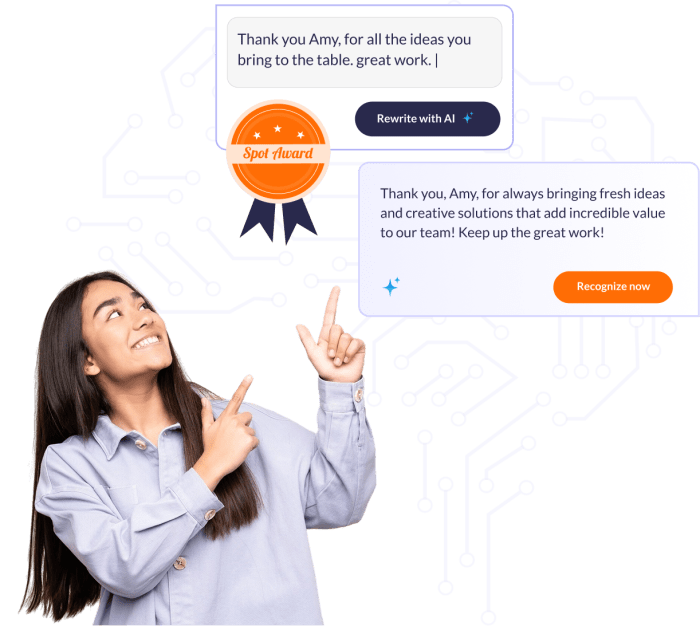
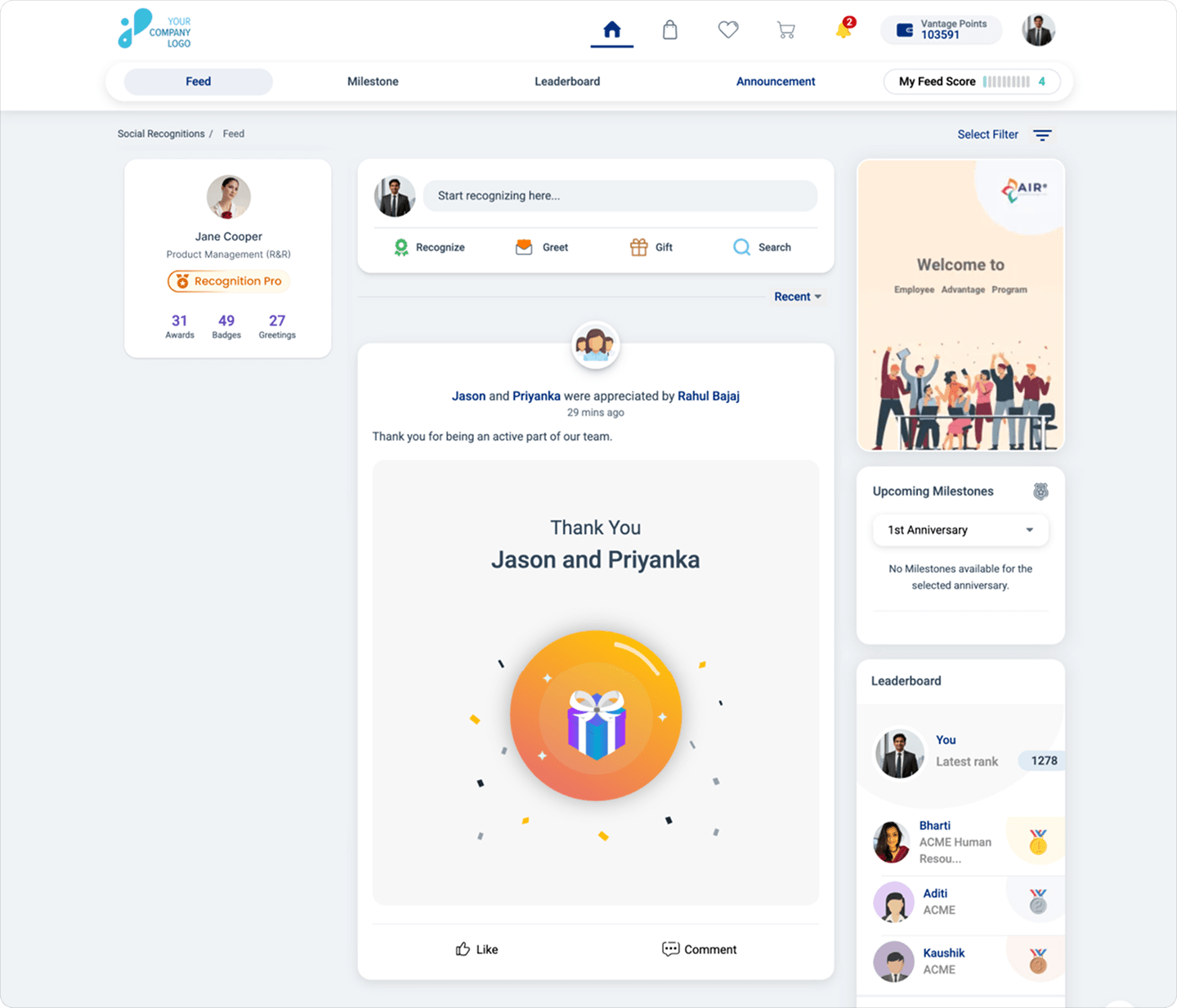
Shift-based teams rarely overlap with a manager long enough for formal recognition to happen the way it does in a salaried office. Peer-to-peer recognition lets a colleague acknowledge good work the moment it happens, sent instantly from a phone, even across a shift handoff, without waiting for a schedule overlap that may not come for days. That immediacy matters more in hospitality than in almost any other industry.
2. Low-Cost Perks and Discounts for Hourly Staff
Hourly and frontline hospitality staff are the least likely group in most companies to have discretionary budget for wellness or lifestyle spending, which is exactly why low-cost, high-frequency perks matter here: ongoing discounts on everyday spending close that gap without requiring a base-pay increase the business may not be able to sustain across every shift.
3. Compensatory Time and Flexible Scheduling
A hospitality shift runs on the guest's schedule, not the employee's, which makes rest one of the few rewards that actually lands. Offering compensatory time off, or letting a top performer set their preferred shift for a week, communicates trust in a way a gift card can't. It also costs the business little beyond the scheduling flexibility to grant it.
4. Friendly, Trackable Competitions Across Shifts
A well-structured competition, tracked across morning, evening, and overnight teams rather than confined to one shift, gives hourly staff a visible, short-term goal that a monthly engagement survey never will. Keep the metric simple, guest-facing, and something every shift has an equal shot at, so the overnight team isn't structurally locked out of a contest built around daytime foot traffic.
5. Development Pathways for Hourly Employees
Many hospitality careers start at the front desk or the server line and grow from there, but only if the path forward is visible. Naming the specific skills that separate an hourly associate from a shift lead, and providing training built around those skills, turns "limited career growth" from a named challenge into a program hourly staff can actually see themselves progressing through.
6. Structured Communication Across Shift Handoffs
The handoff between shifts is where hospitality communication breaks down most often: a maintenance issue, a VIP guest note, or a staffing gap gets mentioned verbally and then lost. A shared, persistent communication channel that every shift can read before clocking in closes that gap without requiring shifts to overlap in person.
The 2025 International Journal of Contemporary Hospitality Management study on restaurant worker retention backs up why these six levers matter: work engagement, not pay alone, was the strongest predictor of whether a restaurant employee intended to stay. Recognition, flexibility, and communication built for the shift are what move that engagement number.
How Vantage Circle Supports Hospitality Employee Engagement
Vantage Circle supports hospitality employee engagement through five specific features built for shift-based, hourly, and frontline teams rather than a single generic engagement dashboard.
| Vantage Circle Feature | Hospitality Use Case |
|---|---|
| Vantage Recognition (Peer-to-Peer & Manager Recognition) | Lets a colleague or shift supervisor recognize good work the moment it happens, across shift handoffs |
| Vantage Pulse (eNPS surveys & anonymous responses) | Pulse-checks engagement across shift patterns instead of relying on an annual survey hourly staff skip |
| Vantage Perks | Gives hourly staff ongoing discounts without requiring a base-pay increase |
| Long Service Awards | Marks tenure milestones formally in a sector where most hospitality staff never reach one |
| Recognition Analytics | Shows HR leaders whether recognition frequency is actually correlated with lower turnover at the property level |
Hospitality's poor-working-conditions and communication-gap challenges are hard to surface through an annual engagement survey that hourly staff mostly skip. Vantage Pulse's frequent, anonymous check-ins, built as an eNPS (employee Net Promoter Score) model, catch these issues on a shift-by-shift cadence, while there's still time to act on them.
High turnover means most hospitality tenure milestones go unmarked entirely. Formal long-service recognition gives hospitality operators a structured way to reward the staff who do stay, reinforcing retention among exactly the workers most likely to leave within that first year, per the Deloitte turnover data cited earlier.
Reducing that turnover starts with the same staff retention strategies that work across industries, adapted for a shift-based workforce rather than a desk-based one. To see how Vantage Circle's features apply to your specific property or portfolio, schedule a free demo.
FAQs About Employee Engagement in the Hospitality Industry
1. What does employee engagement in the hospitality industry look like in practice?
In practice, it looks like a housekeeping associate recognized by a peer for catching a maintenance issue before a guest complained, a server given compensatory time after a double shift, and a front-desk team that receives the same weekly update as the overnight team, rather than three separate versions of the same news.
2. Why is employee engagement important in the hospitality industry specifically?
Guest satisfaction in hospitality is delivered almost entirely through direct, personal contact with frontline staff, so a disengaged employee shows up immediately in the guest experience in a way it doesn't in back-office work. Combined with a 4.3% monthly quits rate in accommodation and food services (BLS JOLTS, 2026), the cost of disengagement compounds through constant rehiring and retraining.
3. How much budget should hospitality businesses allocate to engagement programs?
There is no fixed industry benchmark, but the highest-value spend for hospitality specifically goes to low-cost, high-frequency levers, peer recognition, small perks, and compensatory time, rather than a single large annual event. These match the constraint that most hospitality budgets are already tight and the workforce is paid hourly.
4. What does an employee engagement plan for hospitality teams look like in 2026?
A 2026-ready plan is built around shift-level delivery rather than a single company-wide cadence: recognition that works across shift handoffs, pulse surveys frequent enough to catch a shift-specific issue, and development pathways that hourly staff can actually see themselves moving through, rather than a plan designed for a salaried office and applied to hospitality unchanged.
Conclusion
Most hospitality engagement programs fail for the same reason: they're built for a workforce that sits at a desk, checks the same intranet, and overlaps with its manager every day, and none of that describes a hotel floor or a restaurant line. Closing that gap means engagement built for the shift: recognition that works across handoffs, perks sized for hourly pay, and a pulse survey frequent enough to catch a problem before the next 4.3% of the workforce walks out the door.

Susmita Sarma is a Digital Marketer at Vantage Circle, making employee recognition less of a checkbox and more meaningful - helping organizations say we value our people and truly mean it.
Connect with Susmita on LinkedIn.