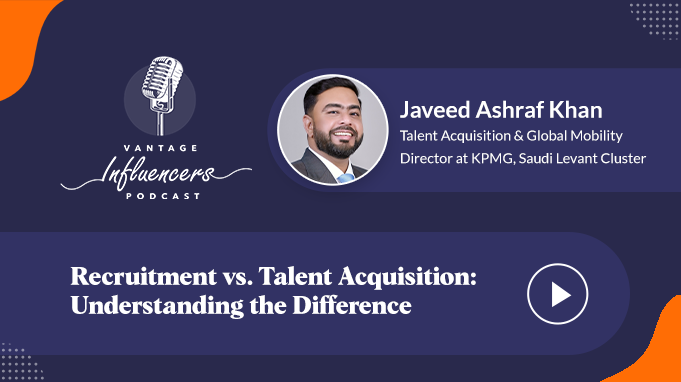
Recruitment vs. Talent Acquisition: Understanding the Difference
Episode Overview
Javeed Ashraf Khan opens by drawing a sharp line between recruitment and talent acquisition, arguing that the two get used interchangeably far too often when they describe fundamentally different postures toward hiring. Recruitment, in his framing, is transactional: you have a seat to fill and you fill it as fast as possible. Talent acquisition is strategic: it's about building relationships with people an organization might need a year or two down the line, and aligning that pipeline with where the business is actually heading rather than only what it needs today. He traces recruiting back further than most conversations do, describing it as one of the oldest human activities, and argues the real inflection point came when organizations realized reactive hiring was quietly costing them long-term capability instead of building it. For him, the sharpest dividing line between the two approaches is candidate experience: recruitment tends to leave candidates chasing feedback that never arrives, while a genuine talent acquisition process keeps them informed and respected throughout, and he insists that responsibility belongs to the whole organization, not just to a recruiter's scorecard.
He then extends the conversation into imposter syndrome, which he says surfaces almost exclusively in high performers on both sides of the hiring table. Talented candidates talk themselves out of applying for roles they'd excel at, while anxious hiring managers overcorrect by second-guessing strong candidates or defaulting to people who remind them of themselves, quietly narrowing the diversity of the teams they build. His fix leans on a story from his own recruiting practice: sending a hesitant hiring manager on a CV-free "blind date" interview to prove that hesitation, not the candidate pool, was the real obstacle. He closes by mapping out where he thinks hiring is headed next: rethinking rigid operating models instead of assuming one structure fits every role, treating AI as a tool that sharpens judgment rather than a threat to jobs, investing as much in retaining people as in recruiting them, and building an employer brand that's authentic rather than scripted.
Episode Highlights
- Javeed Ashraf Khan draws a clear line between recruitment, which he calls transactional hiring to fill an open seat fast, and talent acquisition, which is about building relationships with people an organization might need a year or two down the line.
- He traces recruiting back to some of history's oldest civilizations and argues the real shift toward talent acquisition happened once organizations realized reactive hiring was quietly costing them long-term capability.
- Candidate experience, not tooling, is the clearest dividing line he sees between the two approaches, and he insists it's the whole organization's responsibility, not just a metric on the recruiter's scorecard.
- Imposter syndrome, he says, shows up almost exclusively in high performers: capable candidates talk themselves out of applying, while anxious hiring managers reject strong candidates or default to people who remind them of themselves.
- He shares how sending a hesitant hiring manager on a CV-free "blind date" interview solved a run of unexplained rejections, proving the block was the manager's own hesitation, not the candidate pool.
- Looking ahead, he points to rethinking hiring operating models, treating AI as a judgment aid, investing in employee development to slow attrition, and building an authentic, unscripted employer brand.
About the Guest
Javeed Ashraf Khan, Talent Acquisition & Global Mobility Director at KPMG Saudi Levant Cluster
With a robust background that spans roles at IBM, a startup digital bank in Saudi Arabia, and Mastercard, Javeed excels in integrating innovative HR technologies and driving strategic recruitment initiatives. His expertise includes developing targeted operating models and promoting diversity and inclusion, significantly improving operational efficiency and workforce diversity. Recognized as a Top Global TA Voice on LinkedIn and an HR Influencer by the Economic Times, Javeed is committed to shaping transformative HR practices that align with corporate goals and cultural nuances in the Middle East and Africa.
Connect with Javeed on LinkedIn
Host
Susmita Sarma, Vantage Influencers Podcast Host
What You Will Learn
- The core difference between recruitment and talent acquisition, and why treating them as the same thing costs organizations long-term capability
- Why candidate experience, not process speed, is the clearest signal of a mature talent acquisition function
- How imposter syndrome affects candidates and hiring managers differently, and why it tends to strike high performers rather than average performers
- A practical way to get a hesitant hiring manager to trust a candidate before a CV ever enters the conversation
- Why employer branding works like product research for candidates, and what happens to organizations that neglect it
- What a future-ready talent acquisition operating model needs, from AI adoption to employee development to genuine agility
Key Topics & Timestamps
| Timestamp | Topic |
|---|---|
| 00:30 | Susmita introduces guest Javeed Ashraf Khan |
| 01:15 | Javeed's professional journey through the UN, IBM, Mastercard, and a Saudi startup bank |
| 03:40 | How recruiting evolved from an age-old, transactional practice into strategic talent acquisition |
| 08:56 | Why organizations need a deliberate balance between recruitment and talent acquisition |
| 11:55 | How imposter syndrome shows up differently in candidates and in hiring managers |
| 19:14 | Why employer branding shapes recruitment and talent acquisition in different ways |
| 24:52 | Javeed's vision for where recruitment and talent acquisition are headed next |
Full Transcript
Click to read the full episode transcript
Welcome to the Vantage HR Influencers Podcast. This podcast is sponsored by Vantage Circle, the simple and AI-powered rewards and recognition platform for employee engagement.
Susmita Sarma: Hello and welcome everyone to a brand new episode of the Vantage Influencers Podcast. In today's episode, we'll be diving deep into a topic that's often misunderstood: the fundamental differences between recruitment and talent acquisition. I'm your host, Susmita, and joining me today is an esteemed guest, Javeed Ashraf Khan. Javeed is the Talent Acquisition and Global Mobility Director at KPMG's Saudi Levant Cluster. Welcome, Javeed. It's great to have you on our podcast today.
Javeed Ashraf Khan: Thank you, Susmita. It's a pleasure, thank you so much for having me. How are you doing?
Susmita Sarma: I'm doing very well, thank you very much. I think it's a time when recruiting and talent acquisition are so much better than before, so we're enjoying ourselves. But before we delve into our discussion on recruitment versus talent acquisition, could you share a bit about your professional journey and experiences in this field, Javeed?
Javeed Ashraf Khan: Absolutely, more than happy to. It's about 20-plus years, but I'm going to shorten it and not bore you with too many details. From my growing days, I always wanted to do something that was people-centric. Everybody says it's become a cliché, but I've always stuck to doing this. When I first started work, I worked for the United Nations, that was my first job right after college. Then I went to work for a call center called America Online. Neither of those was HR or talent acquisition. Then I stumbled onto talent acquisition, or recruiting, in the early 2000s with IBM, and I fell in love with this profession, the profession that basically helps people find a career or a direction for their lives, and is also a way of providing for their families. I just loved it. I worked for IBM for close to 14 years, half of it based out of Bangalore, though I was always traveling around most parts of India. Then I moved to Dubai in 2012, managing IBM's Middle East and Africa portfolio. While I was at IBM for all those years, I was also lucky enough to work as a consultant, handling external clients and delivering HR and talent acquisition projects for them. Then I came back to internal HR with Mastercard, and after that I did a startup, a bank in Saudi Arabia. That was a completely different experience of talent acquisition altogether, building up a brand-new people team, going from me being employee number five to about 200 employees in about eight or nine months. And then I went to work for KPMG. That happened in 2021, and I'm still with KPMG, managing talent acquisition, retention, engagement, and so on. That's what I'm doing right now.
Susmita Sarma: That really sounds like a very enriching journey, Javeed.
Javeed Ashraf Khan: Thank you.
Susmita Sarma: It's fascinating to see how you've evolved over the years. And speaking of evolution, could you share insights on how you've seen recruitment and talent acquisition evolve throughout your career?
Javeed Ashraf Khan: Well, it's not just my career, right? If you look at recruiting, let me start there, I'll come to talent acquisition because that's a much newer, relative term that's started to gain prominence in the last couple of years. But recruiting is a very, very old profession. Let me ask you this: the Egyptian civilization is one of the oldest civilizations, and when they were building the pyramids, they were still recruiting people to do that. Imagine the job description: find me a man who's about twelve years old so he can come and work on the pyramids, find me a woman who has strong attributes to do this kind of job. So recruiting is a very age-old profession we've been doing, though of course we don't hire the way the pyramid builders or their supervisors did. It's come a long way and taken a dramatic turn in its evolution. Now, what's recruiting? It's very transactional in nature. You're going after a job, a seat you need to fill as soon as possible, and that's how it works. If you look at recruiting pre-internet, it was through newspapers and manual resumes and so on. With the advent of the internet, the landscape changed to online jobs, tracking systems, ATS systems, and more efficient recruitment processes. The real shift came when organizations started to understand that recruiting alone wasn't enough, because recruiting is reactive and superficial, you're just filling a job and forgetting about the process behind it. That's when talent acquisition started to take more prominence, because it's far more strategic. It's about building relationships, not just about the candidate you need now, but whether you could use this candidate a year or a year and a half later, and it's worth nurturing a pipeline of candidates. This needs to align not just with your organization's current need, but with its future goals. Now, slowly, we're seeing talent acquisition as an HR profession also getting shaped by AI, data, and analytics, with various external tools coming in to help make it more targeted and precise, which is a key difference from recruiting. And I always feel the key factor here is candidate experience. What's a candidate's biggest issue with a recruiter? Not getting a response, not getting feedback, not knowing what's happening in their process. So in talent acquisition, the candidate has more power and is far more aware of the process they're going through on their way to being selected or recruited by the organization. Those are some of the key differences between recruiting and talent acquisition. From the time it built pyramids till today, recruiting has definitely been part of everybody's life, and for me, it's not just the hiring manager or the recruiter, the entire organization is a recruiter in itself. That's why employer branding plays such a critical role, because once you understand what you are as a brand and what your future looks like, everybody becomes a potential talent scout who feeds into bringing good talent into the organization. It's not just the recruiter's KPI, it's the organization's KPI to nurture and build great talent. So that's the evolution in a nutshell, from newspapers and the pyramids to today's HR tech platforms like PeopleStrong, Oracle, SAP, and SuccessFactors, and every day there's a new tool claiming to have a great algorithm to shortlist candidates better. But you've got to understand it's not just about finding talent, it's about nurturing talent through the acquisition process, and your job doesn't end the day the candidate joins. It's an ongoing process, and that's the major evolution we're seeing these days.
Susmita Sarma: So there's been significant transformation in this. And organizations, I imagine, are best served by understanding the difference between recruitment and talent acquisition, isn't it?
Javeed Ashraf Khan: They do, right. They understand: if I need to do senior hiring, I need a different team, an executive recruiting team. If I need to do a lower-level job, there's a different team. If I want to do campus hiring, there's a different team. Organizations definitely understand the value, but they need to be able to bring a balance between the two.
Susmita Sarma: Exactly, that's what I wanted to ask: is there value in maintaining a balance between recruitment and talent acquisition efforts?
Javeed Ashraf Khan: A hundred percent, Susmita, you definitely need that balance. You don't need every job to be proactive and strategic. There are going to be jobs where you just need to be a recruiter and get the person hired quickly, managing the average time to hire and so forth. But there are also going to be strategic, proactive aspects, where you're looking at a high-potential person in your organization who hasn't officially resigned, but you sense they're a high performer who might not stay long because high performers are always headhunted by the competition. As a recruiter, you start thinking you should build a pipeline for that. That's how organizations need to start balancing an immediate need against what the future is going to look like. Ninety percent of the time, and this is something I always tell recruiters, ask yourself how much time you spend with your hiring managers. When we do the job briefing, we spend time, sure, but you need to spend time with your hiring managers and leadership understanding what they're doing for their business, how they're making money, what goals and KPIs they're working toward. Two things happen when you do that: one, you become a better recruiter because you can give candidates much better information about the organization, and two, you become a subject-matter expert in the business you're recruiting for, so you can say, these people are winning these kinds of projects, and I want to build a pipeline and find this kind of talent, figure out where to find it, and understand what the competition is doing. This kind of thinking is very much needed. The balance has to come from both sides: the hunger from the recruiting or talent acquisition team to spend this time, learn, and sharpen their skills, and the organization itself needs to see talent acquisition as a strategic team rather than a purely transactional one. Neither side gets it for free, you have to work hard to build that relationship and that trust with your organization and your hiring managers. It's as important for recruiters to balance this as it is for the organization and its leadership. Only then does this partnership succeed. Otherwise it always turns into "you did it," "I didn't do it," "you didn't listen to me," which isn't healthy for a talent acquisition team.
Susmita Sarma: That's quite a pragmatic approach, I appreciate that, Javeed. Moving toward a slightly different angle of this discussion: imposter syndrome. How do you think this affects recruitment and talent acquisition practices, both for candidates and hiring managers?
Javeed Ashraf Khan: That's a very good question. I think every one of us has some imposter syndrome in us. Let's break it down into candidates and hiring managers, the two parties who make this marriage happen and come together to work for an organization. If candidates have imposter syndrome, they won't apply for jobs where they might be an amazing fit. They think, maybe I don't have the scale, maybe I'm not in that industry, and so on. This imposter syndrome, interestingly, only happens to high-performing individuals and achievers, an average candidate typically doesn't experience it. A few things happen as a result: they don't think they're qualified enough to apply, or they think, let them get in touch with me, why should I reach out, maybe I'm not good enough, or they decide to wait for the next opportunity. When this happens, they're missing out on great opportunities. It's a risk you have to take, but at least if you're applying, having conversations with recruiters, going through first interviews, your confidence around this imposter syndrome starts to fade. It might not disappear, but you start to see that you might be doing just fine, and it's your own thinking or holding yourself back that's causing the trouble. What I always tell candidates showing signs of this is, what's the worst that can happen? They'll say no, and you'll have a better opportunity elsewhere. That's the worst case. Now, from a hiring manager's side, imposter syndrome can manifest as over-caution: not knowing if a candidate is good enough, not knowing if they themselves are capable of managing that candidate, wondering if they should look at someone else, maybe someone more like themselves. This over-caution shows up in recruiting in a few ways. You might have a great candidate right in front of you, but you say you don't think you can manage them, and you lose that candidate. You also increase your average time to hire because you're simply not able to make a decision, fear kicks in, and you miss a lot of opportunities. You might also miss out on a diverse pool, because you think hiring someone who thinks and talks like you, or comes from your own college, will be easier to manage, and then you build a team that looks just like you and struggle to generate new ideas. That's what imposter syndrome does on the hiring manager side. If you want to mitigate it, you build a beautiful, inclusive culture. There are training programs and a lot of research available on this specific issue in recruiting, which can help organizations change how they approach it, but open communication and positive reinforcement matter most, and talent acquisition plays a big role there too. I'll give you an example: at one point I had a run of CV rejections from a hiring manager, and I soon realized it wasn't the quality of the CVs, it was the hiring manager's own imposter syndrome causing the issue. So I went to the hiring manager and said, don't worry about this, I don't want you to shortlist any resumes. Trust us, we'll send you on a "blind date" with a candidate, not with anybody else, just go meet the person, I won't give you the name or the resume or anything. This is a potential candidate for the job you have, go meet them, come back, and tell me how it felt. He came back and told me that's exactly the candidate he wanted. So you have to get proactive and creative. You can't keep living with a hiring manager's imposter syndrome, that's something you can fix. You can't really fix a candidate's imposter syndrome as a recruiter or talent acquisition lead, because you don't control it until someone applies and says they want to be part of your organization. But there are ways to approach a few of those candidates and say, I looked at your profile, I think you'd do really well, here's where I think you could add value, so why don't you come and apply with us. So you can do a lot on that front. There's more I could share, but that's broadly how imposter syndrome is affecting our lives these days.
Susmita Sarma: And in the case of HR professionals who carry this, I think it's mostly unconscious, isn't it?
Javeed Ashraf Khan: Correct, you're very right. First of all, I think we need to tell ourselves that HR is not a support organization, it's not a cost center. Those are terms firms and organizations use about HR: oh, they're a support organization, they'll do what we tell them to. No, I think the first thing you need to tell yourself is that you're the team building the future, the culture, and the talent of an organization. How can you just be a support organization? You need to feel that empowerment, you need to feel enabled to make those kinds of decisions. This isn't easy, it's a cultural aspect that's been building for years and years. When an escalation comes from a hiring manager, HR tends to start panicking, and I think that needs to change too. It's just a question, not necessarily an escalation, about why and how people are doing what they're doing, so I don't think we should treat it as an escalation. But you're very right, Susmita, until we take it out of our heads that we're a support function or a cost center that doesn't generate revenue for the organization, that mindset isn't going to change. Imagine if you don't get the people the organization needs, if you don't manage them well, engage with them, retain them, or pay them properly, how is the organization going to work? So which is the most important team in the organization? Human resources.
Susmita Sarma: Right. But either way, imposter syndrome is a very significant barrier to success if left unaddressed.
Javeed Ashraf Khan: A hundred percent.
Susmita Sarma: Let's shift our focus to employer branding. You've touched on it a bit in one of your previous answers, but how do you think employer branding influences recruitment and talent acquisition differently, and what can organizations do to leverage it effectively?
Javeed Ashraf Khan: Loaded question, but a very important one, especially in this day and age. Take an example of organizations that have gone out of existence. In India, my dad used to work for a well-known Indian watch brand, and I'm only using my own examples here because I don't want to hurt anyone's sentiments through this podcast. Have you heard of them?
Susmita Sarma: Yeah.
Javeed Ashraf Khan: Right. So that watch brand didn't put much effort into employer branding, or branding in general. They assumed it would sell itself. It didn't. Titan came in and took the market away from them, and they went out of business completely. There could be many other reasons why they went out of business, but from my own lens, that's one factor: they couldn't manage their brand. Even today, what do you do first, even for something as simple as a product purchase? You go online and research it, even if it costs a couple of thousand rupees. Today, when somebody wants to make a career change, they go online. They check employer review sites, professional community apps, and social media platforms like LinkedIn, and so on. They do a lot of research before joining an organization. Even today, when somebody writes to me saying, Javeed, we might be interested in you, would you like to make a change, I first ask them to tell me the brand they're recruiting for, and I do my own research before saying yes or no. That's how I approach my own career moves. This matters because if you don't consistently communicate your values and culture through social media, career pages, and, very importantly, genuine employee testimonials, not scripted ones, how will the world know what kind of culture and values you have? And if you don't engage your candidates through various approaches, not just moving them through a process but keeping that pipeline warm for the future, how will they know they need to be part of this organization? The recruiter handles this so much, and they're the first face of the company for anyone, and then the experience itself matters just as much. It's about building a long-term reputation, Susmita. It attracts and retains top talent. Employer branding influences so many areas, but since we're talking recruiting and talent acquisition today, and because I come from that background and I'm deeply passionate about recruiting above everything else: if you don't have a way to communicate where you're investing, how you're developing people, how you're recognizing them, the outside world isn't going to come and join you, and they're not going to want to invest their careers with you. It's not like the old days when people spent fifteen or twenty-five years in one organization. That's changing with today's workforce. The first filter for them isn't whether they're paid well or working on something amazing, though those matter too, it's whether they're having a great time in the job, because most of their time is spent in the office or with colleagues. Are they enjoying the culture and the values of the organization? Are they contributing to something? That's why employer branding becomes so important, communicating a true story, not a scripted one, and constantly watching for shifts in what today's employees want.
Susmita Sarma: Very true. I think about average tenure, and LinkedIn gives you great insights there. I was looking at an organization recently, and their insights showed an average employee tenure of just one year.
Javeed Ashraf Khan: What does that say? It says either you have a bad culture and that's why everyone's leaving after a year, or something's wrong that you need to fix, or employees aren't sticking around because they don't feel engaged. That's how organizations need to look at average tenure, to understand where their brand stands. Is your brand emotionally connecting with your employees? Is it connected with the community and the broader environment you operate in? Are your goals aligned with where the country or the wider industry is heading, are you ESG-enabled, and so on. There's a lot that needs to happen there.
Susmita Sarma: Brilliant advice, Javeed. And finally, let's talk about the future outlook. What is your vision for the future of recruitment and talent acquisition, and how can organizations prepare for it?
Javeed Ashraf Khan: There's so much more to do here, we haven't even fully figured out whether the current algorithms are the right or wrong way to do this. I think the first thing every talent acquisition leader, every person involved in strategic output, should do is look at their current target operating model: do you have a model where sourcing, scheduling, and offers are handled separately, or a model that's 360 in nature, where one recruiter spends end-to-end time with the hiring manager from the hire through to onboarding? Look at the target operating model, there are various models you can apply, you don't need a one-size-fits-all approach. You can run multiple target operating models within a single organization, whichever works best for recruiting and for talent acquisition in that context. So the first item sits with talent acquisition leaders. Second, embrace technology, it's not going to take away your jobs. I think recruiters have one of the safest jobs out there. Recruiters will use AI to shortlist resumes, but they're not going away. I'll give you an example: the largest, most branded aviation company here in the Middle East uses AI for shortlisting candidates, but they still have a "maybe" category that recruiters have to look at personally. So the jobs aren't disappearing. I don't think AI is going to replace any of us anytime soon, not until we have an android sitting there shortlisting or calling candidates, which isn't happening. But we do need to embrace the change, utilize machine learning and AI concepts for sourcing, screening, and engagement, while keeping the human touch for everything else. The other piece is enhancing your employer branding, continuously building a very authentic employer brand that resonates with candidates, the community, hiring managers, and everyone in that ecosystem. Don't script it, be authentic, so people connect with the human behind the brand rather than a script. Invest in employee development too, it's not just one road coming into your company. There has to be a place where employees feel they're continuously learning, that their career is growing, that they want to stay, which reduces your biggest attrition problem. It won't stop the leaking bucket entirely, if you keep leaking from the bottom and keep recruiting, there's never an end to it, but it'll meaningfully reduce the leak. And you need to be agile. There are so many changes happening in the market and so many emerging trends in the workforce that you need to stay on top of. For example, on my team, one recruiter's stretch assignment is running our Thursday team meeting: every Thursday, my entire team gets on a call no matter where they are in the world, and one recruiter gets fifteen minutes to share what's happening in the market, emerging trends, what other recruiting organizations and agencies and freelance recruiters are doing, whatever they can research using the internet or AI tools, and they present it to the whole team. It rotates, so everyone gets to do it, and it builds a learning environment around all of this. So: target operating model, technology, employer branding, employee development, and agility. There's one more that's become a bit of a cliché because everybody talks about it, so I won't spend too much time on it, diversity and inclusion. I think that's become part of the DNA of having an inclusive and diverse work culture at this point. So those, I think, are the future of recruiting and talent acquisition, and you need to be very approachable and very holistic across all of these aspects.
Susmita Sarma: It has been an absolute pleasure delving into the world of recruitment and talent acquisition with you today, Javeed. I'm confident our conversation will be both informative and valuable to the organizations and recruiters tuning into this podcast. Looking forward to another possibility of having you join us for another episode in the future. Take care, and have a wonderful day.
Javeed Ashraf Khan: Thank you for having me, Susmita. It's been great to share these perspectives, and I'm always so passionate about this profession that I could keep talking about it. So, happy recruiting, and take care of yourself.
FAQ
What is the difference between recruitment and talent acquisition?
According to Javeed Ashraf Khan, recruitment is transactional, filling an open seat as quickly as possible, while talent acquisition is strategic, focused on building relationships with candidates an organization might need in the future and aligning hiring with long-term business goals rather than only immediate openings.
How does imposter syndrome affect candidates and hiring managers differently?
Javeed Ashraf Khan explains that imposter syndrome mostly affects high performers on both sides. Capable candidates talk themselves out of applying for roles they'd be great at, while hiring managers with imposter syndrome become overly cautious, second-guessing strong candidates or defaulting to people who resemble themselves, which narrows the diversity of the teams they build.
Why does employer branding matter for recruitment and talent acquisition?
Javeed Ashraf Khan compares employer branding to product research: candidates now research organizations online before applying, the same way shoppers research products before buying. Without consistent, authentic communication about culture and values, organizations struggle to attract and retain talent, regardless of how strong their recruitment or talent acquisition process is.
What does Javeed Ashraf Khan see as the future of talent acquisition?
He points to five priorities: rethinking rigid target operating models, embracing AI and technology as tools that support recruiters rather than replace them, building an authentic (not scripted) employer brand, investing in employee development to reduce attrition, and staying agile as workforce trends keep shifting.
Related Reading
Also listen on