
The employer-employee relationship is the foundation everything else at work is built on. Legally, it is the bond between a business and the people it hires, defined by who selects the worker, who pays them, who can dismiss them, and who controls the work. In practice, it is about trust. This guide covers what the relationship is, the four elements that define it, the main types, why it matters, and the practical steps HR leaders use to make it stronger.
Key Takeaways
- The legal definition of the employer-employee relationship and the four-fold test.
- How to distinguish an employee from an independent contractor.
- The four main types of employer-employee relationships.
- Why a strong relationship drives engagement, retention, and advocacy — with sourced data.
- Five practical steps HR leaders use to build and strengthen the relationship.
- Common challenges and how to overcome them.
What Is an Employer-Employee Relationship?
The relationship is also called a contract of service or an employment relationship. It creates rights and obligations on both sides: the employer provides work, compensation, and a safe environment; the employee provides skills, effort, and professional conduct. The Fair Labor Standards Act (FLSA) governs minimum wage, overtime, and related protections for workers in a recognized employment relationship in the United States.
The Four Elements of the Employer-Employee Relationship
Courts and regulators worldwide use a four-factor test to determine whether an employer-employee relationship exists. The U.S. Department of Labor and the Internal Revenue Service both rely on versions of this test. In jurisdictions that follow the four-fold test, all four elements are assessed together — no single factor is conclusive.
| Element | What It Means | Why It Matters |
|---|---|---|
| Selection and Engagement | The employer chooses the worker and brings them into the organization through a hiring process. | Establishes the employer's authority to set expectations from day one. |
| Payment of Wages | The employer pays the worker a salary, hourly wage, or agreed compensation — not a project fee to a business. | Distinguishes an employee from a vendor; triggers payroll tax and benefit obligations. |
| Power of Dismissal | The employer has the right to end the relationship for cause or under the terms of the employment agreement. | Establishes accountability and frames disciplinary frameworks. |
| Control Over Work | The employer directs how, when, and where work is performed — not just the result, but the method. | The most decisive factor: if the employer controls the process, a contract of service exists. |
Employee vs Independent Contractor: Why the Distinction Matters
Not every working relationship is an employer-employee relationship. Independent contractors operate as their own businesses, control how they deliver results, use their own tools, and typically work for multiple clients. Employees work under the employer's direction, on the employer's schedule, and with the employer's resources.
The distinction matters for tax withholding, benefit eligibility, and legal protections. The IRS uses a three-category test (behavioral control, financial control, and type of relationship) to determine worker classification. The DOL applies the economic reality test under the FLSA. Misclassifying an employee as a contractor exposes a business to back taxes, penalties, and benefit claims.
Types of Employer-Employee Relationships
The employer-employee relationship is not one-size-fits-all. The legal basis, duration, and nature of the work shape how the relationship is structured.
| Type | Description | Example |
|---|---|---|
| Permanent (Full-Time) Employment | An ongoing contract of service with no set end date. The employee works regular hours and receives full benefits. | A salaried HR manager at a manufacturing company. |
| Fixed-Term / Contract Employment | A contract of service that runs for a defined period or until a specific project is complete. | A project manager hired for an 18-month ERP implementation. |
| Part-Time Employment | A contract of service with fewer hours than a full-time role. Employer still controls when and how work is done. | A customer service representative working 20 hours per week. |
| Casual / Gig Employment | Work performed on an as-needed basis, often without guaranteed hours. Classification varies by jurisdiction. | A delivery driver engaged through a platform; classification depends on degree of control exercised by the platform. |
For HR leaders, the type of relationship determines compliance obligations, benefit eligibility, notice periods, and what "building the relationship" even looks like. A permanent employee and a fixed-term contractor need different onboarding, feedback, and recognition approaches. Learn more about managing the broader scope of employee relations across different workforce types.
Why the Employer-Employee Relationship Matters
A functional legal relationship gets work done. A strong one drives business outcomes. The research across engagement, retention, and productivity consistently points to the same variable: the quality of the relationship between people and the organization they work for.
Engagement and Productivity
According to Gallup's research on employee engagement, highly engaged business units achieve 23% higher profitability and 18% higher sales productivity compared to disengaged ones. The Society for Human Resource Management (SHRM) found that a majority of employees consider their relationship with their employer to be directly tied to employee engagement and job satisfaction.
The mechanism is straightforward: when employees trust that the organization is invested in them, they reciprocate with discretionary effort — the work that goes beyond the job description.
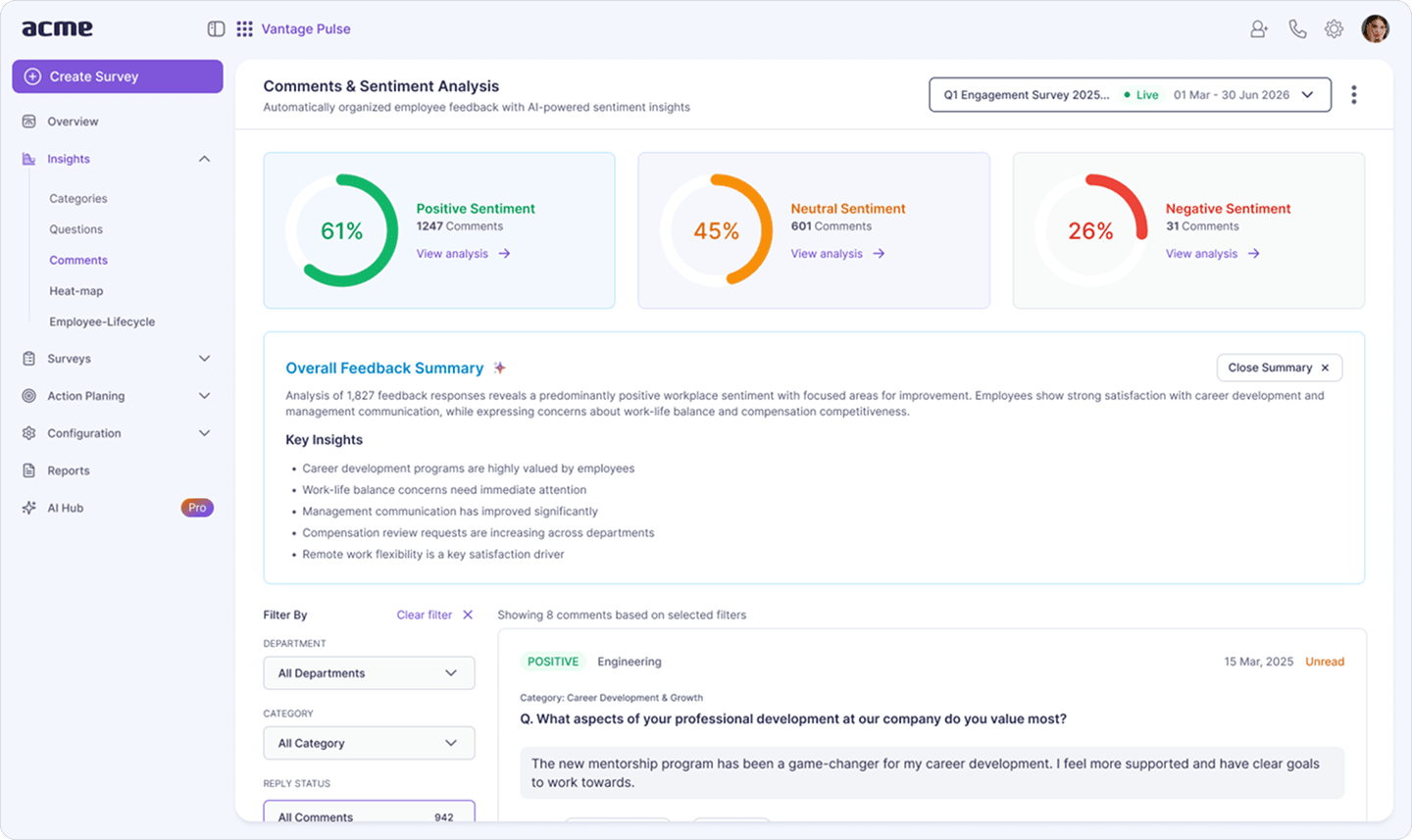
The health of the relationship shows up in one question: would employees recommend working here? An eNPS pulse turns that question into a recurring metric leaders can track, compare across departments, and act on before disengagement becomes attrition. Explore Vantage Pulse →
Retention and Fewer Disputes
McKinsey research identified a lack of meaningful work and weak manager relationships as two of the top reasons employees leave voluntarily. Organizations with strong relational cultures report lower voluntary turnover — and lower costs: the average cost of replacing an employee runs 50–200% of their annual salary, according to SHRM.
A strong relationship also reduces formal disputes. When employees feel heard and treated fairly, they raise concerns through internal channels rather than escalating them. See a deeper breakdown of employee retention strategies that reinforce this dynamic.
Culture and Employee Advocacy
A strong employer-employee relationship is the substrate company culture grows in. Culture is what employees experience and repeat; the relationship is what makes them willing to repeat it positively. Employees who trust their employer become voluntary advocates — sharing positive experiences externally, referring candidates, and representing the brand authentically.
The research consistently links a strong employer-employee relationship to measurable business outcomes:
| Benefit | What the Data Shows |
|---|---|
| Lower voluntary turnover | Employees who feel their employer cares about their well-being are 69% less likely to actively search for a new job. (Gallup, 2023) |
| Higher productivity | Highly engaged business units achieve 23% higher profitability and 18% higher sales productivity than disengaged ones. (Gallup, Meta-Analysis, 2023) |
| Fewer workplace disputes | Employees who feel heard and treated fairly raise concerns through internal channels rather than escalating them, reducing the frequency and cost of formal disputes. |
How to Build and Strengthen the Employer-Employee Relationship
A strong relationship does not happen by default. It is built through consistent, deliberate actions by HR leaders, managers, and the organization as a whole. These five steps represent the actions with the highest evidence base.
1. Communicate Openly and Often
Employees cannot trust an organization they do not understand. Transparent workplace communication — on business direction, role expectations, performance feedback, and organizational change — removes the ambiguity that erodes trust. Regular one-on-ones between managers and employees, honest company-wide updates, and clear escalation paths all signal that the employer values the employee's need to know.
The standard is not just frequency but quality: does the employee walk away from a conversation knowing where they stand and what is expected of them?
2. Build Trust and Psychological Safety
Trust is earned in the gap between what an organization says and what it does. When a company says it values work-life balance and then rewards overwork, the gap destroys trust faster than any single policy can repair it. Consistency between stated values and daily decisions is the most reliable builder of a strong relationship.
Psychological safety — the belief that one can speak up, disagree, or admit a mistake without punishment — is the trust component most directly linked to team performance, according to Google's Project Aristotle (2016). HR leaders can build it by modeling vulnerability at the top, setting explicit norms for constructive disagreement, and removing status-based silencing of junior employees.
3. Recognize Contributions Consistently
Recognition is one of the highest-ROI actions an employer can take to strengthen the relationship. When employees feel their work is seen and valued, they stay engaged, perform better, and feel a stronger sense of belonging.
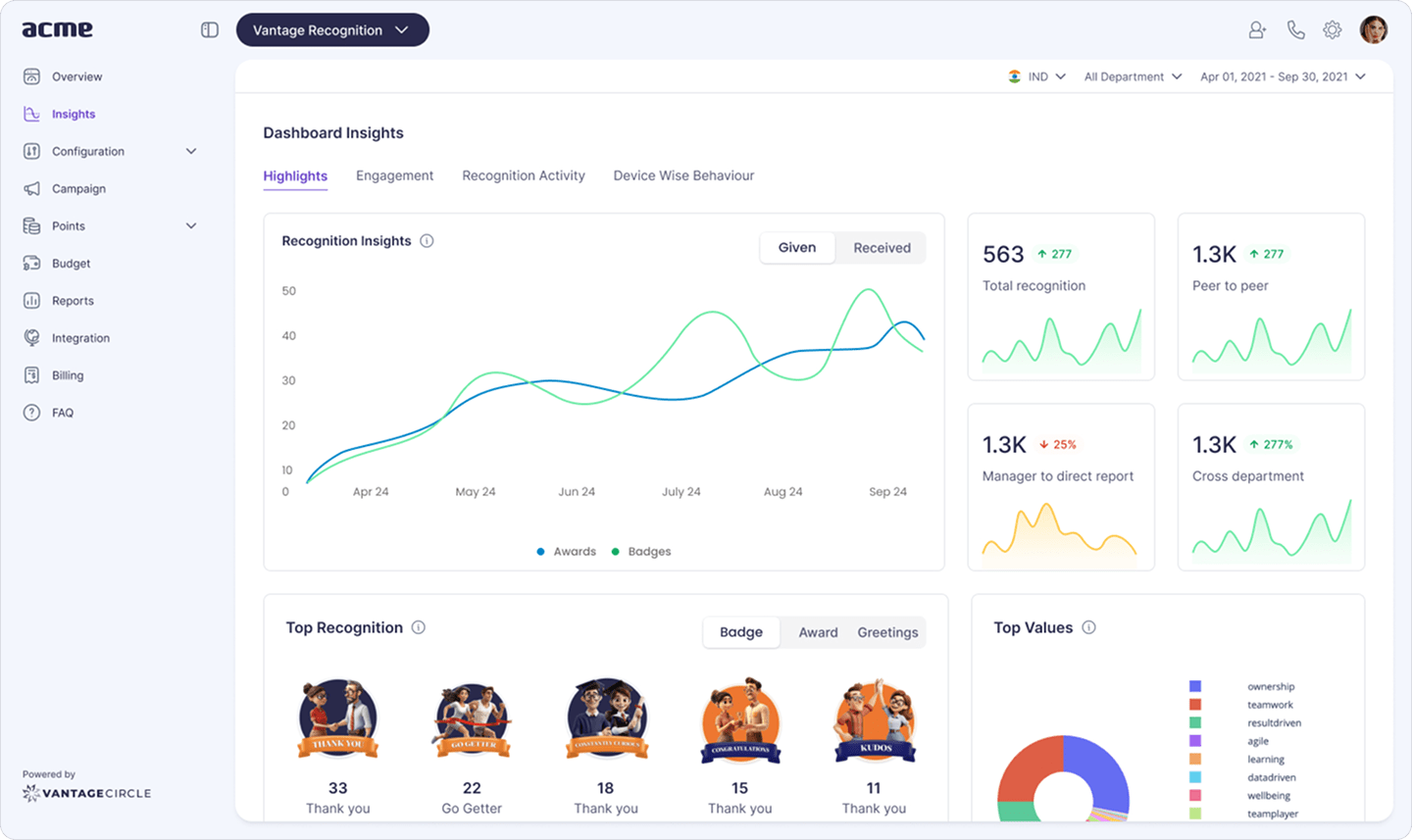
Effective recognition is frequent (not just annual), specific (tied to a behavior or outcome), and multi-directional (peer-to-peer, not only manager-down). A structured recognition program makes appreciation routine rather than dependent on an individual manager's habits. Manager and peer recognition together reinforce the bond at every level of the organization.
4. Invest in Growth and Well-being
A relationship is one-sided if the employer only takes. Investing in employees' professional growth (through learning opportunities, mentorship, and stretch assignments) and personal well-being (through mental health support, financial wellness benefits, and flexible work) signals that the organization sees the person, not just the role. Benefits that address financial stress — a leading driver of reduced focus and productivity — have an outsized impact on the perceived quality of the relationship.
5. Act on Feedback
Listening programs only strengthen the relationship when the employer closes the loop. An employee who completes a pulse survey and never hears what changed as a result learns that feedback is performative. Trust declines.
The pattern that builds trust is: ask, acknowledge, act, and report back. Anonymous pulse responses give employees a safe channel to be honest, which is where a stronger relationship starts. When HR shares what it heard and what it changed, even when the action is "we heard you and here is why we cannot change this right now," it demonstrates that the employer takes the relationship seriously.
Common Challenges and How to Overcome Them
Even well-intentioned employers face structural and situational challenges that strain the relationship. Recognizing these challenges early allows HR to intervene before they compound.
| Challenge | Impact on the Relationship | How to Overcome |
|---|---|---|
| Remote and hybrid work dynamics | Distance reduces visibility, slows communication, and creates feelings of isolation — particularly for employees who rarely meet their manager in person. | Build structured connection rituals (regular one-on-ones, virtual team check-ins, asynchronous recognition). Use a social recognition feed to keep remote employees visible and included. |
| Generational differences | Different generations have different expectations around feedback frequency, communication style, career progression, and the meaning of loyalty. | Train managers to flex their approach by individual, not by generational stereotype. Build multi-generational listening into pulse surveys. Create mentorship and reverse-mentorship programs. |
| Work-life boundary erosion | Technology and remote work blur the boundary between professional and personal time, leading to burnout and resentment — both of which directly damage the relationship. | Set clear policies around after-hours communication. Model boundary-setting at the leadership level. Offer flexible scheduling where the role allows it. |
| Mental health and well-being | Unaddressed stress, burnout, and mental health challenges reduce discretionary effort and increase absenteeism and turnover. | Provide access to employee assistance programs (EAPs), mental health days, and financial wellness benefits. Train managers to recognize early warning signs without diagnosing. |
| Rapidly changing expectations | Post-pandemic, employees recalibrated what they want from work: more purpose, more flexibility, and more transparency. Organizations slow to adapt face trust deficits. | Run regular expectation-setting conversations at the team level, not just in annual reviews. Use department-level pulse insights to surface where the gap between employer and employee expectations is widest. |
Frequently Asked Questions
1. What is the employer-employee relationship?
The employer-employee relationship is the legal and professional bond between a business and the people it hires. It is defined by four elements: selection, payment of wages, the power to dismiss, and control over how work is done.
2. What are the four elements of the employer-employee relationship?
Selection and engagement, payment of wages, the power of dismissal, and control over how work is done. Courts assess all four together — no single factor is conclusive on its own.
3. What is the four point test of an employer-employee relationship?
The four point test (also called the four-fold test) checks who selected the worker, who pays them, who can dismiss them, and who controls how the work is done. If all four point to the same party, an employer-employee relationship exists.
4. What do you call an employer-employee relationship?
It is also called an employment relationship or a contract of service. The term "contract of service" is more common in Commonwealth jurisdictions and distinguishes it from a contract for services, which describes an independent contractor.
5. How can employers improve the relationship with employees?
Communicate openly, recognize contributions consistently, act on employee feedback, invest in growth and well-being, and build psychological safety. The relationship strengthens when what the employer says matches what it does.

This article is written by Susmita Sarma. She is a Digital Marketer at Vantage Circle, making employee recognition less of a checkbox and more meaningful - helping organizations say we value our people and truly mean it.
Connect with Susmita on LinkedIn.