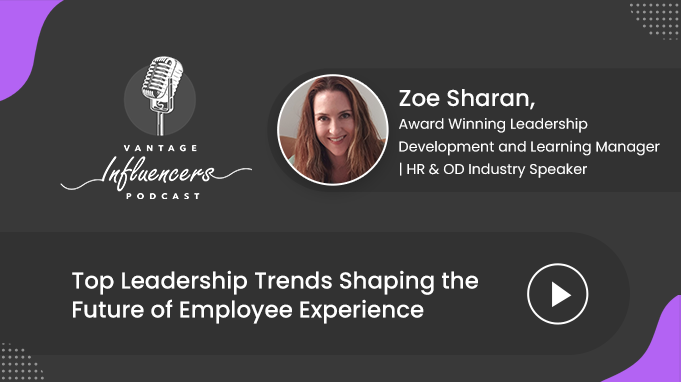
Top Leadership Trends Shaping The Future Of Employee Experience
Episode Overview
Zoe Sharan opens this conversation with a simple provocation: employee experience isn't something leaders can do to their teams, it has to be built with them. She traces how workplace leadership has moved away from rigid, hierarchical command structures toward styles built on transparency, trust, and genuine collaboration, and explains why so many leaders still default to old habits even when they want to change. Along the way, she unpacks the difference between collaboration that empowers a team and collaboration that collapses into decision paralysis, and shares a practical filter for deciding when a leader should invite everyone into a decision and when they should simply own it.
The conversation moves into how leaders handle emotion, transparency, and hard calls without losing their team's trust, including a memorable example of how the same piece of unwelcome news can be delivered honestly in ways that either bring a team closer together or drive it apart. Zoe also walks through the themes she sees shaping leadership right now: constant upskilling, deliberate trust-building, better delegation, and leaders showing up as authentic, human people rather than titles. She closes with a reflection on whether great leaders are born or built, a plain-language breakdown of the 70-20-10 learning rule, and concrete advice for anyone trying to future-proof their own leadership.
Episode Highlights
- Employee experience should be built with a team, not handed down to them; the fastest starting point is simply asking people what they need.
- Collaboration works best with a clear purpose behind it; over-inviting people to every decision creates paralysis instead of progress.
- Honesty doesn't mean sharing everything; leaders can be transparent about what they can't disclose without ever lying to their team.
- How a leader delivers unwelcome news matters more than the news itself, since the same fact can unite or divide a team depending on the framing.
- Showing emotion is no longer a weakness; authenticity now ranks among the top leadership skills that global research points to.
- Delegation, trust, and continuous upskilling are the leadership themes with the most staying power, more than any passing trend.
About the Guest
Zoe Sharan, Leadership Development, Learning & OD Professional
Zoe holds a Masters in Education (Organisational & Workplace Learning) and a Postgraduate Certificate in HR Management, with in-house consulting experience across construction, media, technology, electronics, telco, FMCG, and retail. She is an IECL Certified Organisational Coach with additional accreditations in Team Management Systems, Hogan Assessments, Conflict and Alternative Dispute Resolution, Psychology of Criminal Justice, Korn Ferry Leadership Architect (Lominger), PROSCI Change Management, and NLP, and has won awards for her leadership development and onboarding program design. She regularly speaks at industry events on topics such as metrics for leadership development programs and transformational leadership.
Host
Susmita Sarma, Vantage Influencers Podcast Host
What You Will Learn
- How to start improving employee experience by asking your team what they actually need, instead of designing it for them.
- The difference between healthy collaboration and over-collaboration, and how to tell which one a decision calls for.
- How to stay honest with your team without oversharing confidential or sensitive information.
- Why showing emotion authentically has become a leadership skill, not a weakness.
- How to use the 70-20-10 rule to structure your own leadership development.
- Practical ways to future-proof your leadership as workplace expectations keep shifting.
Key Topics & Timestamps
| Timestamp | Topic |
|---|---|
| 01:06 | Zoe's journey into leadership development and OD |
| 02:45 | Where to start when building a better employee experience |
| 04:34 | Moving a team from hierarchy to genuine collaboration |
| 07:47 | Balancing transparency with confidentiality as a leader |
| 11:41 | Why leaders should show emotion, not hide it |
| 13:46 | Removing ambiguity from decisions that affect the team |
| 16:17 | The top leadership trends shaping employee experience |
| 19:34 | How remote and hybrid work has changed leadership |
| 21:36 | Are leaders born or made |
| 23:05 | Breaking down the 70-20-10 learning rule |
| 27:07 | Zoe's final advice for future-proofing your leadership |
Full Transcript
Click to read the full episode transcript
Welcome to the Vantage HR Influencers Podcast. This podcast is sponsored by Vantage Circle, the leading employee benefits and engagement platform. Leaders who provide meaningful employee experiences help their teams to be positive and inspired. This isn't something that just happens. To improve the employee experience and reap the benefits of increased employee involvement, leaders must adopt a more transparent, trusting, and collaborative leadership style. Thankfully, authoritative leadership is a thing of the past now. Today's leaders use leadership approaches that promote faith and employee involvement in their workplace. In today's episode, let's know more about the top leadership trends shaping the future of employee experience.
Susmita Sarma: Hi everyone, this is Susmita from the Vantage HR Influencers Podcast. And today we have with us guest speaker Zoe Sharan, who is a Learning, OD, and HR professional with a Masters in Education, Organisational and Workplace Learning, and a Postgraduate Certificate in HR Management. Welcome to our show, Zoe.
Zoe Sharan: Thank you.
Susmita Sarma: Okay, so Zoe, please brief us about your journey in the corporate world.
Zoe Sharan: No problem, okay. So, casting my mind back a long time when I think about beginning my journey, I started in retail actually, and I wasn't sure what I wanted to study. So I got a job in retail, and I worked for a cosmetics company for 13 years and worked my way up a little bit, managing different stores, and then fell in love with the training side. It was more on the product training side, but I fell in love with training. And then from there, I realised that's where I wanted to be, in the world of learning and development and organizational development. So I left there, went inside an agency for a while, providing L&D solutions to various FMCG companies. Then I went on to work at another company and headed up learning and development there, both on the product side and also across capabilities and leadership learning as well. And then that's basically been the direction of my career. I then moved to another organisation and again looked after leadership learning there. And now I'm in a role here at Amicus, where it does combine all that background of learning and development and HR, and probably half my role is leadership learning, both internally for our own people. But my role has had a bit of a change to it recently, and I'm now going into other organisations quite often to help their leaders learn how to lead teams that won't necessarily be sitting in front of them anymore, more leading virtually.
Susmita Sarma: So, that is being an employee experience focused leader, one needs to ensure that the overall leadership style is focused on gaining traction with a team towards an ideal employee experience, right? So what is your first step in this procedure?
Zoe Sharan: Yeah, so definitely when we're wanting to place emphasis on that employee experience, the first step, oh, there are so many, but the first step is really just to be aware that you want to do something with your team, not do something to your team. Meaning, if you're wanting to increase employee experience, who better to ask about what they want than the people themselves? So that means asking, well, what will it take for you to have a great employee experience here? And that can factor in a number of different things. If I was a leader of that team, I would be asking questions such as: what types of work energise you? And also, what are the types of work that you need to do that you wouldn't want to work on every day? Also ask about the conditions that people like to work within, that might mean the spaces they work in. They might like to work in the office, they might like to work from home, it could be a combination of both. It might be that they're a morning person or an afternoon person. Also, the best ways to communicate as well. If you've got the luxury of your company having invested in a profiling tool like TMS, HBDI, or DISC, then a lot of that information will already be there about the role that personality plays in creating an ideal employee experience. But if that's not there, the first step that I would take is just asking people, rather than as a leader going away, coming up with all these ideas, and then doing employee experience to people, not doing it with them.
Susmita Sarma: Right. So what are the critical components to know while leading to a place of collaboration from a place of insecurity or superiority? Should there be any hierarchical structure, or is it all about being a leader like a boss?
Zoe Sharan: Yeah, it's interesting because my company does workspace fit-outs. And usually in the early stages of engagements, what we do is go in and find out the type of leadership style that's there and what they want the leadership style to shift to. And any organisation that has got that strong presence of hierarchical leadership has mostly aspired to shift to that collaboration style, as you've mentioned. Sometimes they want a bit more of a shift to an adhocracy style, just with so many companies focusing on innovation these days. But typically the shift is to be more collaborative. And it's interesting, because sometimes that hierarchical nature is there, and to use your words, it could be because of insecurities, or it could be because of superiority. But it also could be because the leaders just don't know any other way. We've all at some point decided what our definition of good leadership is, and often it's been based on our role models. So I do know there are a lot of leaders out there who might be presenting as quite hierarchical, but they're actually just doing the best they can with the only way they know how. So what I would say, if anyone is wanting to move from hierarchy to more of a clan leadership style with that collaboration, is: know that collaboration comes in many shapes and sizes. One of the mistakes I see is a leader who suddenly goes, "okay, as of tomorrow, I'm a collaborative leader," so they invite every single person to every single meeting, and then nothing gets done because there are too many people talking about things, because they're over-collaborating. So it really is a balance. And it's also recognising that there are some circumstances where collaboration will be needed, and some circumstances where really it is the leader's decision to make alone, because they've got access to information that other people just don't have, for whatever reason. So what I would say is, if you're a leader trying to ramp up your collaboration: first, think about what's trying to be solved. Secondly, think about who can offer diverse views on the subject, because if you put everyone in a room who's just like you, you're just going to get the same answer you could have come up with by yourself. Make people clear on what they're there to do as well, so be really upfront if people are there just to give a view, maybe they've got more of a consultative role, or if you're actually asking someone to do a part of a project, be upfront about that. So there are no surprises about why people are there and what you're wanting them to do, if you've asked them to collaborate on something.
Susmita Sarma: Right, so my next question is along similar lines. When it comes to transparency, there are some very real boundaries that your organization needs leaders to follow, and these boundaries are very important. As a leader, you must determine whether to deliver or withhold details. You'll come across a lot of situations where you'll have to keep company secrets from your team, or share details that you don't personally agree with. Going down this road, your team might stop listening to you, and you might lose faith in your own leadership. So to summarise, leadership is a very difficult position to hold, but the aim is always to be a people's leader. So what are your recommendations for getting through these situations?
Zoe Sharan: Yeah, it's definitely a really real question, given the challenges leaders have to face. My first reaction to that is that honesty comes in many different forms. It isn't just about sharing everything, including confidential information. So say the scenario is that your office is moving locations next week, and a team member comes to you and asks, "where are we going?" It's an honest answer to say, "we're moving five minutes down the road." It's also an honest answer to say, "you know what, I do know the new address, and while it's not being announced this week, it will be announced in three weeks." Those are both honest answers. A dishonest answer would be, "I have no idea," when that person knows that they've been on the team deciding the new office location the entire time. So I guess my message there is: you don't have to blurt out everything you know just to be considered honest. Saying that you do know something but can't share it is still an honest answer. It's a balance, and that's absolutely key. I think what's more important is when a leader does have to make that decision, say you don't want to move offices down the road because, as a leader, you currently have a really big, beautiful office, and in the new place no one has any offices, in fact no one has assigned seating, they can sit anywhere. How that is presented is key. You can say something like, "we're going to a new spot, and I would have loved it if we all got to keep our offices, but we're moving to a new model." That's okay, to be honest about your position. What wouldn't be okay is an answer like, "we're going to this new space, unbelievable, I said we all need offices because I know how much they mean to us, and no one would listen to me." Because even though that's very honest, it basically creates division. While it's probably well-intentioned, it forms an "us against them" concept, where "we want our offices, and those horrible people are taking them away." So that's one of the balancing acts leaders have to do: if they don't agree with a decision, they need to balance what they share and how they share it, being really mindful that everything they do has either the opportunity to bring the company a little closer together, or to create bigger divisions between layers within the company.
Susmita Sarma: And Zoe, I'm sure you'll agree that leaders are also supposed to deal with a wide range of emotions in the workplace. So how can they be very precise about the feelings and emotions they want to consider?
Zoe Sharan: Yeah, look, I'm glad this has come up, it's a very 2021 question. I have worked with some leaders recently who still think that having a poker face and showing no emotion shows strength, but that's just not how the world works anymore. So if there are any leaders weighing up whether they should show emotion, then absolutely, yes, please show some, I'd rather see some than none at all, because that's a different problem in itself. And if you turn to research from the World Economic Forum, top skills like being authentic and being human are right at the top of the list. It's how you present yourself authentically that's the difference-maker. So it's definitely okay to share that you're a bit frustrated by something. It's definitely not okay if that involves yelling. It's okay to be really upfront and say to someone, "look, a different approach was needed in that scenario," and to show a bit of emotion behind that. But it's certainly not okay to ask someone to change their entire personality and style because you're just trying to make a mini carbon copy of yourself. So on the topic of emotions, I'd rather see some, I don't want to see none. The key is for leaders to get really in tune with their own emotions, and then know how they can use them to help, not hinder. There was an article that landed in my inbox, I think it was today, I can't wait to read it, but it apparently shares 30-plus different emotions and draws attention to the fact that if you can't easily name 30 emotions, it's time to brush up your emotional vocabulary. That's what the world wants from us now: authentic leadership, not just people who behave like robots.
Susmita Sarma: Right. And then, what are the best touchpoints that leaders can use to remove ambiguity from decisions they make on behalf of their team members?
Zoe Sharan: Yeah, I'm going to connect this to a previous answer a little bit, in the sense that it starts right from the beginning. If you're a leader and there's a decision to be made, with complexities involved that could go down many different paths, the first decision really is: are we going to collaborate with people on this, and bring people in, being really purposeful about it? So if you're working with others on that decision, and all the ambiguity that comes with it, you need to be clear: are you the leader who's going to make the final decision and just wants some input to sense-check your thinking, or are you collaborating with people because it's a democracy and you're all going to decide together, or is it something you can entirely hand over and delegate to people? So a starting point when it comes to making decisions is the "how" and the "who": who's going to be involved, and how you're going to approach it. And then, we've also got a lot to learn from the world of innovation, which is looking at which decisions you need to permanently lock in, or, to use a concept from decision-making research, which ones can you "test and adjust"? What decisions are you making at this point in time with the best information you have, but that will be reviewed in a month's time, versus which decisions do you have to lock in now and stick to for years to come? I would really encourage anyone to think about agile decision-making, because the world is throwing new circumstances and information at us all the time. So it's great to have a decision, but it's also great not to stick to a decision just for the sake of it, and to be able to redirect when more information or other circumstances prompt you to rethink it, and either reconfirm that it was a great decision, or figure out how to adapt it to better suit the latest information that's come through.
Susmita Sarma: Great. Now the most important question that goes with our topic today: what are the top leadership trends shaping the future of employee experience?
Zoe Sharan: Yeah, and I'm going to use the word "trends" as in "themes," not trends as in something that comes and goes quickly, like fashion. So a couple that I'll call out: leaders' ability to constantly upskill their leadership skills. I don't mind whether a leader loves podcasts, books, articles, or magazines, just keep on learning what good leadership is and doing it, because gone are the days where we can have just one approach to leading. We need to constantly be thinking about whether this approach is right for the person, and right for the situation. And we can stay on top of that if we keep ourselves educated in whatever way works for us, but more importantly, by really observing whether the approach is working, because you can read all the books under the sun, but again, leadership isn't something you do to people. It's something where you try your approach, then stop and reflect, even if it's just keeping a little journal saying, "as a leader, what are two things I did well today, and what's one thing I'd do differently," so you can keep continually evolving. I actually get concerned when I'm working with leaders and I ask, "so what's the next step for you as a leader," and they say, "you know what, I'm pretty good, there's not much more I need to work on, I'm an excellent leader, everyone says so." It would be very rare if it's true that someone is perfect in leadership, otherwise we wouldn't keep studying the topic to the extent that we do. Trust is another area I believe leaders need to keep developing skills in, because if your team doesn't trust you, and you can't trust your team, you're not going to realise any individual's, let alone the team's, potential and performance. Delegation as well, that's one I've got a big spotlight on, because delegation isn't just handballing the things you don't like doing. Delegation is an art in itself, because it will or won't lead to actually helping your team develop, and also creating high-performing team members. But that's a big opportunity area. The number of times I ask people what their definition of delegation is, or see how they're doing it, and see that they've still got a long way to go. So that's something I see as a focus. And just overall, leaders becoming more human, not the poker-faced people who pretend to have all the answers, but people who bring their true selves to work, show up, have the awkward conversations, and let people in to understand why they're there as a leader, what drives them, and what their purpose is. So it's not just a title, it's someone with a purpose that people can find genuine and want to follow, not just have to listen to because they've got the leadership title.
Susmita Sarma: Yeah, so I'd like to add something. Do you believe leadership has drastically changed now that the entire workforce has taken to working from home? Has the concept changed?
Zoe Sharan: Yeah, so for some organisations, it hasn't. If I think about our organisation at Amicus, it hasn't drastically changed for us, because we've been doing activity-based work, working from anywhere, just get your work done and your goals achieved, for seven years. So anything to do with working from home hasn't been a COVID response for us, it's what we've been doing the entire time. The organisations that are struggling, and I suspect it's why you asked the question earlier, are those with traditional ways of working: you must arrive at this time, you must finish at that time, and your leader starts the day by sitting down and asking, "what are all the things you're working on," and you want to make that list as long as possible because it will show you're a hard worker. Those are the organisations I see finding it trickiest to adjust. Then there are some in the middle where they've made a lot of adjustments and figured out how to adapt to this new world, and they're doing okay, it just requires a bit of polishing in a couple of areas. That's probably the main area of work we're doing at the moment when we go into organisations and help them out, it's not companies that need someone to come in and rewrite their entire leadership development program, it's more that their internal teams have gotten it to a point where there are just a few finishing touches needed to really help their leaders evolve, to truly be able to lead from anywhere, not just cope when a pandemic hits. Hopefully we won't have another pandemic, on that note.
Susmita Sarma: Okay, so I think that's a great deal for our leaders. Are leaders born, or are they made? What do you think about this?
Zoe Sharan: Yeah, look, I'm going to give a slightly annoying answer for this one: I'm going to say that leaders are made, because what I would love for every leader out there is to just never stop striving to be a great leader. My worry is that if someone hears "you're a born leader," some people will self-assess and go, "oh, I don't know about that, but thanks," and others will think, "great, my work here is done, time to put down the learning, I'm a finished product." My wish is that every leader keeps that mindset of always improving. I did another accreditation recently, and the two facilitators there were some of the most amazing, genius people I've come across in a while. When they rated themselves on how effective they are at what they do, they gave themselves a seven out of ten. I would have given them a twenty out of ten. But I think it's because they keep that gap there that helps them keep looking for ways to develop and improve. I really think that's the secret to their success, that they're humble and they keep on learning. And those are all the things great leaders do.
Susmita Sarma: Also, Zoe, what is this 70-20-10 rule? Would you like to explain that briefly?
Zoe Sharan: Yeah, look, it's from the learning and development world. It's very purposely built starting with the 70, because what it's saying is that as adults, most of what we learn is by doing. So let's apply this to someone who might be new to leadership: here's your new title, here's your team, good luck. The first 70% might be what you work out for yourself. There's another 20% when you're connecting with another person, in its simplest terms you might be debriefing, saying, "hey, I'm now leading a team, what's going really well is when I get to take over from people and show them how it's done, but the part that's not working well for me is when I try to give people feedback, something's not working there." That 20% is those conversations you're having with other people. And then the 10% is the formal learning piece. So often a leader might say, "okay, I feel like I'm doing really well leading this team, people are happy, but I'm just not nailing the art of giving feedback." So now they zoom in and formally learn, maybe they go to a training course, or an online learning module, or attend something that isn't necessarily academic but has a bit of theory involved. So that 10% is formally learning how to do something, whether it's giving feedback or other practices. And sometimes it can go the other way around and start with the 10, but as adults we definitely learn better when, on hearing a new concept, we can think about all the times we could have applied it in the past, and know where we can apply it in the future.
Susmita Sarma: Right, so this is a really good approach that should be followed for building a leader in oneself, right?
Zoe Sharan: Yeah, definitely, there are so many different roles and suggestions for leadership, it's a good one. I would say, if someone's now thinking, "oh my god, I've never done anything formal in my life, I've never had a conversation with someone like this," how they could hit the ground running from here is: if you're a leader with a team of people around you, then the 70% has already been done, you've been leading this entire time. What you could do for that 20% is talk to members of your team and other people who observe you in action, and ask, "if I could do one thing differently with my leadership style, what would you recommend it was?" It's really key to tell people, "I want you to be helpful, not nice," because often when leaders ask for feedback, the person isn't sure if they actually want it or not. So you often have to say, "I do want the truth, nothing but the truth." And then, for example, ask at least six people, because then you can start to notice patterns. If three or four of the six say, "you know, I actually don't know how I'm doing in my job, it's been a while since I've been told what I could do differently," then as a leader you're aware that maybe feedback is something you need to get better at giving. And knowing that is your area of opportunity for that 10% of formally learning how to give feedback, you can do that in whatever way works for you: a podcast, attending formal training if your company offers it, an online learning module, even YouTube, just search and you'll find something helpful, as a starting point, if there isn't a great leadership development program that's accessible.
Susmita Sarma: Okay, so what would be your final suggestions to our listeners?
Zoe Sharan: Look, I would just say never stop learning. There's so much information out there, so it's easy to be overwhelmed, and to do that thing where you bookmark a number of articles to read later but never get to them. So I would keep on asking for feedback from those in your team and around you, look for those patterns, and prioritise attending to those first. But also stay one step ahead, don't just look at leadership in 2021, there's research out on the leadership skills needed for 2030. So don't just try to solve for here and now, try to be one step ahead and future-proof yourself.
Susmita Sarma: Okay, so if listeners want to reach out to you, where can they find you?
Zoe Sharan: Yeah, look, I've got a little bit of an online presence, so LinkedIn, under Zoe Sharan, Z-O-E, S-H-A-R-A-N, or I'm more than happy for my direct email address to be included with this podcast, because I genuinely do want to know what's been useful for people. When you do podcasts, you don't know who out there has listened, so I'd rather have a bunch of emails or LinkedIn comments telling me what they found interesting, or what they disagree with, I'm more than up for that too. I love a good discussion about all things leadership. But yeah, the message is: feel very, very welcome to contact me, I would love that.
Susmita Sarma: Thanks for joining me in the conversation, and for all the wonderful insights you've shared.
Zoe Sharan: That's my pleasure, thank you for having me.
Thanks for listening to the Vantage HR Influencers Podcast, where we engage with HR influencers about human resources. Please do subscribe to the Vantage HR Influencers Podcast on Apple Podcasts and Spotify for new episodes.
FAQ
What's the first step to improving employee experience?
Ask your team directly. Zoe Sharan advises finding out what type of work energizes people, what conditions help them do their best work, and how they like to communicate, rather than designing an experience for them and rolling it out top-down.
How can leaders be transparent without oversharing confidential information?
Honesty doesn't require disclosing everything. A leader can say they know something but can't share it yet, and still be giving an honest answer. What matters most is how a decision is framed, since the same information can either build trust or create an "us versus them" divide.
Is showing emotion at work a weakness for leaders?
No. Zoe argues the opposite: authenticity and being human are now considered top leadership skills. Leaders should show emotion in a controlled, professional way rather than hiding behind a poker face, while still avoiding extremes like yelling.
What is the 70-20-10 rule in leadership development?
It's a learning framework where roughly 70% of leadership skill comes from on-the-job experience, 20% from conversations and feedback with others, and 10% from formal training or courses.
Related Reading
Also listen on